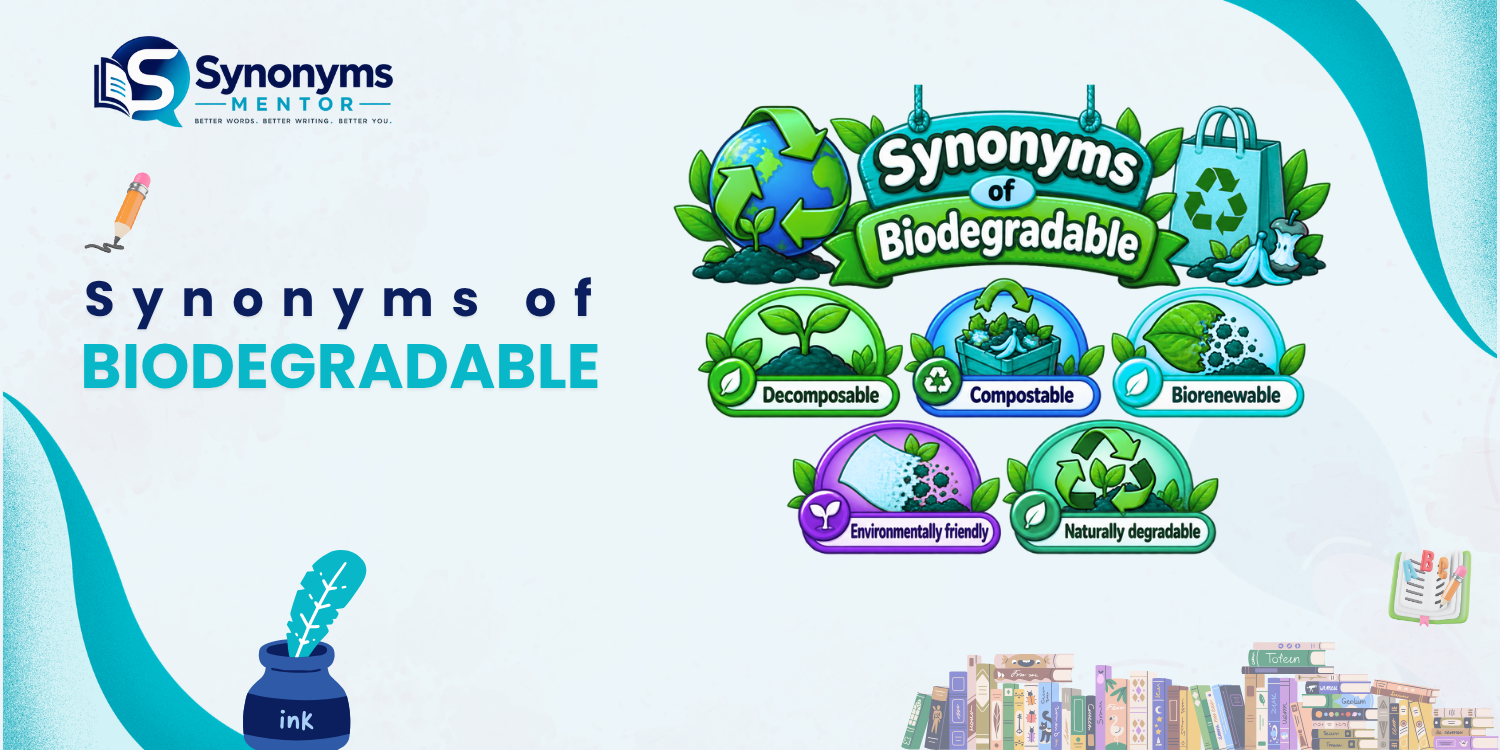
Synonyms of Biodegradable: Better Alternatives With Examples
Finding a synonym for biodegradable is not as simple as replacing it with any word associated with environmental protection. The word has a specific meaning: it describes something that can be broken down naturally through the action of living organisms, such as microorganisms.
That distinction matters because words such as degradable, compostable, recyclable, and eco-friendly overlap with biodegradable but do not necessarily mean exactly the same thing.
This guide separates the closest alternatives from near-synonyms and related environmental vocabulary so you can choose the most accurate word for your sentence.
Quick Answer: What Are the Best Synonyms of Biodegradable?
The closest alternatives to biodegradable include biologically degradable, degradable, biodecomposable, and, in suitable contexts, naturally decomposable. However, these alternatives are not equally interchangeable.
Degradable is broader and does not always specify biological breakdown, while compostable describes material that can break down under composting conditions. Eco-friendly and sustainable are related environmental terms, but they are not true synonyms.
Core Synonym Resource
| Word or Phrase | Relationship | Meaning | Best Context |
|---|---|---|---|
| Biologically degradable | Very close alternative | Able to break down through biological processes | Scientific and technical writing |
| Degradable | Near synonym | Capable of breaking down into simpler substances | General or technical contexts |
| Biodecomposable | Close alternative | Capable of being decomposed biologically | Scientific or specialized writing |
| Naturally decomposable | Contextual alternative | Able to decompose through natural processes | General explanations |
| Decomposable | Near synonym | Capable of being broken down or decomposed | General and scientific writing |
| Compostable | Context-specific alternative | Able to break down under appropriate composting conditions | Composting and waste management |
| Environmentally degradable | Contextual phrase | Designed or able to degrade with environmental processes | Environmental/technical writing |
| Eco-friendly | Related term | Having relatively low environmental impact | Marketing and general writing |
| Sustainable | Related term | Able to be maintained with reduced long-term environmental impact | Sustainability discussions |
| Recyclable | Related term | Able to be collected and processed for reuse | Waste and materials management |
Important: The last three terms—eco-friendly, sustainable, and recyclable—should generally not replace biodegradable when biological decomposition is the specific meaning you need.
What Does “Biodegradable” Mean?
Biodegradable is an adjective describing a substance or material that can be broken down by living organisms, particularly microorganisms such as bacteria and fungi.
Merriam-Webster defines it as being capable of being broken down into relatively harmless products through the action of living things. Cambridge similarly explains that biodegradable substances can decay naturally without harming the environment.
For example:
The company uses biodegradable packaging for its food products.
Here, biodegradable tells the reader something specific about what happens to the packaging: it can undergo biological breakdown.
Part of speech
Biodegradable is an adjective.
Common collocations include:
- biodegradable packaging
- biodegradable plastic
- biodegradable materials
- biodegradable products
- biodegradable waste
- biodegradable bags
- biodegradable containers
1. Biologically Degradable
Biologically degradable is one of the closest descriptive alternatives to biodegradable.
It explicitly emphasizes biological degradation, making it particularly useful in scientific or technical writing.
Example
The researchers developed a biologically degradable material for temporary medical applications.
Best used when:
- writing scientifically
- discussing biological processes
- emphasizing microorganisms or biological activity
- explaining how a material breaks down
In everyday writing, biodegradable is usually more natural and concise.
2. Degradable
Degradable is a genuine near-synonym, but it is broader than biodegradable.
Cambridge defines degradable as describing something that can change into a simpler chemical structure, particularly over time. Its learner-oriented definition also identifies it as a short form of biodegradable in some usage, but the broader dictionary sense does not necessarily specify biological action.
Example
The manufacturer developed a degradable packaging material.
Why it is different
Biodegradable specifically points toward biological breakdown.
Degradable can simply indicate that a material is capable of degradation.
Therefore:
biodegradable material
is more precise when biological decomposition is what you mean.
3. Biodecomposable
Biodecomposable is a close lexical alternative formed from bio- and decomposable. It emphasizes the ability of something to be decomposed through biological processes.
It is much less common in ordinary American English than biodegradable, so it is usually better to use biodegradable unless a specialized context calls for the alternative.
Example
The researchers tested a biodecomposable polymer under controlled conditions.
Register
Specialized / technical
Best advice
For general readers, choose biodegradable. For technical writing, biodecomposable may occasionally be useful when the emphasis is specifically on biological decomposition.
4. Naturally Decomposable
Naturally decomposable can work as a phrase when you want to explain the concept in plain English.
Example
The material is naturally decomposable, so it does not remain intact indefinitely in the environment.
However, this phrase is not a perfect replacement in every sentence. Naturally decomposable emphasizes natural decomposition, while biodegradable more specifically identifies a material’s capacity for biological breakdown.
Best for
- educational writing
- explanatory content
- general audiences
- simplifying technical vocabulary
5. Decomposable
Decomposable means capable of being decomposed or broken down.
It overlaps with biodegradable, but it does not necessarily communicate the same biological mechanism.
Example
Organic waste is generally decomposable under suitable conditions.
Compare:
The packaging is biodegradable.
The second sentence gives a more specific environmental and biological meaning.
Best use
Use decomposable when the focus is simply on decomposition rather than specifically on biodegradation.
Biodegradable vs. Degradable
These two words are easy to confuse.
| Biodegradable | Degradable |
|---|---|
| Specifically associated with biological breakdown | Broader term for degradation |
| Common in environmental writing | Common in technical contexts |
| Often refers to action by microorganisms | Does not necessarily specify microorganisms |
| More precise when discussing biological decomposition | Broader and potentially less specific |
Simple rule
Choose biodegradable when you want to communicate:
“Living organisms can break this material down.”
Choose degradable when the broader idea of degradation is sufficient.
Biodegradable vs. Decomposable
These words overlap, but decomposable is broader.
Biodegradable focuses on biological degradation.
Decomposable simply indicates that something can be decomposed.
Example
The food waste is biodegradable.
This emphasizes its biological breakdown.
The material is decomposable.
This emphasizes the fact that it can break down, without necessarily making the biological mechanism the central point.
Biodegradable vs. Compostable
Compostable is one of the most commonly confused terms.
Something can be described as compostable when it is capable of breaking down as part of an appropriate composting process. That does not make compostable a universal synonym for biodegradable.
Compare:
Biodegradable: capable of biological breakdown.
Compostable: capable of breaking down under appropriate composting conditions.
Therefore, avoid automatically replacing:
biodegradable packaging
with:
compostable packaging
unless the material actually meets the relevant composting requirements.
Biodegradable vs. Eco-Friendly
Eco-friendly is not a direct synonym for biodegradable.
Eco-friendly is a broad descriptive term for something considered relatively less harmful to the environment.
A product can be marketed as eco-friendly for many different reasons, including its materials, manufacturing process, energy use, packaging, or environmental impact.
Example
The company introduced an eco-friendly cleaning product.
This does not necessarily mean the product itself is biodegradable.
Best rule
Use biodegradable when discussing biological breakdown.
Use eco-friendly when discussing broader environmental benefits.
Biodegradable vs. Sustainable
Sustainable is another related term rather than a direct synonym.
Sustainability can involve:
- resource use
- production methods
- energy consumption
- long-term environmental impact
- social and economic considerations
A sustainable material may or may not be biodegradable.
Example
The company uses sustainable materials in its clothing line.
This does not automatically mean those materials are biodegradable.
Biodegradable vs. Recyclable
Recyclable and biodegradable describe two different properties.
A biodegradable material can break down through biological processes.
A recyclable material can be collected and processed so that its material can be reused or recovered.
Example
The container is recyclable, but that does not necessarily mean it is biodegradable.
This distinction is particularly important in environmental writing because recycling and biodegradation are different waste-management pathways.
Which Word Should I Use?
If you need a quick decision, use this guide:
Choose biodegradable when:
You mean that a material can be broken down biologically.
Biodegradable packaging can break down through biological processes.
Choose biologically degradable when:
You want to emphasize biological degradation, particularly in technical writing.
The researchers developed a biologically degradable polymer.
Choose degradable when:
You need a broader term describing material degradation.
The coating is degradable under certain conditions.
Choose decomposable when:
You are focusing on decomposition rather than specifically on biological degradation.
Organic matter is naturally decomposable.
Choose compostable when:
The material is specifically suitable for composting under the required conditions.
The company sells compostable food-service products.
Choose eco-friendly when:
You are discussing broader environmental impact.
The company promotes eco-friendly packaging.
Choose sustainable when:
You are discussing long-term environmental or resource considerations.
The brand uses sustainable materials.
Choose recyclable when:
The key property is the ability to be processed for material recovery or reuse.
The bottle is recyclable.
Synonyms of Biodegradable by Context
For Biodegradable Packaging
Useful alternatives include:
- biologically degradable
- naturally decomposable
- degradable
- decomposable
But biodegradable packaging remains the clearest general expression.
Example
The company replaced conventional packaging with biodegradable packaging.
For Biodegradable Materials
Depending on the context, you could use:
- biologically degradable materials
- degradable materials
- decomposable materials
- naturally decomposable materials
Be careful with sustainable materials, because sustainability describes a broader concept.
For Biodegradable Products
Possible contextual alternatives include:
- environmentally degradable products
- biologically degradable products
- naturally decomposable products
However, biodegradable products is normally the most natural phrase for general readers.
For Biodegradable Waste
Depending on the context, you might use:
- decomposable waste
- organic waste
- biodegradable waste
- biologically degradable waste
But organic waste is not always interchangeable with biodegradable waste. The two categories overlap but are not identical.
Common Mistakes
1. Treating “eco-friendly” as an exact synonym
Incorrect assumption:
Eco-friendly = biodegradable
Why it matters: Eco-friendly is much broader.
2. Treating “recyclable” as synonymous with “biodegradable”
Recycling and biodegradation describe different processes.
Recyclable does not automatically mean biodegradable.
3. Assuming “compostable” always means “biodegradable”
Compostability concerns breakdown under appropriate composting conditions. It should not automatically be substituted for biodegradable.
4. Using “degradable” when biological breakdown matters
Degradable can be broader than biodegradable. If the biological mechanism is important, biodegradable is usually the clearer choice.
5. Using “sustainable” as a direct replacement
Sustainable covers a much wider concept than biodegradability.
A material can be sustainable without being biodegradable.
Pronunciation of “Biodegradable”
US English
/ˌbaɪ.oʊ.dɪˈɡreɪ.də.bəl/
UK English
/ˌbaɪ.əʊ.dɪˈɡreɪ.də.bəl/
Cambridge lists both US and UK pronunciations.
What Is the Opposite of Biodegradable?
There is no single perfect antonym for every context, but common contrasting expressions include:
- non-biodegradable
- persistent
- non-degradable
- resistant to biodegradation
Non-biodegradable is generally the clearest direct contrast when discussing materials.
Example
Many conventional plastics are described as non-biodegradable because they do not readily undergo biological breakdown.
FAQ
What is another word for biodegradable?
The closest alternatives include biologically degradable, degradable, biodecomposable, and naturally decomposable. However, these terms differ in precision and usage. Degradable is broader, while biologically degradable makes the biological process explicit.
Is “degradable” the same as “biodegradable”?
Not always. Biodegradable specifically refers to breakdown through biological processes, while degradable is broader and can refer to degradation without specifying that microorganisms are responsible. Cambridge recognizes degradable as related to biodegradable, but the broader meaning should be considered when choosing between them.
Is “compostable” a synonym for biodegradable?
Not exactly. Compostable refers to material that can break down under suitable composting conditions. Biodegradable is a broader term describing biological breakdown. Some materials can be both biodegradable and compostable, but the words should not automatically be treated as interchangeable.
Is “eco-friendly” another word for biodegradable?
No. Eco-friendly is a broad environmental term, whereas biodegradable describes a specific material property. Something may be eco-friendly for reasons unrelated to biodegradation.
Is “sustainable” a synonym for biodegradable?
No. Sustainable refers to a much broader concept involving environmental, resource, and sometimes social or economic considerations. A sustainable product is not necessarily biodegradable.
Is recyclable the same as biodegradable?
No. Recyclable means that a material can be collected and processed for reuse or material recovery. Biodegradable means that it can break down through biological processes.
What is the best synonym for biodegradable in formal writing?
Biologically degradable is a strong technical alternative when you specifically want to emphasize biological degradation. For most formal and general writing, however, biodegradable itself is usually the clearest and most natural choice.
Conclusion
The best synonym for biodegradable depends on what you are trying to communicate. Biologically degradable is one of the closest alternatives when biological action needs emphasis, while degradable and decomposable are broader. Compostable can work in a specific composting context, but eco-friendly, sustainable, and recyclable are related environmental terms rather than true synonyms.

David Wilson is a content strategist and SEO expert who focuses on creating structured vocabulary content. He combines keyword research with simple explanations to make learning English both effective and search-friendly.