Synonyms for Autism: Accurate Terms and Usage Guide
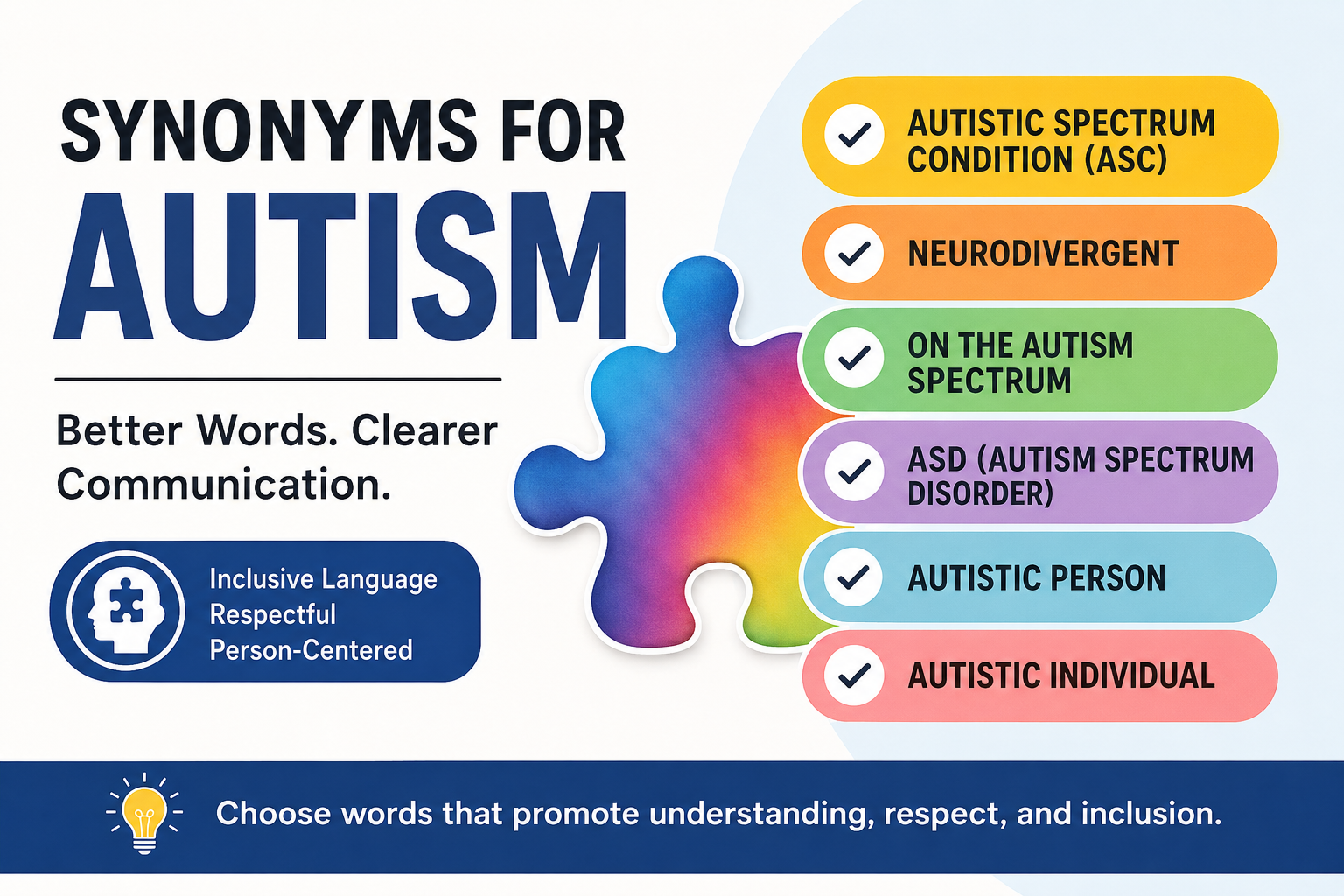
f you are looking for synonyms for autism, the closest established alternative is autism spectrum disorder (ASD), particularly in clinical and medical contexts. Autism spectrum can also work in some contexts, while autistic describes a person or something associated with autism rather than replacing the noun autism.
Terms such as neurodivergent, developmental condition, and on the autism spectrum are related expressions, but they are not exact synonyms.
The distinction matters because autism terminology can be both clinical and personal. Different people may prefer identity-first language such as autistic person or person-first language such as person with autism, so wording should follow the individual’s preference where possible.
Quick Answer
The closest synonym for autism is autism spectrum disorder (ASD), especially in medical or clinical writing. Autism spectrum is a shorter contextual alternative, while autistic is the adjective used to describe a person or characteristic. Neurodivergent is broader and should not be treated as a direct synonym for autism.
What Does “Autism” Mean?
Autism is a neurological and developmental condition that affects how a person communicates, interacts, learns, and behaves. Autism is described as a spectrum because people can have substantially different characteristics, strengths, support needs, and challenges.
The formal clinical term used in current diagnostic classification is autism spectrum disorder (ASD). The National Institutes of Health notes that both autism and autism spectrum disorder (ASD) are acceptable terms, depending on context and audience.
Part of Speech
Autism is primarily a noun.
Examples:
- Autism can affect communication and sensory processing.
- She researches autism and developmental differences.
- The school provides support for autistic students.
The related adjective is autistic:
- He is an autistic adult.
- The organization provides autistic students with additional support.
The Closest Synonyms and Alternatives for Autism
Not every term associated with autism should be called a synonym. The following distinctions are important.
| Word or phrase | Relationship | Formality | Best context |
|---|---|---|---|
| Autism spectrum disorder (ASD) | Direct clinical equivalent | Formal/medical | Clinical, academic, professional |
| ASD | Abbreviation of autism spectrum disorder | Formal | Medical, academic, professional |
| Autism spectrum | Contextual alternative | Neutral | General discussion and writing |
| Autistic | Related adjective/person descriptor | Neutral | Describing people or characteristics |
| On the autism spectrum | Contextual phrase | Neutral | Person-centered general communication |
| Autism spectrum condition (ASC) | Contextual terminology | Formal/neutral | Some professional and regional contexts |
| Neurodivergent | Broader related term | Neutral | Neurodiversity discussions |
| Neurodevelopmental condition | Broader descriptive category | Formal | Medical/academic contexts |
| Developmental disability | Broader category, not a synonym | Formal | Education, disability services |
| Asperger syndrome | Historical diagnostic term, not a current synonym | Historical | Historical or diagnostic-history discussions |
The key point is that ASD is the strongest direct alternative, while several other expressions are useful only in particular contexts.
1. Autism Spectrum Disorder (ASD)
Autism spectrum disorder is the closest formal equivalent to autism.
The abbreviation ASD is especially common in medical, academic, research, educational, and professional writing.
Example:
The researchers studied communication patterns in children with autism spectrum disorder.
In ordinary writing, however, autism is often simpler and more natural.
The researchers studied communication patterns in autistic children.
Current NIH guidance specifically recognizes autism and autism spectrum disorder (ASD) as acceptable ways of referring to the condition, depending on audience and context.
Best choice
Use ASD when:
- writing a medical or academic document;
- discussing diagnosis;
- introducing the formal clinical terminology;
- repeating autism spectrum disorder would make the writing cumbersome.
Use autism when a simpler, more natural noun is appropriate.
2. ASD
ASD is simply the abbreviation for autism spectrum disorder.
It is therefore not a different condition or a completely separate synonym. It is the shortened form of the formal term.
Example:
The study examined sensory characteristics associated with ASD.
For general audiences, spell out autism spectrum disorder at first mention and then use ASD if repeated references are necessary.
3. Autism Spectrum
Autism spectrum is a useful contextual alternative, but it is not interchangeable with autism in every grammatical construction.
For example:
She is on the autism spectrum.
This is natural.
But:
She was diagnosed with autism spectrum.
is not natural. The appropriate wording would be:
She was diagnosed with autism spectrum disorder.
or simply:
She was diagnosed with autism.
Autism spectrum is therefore best understood as part of a broader phrase rather than a universal noun-for-noun replacement.
4. Autistic
Autistic is closely related to autism, but it is not a direct grammatical synonym because it is normally an adjective and can also function as a noun in expressions such as an autistic person.
Examples:
She is autistic.
He is an autistic adult.
The study examined autistic participants.
It should not normally replace autism:
❌ He has autistic.
✅ He has autism.
This distinction is particularly important for English learners because autism and autistic belong to different grammatical categories.
5. On the Autism Spectrum
On the autism spectrum is a contextual phrase referring to a person who is autistic or has an autism diagnosis.
For example:
Several students on the autism spectrum receive classroom accommodations.
This expression can be useful when discussing people without repeatedly using either autistic or person with autism.
However, it is a phrase rather than a direct lexical synonym for the noun autism.
6. Autism Spectrum Condition (ASC)
Autism spectrum condition (ASC) is terminology used in some professional and regional contexts.
It can refer to the same broad condition that is commonly called autism or autism spectrum disorder. However, ASD remains the more recognizable clinical abbreviation in many English-language medical contexts.
Because terminology varies by institution, country, and audience, use the terminology preferred by the relevant organization or individual.
7. Neurodivergent
Neurodivergent is not a synonym for autism.
It is a broader term describing people whose neurological development or functioning differs from what is considered typical. Autism can be included within neurodivergence, but neurodivergence encompasses more than autism.
Therefore:
❌ Neurodivergent means autistic.
is too broad.
A more accurate statement is:
Autistic people can be neurodivergent, but not every neurodivergent person is autistic.
NIH describes neurodiversity as the idea that people experience and interact with the world in different ways and notes that the terminology is often used in connection with autism and other neurological or developmental conditions.
8. Neurodevelopmental Condition
Neurodevelopmental condition is a broader descriptive term.
Autism is classified as a neurodevelopmental disorder in clinical contexts, but neurodevelopmental condition itself is not an exact synonym.
The broader category can include other conditions as well, so replacing autism with it can remove important information.
For example:
More precise: The child was diagnosed with autism.
Broader: The child has a neurodevelopmental condition.
The second sentence does not communicate the same specific information.
9. Developmental Disability
Developmental disability is another broader category rather than a direct synonym.
Some autistic people may have a developmental disability, but autism and developmental disability are not interchangeable concepts.
This distinction matters in educational, legal, disability-service, and medical writing.
Use the more specific term when autism itself is what you mean.
10. Asperger Syndrome
Asperger syndrome should not be presented as a current synonym for autism.
The term has historical significance because it was previously used as a diagnostic category. Under current diagnostic classification, it is no longer a separate diagnosis in the DSM-5 framework; autism spectrum disorder encompasses the relevant diagnostic category.
Therefore, it is most appropriate when discussing:
- historical diagnoses;
- older medical records;
- diagnostic history;
- historical terminology.
Avoid presenting it as though it were simply another current word for autism.
Autism Terminology by Context
Medical or Clinical Writing
Prefer:
- autism
- autism spectrum disorder (ASD)
- ASD
Example:
The clinician evaluated the child for autism spectrum disorder.
Academic Writing
Prefer precise terminology:
- autism
- autism spectrum disorder
- ASD
Example:
The study investigated sensory processing among autistic adults.
Define abbreviations when they first appear if the audience may not know them.
Everyday Communication
Autism is usually the clearest choice.
Example:
My nephew has autism.
Depending on the person’s preference, autistic can also be natural:
My nephew is autistic.
There is no universal requirement that one construction must always be used. Language preferences vary among autistic people and their communities.
Writing About a Person
Two common constructions are:
- autistic person — identity-first language
- person with autism — person-first language
Both are used in contemporary English.
The best choice is to respect the individual’s stated preference when known. Autism Speaks notes that its community includes people who prefer both identity-first and person-first language. NIH likewise recognizes autistic person, person with autism, and person on the autism spectrum, while noting that preferences vary.
Which Term Should You Use?
The simplest decision is:
Use “autism” when:
You want the standard, concise noun.
The article discusses autism and education.
Use “autism spectrum disorder” when:
You need formal or clinical terminology.
The patient was evaluated for autism spectrum disorder.
Use “ASD” when:
You have already established the full term and need an abbreviation.
The study included 120 participants with ASD.
Use “autistic” when:
You are describing a person or characteristic.
She is an autistic researcher.
Use “on the autism spectrum” when:
You prefer a person-focused descriptive phrase.
The program supports students on the autism spectrum.
Use “neurodivergent” when:
You intentionally mean the broader concept rather than autism specifically.
The workplace aims to support neurodivergent employees.
Autism vs. Autistic vs. ASD
| Term | Grammar | What it refers to | Example |
| Autism | Noun | The condition | She has autism. |
| Autistic | Adjective / person descriptor | A person or characteristic associated with autism | She is autistic. |
| Autism spectrum disorder | Noun phrase | Formal clinical terminology | He was diagnosed with autism spectrum disorder. |
| ASD | Abbreviation | Autism spectrum disorder | The study examined ASD. |
| On the autism spectrum | Phrase | A person identified as being on the spectrum | He is on the autism spectrum. |
| Neurodivergent | Adjective | A broader neurological category | She is neurodivergent. |
Common Mistakes
Mistake 1: Treating “neurodivergent” as an exact synonym
Incorrect:
Neurodivergent is another word for autism.
Better:
Neurodivergent is a broader term that can include autistic people.
Mistake 2: Using “autistic” as a noun for the condition
Incorrect:
He has autistic.
Correct:
He has autism.
or:
He is autistic.
Mistake 3: Treating Asperger syndrome as a current equivalent
Older terminology should not automatically be presented as current terminology. Current diagnostic classification places autism spectrum disorder within a single spectrum rather than treating Asperger syndrome as a separate diagnosis.
Mistake 4: Assuming one language preference applies to everyone
Both autistic person and person with autism are used. When writing about a particular person, follow their preference when it is known.
Mistake 5: Using “high-functioning” or “low-functioning” as convenient synonyms
These labels can obscure a person’s actual strengths and support needs. NIH guidance recommends describing specific support needs instead.
Respectful and Precise Language
Terminology surrounding autism is not purely a thesaurus issue. It can also involve identity, disability, diagnosis, and personal preference.
A useful principle is precision plus respect.
Instead of searching for a substitute merely to avoid repeating autism, first ask what you actually mean:
- the condition → autism
- the formal clinical term → autism spectrum disorder
- the abbreviation → ASD
- a person → autistic person or person with autism
- a broader neurological category → neurodivergent
- a historical diagnosis → Asperger syndrome, when historically relevant
This approach prevents a common vocabulary problem: replacing a precise word with a broader or technically different term simply because it appears in a thesaurus.
Antonyms of Autism
There is no straightforward antonym for autism.
Autism names a neurological and developmental condition, not a simple quality that has an opposite such as hot/cold or large/small.
Terms such as neurotypical may sometimes be discussed in contrast with neurodivergent, but neurotypical is not an antonym of autism in the strict lexical sense.
FAQ
What is the closest synonym for autism?
The closest formal synonym is autism spectrum disorder (ASD). In ordinary communication, autism is usually the simplest and most natural term.
Is ASD another word for autism?
Yes. ASD is the abbreviation for autism spectrum disorder, the formal clinical term commonly used for autism.
Is “autistic” a synonym for “autism”?
No. Autistic is primarily an adjective describing a person or characteristic associated with autism, whereas autism is a noun.
Is “neurodivergent” another word for autism?
No. Neurodivergent is broader than autism. Autism can fall within the broader concept of neurodivergence, but the terms are not interchangeable.
Is “on the autism spectrum” a synonym for autism?
It is a useful contextual phrase for describing a person, but it is not a direct noun-for-noun synonym. For example, a person on the autism spectrum is natural, while she has on the autism spectrum is not.
Which is better: “autistic person” or “person with autism”?
Both are used. Some people prefer identity-first language (autistic person), while others prefer person-first language (person with autism). When someone’s preference is known, follow it.
Is Asperger syndrome a synonym for autism?
Not as a current diagnostic synonym. Asperger syndrome is a historical diagnostic term that was previously used separately but is now incorporated within autism spectrum disorder in current diagnostic classification.
What is a professional term for autism?
Autism spectrum disorder (ASD) is an appropriate formal term in clinical, academic, and professional contexts. Autism is also accurate and often preferable when a concise term is sufficient.
Conclusion
The best synonym for autism depends on what you are trying to say. Autism spectrum disorder (ASD) is the closest formal equivalent; autism spectrum and on the autism spectrum are useful contextual expressions; and autistic describes a person or characteristic rather than replacing the noun autism.
Words such as neurodivergent, developmental disability, and neurodevelopmental condition are related but broader, so they should not be presented as exact synonyms. For respectful communication, use precise terminology and follow an individual’s preferred language when discussing that person.

James Anderson is an English teacher and language researcher who creates easy synonym guides and vocabulary lessons. His goal is to help students and writers improve their language skills through simple and clear explanations.