Synonyms for Immaterial: 20 Better Words for Different Contexts
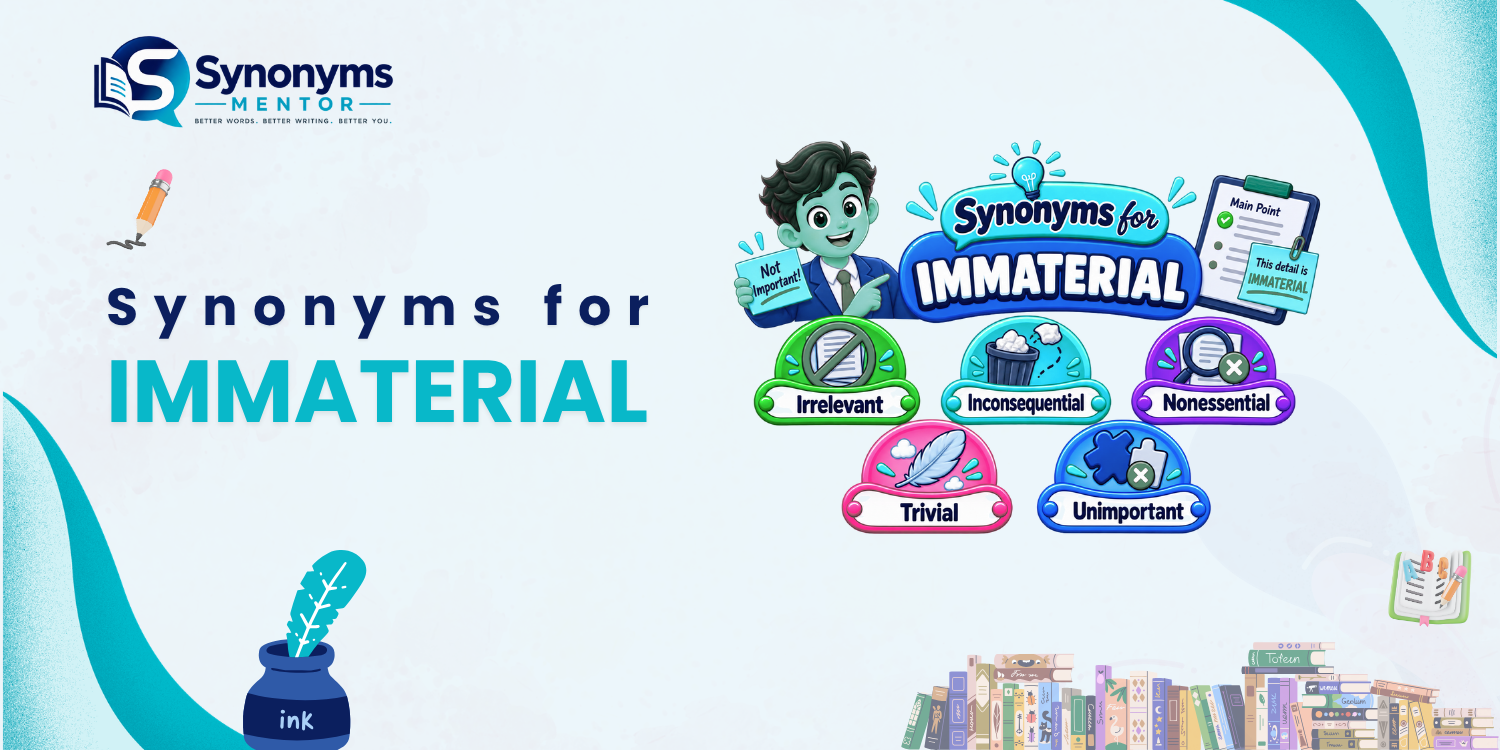
The best synonym for immaterial depends on which meaning you intend. When immaterial means unimportant or irrelevant, alternatives include irrelevant, inconsequential, insignificant, unimportant, extraneous, and trivial. When it means not physical or not made of matter, words such as incorporeal, nonphysical, intangible, and insubstantial may be appropriate.
This distinction matters because these two meanings are related historically but are not interchangeable in modern sentences. For example, The detail is immaterial usually means the detail is not important, whereas an immaterial entity can mean something that does not consist of physical matter.
Understanding the difference will help you choose a synonym that sounds natural rather than simply replacing immaterial with the first word in a thesaurus.
Quick Answer: What Are the Synonyms for Immaterial?
The closest synonyms for immaterial in the sense of unimportant or irrelevant are irrelevant, inconsequential, insignificant, unimportant, extraneous, trivial, and trifling. If immaterial means not physical, the closest alternatives include incorporeal, nonphysical, intangible, and insubstantial. The context determines which synonym is accurate.
Core Synonym Resource
When immaterial means “unimportant” or “irrelevant”
| Word | Relationship | Meaning | Strength | Formality | Best Context |
|---|---|---|---|---|---|
| irrelevant | Direct synonym | Not related to the matter being considered | Similar | Neutral/Formal | Facts, evidence, discussions |
| inconsequential | Near synonym | Having little or no significant effect | Similar | Formal | Results, decisions, events |
| insignificant | Near synonym | Too small or unimportant to matter | Similar | Neutral | Amounts, details, differences |
| unimportant | Direct synonym | Not important | Similar | Neutral | General situations |
| extraneous | Contextual alternative | Not necessary or relevant to the matter | Similar | Formal | Information, details, material |
| trivial | Near synonym | Of little importance or seriousness | Often stronger | Neutral | Problems, details, matters |
| trifling | Near synonym | Very small or unimportant | Often stronger | Formal/Literary | Amounts, concerns, matters |
| inconsequential | Near synonym | Producing little meaningful effect | Similar | Formal | Actions, consequences |
| of no consequence | Phrase-level alternative | Having no meaningful importance or effect | Similar | Formal | Decisions, outcomes |
| of little importance | Phrase-level alternative | Not very important | Weaker | Neutral | General writing |
Cambridge lists irrelevant, inconsequential, insignificant, extraneous, unimportant, trivial, and trifling, among others, for the relevance/importance sense of immaterial. Collins similarly identifies irrelevant, insignificant, unimportant, trivial, trifling, and inconsequential as alternatives.
When immaterial means “not physical”
| Word | Relationship | Meaning | Best Context |
|---|---|---|---|
| incorporeal | Close synonym | Having no physical body | Philosophy, literature, formal writing |
| nonphysical | Direct contextual alternative | Not physical | Academic/general description |
| intangible | Near synonym | Not physically touchable or concrete | Qualities, assets, concepts |
| insubstantial | Near synonym | Lacking physical substance or solidity | Abstract or physical descriptions |
| bodiless | Contextual alternative | Without a physical body | Literary descriptions |
| spiritual | Contextual alternative | Relating to the spirit rather than physical matter | Religious/philosophical contexts |
| metaphysical | Related/near synonym | Concerning reality beyond ordinary physical explanation | Philosophy |
| ethereal | Contextual alternative | Extremely delicate, light, or seemingly otherworldly | Literary descriptions |
Merriam-Webster defines immaterial in this sense as “not consisting of matter” and lists incorporeal, metaphysical, nonmaterial, nonphysical, and insubstantial among related synonyms. Cambridge also gives incorporeal as a synonym and separates the physical sense from the “not important” sense.
What Does “Immaterial” Mean?
Immaterial is an adjective with two important meanings.
1. Not important or relevant
In this sense, immaterial means something does not matter, has little significance, or is not relevant to the issue being considered.
The exact date is immaterial to the decision.
Here, immaterial means that the exact date does not affect the decision.
Cambridge defines this sense as “not important, or not relating to the subject” and gives examples involving facts and circumstances that do not make a difference.
2. Not consisting of physical matter
In a more formal, philosophical, or literary sense, immaterial can describe something without physical substance.
The philosopher discussed the possibility of immaterial entities.
Here, immaterial does not mean “unimportant.” It means nonphysical.
Merriam-Webster recognizes this as a separate definition and gives incorporeal as a particularly close synonym.
The Most Useful Synonyms for Immaterial
1. Irrelevant
Irrelevant is probably the best replacement when immaterial means not related to the subject or issue under discussion.
The witness’s personal opinion was irrelevant to the case.
Use irrelevant when the key idea is lack of relevance, rather than simply lack of importance.
Best for: information, facts, evidence, comments, questions, details.
2. Inconsequential
Inconsequential describes something that has little or no important effect or consequence.
The error was inconsequential and did not affect the final result.
It is often a better choice than irrelevant when something is related to the situation but doesn’t materially affect the outcome.
3. Insignificant
Insignificant means too small, minor, or unimportant to have much significance.
The difference between the two estimates was insignificant.
It works particularly well with differences, amounts, changes, details, and effects.
4. Unimportant
Unimportant is the simplest and most straightforward synonym.
The minor detail is unimportant.
Unlike irrelevant, it does not necessarily mean that something is unrelated to the subject. Something can be relevant but still unimportant.
5. Extraneous
Extraneous refers to something that is unnecessary or unrelated to the main matter.
Please remove any extraneous information from the report.
This is especially useful in academic, professional, and technical writing.
It is not always a direct replacement for immaterial: extraneous emphasizes something being unnecessary or outside the main subject.
6. Trivial
Trivial describes something of very little importance, seriousness, or significance.
They spent an hour arguing about a trivial issue.
Compared with unimportant, trivial can sound more dismissive.
7. Trifling
Trifling means very small or unimportant.
The disagreement arose over a trifling matter.
It is more formal or literary than unimportant and is less common in everyday American English.
8. Insubstantial
Insubstantial can describe something lacking substance, strength, or importance.
The evidence was too insubstantial to support the claim.
It overlaps with immaterial but can suggest weakness or lack of substance, so it should not automatically replace the target word.
9. Incorporeal
Incorporeal means having no physical body or material form.
The story describes an incorporeal presence.
This is one of the closest alternatives when immaterial means nonphysical. Cambridge explicitly identifies incorporeal as a synonym in this sense.
10. Intangible
Intangible describes something that cannot be physically touched or is difficult to define in concrete terms.
Trust is an intangible quality.
It is related to immaterial, but the two are not always interchangeable.
For example:
- an intangible asset → something valuable but nonphysical
- an immaterial detail → a detail that does not matter
This distinction is especially important for vocabulary learners.
Which Word Should I Use?
Choose irrelevant when:
The information has no meaningful connection to the subject.
That information is irrelevant to the discussion.
Choose inconsequential when:
Something has little effect on the outcome.
The mistake was inconsequential.
Choose insignificant when:
Something is too small or minor to matter.
The difference was insignificant.
Choose unimportant when:
You simply want to say something does not matter much.
The detail is unimportant.
Choose extraneous when:
Something is unnecessary or outside the main subject.
Delete the extraneous details.
Choose trivial when:
Something is so minor that it deserves little attention.
They argued over a trivial issue.
Choose incorporeal when:
You mean something has no physical body.
The novel features an incorporeal character.
Choose intangible when:
You mean something cannot be physically touched or exists as an abstract quality.
Reputation is an intangible asset.
Immaterial vs. Irrelevant
These words overlap strongly when immaterial means “not relevant.”
| Immaterial | Irrelevant |
|---|---|
| Can mean unimportant or irrelevant | Specifically emphasizes lack of relevance |
| Often used in formal writing | Common in everyday and professional English |
| Can also mean nonphysical | Does not mean nonphysical |
| “The distinction is immaterial.” | “The distinction is irrelevant.” |
In many sentences, irrelevant is the most natural replacement for the relevance-related sense of immaterial. Cambridge and Collins both list irrelevant prominently among its synonyms.
Immaterial vs. Insignificant
The distinction is subtle.
Immaterial often means that something does not matter to a particular issue or decision.
Insignificant usually means that something is too small or unimportant to have much significance.
Compare:
The employee’s age was immaterial to the decision.
The age was not relevant to the decision.
The difference in price was insignificant.
The difference was so small that it did not matter much.
Immaterial vs. Inconsequential
These words are especially close.
Inconsequential emphasizes little effect or consequence.
Immaterial can emphasize either lack of relevance or lack of importance.
The formatting error was inconsequential.
The error had little effect.
The formatting detail was immaterial to the decision.
The detail did not matter to the decision.
Immaterial vs. Intangible
These words are often confused because both can describe things that are not physical.
Immaterial can mean nonphysical, but in ordinary modern usage it frequently means unimportant or irrelevant.
Intangible normally emphasizes something that cannot be physically touched or measured as a concrete object.
Customer loyalty is intangible.
The customer’s personal preference was immaterial to the calculation.
The first sentence describes the nature of something. The second describes its importance to a particular matter.
Immaterial vs. Incorporeal
Incorporeal is more specifically concerned with the absence of a physical body or material form.
The ghost was described as incorporeal.
Immaterial can express the same idea:
The ghost was described as immaterial.
But incorporeal is often the more precise choice when the intended meaning is “without a physical body.”
Common Mistakes With “Immaterial”
1. Treating “immaterial” and “intangible” as exact synonyms
They overlap only in some contexts.
Incorrect assumption:
Immaterial always means intangible.
Better understanding:
Immaterial frequently means irrelevant or unimportant, while intangible usually concerns something nonphysical or difficult to touch.
2. Using “irrelevant” when the meaning is physical
The ghost was irrelevant.
This means the ghost was not relevant to something. It does not mean the ghost had no physical body.
For that meaning, incorporeal or nonphysical may be appropriate.
3. Using “trivial” for every meaning of immaterial
Trivial means unimportant or insignificant, but it does not mean “nonphysical.”
4. Assuming “unimportant” always equals “irrelevant”
These words overlap but emphasize different things.
Something can be relevant but unimportant.
For example, a small detail may technically relate to a discussion but still have very little significance.
Related Words That Are Not Exact Synonyms
Some words appear in thesaurus lists because they are semantically related, but they should not automatically replace immaterial.
Spiritual
Concerns the spirit or religious/spiritual matters. It can overlap with the nonphysical sense but is much more specific.
Metaphysical
Concerns fundamental questions about reality, existence, and what lies beyond ordinary physical explanation. It is not a general synonym for immaterial.
Invisible
Means unable to be seen. Something can be invisible without being immaterial.
Supernatural
Refers to phenomena beyond ordinary natural explanation. It is not equivalent to simply being nonphysical.
Meaningless
Means lacking meaning or significance. Something can be immaterial without being meaningless.
This distinction prevents a common thesaurus problem: semantic association does not automatically make two words interchangeable.
Antonyms of Immaterial
The appropriate antonym depends on the sense.
When immaterial means “unimportant”:
- important
- significant
- relevant
- essential
- crucial
- consequential
- germane
Cambridge lists relevant, significant, germane, important, essential, and crucial among the antonyms for this sense.
When immaterial means “nonphysical”:
- material
- physical
- tangible
- corporeal
- concrete
Pronunciation of Immaterial
US: /ˌɪməˈtɪriəl/
UK: /ˌɪməˈtɪəriəl/
Cambridge provides both US and UK pronunciations.
FAQ
What is the closest synonym for immaterial?
For the common meaning “not important or relevant,” irrelevant is often the closest synonym. Depending on context, inconsequential, insignificant, unimportant, and extraneous can also work. For the nonphysical sense, incorporeal is a closer choice.
Is immaterial the same as irrelevant?
Not always, but the words can be interchangeable when immaterial means “not relevant.” Immaterial also has a separate meaning: not consisting of matter. Irrelevant does not have that physical/nonphysical meaning.
What is a professional synonym for immaterial?
Irrelevant, extraneous, inconsequential, and insignificant can all work in professional writing, depending on context. Extraneous is particularly useful when referring to unnecessary information or details.
Is insignificant a synonym for immaterial?
Yes, in some contexts. Both can describe something that is not important enough to matter. However, insignificant often emphasizes small size, degree, or importance, whereas immaterial can specifically emphasize that something does not affect a particular matter.
Is intangible a synonym for immaterial?
Only in the nonphysical sense. Intangible usually means something cannot be physically touched or is not concrete. Immaterial commonly means irrelevant or unimportant, so the two should not be treated as universal substitutes.
What is the difference between immaterial and inconsequential?
Immaterial often means that something is irrelevant or does not matter to a particular issue. Inconsequential emphasizes that something has little effect or produces little consequence.
What is the opposite of immaterial?
For the “unimportant” sense, opposites include important, significant, relevant, essential, and crucial. For the “nonphysical” sense, opposites include material, physical, tangible, and corporeal.
Conclusion
The best synonym for immaterial depends on its meaning in the sentence. For the common sense of not important or relevant, choose words such as irrelevant, inconsequential, insignificant, unimportant, extraneous, or trivial. For the less common sense of not physical, consider incorporeal, nonphysical, intangible, or insubstantial.

Our editorial team is dedicated to making English vocabulary easier to understand and use correctly. We research and review synonyms, antonyms, definitions, word usage, and example sentences to ensure our content is clear, accurate, practical, and useful for students, writers, professionals, and English learners.