Synonyms for Illegal: Better Alternatives With Examples
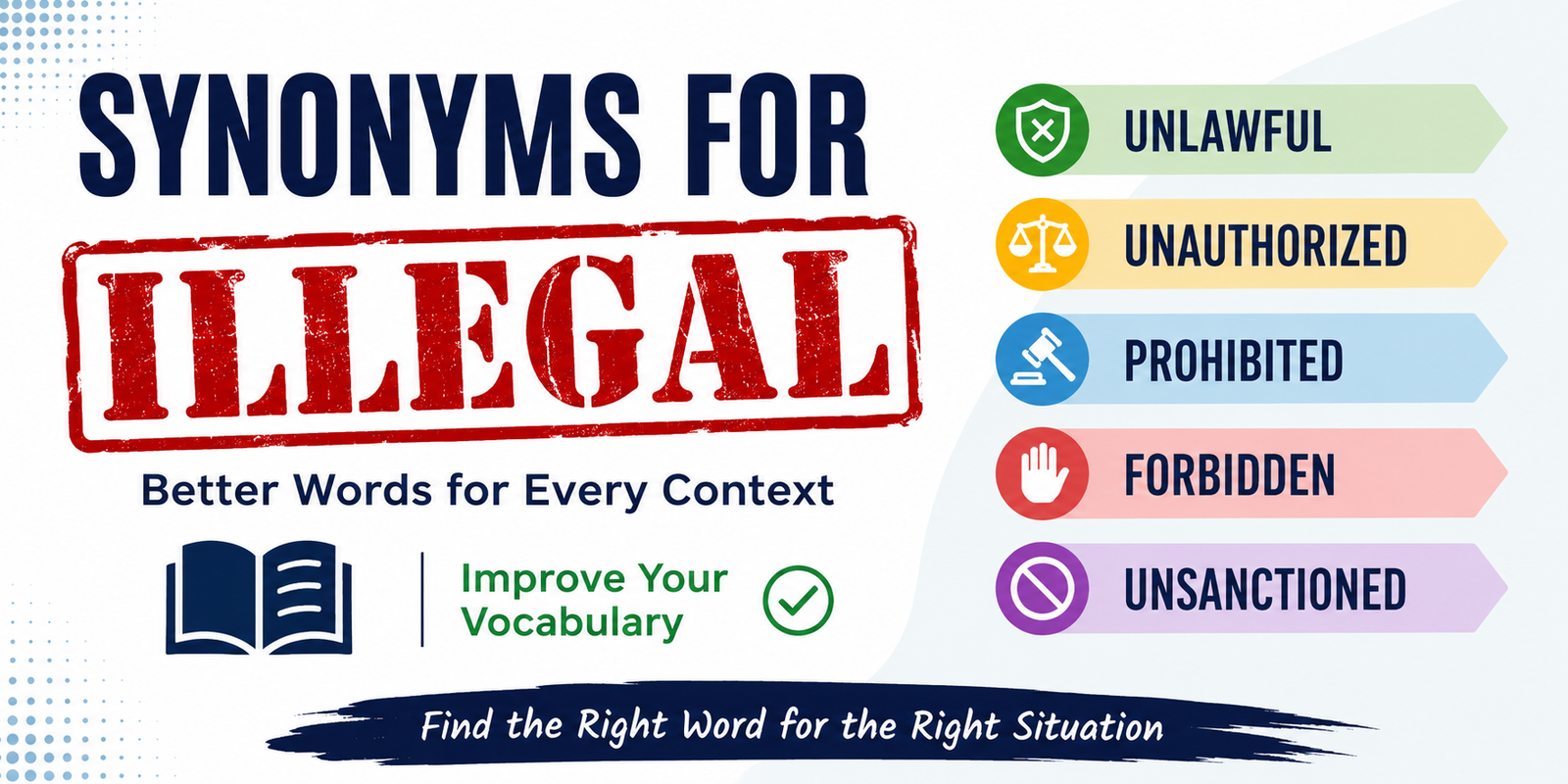
If you need another word for illegal, the best choice depends on what you are describing. Unlawful is one of the closest general alternatives, while illicit often describes prohibited or unauthorized activity, especially when it is secret or questionable.
Prohibited, forbidden, and banned emphasize that something is not allowed, whereas unauthorized focuses on a lack of official permission. Criminal is stronger because it commonly suggests conduct that constitutes a crime.
Understanding these differences matters because synonyms are rarely interchangeable in every sentence. A word that works naturally for an illegal activity may sound wrong when describing an unauthorized transaction or something forbidden by an organization’s rules.
Quick Answer
The closest synonyms for illegal include unlawful, illicit, prohibited, forbidden, banned, unauthorized, and criminal. However, they are not identical. Unlawful is the closest general substitute; illicit often suggests prohibited or secret activity; unauthorized emphasizes lack of permission; and criminal specifically emphasizes criminal conduct.
Core Synonyms for Illegal
| Word | Relationship | Main Meaning | Best Context | Formality |
|---|---|---|---|---|
| Unlawful | Direct synonym | Contrary to law | Legal and formal writing | Formal |
| Illicit | Near/direct synonym | Forbidden or unlawful, often involving questionable activity | Trade, finance, activity, substances | Formal |
| Prohibited | Contextual alternative | Officially not permitted | Rules, regulations, policies | Formal |
| Forbidden | Contextual alternative | Not allowed | General rules and restrictions | Neutral |
| Banned | Contextual alternative | Officially prohibited | Products, activities, practices | Neutral |
| Unauthorized | Near synonym | Done without required permission | Access, transactions, use | Formal |
| Criminal | Near synonym | Relating to crime | Criminal acts or behavior | Neutral/Formal |
| Felonious | Specialized synonym | Involving a felony or serious crime | Legal contexts | Formal |
| Lawless | Near synonym | Characterized by disregard for law | People, places, behavior | Formal/Literary |
| Outlawed | Contextual alternative | Made illegal by law | Practices, activities, objects | Formal |
Several of these relationships are supported by major dictionary thesauruses. Cambridge lists unlawful, prohibited, unsanctioned, proscribed, forbidden, banned, illicit, unauthorized, illegitimate, and criminal in its synonym group for illegal, while Merriam-Webster also includes felonious, wrongful, and lawless.
What Does “Illegal” Mean?
Illegal is an adjective meaning contrary to or forbidden by law. It is the standard, broad term for something that the law does not permit.
Examples:
- It is illegal to enter the restricted area.
- The company was accused of illegal practices.
- Police investigated an illegal operation.
The word itself does not necessarily tell the reader why something is illegal, what kind of law is involved, or whether the conduct is a serious crime. That is why a more specific alternative can sometimes be better.
The Most Useful Synonyms Explained
1. Unlawful
Meaning: Contrary to or forbidden by law.
How it differs:
Unlawful is probably the closest general synonym for illegal. It is especially common in formal, legal, and official writing.
Best contexts:
- unlawful conduct
- unlawful possession
- unlawful detention
- unlawful activity
- unlawful use
Example:
The court ruled that the search was unlawful.
Best choice when: You need a formal alternative to illegal without adding much extra meaning.
2. Illicit
Meaning: Not legally permitted; unlawful or prohibited.
How it differs:
Illicit overlaps heavily with illegal, but it often carries an additional suggestion of secrecy, concealment, or questionable activity.
Common phrases include:
- illicit trade
- illicit activity
- illicit payments
- illicit market
- illicit goods
Example:
Authorities investigated an illicit trading network.
Best choice when: You are describing prohibited activity that also has a questionable, clandestine, or underground character.
3. Prohibited
Meaning: Officially not permitted.
How it differs:
Prohibited focuses on permission or rules, rather than necessarily emphasizing criminality.
For example:
Photography is prohibited inside the museum.
This does not automatically mean photography is a crime everywhere; it means the relevant authority or rules do not permit it.
Common phrases:
- prohibited activities
- prohibited items
- prohibited conduct
- prohibited access
- prohibited behavior
Best choice when: Something is officially not allowed by a rule, regulation, policy, or authority.
4. Forbidden
Meaning: Not allowed or permitted.
How it differs:
Forbidden is broader and more general than illegal. Something can be forbidden by a person, organization, tradition, religion, or set of rules without necessarily being illegal under government law.
Examples:
Pets are forbidden in this building.
The teacher forbade students from using phones during the exam.
Best choice when: The emphasis is simply on something being not allowed, rather than necessarily against the law.
5. Banned
Meaning: Officially prohibited or not allowed.
How it differs:
Banned usually emphasizes an official decision to prevent something from being used, sold, entered, or performed.
Examples:
- a banned substance
- a banned product
- a banned activity
- a banned practice
Example:
The organization banned the practice after reviewing its safety concerns.
Best choice when: An authority has explicitly decided that something should not be allowed.
6. Unauthorized
Meaning: Not officially permitted or approved.
How it differs:
Unauthorized focuses on permission, not necessarily the law.
For example:
The bank detected an unauthorized transaction.
The transaction may violate financial rules or laws, but the word unauthorized specifically tells us that the person did not have the necessary permission.
Common phrases include:
- unauthorized access
- unauthorized use
- unauthorized transaction
- unauthorized disclosure
- unauthorized entry
Best choice when: The key issue is missing authorization.
7. Criminal
Meaning: Relating to or involving a crime.
How it differs:
Criminal can be stronger and more specific than illegal. Not every violation described as illegal is necessarily best described as criminal.
Compare:
The company violated an administrative rule.
with:
The suspect was investigated for criminal conduct.
Best choice when: The situation specifically concerns a crime or criminal law.
8. Felonious
Meaning: Involving or characteristic of a felony.
How it differs:
This is a specialized legal term and should not be used as a casual replacement for illegal.
Example:
The defendant was charged with felonious conduct.
Best choice when: The legal context specifically concerns a felony or conduct characterized as such.
9. Lawless
Meaning: Characterized by a disregard for or absence of law.
How it differs:
Lawless often describes people, places, societies, or behavior rather than simply identifying one prohibited act.
Example:
The region became increasingly lawless.
This means the normal authority of law is absent, ignored, or ineffective—not simply that one action violates a statute.
10. Outlawed
Meaning: Made illegal by law.
How it differs:
Outlawed emphasizes the process or status of something having been officially prohibited by law.
Example:
The practice was outlawed decades ago.
Best choice when: You want to emphasize that something was specifically made illegal.
Which Word Should I Use?
Choose unlawful when:
You need the closest formal substitute for illegal.
The detention was unlawful.
Choose illicit when:
The activity is illegal and often has an underground, secretive, or questionable character.
The investigation uncovered illicit financial activity.
Choose prohibited when:
A rule, regulation, or authority says something is not permitted.
The use of cameras is prohibited.
Choose forbidden when:
Something is simply not allowed.
Visitors are forbidden from entering the area.
Choose banned when:
An authority has officially imposed a ban.
The organization banned the practice.
Choose unauthorized when:
The central issue is lack of permission.
The system detected unauthorized access.
Choose criminal when:
The conduct specifically involves a crime.
The investigation concerns criminal activity.
Important Comparisons
Illegal vs Unlawful
These are the closest pair.
Both can describe something contrary to law:
The court declared the action illegal.
The court declared the action unlawful.
Unlawful often sounds more formal and is especially common in legal contexts.
Quick rule:
Use illegal for ordinary general communication; use unlawful when a formal or legal tone is appropriate.
Illegal vs Illicit
These words overlap substantially, but illicit can suggest secretive, concealed, or underground activity.
illegal activity
is a broad description.
illicit activity
can suggest activity occurring outside legitimate or authorized channels.
Quick rule:
Use illicit when you want the reader to notice the prohibited or clandestine nature of the activity.
Illegal vs Prohibited
Illegal means contrary to law.
Prohibited means not permitted.
That distinction is important.
It is illegal to commit fraud.
Food is prohibited in the laboratory.
The second sentence is primarily about a rule or restriction, not necessarily criminal law.
Illegal vs Unauthorized
Unauthorized means lacking permission.
Something can be unauthorized without the word itself establishing that it is illegal.
Someone made an unauthorized change to the website.
The key issue is permission.
Someone made an illegal change.
The second statement specifically claims that the action violated law.
Illegal vs Criminal
Illegal is broader.
Criminal specifically relates to crime.
Therefore, criminal can carry a stronger legal implication.
Quick rule:
Use criminal when the connection to a crime is important; otherwise, illegal may be more accurate.
Contextual Alternatives
Different contexts call for different vocabulary.
Illegal activity
- unlawful activity
- illicit activity
- criminal activity
Illegal access
- unauthorized access
- unlawful access
transaction Illegal
- unauthorized transaction
- illicit transaction
- unlawful transaction
Illegal practice
- prohibited practice
- unlawful practice
- outlawed practice
Illegal product
- prohibited product
- banned product
- illicit product
The best replacement depends on what aspect you want to emphasize: law, permission, prohibition, criminality, or secrecy.
Common Mistakes
1. Treating “forbidden” as always meaning “illegal”
Not necessarily. A school, employer, organization, or individual can forbid something without it being against the law.
2. Using “criminal” for every illegal action
Criminal has a more specific connection to crime. It can therefore be too strong in some contexts.
3. Using “unauthorized” as a perfect replacement for “illegal”
An unauthorized action lacks permission, but that does not automatically establish that it violates criminal law.
4. Treating “illicit” and “illegal” as completely identical
They overlap, but illicit can carry additional associations of secrecy, concealment, or questionable activity.
5. Calling every rule violation “illegal”
A violation of a company policy or organization’s rules is not automatically a violation of government law.
Antonyms of Illegal
The clearest opposites are:
- legal
- lawful
- licit
- authorized
- permitted
- legitimate
Cambridge specifically lists legal, licit, lawful, authorized, permissible, and sanctioned among antonyms of illegal.
The choice again depends on context:
illegal ↔ legal
unlawful ↔ lawful
unauthorized ↔ authorized
prohibited ↔ permitted
FAQ
What is the closest synonym for illegal?
Unlawful is generally the closest direct synonym for illegal. Both mean contrary to or forbidden by law. Illicit is also very close, although it can carry additional associations of prohibited or secretive activity.
What is a formal synonym for illegal?
Unlawful is one of the strongest formal alternatives. Illicit, prohibited, and felonious can also work in specific contexts, but they introduce different shades of meaning.
Is “unlawful” the same as “illegal”?
They are very close and are often interchangeable. However, unlawful is particularly common in formal and legal writing, while illegal is more general and widely used in everyday English.
Is “illicit” stronger than “illegal”?
Not necessarily. Illicit and illegal overlap significantly. The difference is usually one of nuance rather than simple strength: illicit can suggest prohibited, concealed, or questionable activity.
Is “forbidden” the same as “illegal”?
No. Forbidden means not allowed, but the prohibition can come from a law, rule, organization, person, or social convention. Illegal specifically refers to something contrary to law.
What is a synonym for illegal activity?
Depending on context, unlawful activity, illicit activity, or criminal activity may work. Criminal activity is the most specific when actual criminal conduct is meant.
What is the difference between illegal and unauthorized?
Illegal means contrary to law. Unauthorized means done without the required permission or approval. An unauthorized action is not automatically illegal.
What is the opposite of illegal?
The most direct opposite is legal. Other context-dependent opposites include lawful, authorized, permitted, licit, and legitimate.
Conclusion
The best synonym for illegal depends on the exact meaning you want to communicate. Unlawful is the closest broad alternative; illicit suits prohibited or questionable activity, prohibited and forbidden emphasize restrictions, unauthorized focuses on missing permission, and criminal specifically points toward crime.

Sophia Martinez is an ESL educator who specializes in teaching vocabulary and word meanings. She writes beginner-friendly content that helps learners understand synonyms and improve their English fluency step by step.