Synonyms of Facade: 15 Better Words for Different Contexts
The word facade (also spelled façade) has two closely related meanings, and the best synonym depends on which one you mean. In architecture, a facade is the front or outward-facing part of a building. In figurative English, it describes an outward appearance that hides a different or less pleasant reality.
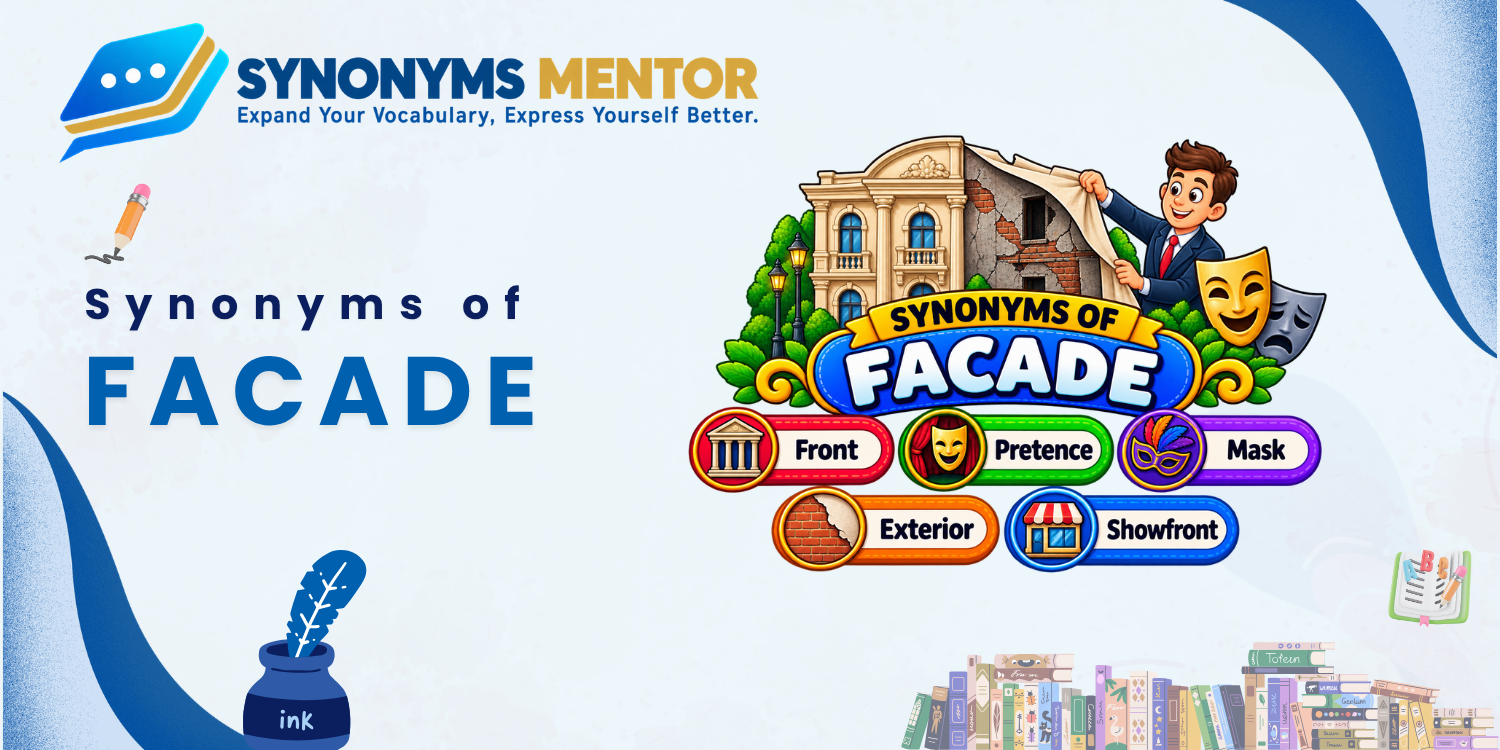
For a building, words such as front, face, exterior, and frontage may work. When facade refers to a false appearance, better choices include pretense, guise, veneer, semblance, mask, and show. However, these words are not interchangeable in every sentence. This guide explains the differences so you can choose the most natural alternative.
Quick Answer: What Are the Synonyms of Facade?
The closest synonyms of facade depend on its meaning. For the architectural sense, the strongest alternatives are front, face, exterior, and frontage.
For the figurative sense, useful alternatives include pretense, guise, veneer, semblance, mask, show, and pose. A veneer emphasizes a thin or attractive surface that conceals reality, while pretense emphasizes something deliberately false.
Core Synonyms of Facade
| Word | Relationship | Meaning | Strength | Formality | Best Context |
|---|---|---|---|---|---|
| Front | Direct synonym, architectural | The forward-facing part of a building | Similar | Neutral | Buildings |
| Face | Direct/near synonym | The outward-facing side of something | Similar | Neutral | Buildings, structures |
| Exterior | Near synonym | The outside surface or appearance | Broader | Neutral | Buildings and objects |
| Frontage | Contextual synonym | The front boundary or face of a property/building | Similar | Neutral–formal | Architecture, property |
| Pretense | Near synonym, figurative | A false claim, appearance, or behavior | Strong | Neutral–formal | Deception, behavior |
| Guise | Near synonym, figurative | An appearance or form used to conceal the true nature of something | Strong | Formal | Concealment |
| Veneer | Contextual synonym | A thin or attractive outer layer hiding something underneath | Strong | Neutral–formal | People, organizations, situations |
| Semblance | Near synonym | An outward appearance or partial resemblance | Moderate | Formal | States, order, normality |
| Mask | Contextual synonym | Something that conceals the truth or real nature | Strong | Neutral | Emotions, personalities |
| Show | Contextual synonym | An outward display that may conceal reality | Moderate | Neutral | Behavior, appearances |
| Pose | Contextual synonym | An assumed attitude or manner presented to others | Moderate | Neutral | Behavior, identity |
| Charade | Contextual synonym | A false performance intended to make something appear genuine | Strong | Neutral–formal | Situations, relationships |
| Appearance | Broad near synonym | The way someone or something looks or seems | Weaker | Neutral | General descriptions |
| Front | Near synonym, figurative | A false appearance used to hide the truth | Strong | Neutral | Organizations, behavior |
| Gloss | Contextual synonym | An attractive or favorable surface presentation that can conceal problems | Strong | Neutral–formal | Reports, organizations, situations |
What Does Facade Mean?
Facade is a noun with two principal meanings.
1. Facade as the Front of a Building
In architecture, a facade is the front of a building, particularly the side that faces a street or public space. It can refer to a building’s main decorative or architecturally treated face.
Example:
The museum’s stone facade was carefully restored.
In this sense, front is usually the simplest replacement.
2. Facade as a False Appearance
Figuratively, a facade is an outward appearance that makes a person, organization, or situation seem different from reality. The word often suggests concealment or artificiality.
Example:
Behind his confident facade, he was extremely nervous.
Here, front, guise, mask, pretense, or veneer may be more appropriate depending on the exact meaning.
Synonyms of Facade for a Building
When facade refers to architecture, avoid figurative alternatives such as pretense or guise. The following words are more useful.
Front
Front is usually the most straightforward synonym for an architectural facade.
The front of the building was covered in decorative stone.
It is less technical than facade, making it suitable for everyday writing.
Face
Face can describe the outward side of a building or structure.
The eastern face of the building receives little sunlight.
It is particularly useful when distinguishing different sides of a structure.
Exterior
Exterior refers to the outside of a building rather than specifically its front. Therefore, it is a broader alternative, not a perfect substitute.
The building’s exterior was recently renovated.
Use facade when you specifically mean the building’s outward-facing architectural front.
Frontage
Frontage refers to the front or face of a property, especially where it meets a road or public area.
The property has extensive road frontage.
It is especially natural in architecture, real estate, planning, and property-related contexts.
Synonyms of Facade for a False Appearance
The figurative meaning requires more careful word choice.
Pretense
Pretense refers to something presented as true or genuine when it is not. It is one of the strongest choices when the emphasis is on deliberate falseness.
Their friendship was merely a pretense.
Choose pretense when: you want to emphasize that the appearance or behavior is not genuine.
Guise
A guise is an outward form or appearance that conceals the real nature of something.
The proposal was presented under the guise of environmental protection.
Choose guise when: something is being presented in one form while its true purpose or nature is different.
Veneer
A veneer is an attractive or acceptable outer layer that hides something underneath. It is particularly effective when the contrast between appearance and reality matters.
The company’s polished veneer concealed serious internal problems.
Choose veneer when: the outward appearance seems attractive, respectable, or polished but does not reflect what lies beneath.
Semblance
Semblance means an outward appearance or resemblance, often suggesting that something appears to be true without necessarily being fully genuine.
The negotiations restored a semblance of normality.
Choose semblance when: you want a more formal word for an outward appearance or partial appearance of a condition.
Mask
Mask emphasizes concealment. It works particularly well with emotions, personalities, motives, or problems.
Her cheerful attitude was a mask for her disappointment.
Choose mask when: the main idea is hiding something beneath an outward presentation.
Show
Show can describe an outward display that does not necessarily represent reality.
His confidence was partly a show.
It is less formal than facade and works best in conversational or straightforward writing.
Pose
A pose is an assumed attitude, manner, or presentation.
His calmness was only a pose.
Choose pose when: someone deliberately adopts a particular attitude or appearance.
Charade
A charade suggests a false performance maintained to make something appear genuine.
The meeting had become a charade.
It is stronger and more openly critical than the neutral word appearance.
Which Word Should I Use?
The easiest way to choose a synonym is to identify what you want to emphasize.
Choose “front” when:
You mean the physical front of a building.
The front of the theater was recently renovated.
Choose “exterior” when:
You mean the outside of a building or object more generally.
The exterior of the house needs painting.
Choose “pretense” when:
You want to emphasize deliberate falseness.
His kindness was a pretense.
Choose “guise” when:
Something is presented under a misleading form or identity.
The request came under the guise of a routine inspection.
Choose “veneer” when:
An attractive surface conceals underlying problems.
The company’s success was only a veneer.
Choose “mask” when:
Something, especially an emotion or personality trait, is being concealed.
Her smile was a mask for her frustration.
Choose “semblance” when:
You want to describe an outward appearance, often in formal writing.
The agreement restored a semblance of stability.
Facade vs. Front
These words overlap, but they are not identical.
Front is the ordinary word for the forward-facing part of a building. Facade is more architectural and can emphasize the designed or visually treated front of a structure. In figurative use, front can also mean a false appearance or cover.
The building has a beautiful front.
The building has an ornate facade.
For everyday architectural writing, front is simpler. For architectural descriptions, facade is often more precise.
Facade vs. Exterior
Exterior is broader than facade.
A facade normally refers to a building’s front or an architecturally significant outward face. Exterior refers to the outside as a whole.
The facade of the building features large windows.
The exterior of the building includes several renovated walls.
Therefore, don’t automatically replace facade with exterior when you specifically mean the front.
Facade vs. Veneer
These words overlap strongly in figurative contexts, but veneer carries a particular idea of a thin or attractive surface concealing what is underneath.
The politician maintained a calm facade.
This emphasizes an outward appearance.
The company’s professionalism was only a veneer.
This emphasizes the contrast between a polished surface and an underlying reality.
Veneer is therefore especially useful when the hidden reality is important.
Facade vs. Guise
Both words can describe an outward presentation that conceals something else.
A guise usually emphasizes the form or identity under which something is presented.
The criticism was delivered under the guise of advice.
A facade focuses more broadly on an outward appearance that does not reflect reality.
The company’s friendly facade hid serious disagreements.
Use guise when the emphasis is on what something is pretending to be; use facade when the emphasis is on the outward appearance itself.
Facade vs. Pretense
Pretense directly emphasizes falseness or pretending.
Their friendship was a pretense.
Facade can imply falseness, but it can also describe an ordinary outward presentation without necessarily accusing someone of deliberately pretending.
The building has a glass facade.
For figurative writing, pretense is stronger when deliberate insincerity is central to the meaning.
Common Collocations With Facade
Some combinations sound particularly natural:
- building facade
- front facade
- glass facade
- historic facade
- main facade
- street facade
- maintain a facade
- a facade of respectability
- a facade of normality
- a facade of success
- a facade of confidence
- a facade of happiness
Collocations are useful because they show how facade actually behaves in natural English. Collins specifically records combinations such as front facade, glass facade, historic facade, main facade, original facade, street facade, and maintain a facade.
Common Mistakes When Using Facade Synonyms
Mistake 1: Treating every synonym as interchangeable
Facade, front, veneer, and guise overlap, but they emphasize different ideas.
Mistake 2: Using “pretense” for a building
You cannot normally replace the architectural meaning in:
The building’s facade was made of marble.
with:
The building’s pretense was made of marble.
Pretense belongs to the figurative meaning.
Mistake 3: Assuming “exterior” always means “facade”
The exterior includes the outside of a building generally, while a facade usually identifies a particular outward face.
Mistake 4: Using “appearance” when deception matters
Appearance is much broader and does not necessarily imply anything false.
Her appearance changed.
does not mean the same thing as:
Her friendly facade concealed her anger.
Mistake 5: Using “guise” for every false appearance
A guise often emphasizes the form or identity something adopts to conceal its true nature. It is not simply a universal replacement for facade.
Antonyms of Facade
The best antonym for facade depends on whether you mean the exterior of a building or a figurative appearance that hides the truth.
Architectural Meaning
When facade refers to the exterior face of a building, contrasting terms include interior, inside, rear, and back. These words shift the focus from the front or outer surface to another part of the structure.
Figurative Meaning
In its figurative sense, facade describes an outward appearance that may conceal a person’s genuine feelings, character, or situation. The opposite idea can therefore be expressed through words such as authenticity, genuineness, or reality.
The facade of confidence disappeared when he spoke honestly about his concerns.
In this example, genuine expression or authenticity conveys the contrasting idea because the person’s outward appearance is replaced by an honest expression of their actual feelings.
Pronunciation and Spelling
Facade and façade are spelling variants.
- US: /fəˈsɑːd/
- UK: /fəˈsɑːd/
The pronunciation is essentially the same in standard American and British English. Cambridge lists the pronunciation as /fəˈsɑːd/, while Collins also recognizes both facade and façade.
The word is commonly written facade in English, although façade retains the French cedilla.
Etymology of Facade
Facade ultimately traces back through French and Italian forms related to the word for face. Its architectural sense developed from the idea of the “face” or front of a building. Merriam-Webster and Collins both trace the word through French and Italian origins.
This history helps explain why face remains a useful synonym in architectural contexts.
Frequently Asked Questions
What is the closest synonym for facade?
There is no single closest synonym for every use. For a building, front is usually the simplest alternative. For a false appearance, pretense, guise, veneer, or mask may be better depending on the intended meaning.
Is “front” a synonym for facade?
Yes. Front can be a direct synonym when facade means the front of a building. It can also have a figurative meaning involving a false appearance. However, front is generally less specialized than facade.
Is “exterior” the same as facade?
Not exactly. Exterior means the outside of something generally, whereas facade usually refers to the front or a particular outward-facing architectural surface. The words overlap, but exterior is broader.
What is a synonym for facade meaning false appearance?
Good choices include pretense, guise, veneer, mask, semblance, front, and show. The best choice depends on the nuance. Pretense emphasizes falseness, while veneer emphasizes an attractive surface hiding something underneath.
Is “veneer” a synonym for facade?
Veneer can be a contextual synonym when facade means a superficial or attractive outward appearance that conceals reality. It is not a general synonym for the architectural facade of a building.
What is a formal synonym for facade?
For the figurative sense, guise and semblance can work well in formal writing. Exterior and frontage can be useful in formal architectural or property-related contexts.
What is the difference between facade and guise?
A facade is an outward appearance that may conceal reality. A guise is the form or appearance under which something is presented, often to hide its true nature. Guise therefore places more emphasis on the misleading form adopted.
Can facade describe a person?
Yes. In figurative English, a person’s facade can mean the image or outward personality they present to others, especially when it differs from their actual feelings or character. Cambridge gives this figurative sense in its American Dictionary.
Conclusion
The best synonym for facade depends on whether you mean a building’s outward face or a false outward appearance. For architecture, front, face, exterior, and frontage are useful choices. For figurative writing, pretense, guise, veneer, semblance, mask, and front provide different shades of meaning.

Sophia Martinez is an ESL educator who specializes in teaching vocabulary and word meanings. She writes beginner-friendly content that helps learners understand synonyms and improve their English fluency step by step.