Synonyms for Exact: 15 Precise Alternatives With Examples
Finding a synonym for exact is not simply a matter of choosing another word that means “correct.” Exact can emphasize strict accuracy, complete agreement with a fact or standard, or precision down to the smallest detail.
Depending on the sentence, words such as precise, accurate, correct, specific, definite, explicit, and identical may work—but they are not interchangeable in every context.
The best alternative therefore depends on what you want to emphasize: accuracy, precision, correctness, detail, certainty, or exact sameness.
Quick Answer: What Are the Best Synonyms for Exact?
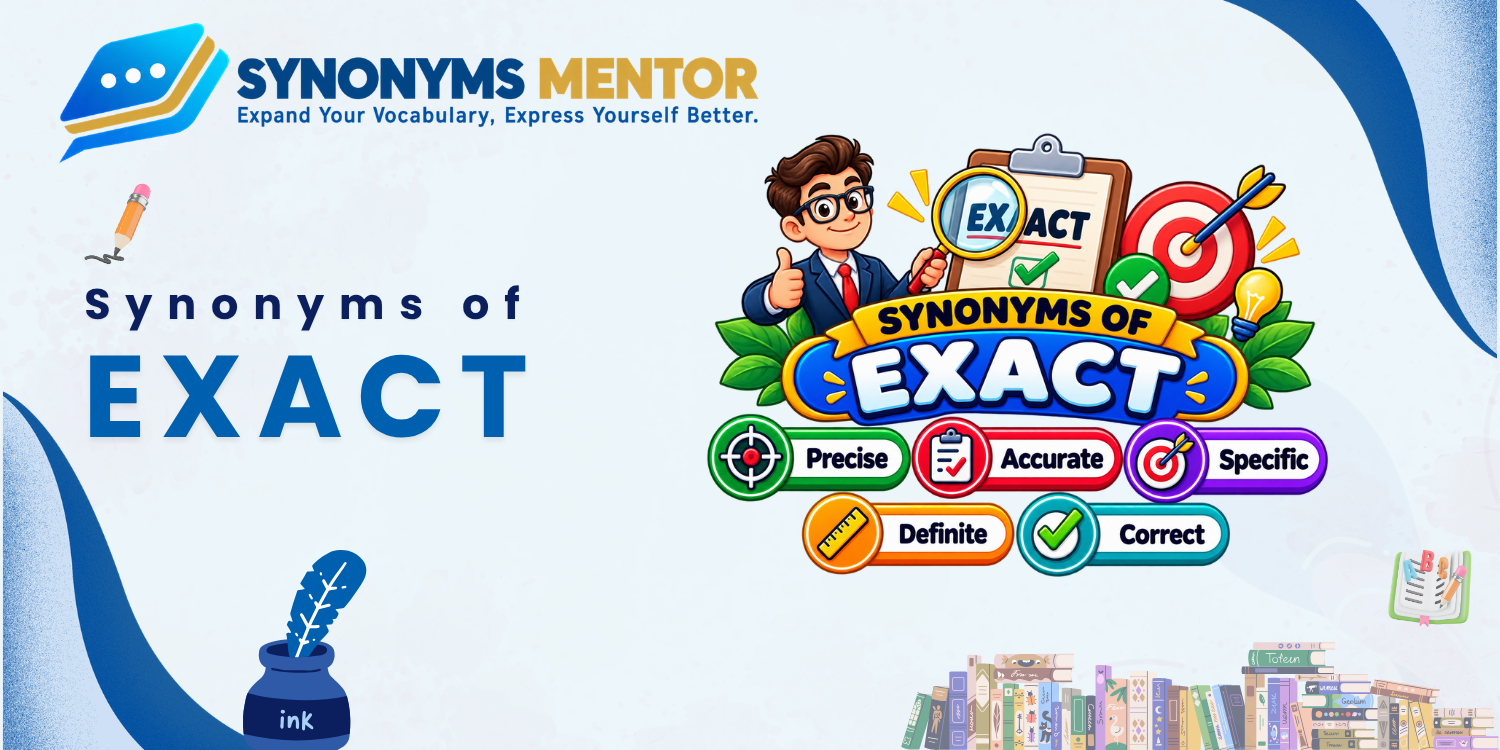
The closest synonyms for exact include precise, accurate, correct, specific, definite, and precisely stated alternatives such as explicit. However, each carries a slightly different emphasis.
Precise is usually the closest replacement when referring to measurements or details; accurate emphasizes conformity with facts; correct emphasizes freedom from error; specific emphasizes clearly identified details; and identical is appropriate when two things are exactly the same.
The Best Synonyms for Exact at a Glance
| Word | Relationship | Meaning | Strength | Formality | Best Context |
|---|---|---|---|---|---|
| Precise | Direct synonym | Exact and carefully measured or stated | Similar | Neutral/Formal | Measurements, details, wording |
| Accurate | Near synonym | Correct according to facts or reality | Similar | Neutral/Formal | Information, reports, measurements |
| Correct | Near synonym | Free from error | Similar | Neutral | Answers, facts, calculations |
| Specific | Contextual alternative | Clearly identified rather than general | Similar in some contexts | Neutral | Details, instructions, requests |
| Definite | Contextual alternative | Clearly established or certain | Similar in some contexts | Neutral/Formal | Dates, decisions, information |
| Explicit | Contextual alternative | Clearly and directly expressed | Similar for instructions/details | Formal/Neutral | Rules, instructions, statements |
| Identical | Contextual alternative | Exactly the same | Stronger/specific | Neutral/Formal | Objects, copies, results |
| Literal | Contextual alternative | Following the exact words or original meaning | Context-dependent | Neutral/Formal | Quotations, translations |
| Faithful | Contextual alternative | Closely matching an original | Context-dependent | Neutral/Formal | Copies, adaptations, representations |
| Verbatim | Contextual alternative | Using exactly the original words | Stronger/specific | Formal | Quotations, records |
| Rigorous | Near synonym in limited contexts | Extremely careful and exacting | Different emphasis | Formal | Methods, analysis |
| Thorough | Near synonym in limited contexts | Complete and detailed | Weaker for numerical precision | Neutral/Formal | Research, examination |
| Meticulous | Related/contextual | Extremely careful about details | Different emphasis | Formal | Work, preparation, checking |
| True | Near synonym in limited contexts | In accordance with reality | Broader | Neutral | Statements, accounts, facts |
| Right | Near synonym in limited contexts | Correct or appropriate | Broader | Neutral | Answers, choices, information |
Not every word above can replace exact in every sentence. That distinction is important: a useful vocabulary resource should explain the relationship rather than simply reproduce a long thesaurus list.
What Does Exact Mean?
As an adjective, exact describes something that is completely correct or in strict agreement with a fact, standard, measurement, or original. It can also emphasize that something is identified with complete precision.
Examples include:
- What is the exact address?
- We need the exact measurements before construction begins.
- I don’t remember her exact words.
- The report gives the exact number of participants.
Cambridge lists precise as a synonym and gives examples involving exact distances, times, locations, wording, and numbers.
Merriam-Webster also distinguishes exact from broader terms such as accurate and correct: exact strongly emphasizes strict agreement with a fact, standard, or measurement.
A Note About the Verb “Exact”
The word exact also functions as a verb, but that is a different meaning. As a verb, to exact means to demand and obtain something, sometimes forcefully—for example, to exact payment or to exact revenge.
This article focuses mainly on the adjective exact, because that is the meaning behind searches for synonyms such as precise and accurate.
1. Precise
Precise is usually the closest everyday synonym for the adjective exact. It emphasizes accuracy, careful measurement, or clearly defined details.
Best for: measurements, times, locations, descriptions, calculations, and wording.
Example:
The engineer recorded the precise dimensions of the structure.
Exact vs. precise: These words are often interchangeable, but precise can place more emphasis on fine measurement or careful specification. Cambridge directly lists precise as a synonym of exact.
2. Accurate
Accurate means correct or faithful to the facts. It is especially useful when the concern is whether information, measurements, or descriptions correspond to reality.
Best for: information, statistics, reports, measurements, descriptions, and records.
Example:
The article provides accurate information about the historical event.
Exact vs. accurate
An exact figure is completely specified, while an accurate figure is correct according to the facts.
For example:
- We need the exact time of the meeting.
- The clock gives an accurate time.
The distinction can be subtle, and the words can overlap. Merriam-Webster notes that accurate and exact are sometimes interchangeable, but accurate particularly emphasizes fidelity to fact or truth.
3. Correct
Correct means free from error or fault. It is broader than exact and is often the natural choice when discussing answers, facts, calculations, or decisions.
Best for: answers, information, calculations, statements, and conclusions.
Example:
Your answer is correct.
Exact vs. correct
Something can be correct without being exact.
For example, saying “The meeting is sometime in the afternoon” might be correct, but it is not exact. Saying “The meeting begins at 2:30 p.m.” provides exact information.
Merriam-Webster notes that correct generally emphasizes freedom from fault or error, whereas exact stresses strict agreement with a fact or standard.
4. Specific
Specific means clearly identified or defined rather than general or vague. It can replace exact when the context concerns particular details.
Best for: requests, details, instructions, examples, requirements, and descriptions.
Example:
Please provide a specific reason for the change.
However, specific does not always mean exact.
Compare:
- Do you have a specific date in mind?
- Do you know the exact date?
The first asks for a particular date; the second asks for the precise date.
5. Definite
Definite means clearly established, certain, or fixed.
Best for: dates, plans, decisions, information, and conclusions.
Example:
We don’t have a definite date for the announcement yet.
Definite overlaps with exact when something is clearly established, but it often emphasizes certainty rather than numerical or factual precision.
6. Explicit
Explicit means clearly and directly expressed, leaving little room for interpretation.
Best for: instructions, rules, warnings, statements, and requirements.
Example:
The teacher gave explicit instructions for completing the assignment.
You could sometimes replace exact with explicit when discussing wording or instructions, but the words emphasize different qualities:
- exact instructions → instructions stated with precision
- explicit instructions → instructions stated clearly and directly
7. Identical
Identical means exactly the same in relevant respects.
Best for: objects, copies, designs, results, images, and versions.
Example:
The two documents are identical.
This is not a general synonym for exact. Instead, it is a strong contextual alternative when exact means completely the same.
For example, “an exact copy” can often become “an identical copy,” although the emphasis shifts toward sameness.
8. Literal
Literal refers to the exact original meaning or wording rather than a figurative or altered interpretation.
Best for: translations, quotations, interpretations, and expressions.
Example:
The translation gives the literal meaning of the original phrase.
Do not use literal as a general replacement for exact. Its meaning is much narrower.
9. Faithful
Faithful can describe something that closely follows or accurately represents an original.
Best for: translations, adaptations, reproductions, accounts, and representations.
Example:
The film is a faithful adaptation of the novel.
Here, faithful emphasizes closeness to the source rather than mathematical or numerical precision.
10. Verbatim
Verbatim means using exactly the same words as the original.
Best for: quotations, transcripts, records, and reported speech.
Example:
The journalist reproduced the statement verbatim.
This is much more specific than exact. If you mean exact wording, verbatim can be an excellent choice.
11. Rigorous
Rigorous describes something performed with great care, strictness, or thoroughness.
Best for: analysis, methods, testing, research, and procedures.
Example:
The study used a rigorous testing process.
It is not a direct synonym for exact. Instead, it can describe the careful process that helps produce exact or reliable results.
12. Thorough
Thorough means complete and careful, including all important aspects.
Best for: research, investigations, reviews, checks, and examinations.
Example:
The editor conducted a thorough review of the manuscript.
A thorough review may help produce an exact result, but thorough emphasizes completeness, not precision.
13. Meticulous
Meticulous describes someone or something extremely careful about small details.
Best for: work, planning, checking, organization, and craftsmanship.
Example:
She kept meticulous records of every experiment.
This is better viewed as a contextual alternative or related word rather than a direct synonym. Meticulous describes the care taken, whereas exact describes the precision or correctness of the result.
14. True
True can overlap with exact when referring to information that corresponds with reality.
Best for: statements, accounts, facts, descriptions, and claims.
Example:
The statement is true.
But true is broader. It does not necessarily imply the fine-grained precision that exact can convey.
15. Right
Right can mean correct and is therefore related to exact in contexts involving facts, answers, or choices.
Example:
You were right about the date.
However, right is much broader and more conversational. It usually cannot replace exact where precise measurement or detailed specification is important.
Which Synonym Should You Use?
Choosing the right alternative becomes easier when you focus on the quality you want to emphasize.
Choose “precise” when:
You mean exactly measured, stated, or defined.
The scientist recorded the precise temperature.
Choose “accurate” when:
You mean correct according to facts or reality.
The report contains accurate information.
Choose “correct” when:
You mean free from error.
The calculation is correct.
Choose “specific” when:
You mean particular rather than general.
Please give me a specific example.
Choose “definite” when:
You mean certain or firmly established.
We still don’t have a definite answer.
Choose “explicit” when:
You mean clearly expressed.
The instructions were explicit.
Choose “identical” when:
You mean exactly the same.
The two copies are identical.
Choose “verbatim” when:
You mean using the exact original words.
The witness’s statement was recorded verbatim.
Exact vs. Precise vs. Accurate vs. Correct
These four words are among the most easily confused.
| Word | Main emphasis | Example |
|---|---|---|
| Exact | Strict agreement with a fact, standard, or precise specification | the exact amount |
| Precise | Fine accuracy or careful measurement | a precise measurement |
| Accurate | Correspondence with facts or reality | an accurate report |
| Correct | Freedom from error | the correct answer |
A useful rule is:
Exact asks, “Is this the precise thing?”
Precise asks, “How finely or carefully is this specified?”
Accurate asks, “Does it match the facts?”
Correct asks, “Is it free from error?”
These distinctions overlap, so context matters. Merriam-Webster specifically explains the different emphases of exact, accurate, and correct.
Exact vs. Specific
Exact and specific are related but not identical.
Specific contrasts with something general:
She gave a specific example.
Exact emphasizes complete precision:
She gave the exact example I was looking for.
A person can be specific without being exact. For example, “sometime next week” is relatively specific compared with “later,” but it is not an exact date.
Exact vs. Identical
These words overlap when exact means “completely the same,” but they serve different grammatical purposes.
- an exact copy → a copy matching the original precisely
- two identical copies → two copies that are exactly alike
Use identical when the central idea is sameness between two or more things.
Exact vs. Explicit
Use exact when you emphasize precision.
The exact wording is important.
Use explicit when you emphasize clarity and directness.
The instructions were explicit.
Something can be explicit without being exact, and something can be exact without being explicit.
Common Collocations With Exact
Some combinations with exact are especially natural:
- exact time
- exact date
- exact location
- exact amount
- exact number
- exact wording
- exact details
- exact measurements
- exact dimensions
- exact opposite
- exact copy
- exact match
- exact same
- exact cause
- exact meaning
Examples:
Do you know the exact location?
The report doesn’t give the exact number of participants.
I remember the exact wording of the message.
For many of these phrases, precise can work naturally, but the best alternative depends on the noun. For example, precise measurements sounds very natural, while precise opposite does not normally replace exact opposite.
Common Mistakes When Choosing a Synonym for Exact
Treating every related word as a direct synonym
Words such as meticulous, thorough, and rigorous relate to precision but do not simply mean exact.
Using “accurate” when the emphasis is precision
Accurate means correct according to facts, but exact can emphasize a fully specified detail.
Using “specific” to mean “precise” in every situation
Specific means particular or clearly identified. It does not automatically mean completely precise.
Using “identical” for every meaning of exact
Identical is appropriate only when the meaning involves complete sameness.
Confusing the adjective and verb
As an adjective, exact relates to precision and correctness. As a verb, exact means to demand and obtain something.
Antonyms of Exact
The most useful opposites of exact include:
- approximate
- inexact
- imprecise
- inaccurate
- vague
- uncertain
The best antonym depends on the context. Inexact and imprecise are direct opposites when discussing precision, while inaccurate is more appropriate when something is factually wrong. Cambridge lists imprecise, inaccurate, and inexact among the opposites of exact.
Frequently Asked Questions
What is the closest synonym for exact?
Precise is generally the closest synonym when exact means highly accurate or carefully specified. However, accurate may be better when the focus is factual correctness, while correct is better when the focus is freedom from error. The best choice depends on the noun and context.
Is precise the same as exact?
They are often interchangeable, especially when discussing measurements, details, or wording. However, precise often emphasizes fine measurement or careful specification, while exact can emphasize strict agreement with a fact, standard, or original.
What is a formal synonym for exact?
Precise is a natural formal or neutral alternative. Depending on context, explicit, definite, rigorous, or verbatim may also work, but each has a narrower meaning and should not automatically replace exact.
What is another word for exact information?
Accurate is often the most natural alternative when you mean information that correctly reflects the facts. Precise may work when the information contains highly specific details.
What is another word for exact details?
Precise details is the most natural alternative in many contexts. Specific details can also work, but specific emphasizes particularity rather than complete precision.
What is another word for an exact copy?
Depending on the intended meaning, identical copy or faithful reproduction may work. Identical emphasizes sameness, while faithful emphasizes how closely the reproduction follows the original.
What is the difference between exact and accurate?
Exact emphasizes strict precision or complete specification, whereas accurate emphasizes correspondence with facts or reality. The words can overlap, but they are not identical in every context.
Conclusion
The best synonym for exact depends on what you want to emphasize. Precise is usually the closest replacement for measurements and detailed specifications. Accurate focuses on factual correctness, while correct emphasizes freedom from error. Specific works when you mean particular rather than general, explicit when something is clearly stated, and identical when two things are exactly alike.

Olivia Brown is a vocabulary expert and content writer who focuses on synonyms, antonyms, and word usage. She helps learners understand English words in a simple and practical way, making communication clearer and more effective