
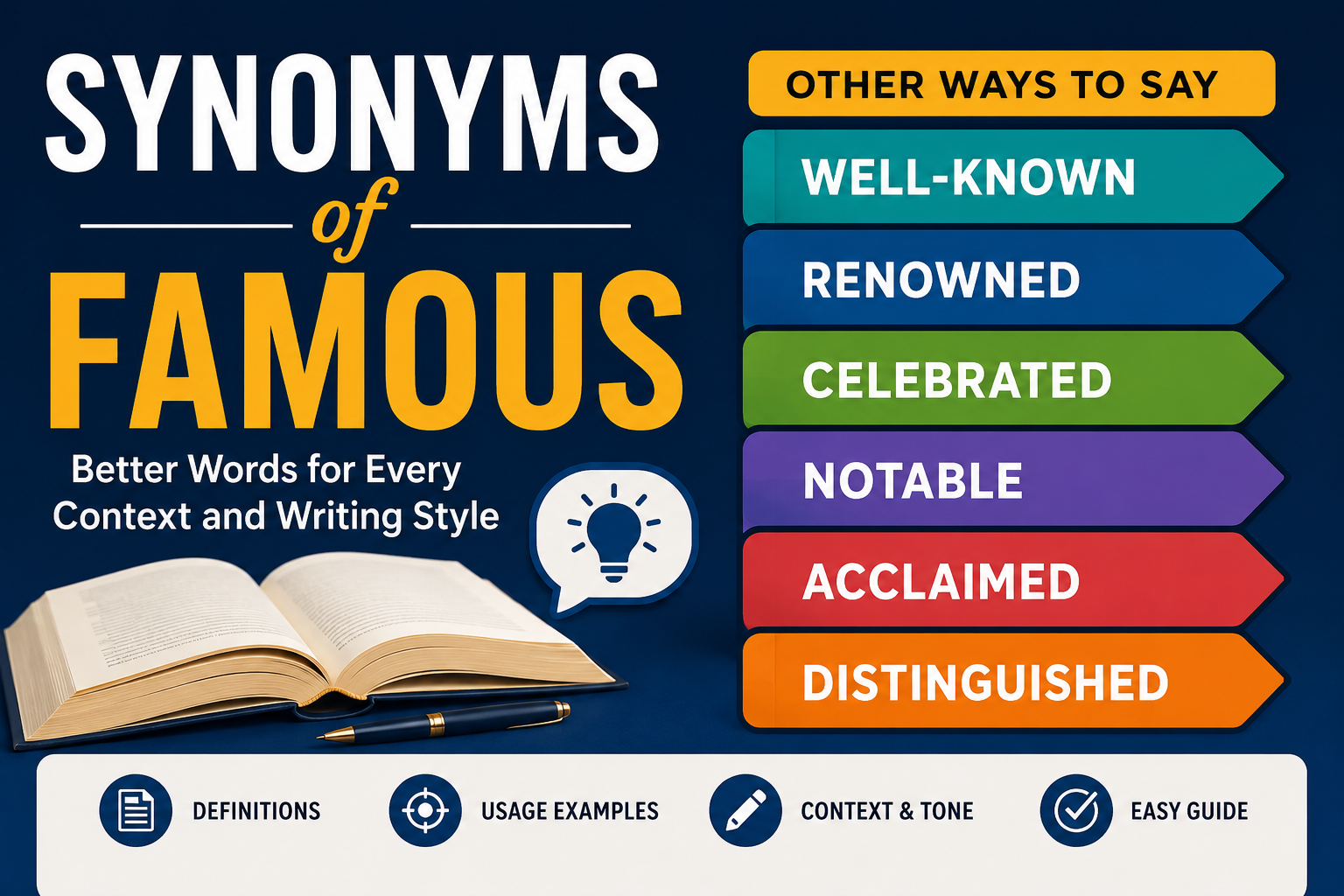
Synonyms of Famous: 20+ Alternatives With Examples
If you need another word for famous, the best choices include renowned, celebrated, famed, well-known, notable, prominent, distinguished, eminent, illustrious, and acclaimed.
However, these words are not completely interchangeable. Renowned often suggests admiration or high achievement, while notorious usually refers to someone or something widely known for a negative reason.
Choosing the right synonym depends on what kind of recognition you want to express: general public awareness, professional importance, admiration, historical significance, or notoriety.
Quick Answer: What Are the Best Synonyms for Famous?
The closest synonyms of famous are well-known, renowned, celebrated, famed, notable, noted, prominent, distinguished, eminent, illustrious, and acclaimed. Use well-known for neutral everyday English, renowned for respected achievement, celebrated for widespread recognition, and notorious when the fame has a negative association.
What Does “Famous” Mean?
Famous is an adjective meaning widely known or recognized by many people. It can describe a person, place, object, event, work, organization, or characteristic.
For example:
- She is a famous actress.
- Paris is a famous city.
- The restaurant is famous for its seafood.
- He became famous after winning the competition.
The word can be neutral, positive, or occasionally negative depending on context. Someone can be famous for an achievement, a talent, a location, a controversial event, or even a wrongdoing.
Merriam-Webster gives famous the core senses “widely known” and, in another usage, “excellent” or “first-rate.” It traces the word through Middle English and Anglo-French to Latin famosus, from fama, meaning fame.
Part of Speech
Famous is an adjective.
Pronunciation
US: /ˈfeɪ.məs/
UK: /ˈfeɪ.məs/
Best Synonyms of Famous
Not every word associated with fame is a perfect replacement. The table below separates close synonyms from words that introduce a particular nuance.
| Word | Relationship | Strength | Formality | Best Context |
|---|---|---|---|---|
| Well-known | Direct synonym | Neutral | Neutral | Everyday English |
| Renowned | Near synonym | Strong | Formal | Achievement and reputation |
| Celebrated | Near synonym | Strong | Formal/neutral | Admired people and achievements |
| Famed | Direct synonym | Strong | Neutral/literary | People, places, achievements |
| Notable | Near synonym | Moderate | Formal | Important or worthy people/things |
| Noted | Near synonym | Moderate | Formal | Writers, scholars, professionals |
| Prominent | Contextual alternative | Strong | Formal | Important public figures or institutions |
| Distinguished | Near synonym | Very strong | Formal | Achievement and excellence |
| Eminent | Near synonym | Very strong | Formal | Highly respected professionals |
| Illustrious | Near synonym | Very strong | Formal/literary | Historic honor and achievement |
| Acclaimed | Near synonym | Strong | Neutral/formal | Artists, writers, performers, works |
| Legendary | Contextual alternative | Very strong | Neutral | Extraordinary or enduring fame |
| Popular | Contextual alternative | Moderate | Neutral | Broad public appeal |
| Influential | Related/contextual | Strong | Neutral/formal | People who shape opinions or events |
| Notorious | Contextual alternative | Strong | Neutral/formal | Negative or troubling fame |
| Infamous | Contextual alternative | Strong | Neutral/formal | Fame associated with wrongdoing |
The major distinctions among famous, renowned, celebrated, noted, notorious, distinguished, eminent, and illustrious are also reflected in Merriam-Webster’s synonym guidance.
1. Well-Known
Well-known is one of the safest and most natural alternatives to famous.
It simply means that many people know about someone or something. Unlike renowned or distinguished, it does not necessarily imply admiration or exceptional achievement.
Example:
She is a well-known journalist who has covered international affairs.
Best used for:
- Everyday conversation
- General descriptions
- Neutral writing
- People, places, organizations, and ideas
Famous and well-known are often interchangeable:
a famous author
a well-known author
However, well-known can sound more neutral.
2. Renowned
Renowned means widely known and highly respected, particularly because of achievement, quality, or expertise.
Example:
The university is renowned for its medical research.
Use renowned when reputation matters as much as recognition.
Famous vs. renowned
- Famous: widely known
- Renowned: widely known and highly respected
She is a famous singer.
She is a renowned singer.
The second sentence places greater emphasis on her reputation and accomplishments. Merriam-Webster notes that renowned generally implies more glory and acclaim than famous.
3. Celebrated
Celebrated describes someone or something that has received considerable public recognition, attention, or admiration.
Example:
The celebrated author has written more than twenty novels.
It is particularly natural when discussing:
- Writers
- Artists
- Musicians
- Actors
- Historical figures
- Achievements
Merriam-Webster notes that celebrated can emphasize attention, especially attention received in print or public discussion.
4. Famed
Famed is a close synonym of famous and is especially common before nouns.
Examples:
The city is famed for its ancient architecture.
He was a famed explorer of the nineteenth century.
It can sound slightly more literary than famous, but it remains natural in modern English.
5. Notable
Notable means worthy of attention, especially because someone or something is important, unusual, successful, or significant.
Example:
She is a notable figure in modern architecture.
Unlike famous, notable does not necessarily mean that almost everyone knows the person.
A notable scientist may be highly respected within a particular field without being a household name.
Best used for:
- Academic writing
- Professional writing
- Historical discussions
- Important achievements
6. Noted
Noted is a formal alternative meaning well-known or recognized, often because of a particular achievement or area of expertise.
Example:
He is a noted historian and author.
It is especially natural with professions and intellectual achievements.
a noted scholar
a noted researcher
a noted novelist
Merriam-Webster describes noted as suggesting well-deserved public attention.
7. Prominent
Prominent means important, influential, or highly visible within a particular group, field, or public sphere.
Example:
She is a prominent figure in environmental policy.
This is not always a direct substitute for famous.
Someone can be prominent in a profession without being famous among the general public.
Use “prominent” when:
You want to emphasize importance or visibility, not simply recognition.
8. Distinguished
Distinguished suggests that someone is respected because of exceptional achievement, ability, status, or service.
Example:
The award was presented to a distinguished professor of physics.
It is particularly useful in formal and professional English.
Famous vs. distinguished
Famous focuses on being widely known.
Distinguished focuses on recognized excellence.
A person may therefore be distinguished without being broadly famous.
9. Eminent
Eminent is a strong, formal synonym associated with exceptional reputation, expertise, or status.
Example:
An eminent physician delivered the keynote address.
It is particularly common with:
- Scholars
- Scientists
- Physicians
- Lawyers
- Academics
- Public intellectuals
Merriam-Webster distinguishes eminent from famous by emphasizing a higher degree of prominence connected with outstanding quality or character.
10. Illustrious
Illustrious is a strong and somewhat literary word for someone who is famous because of remarkable achievements, honor, or historical importance.
Example:
The museum celebrates the city’s illustrious artistic tradition.
It works especially well in formal, historical, and ceremonial writing.
Because it carries a strong sense of honor, it is not a neutral replacement for famous in every sentence.
11. Acclaimed
Acclaimed means publicly praised or recognized as excellent.
Example:
The acclaimed director returned with a new film.
It is especially natural for:
- Films
- Books
- Authors
- Directors
- Actors
- Artists
- Performances
Important distinction
Famous = widely known.
Acclaimed = widely praised or critically recognized.
A person can be famous without being acclaimed.
12. Legendary
Legendary describes someone or something whose fame is exceptionally great or enduring.
Example:
The legendary athlete inspired generations of fans.
The word often carries a sense of extraordinary achievement or cultural importance.
It is stronger and more dramatic than ordinary famous.
13. Popular
Popular means liked, admired, or widely favored by many people.
Example:
The restaurant is popular with tourists.
Although popular can sometimes overlap with famous, the words are not equivalent.
- Famous: widely known
- Popular: widely liked or favored
A person can be famous but unpopular.
A local restaurant can be extremely popular without being famous nationally.
14. Influential
Influential describes someone or something that has the power to affect opinions, behavior, decisions, or developments.
Example:
She is one of the most influential designers of her generation.
This is a related word rather than a universal synonym for famous.
Someone may be influential without being famous, and someone famous may have little influence.
15. Notorious
Notorious means widely known, usually for something bad, controversial, or disreputable.
Example:
The notorious criminal was eventually arrested.
This word should not be treated as a neutral synonym for famous.
Compare:
He is a famous politician.
with:
He is a notorious politician.
The second sentence suggests a negative reputation.
Merriam-Webster specifically notes that notorious adds an implication of questionable or evil behavior to the idea of being famous.
16. Infamous
Infamous means famous for something considered extremely bad, shameful, or wrong.
Example:
The site became infamous for its violent history.
Famous vs. infamous
- Famous: widely known, often neutral or positive
- Infamous: widely known for something bad
This distinction is important for English learners because adding in- does not create a stronger version of famous. It changes the meaning.
Closest Synonyms of Famous
If you need the most interchangeable choices, start with:
- Well-known
- Famed
- Renowned
- Celebrated
- Notable
- Noted
But the best choice depends on context.
For neutral meaning:
well-known
For respected achievement:
renowned
For public admiration:
celebrated
For formal importance:
notable
For professional recognition:
distinguished or eminent
For exceptional historical fame:
illustrious or legendary
For negative fame:
notorious or infamous
Formal Synonyms for Famous
For academic, professional, and formal writing, consider:
- renowned
- notable
- noted
- prominent
- distinguished
- eminent
- illustrious
- acclaimed
Examples
Instead of:
He is a famous researcher.
Formal alternatives include:
He is a renowned researcher.
He is a distinguished researcher.
He is an eminent researcher.
The best option depends on whether you want to emphasize reputation, achievement, or professional standing.
Synonyms for Famous When Describing People
Different words emphasize different aspects of a person’s reputation.
| Word | What it emphasizes | Example |
| Celebrity | Public fame | She became a celebrity. |
| Renowned | Respect and achievement | A renowned scientist |
| Prominent | Public importance | A prominent politician |
| Distinguished | Achievement and excellence | A distinguished professor |
| Eminent | High professional status | An eminent scholar |
| Legendary | Exceptional, enduring fame | A legendary performer |
| Notorious | Negative reputation | A notorious criminal |
Note that celebrity is a noun, not a direct adjective replacement for famous.
For example:
She is famous.
becomes:
She is a celebrity.
The grammar and emphasis change.
Synonyms for Famous When Describing Places
The best alternative depends on why the place is known.
Well-known
The city is well-known for its historic buildings.
Renowned
The region is renowned for its wine.
Famed
The island is famed for its beaches.
Popular
The town is popular with tourists.
Legendary
The mountain has a legendary status among climbers.
Notice that popular focuses on popularity rather than recognition, while renowned emphasizes reputation.
Famous vs. Renowned
These words are close, but they are not identical.
Famous means widely known.
Renowned suggests that the person or thing is widely known and admired or respected.
Compare:
The actor is famous.
This simply tells us that many people know the actor.
The actor is renowned for her dramatic performances.
This highlights both recognition and excellence.
Famous vs. Notable
Famous usually suggests broad public recognition.
Notable means worthy of attention or recognition.
A person can be notable within a specialized field without being famous to the general public.
She is a notable researcher in marine biology.
This does not necessarily mean that millions of people know her.
Famous vs. Prominent
Famous emphasizes recognition.
Prominent emphasizes importance, influence, or visibility.
a famous actor
means many people know the actor.
a prominent actor
can suggest that the actor occupies an important position in the industry.
The words overlap, but they are not interchangeable in every sentence.
Famous vs. Distinguished
Famous tells us that someone is widely known.
Distinguished suggests recognized excellence or achievement.
a famous professor
means the professor is widely known.
a distinguished professor
suggests a strong record of achievement and professional respect.
Famous vs. Notorious
This is one of the most important distinctions for learners.
Famous is generally neutral.
Notorious usually carries a negative meaning.
The actor is famous for her award-winning performances.
The criminal is notorious for violent crimes.
Do not replace famous with notorious unless the negative connotation is intended.
Famous vs. Infamous
Infamous is even more clearly associated with a bad reputation.
The dictator became infamous for his brutal policies.
The sentence does not mean merely that the dictator became famous. It means the person became widely known because of something considered bad or disgraceful.
Famous vs. Popular
These words are frequently confused.
Famous = known by many people.
Popular = liked or favored by many people.
For example:
The author is famous but controversial.
This tells us the author is widely known, not necessarily widely liked.
Similarly:
The song is popular in my school.
This means many people like it, but it does not necessarily mean the song is internationally famous.
Natural Collocations With Famous
Some common phrases with famous include:
- famous person
- famous actor
- famous actress
- famous writer
- famous author
- famous scientist
- famous artist
- famous landmark
- famous city
- famous restaurant
- famous company
- famous historical figure
- famous for
- world-famous
- internationally famous
- internationally famous for
Examples
She is famous for her novels.
The city is famous for its historic architecture.
The museum contains several world-famous paintings.
When replacing famous, make sure the synonym fits the collocation naturally.
For example:
The city is renowned for its architecture.
sounds natural.
But replacing every occurrence mechanically can create awkward English.
Which Word Should I Use?
Use well-known when:
You want a neutral, everyday alternative.
Use renowned when:
You want to emphasize respect and achievement.
Use celebrated when:
You want to emphasize public recognition or admiration.
Use famed when:
You want a close alternative that can sound slightly literary.
Use notable when:
You want to emphasize importance or significance.
Use prominent when:
You want to emphasize status, visibility, or influence.
Use distinguished when:
You want to emphasize exceptional professional achievement.
Use eminent when:
You want a strong, formal term for a highly respected expert or professional.
Use illustrious when:
You want to emphasize honor, glory, or historical achievement.
Use acclaimed when:
You want to emphasize praise or critical recognition.
Use legendary when:
You want to emphasize extraordinary or enduring fame.
Use notorious when:
The person or thing is widely known for something negative.
Use infamous when:
The fame is specifically associated with something shameful or seriously bad.
Common Mistakes With Synonyms of Famous
1. Treating “infamous” as a stronger form of “famous”
Incorrect assumption:
infamous = extremely famous
Usually, infamous means famous for a bad reason.
2. Using “popular” to mean “famous”
A popular person or product is widely liked or favored. That does not automatically mean it is widely known.
3. Using “notorious” positively
Avoid:
She is a notorious scientist who won several awards.
Unless you deliberately mean that she is known for something controversial or negative, renowned or distinguished is more appropriate.
4. Assuming “prominent” always means famous
Prominent can describe someone who is important or influential within a particular field without implying broad public fame.
5. Using “celebrity” as an adjective
Celebrity is normally a noun.
Correct:
She is a celebrity.
Incorrect:
She is a celebrity actress.
More natural:
She is a famous actress.
or:
She is a celebrity.
Antonyms of Famous
Useful opposites include:
- unknown
- obscure
- unfamous
- unrecognized
- anonymous
- forgotten
- little-known
The best antonym depends on the context.
For example:
a famous writer
can contrast with:
an unknown writer
while:
a famous historical figure
might contrast with:
an obscure historical figure.
FAQ About Synonyms of Famous
What is another word for famous?
Common alternatives include well-known, renowned, celebrated, famed, notable, noted, prominent, distinguished, eminent, and illustrious.
What is the closest synonym for famous?
Well-known is one of the closest neutral alternatives because it focuses on the same basic idea: being widely known.
What is a formal synonym for famous?
Good formal choices include renowned, notable, prominent, distinguished, eminent, and illustrious. The best choice depends on the intended nuance.
What is a strong synonym for famous?
Renowned, distinguished, eminent, illustrious, and legendary can sound stronger than ordinary famous, but each adds a different nuance.
What is the difference between famous and renowned?
Famous means widely known, while renowned usually suggests being widely known and highly respected for achievement or quality.
Is notorious a synonym for famous?
Notorious can overlap with famous in the sense of being widely known, but it normally adds a negative connotation. It is not a neutral replacement.
Is infamous the opposite of famous?
Not exactly. Infamous means widely known for something bad or disgraceful. It is related to famous but carries a strongly negative meaning.
What is a synonym for famous person?
Depending on the context, you can use celebrity, star, notable figure, prominent figure, public figure, luminary, or well-known person. These are not all exact grammatical substitutes because some are nouns rather than adjectives.
Conclusion
The best synonym for famous depends on the kind of recognition you want to express. Well-known is the safest neutral alternative, while renowned suggests respect, celebrated suggests admiration, distinguished emphasizes achievement, and eminent suggests exceptional professional standing. Notorious and infamous should be reserved for negative forms of fame.

James Anderson is an English teacher and language researcher who creates easy synonym guides and vocabulary lessons. His goal is to help students and writers improve their language skills through simple and clear explanations.