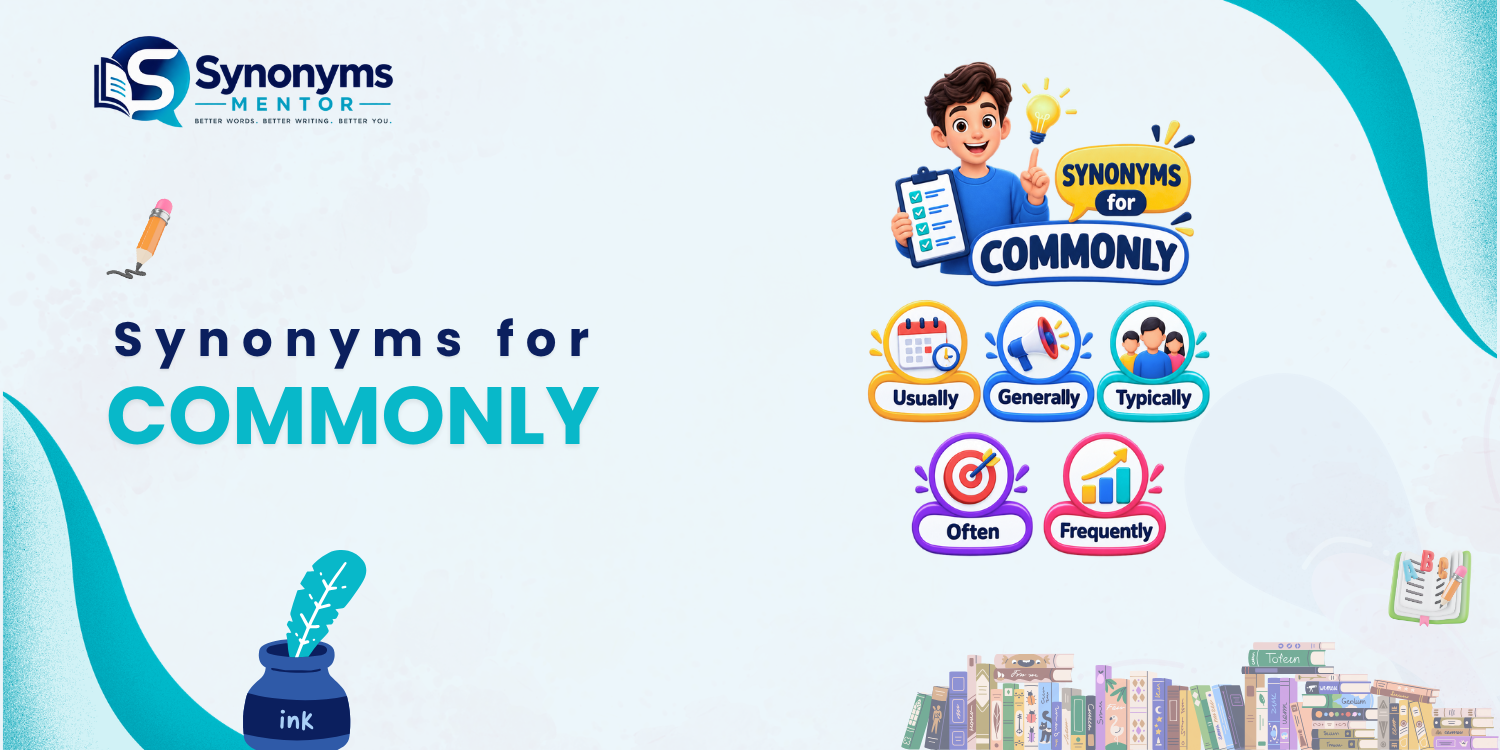
Synonyms for Commonly: 20 Better Alternatives With Examples
Finding a synonym for commonly is easy; choosing the right one is harder. Words such as usually, generally, frequently, typically, normally, ordinarily, and often overlap with commonly, but they do not always express exactly the same idea.
Commonly is usually an adverb meaning often or usually, but it can also describe something shared by two or more people or groups.
The best replacement therefore depends on what you mean. If you are talking about something that happens often, frequently may work. If you mean something that is normal or expected, usually or normally may be better. If you mean something that is widespread, widely can be more precise.
This guide separates genuine synonyms from contextual alternatives so you can choose the word that sounds most natural.
Quick Answer: What Are the Synonyms for Commonly?
The closest synonyms for commonly include usually, generally, normally, typically, ordinarily, frequently, often, customarily, regularly, and routinely. However, they differ slightly in meaning. Frequently emphasizes how often something happens, usually emphasizes what normally happens, widely emphasizes how widespread something is, and customarily emphasizes an established practice or tradition.
Core Synonym Resource
| Word | Relationship | Meaning | Best Context | Formality |
|---|---|---|---|---|
| Usually | Direct synonym | Most often; under normal circumstances | General frequency | Neutral |
| Generally | Direct/near synonym | In most cases; broadly | General statements | Neutral–formal |
| Normally | Direct synonym | Under ordinary conditions | Expected situations | Neutral |
| Typically | Near synonym | In a characteristic or usual way | Typical examples | Neutral–formal |
| Ordinarily | Direct/near synonym | Usually; under normal conditions | Formal or written contexts | Formal |
| Frequently | Near synonym | Often; at short or repeated intervals | Repeated events | Neutral–formal |
| Often | Near synonym | Many times; frequently | Everyday speech | Neutral |
| Customarily | Contextual alternative | According to custom or established practice | Traditions and procedures | Formal |
| Regularly | Contextual alternative | At repeated or predictable intervals | Routines and schedules | Neutral |
| Routinely | Contextual alternative | As a regular or standard practice | Procedures and work | Neutral–formal |
| Habitually | Contextual alternative | As a habit | Repeated behavior | Formal |
| Traditionally | Contextual alternative | According to tradition | Cultural practices | Neutral–formal |
| Conventionally | Contextual alternative | According to accepted convention | Standards and established practices | Formal |
| Widely | Contextual alternative | Across many people or places | Popularity or distribution | Neutral |
| Popularly | Contextual alternative | By many people; in popular usage | Names, beliefs, terms | Neutral |
| As a rule | Phrase alternative | Generally; in most cases | General rules | Neutral |
| For the most part | Phrase alternative | Mostly; in most cases | Qualified statements | Neutral |
| In general | Phrase alternative | Generally; broadly | Summaries and generalizations | Neutral |
| As a matter of course | Phrase alternative | As something normally expected | Formal contexts | Formal |
| Most often | Contextual alternative | More often than other possibilities | Frequency comparisons | Neutral |
Cambridge’s thesaurus includes many of these, including usually, ordinarily, generally, normally, customarily, regularly, routinely, traditionally, conventionally, frequently, and often. Merriam-Webster similarly groups usually, normally, typically, generally, and ordinarily among the closest alternatives.
What Does “Commonly” Mean?
Commonly is an adverb with two particularly useful senses.
1. Commonly = Often or Usually
This is the most important sense for synonym searches.
This plant is commonly found in coastal areas.
Here, commonly means that the plant is often or usually found there. Cambridge defines this sense as “often or usually,” while Merriam-Webster describes it in terms of what happens in the usual course of events.
2. Commonly = Shared by People or Groups
Commonly can also mean something is shared by two or more people.
They held commonly shared values.
In this sense, replacing commonly with frequently would change the meaning. Cambridge specifically identifies this second sense as something shared by two or more people.
Important: Most synonym lists for commonly focus on the first sense. When choosing an alternative, always check which meaning you intend.
The Closest Synonyms for Commonly
1. Usually
Usually is probably the safest everyday replacement for commonly when you mean “in most cases” or “under normal circumstances.”
Commonly, students arrive early for the exam.
Usually, students arrive early for the exam.
Use usually when you want a natural, conversational alternative.
2. Generally
Generally means “in most cases” or “broadly speaking.” It is especially useful when making a broad statement rather than describing repeated events.
This method is commonly used in schools.
This method is generally used in schools.
The second sentence can sound slightly broader and less focused on frequency.
3. Normally
Normally emphasizes what happens under ordinary or expected conditions.
The store commonly closes at 9 p.m.
The store normally closes at 9 p.m.
Choose normally when the idea of a standard or expected situation matters.
4. Typically
Typically means “in a way that is characteristic or usual.” It is particularly useful when describing what is representative of a particular group, situation, or type.
This species is commonly found in wetlands.
This species is typically found in wetlands.
Typically can suggest a characteristic pattern rather than simply saying that something happens often.
5. Ordinarily
Ordinarily is close to usually and normally, but it tends to sound more formal.
The procedure is commonly completed within two hours.
The procedure is ordinarily completed within two hours.
It is useful in formal, academic, or professional writing, although usually is generally more conversational.
6. Frequently
Frequently focuses more directly on frequency.
This error commonly occurs in older software.
This error frequently occurs in older software.
Use frequently when the main point is that something happens many times.
7. Often
Often is one of the simplest and most natural alternatives.
These birds are commonly seen near the lake.
These birds are often seen near the lake.
For everyday American English, often is usually less formal and more conversational than many alternatives.
Contextual Alternatives to “Commonly”
Not every useful alternative is a perfect substitute. Some become better choices only in specific contexts.
Customarily
Use customarily when something is done according to an established custom or practice.
Guests commonly remove their shoes before entering.
Guests customarily remove their shoes before entering.
The second sentence emphasizes a customary practice rather than simple frequency.
Regularly
Use regularly when something happens repeatedly or according to a recurring pattern.
The machine is commonly inspected.
The machine is regularly inspected.
Regularly suggests repetition or a routine.
Routinely
Routinely is especially useful for standard procedures or repeated professional actions.
Employees commonly check the equipment.
Employees routinely check the equipment.
It suggests that the action is a normal part of a process.
Habitually
Habitually refers to something done as a habit.
He commonly arrived late.
He habitually arrived late.
The second sentence suggests an established personal pattern and can carry a slightly negative implication depending on context.
Traditionally
Use traditionally when something has been done or believed over a long period because of tradition.
The dish is commonly served during the holiday.
The dish is traditionally served during the holiday.
Traditionally is more specific than commonly.
Conventionally
Conventionally means according to an accepted convention, standard, or established way of doing something.
The material is commonly represented by this symbol.
The material is conventionally represented by this symbol.
It is particularly useful in technical, academic, and professional writing.
Widely
Widely focuses on how widespread something is, rather than how frequently it occurs.
The term is commonly used in American English.
The term is widely used in American English.
This is a valuable distinction. Widely works especially well with words such as used, known, accepted, recognized, available, and distributed.
Popularly
Popularly can describe something known, called, or accepted by many people.
The building is commonly known as the Old Hall.
The building is popularly known as the Old Hall.
It is especially natural with expressions such as popularly known as.
Which Word Should I Use?
| If you mean… | Best choice |
|---|---|
| In most cases | Usually |
| Broadly speaking | Generally |
| Under normal conditions | Normally |
| Characteristically | Typically |
| Often or many times | Frequently / often |
| According to custom | Customarily |
| At repeated intervals | Regularly |
| As a standard procedure | Routinely |
| As a personal habit | Habitually |
| According to tradition | Traditionally |
| According to an accepted convention | Conventionally |
| Across many people or places | Widely |
| In popular usage | Popularly |
This distinction is more useful than treating every word in a thesaurus list as interchangeable.
Common “Commonly” Collocations
Some combinations are especially useful when choosing alternatives.
Commonly used
This expression is commonly used in everyday English.
Possible alternatives include:
- widely used
- frequently used
- regularly used
- generally used
Widely used emphasizes widespread adoption, while frequently used emphasizes frequency.
Commonly known
The city is commonly known by its nickname.
Natural alternatives:
- widely known
- generally known
- popularly known
Here, widely known often works better when emphasizing broad recognition.
Commonly found
This bird is commonly found in wetlands.
Possible alternatives:
- frequently found
- typically found
- usually found
- regularly found
Typically found is useful when describing a characteristic habitat; frequently found emphasizes occurrence.
Commonly accepted
This is a commonly accepted explanation.
Possible alternatives:
- widely accepted
- generally accepted
- conventionally accepted
Widely accepted emphasizes how many people accept the idea.
Common Mistakes When Replacing “Commonly”
Mistake 1: Treating “frequently” and “usually” as identical
They overlap, but they emphasize different ideas.
Usually means what happens in most normal cases.
Frequently emphasizes repeated occurrence.
She usually takes the train.
This tells us what she normally does.
She frequently takes the train.
This tells us that she takes it often, without necessarily saying it is her normal choice.
Mistake 2: Using “widely” for frequency
Widely means something is distributed, recognized, accepted, or used across a broad range.
The software is widely used.
This does not simply mean the software is used frequently by one person.
Mistake 3: Using “customarily” for any frequent event
Customarily involves a custom or established practice.
People commonly eat this food in winter.
If you simply mean it happens often, frequently or often may be better.
Mistake 4: Forgetting the second meaning of “commonly”
In phrases involving shared ideas or characteristics, replacing commonly with usually may be wrong.
They have commonly shared interests.
Here, the relevant idea is shared, not frequency.
Commonly vs Usually
Commonly and usually overlap strongly when they mean “often” or “in the normal course of events.”
This problem is commonly encountered by beginners.
This problem is usually encountered by beginners.
However, usually is often the more natural choice when discussing what normally happens in a particular situation.
Choose usually for ordinary habits, expectations, and routines.
Choose commonly when emphasizing that something is widespread or frequently encountered.
Commonly vs Frequently
Both can describe repeated occurrence, but frequently is more explicitly about frequency.
This error commonly occurs.
This error frequently occurs.
The first can suggest that the error is a common occurrence; the second places more emphasis on how often it happens.
For a frequency-focused statement, frequently is usually more precise.
Commonly vs Generally
Generally often means “in most cases” or “broadly,” whereas commonly can emphasize occurrence or prevalence.
This approach is commonly used.
This approach is generally used.
Both can work, but the second may sound more like a broad statement about typical practice.
Use generally when making a broad qualification; use commonly when the idea of prevalence or common occurrence is important.
Commonly vs Typically
Typically describes what is characteristic or representative.
These animals are commonly found in forests.
These animals are typically found in forests.
The typically version suggests that forests are characteristic of their normal habitat.
Use typically when describing a representative pattern rather than simply saying something happens often.
Pronunciation
The US pronunciation of commonly is approximately /ˈkɑːmənli/, while the UK pronunciation is approximately /ˈkɒmənli/.
The word is formed from common + -ly. Merriam-Webster traces the word to Middle English communly, from commun meaning “common.”
Antonyms of Commonly
For the frequency-related sense of commonly, useful opposites include:
- rarely
- seldom
- infrequently
- unusually
- exceptionally
For example:
This condition is commonly seen in adults.
This condition is rarely seen in adults.
Cambridge lists rarely, seldom, and infrequently among antonyms, while Merriam-Webster includes terms such as unusually and abnormally among near-antonyms.
FAQ
What is the best synonym for “commonly”?
Usually is one of the best general replacements when commonly means “in most cases.” Other strong choices include generally, normally, typically, ordinarily, and often. The best option depends on whether you mean normality, frequency, generality, or a characteristic pattern.
Is “usually” the same as “commonly”?
They are often interchangeable, but not always. Usually emphasizes what happens in most normal cases, while commonly can emphasize that something is widespread or frequently encountered. For example, “a commonly used term” emphasizes prevalence, while “she usually walks” describes a normal habit.
Is “frequently” a synonym for “commonly”?
Yes, when commonly means “often.” However, frequently places stronger emphasis on repeated occurrence. It is therefore a useful contextual synonym rather than a perfect replacement in every sentence.
What is a formal synonym for “commonly”?
Depending on the sentence, ordinarily, generally, customarily, conventionally, or frequently can provide a more formal alternative. The correct choice depends on the intended meaning rather than formality alone.
What is another word for “commonly used”?
Good alternatives include widely used, frequently used, regularly used, and generally used. Widely used is especially useful when you mean that something is used by many people or across many places.
What is another word for “commonly known”?
Widely known, generally known, and popularly known are useful alternatives. Widely known emphasizes broad recognition, while popularly known often appears when describing a name or label used by many people.
What is the difference between “commonly” and “typically”?
Commonly can mean often or frequently encountered, while typically means characteristic or usual for a particular type or situation. “Commonly found” emphasizes prevalence; “typically found” emphasizes what is characteristic.
What is the difference between “commonly” and “widely”?
Commonly can describe frequency or prevalence. Widely specifically emphasizes distribution across many people, places, or groups. Therefore, “widely accepted” means accepted by many people, while “commonly occurring” means occurring often or as a common phenomenon.
Conclusion
The best synonym for commonly depends on the meaning you want to preserve. Usually is a strong everyday alternative, generally works well for broad statements, frequently emphasizes repeated occurrence, and typically describes characteristic patterns. For more specific contexts, customarily, routinely, traditionally, conventionally, and widely can be more precise.

Olivia Brown is a vocabulary expert and content writer who focuses on synonyms, antonyms, and word usage. She helps learners understand English words in a simple and practical way, making communication clearer and more effective