Synonyms for Notion: 15 Better Alternatives With Examples
The word notion usually refers to an idea, belief, or understanding that someone has about something. It can describe a vague thought, a personal belief, or a general concept. Because of these different uses, there is no single replacement that works perfectly in every sentence.
The best synonym depends on what you mean. Idea is usually the most natural everyday alternative, while concept works well for a developed or abstract idea.
Belief emphasizes something a person accepts as true, whereas impression describes an understanding formed from experience or observation. Choosing the right alternative can make your writing more precise and natural.
Quick Answer: What Are the Best Synonyms for Notion?
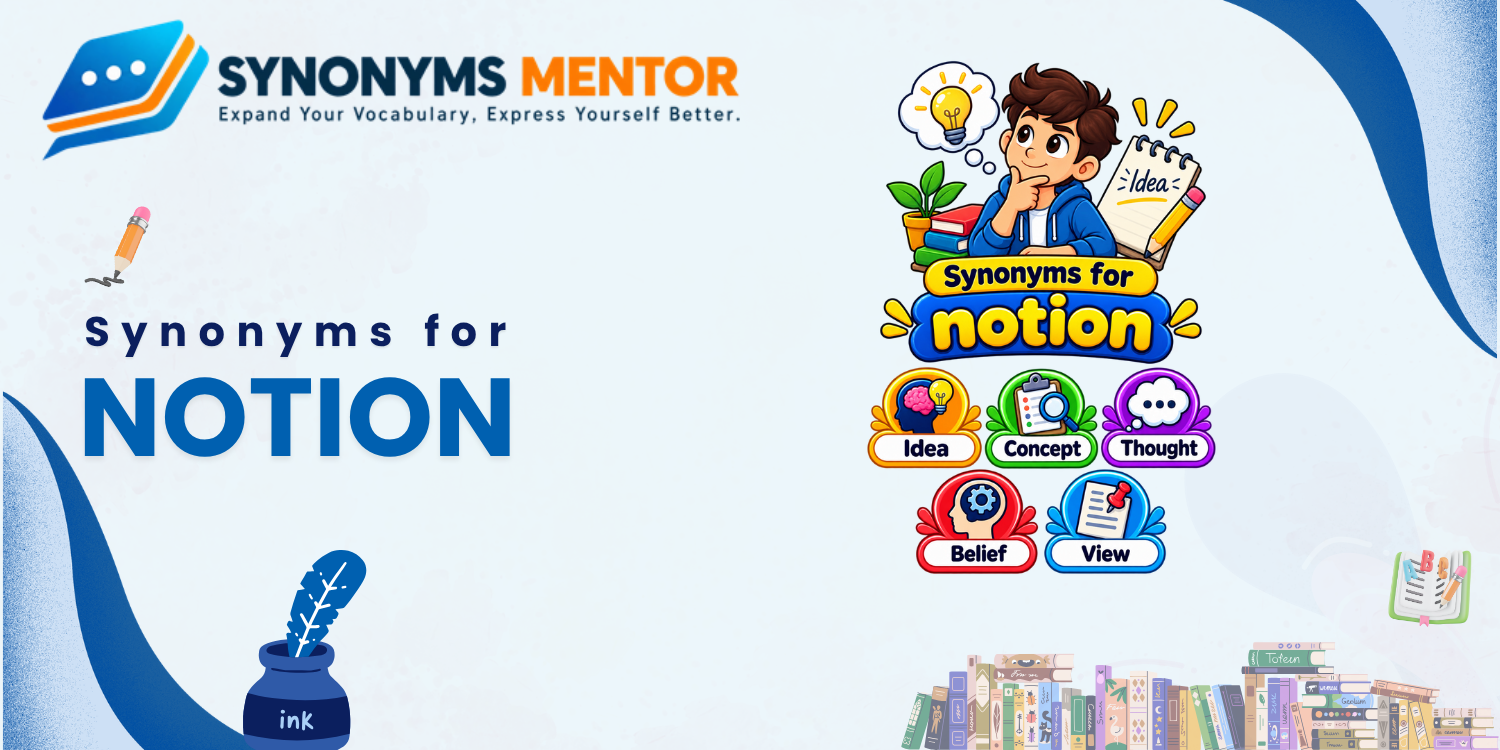
The closest synonyms for notion include idea, concept, conception, thought, belief, opinion, impression, perception, assumption, and view. However, they are not interchangeable in every context. Idea is the safest general replacement, concept suits formal or academic writing, and belief is better when the emphasis is on something someone considers true.
Core Synonyms for Notion
| Word | Relationship | Meaning | Formality | Best Context |
|---|---|---|---|---|
| Idea | Direct synonym | A thought, plan, or understanding | Neutral | Everyday and general writing |
| Concept | Near synonym | A developed or abstract idea | Formal/neutral | Academic and professional writing |
| Conception | Near synonym | A particular understanding or interpretation | Formal | Abstract or intellectual discussion |
| Thought | Direct/near synonym | Something that exists in the mind | Neutral | Mental processes and reflections |
| Belief | Contextual synonym | Something regarded as true | Neutral | Personal convictions |
| Opinion | Contextual synonym | A personal judgment or view | Neutral | Judgments and viewpoints |
| Impression | Contextual synonym | An idea formed from experience or observation | Neutral | First impressions and perceptions |
| Perception | Near synonym | The way something is understood or interpreted | Formal/neutral | Social, academic, and analytical contexts |
| Assumption | Contextual synonym | Something accepted as true without proof | Neutral | Reasoning and analysis |
| View | Contextual synonym | An opinion or way of considering something | Neutral | Discussions and viewpoints |
| Understanding | Near synonym | Knowledge or awareness of something | Neutral | Knowledge and interpretation |
| Conjecture | Contextual alternative | An idea based on incomplete evidence | Formal | Academic or analytical contexts |
| Hypothesis | Contextual alternative | A proposed explanation that can be tested | Formal/academic | Science and research |
| Premise | Contextual alternative | An idea or proposition forming the basis of reasoning | Formal | Arguments and logic |
| Perception | Near synonym | A particular way of seeing or interpreting something | Formal/neutral | Opinions and interpretation |
Important: The final five words are not universal substitutes for notion. They become useful only in particular contexts.
What Does “Notion” Mean?
Notion is a noun meaning an idea, belief, or understanding. Cambridge gives examples involving beliefs and vague ideas, and lists concept, conception, construct, idea, and thought as synonyms.
For example:
She had a vague notion that something was wrong.
Here, notion suggests an idea or feeling that is not necessarily precise.
The word can also appear in phrases such as:
- a vague notion
- a common notion
- an accepted notion
- a basic notion
- the notion that…
- a preconceived notion
Cambridge’s corpus examples include combinations such as “abstract notion,” “accepted notion,” and “basic notion.”
The Most Useful Synonyms for Notion
1. Idea
Idea is usually the closest and most versatile replacement for notion. It can refer to a thought, belief, plan, or mental concept.
Example:
She had the idea that the meeting would be canceled.
Best for: Everyday English, general writing, conversation, and many professional contexts.
Notion vs idea:
Notion can sound slightly more vague or tentative. Idea is broader and more natural in ordinary conversation.
2. Concept
Concept refers to an idea that is often more clearly defined, developed, or abstract.
Example:
The concept of personal freedom differs across cultures.
Best for: Academic writing, philosophy, business, science, and discussions of abstract ideas.
Notion vs concept:
A notion can be vague or loosely formed. A concept generally suggests a more developed or recognizable idea.
3. Conception
Conception refers to a particular way of understanding, interpreting, or imagining something.
Example:
Her conception of success changed after graduation.
Best for: Formal, academic, philosophical, and analytical writing.
It is more formal than notion and is often preferable when discussing someone’s particular understanding of an abstract subject.
4. Thought
Thought refers to something present in the mind, including an idea, reflection, or mental consideration.
Example:
The thought of moving abroad made him excited.
Best for: Personal reflections, mental processes, everyday writing, and emotional contexts.
Notion vs thought:
Thought is broader. A notion often suggests a particular idea or belief, while a thought can be any mental activity or consideration.
5. Belief
Belief is appropriate when notion refers to something a person considers true.
Example:
He held the belief that hard work was more important than talent.
Best for: Personal convictions, values, assumptions about reality, and religious or philosophical discussions.
Notion vs belief:
A belief normally implies greater commitment to an idea. A notion can be much less certain.
6. Opinion
Opinion works when notion means someone’s personal judgment or view.
Example:
She rejected the opinion that the policy was ineffective.
Best for: Discussions, debates, reviews, and personal judgments.
However, opinion is not a synonym for every use of notion. It specifically emphasizes a person’s judgment or viewpoint.
7. Impression
Impression is useful when an idea has been formed from an experience, observation, or appearance.
Example:
I had the impression that he was unhappy with the decision.
This suggests that the speaker interpreted signs or circumstances and formed an understanding.
Best for: Personal observations, first impressions, and interpretations.
8. Perception
Perception describes the way someone understands or interprets something.
Example:
Public perception of the company has changed.
Best for: Journalism, business, psychology, academic writing, and discussions of how people interpret events.
It is more specific than notion because it emphasizes interpretation or awareness.
9. Assumption
Assumption works when a notion is accepted as true without sufficient proof.
Example:
The plan was based on the assumption that demand would remain stable.
Best for: Business, research, analysis, and reasoning.
This word adds an important meaning that notion does not necessarily have: the idea has been taken for granted.
10. View
View can replace notion when the intended meaning is someone’s opinion or way of considering something.
Example:
She expressed the view that the project needed more time.
Best for: Formal discussions, opinions, essays, and professional communication.
Contextual Alternatives for Notion
Some words are useful alternatives only when notion has a particular meaning.
Conjecture
Use conjecture when the idea is based on incomplete information or speculation.
His explanation was merely conjecture.
It is not a general synonym for every use of notion.
Hypothesis
Use hypothesis for a proposed explanation that can be examined or tested.
The researchers developed a hypothesis about the cause of the behavior.
A hypothesis is more technical and specific than a notion.
Premise
Use premise when the idea serves as the basis for an argument or line of reasoning.
The argument depends on a questionable premise.
Again, this is a contextual alternative rather than a universal synonym.
Which Word Should You Use?
The easiest way to choose is to identify what notion means in your sentence.
Choose “idea” when:
You need a general, natural replacement.
She had an idea about how to solve the problem.
Choose “concept” when:
You are discussing a developed or abstract idea.
The concept of equality has been debated for centuries.
Choose “belief” when:
You want to emphasize that someone considers something true.
He has a strong belief in education.
Choose “opinion” when:
You mean someone’s personal judgment.
That is her opinion, not an established fact.
Choose “impression” when:
The idea comes from observation or experience.
I got the impression that they were disappointed.
Choose “assumption” when:
The idea has been accepted without adequate proof.
The decision was based on an assumption about future demand.
Choose “perception” when:
You mean someone’s interpretation or understanding of something.
The campaign changed public perception of the brand.
Notion vs. Idea
Notion and idea overlap strongly, and idea is generally the safest replacement.
The main difference is nuance. Notion can suggest something vague, tentative, or loosely formed, while idea is more neutral and can describe anything from a passing thought to a fully developed plan.
Compare:
I have a notion that something is wrong.
I have an idea about how we can fix it.
The first sounds more tentative; the second sounds more like a proposed solution.
Notion vs. Concept
Both words can refer to abstract ideas.
| Notion | Concept |
|---|---|
| Can be vague | Usually more defined |
| Often personal | Often shared or developed |
| Neutral to somewhat informal | Often formal or academic |
| Can describe a belief | Usually describes an abstract idea |
Example:
He had a vague notion of what the job involved.
The concept of opportunity cost is important in economics.
The second sentence requires a more established intellectual idea, making concept the better choice.
Notion vs. Belief
The distinction is mainly about certainty and commitment.
A belief is something a person accepts as true. A notion can simply be an idea someone has.
She had a notion that the store would be closed.
She had a strong belief that the policy was unfair.
The second example indicates stronger conviction.
Notion vs. Opinion
An opinion is a personal judgment or view. A notion has a broader range of meanings.
His opinion was that the movie was too long.
He had a strange notion that the movie contained a hidden message.
Opinion emphasizes judgment. Notion emphasizes the idea itself.
Common Collocations With “Notion”
Certain combinations are especially useful when writing with notion:
- a vague notion
- a preconceived notion
- a common notion
- an accepted notion
- an abstract notion
- a basic notion
- the notion that
- reject the notion
- challenge the notion
- support the notion
- dispel the notion
These patterns matter because replacing notion with another word can change what sounds natural.
For example:
The study challenges the notion that success depends entirely on talent.
Here, idea could work, but notion fits especially naturally because the sentence discusses a commonly held belief or assumption.
Common Mistakes When Replacing “Notion”
Mistake 1: Treating every related word as an exact synonym
Words such as hypothesis, premise, assumption, and opinion have additional meanings. They should not automatically replace notion.
Mistake 2: Using “belief” for every type of idea
Belief implies that someone accepts something as true. A simple idea does not necessarily involve belief.
Mistake 3: Using “concept” for a vague thought
Concept often suggests something more developed or abstract. For a loosely formed thought, notion or idea may sound more natural.
Mistake 4: Using “opinion” when there is no personal judgment
An idea does not automatically constitute an opinion.
Mistake 5: Ignoring register
Conception, conjecture, hypothesis, and premise can sound more specialized or formal than notion. Choose them because their meanings fit, not simply because they sound sophisticated.
Related Words
The following words are related to notion but should not automatically be presented as synonyms:
- theory — a structured explanation or system of ideas
- knowledge — information or understanding acquired through learning or experience
- belief — something accepted as true
- ideology — a system of ideas and beliefs
- assumption — something accepted without proof
- hypothesis — a testable proposed explanation
This distinction is important because a high-quality synonym resource should explain semantic relationships rather than simply provide a long list.
Antonyms of Notion
Because notion has several meanings, it does not have one universal antonym.
Depending on context, possible contrasting concepts include:
- fact — when notion means an unverified idea
- certainty — when notion suggests uncertainty
- knowledge — when contrasting an idea with established understanding
- reality — when contrasting an idea with what actually exists
These are contextual opposites rather than strict antonyms.
FAQ
What is the closest synonym for notion?
Idea is generally the closest and most versatile synonym for notion. Depending on context, concept, thought, conception, and belief may also work. Cambridge specifically lists concept, conception, construct, idea, and thought among synonyms for notion.
Is “idea” a synonym for “notion”?
Yes. Idea is one of the closest general synonyms for notion. However, notion can sometimes suggest a vaguer or less-developed idea, while idea is more neutral and versatile.
Is “concept” the same as “notion”?
Not exactly. The words overlap, but concept generally suggests a more clearly defined or developed abstract idea. Notion can refer to something vaguer or more personal.
What is a formal synonym for notion?
Depending on the context, concept, conception, perception, premise, or conjecture can provide a more formal alternative. They are not interchangeable, so the intended meaning should determine the choice.
Is “belief” a synonym for notion?
Sometimes. Belief works when notion refers to something a person accepts as true. It is not appropriate when notion simply means an idea or mental concept.
What is another word for “vague notion”?
Depending on the sentence, vague idea, impression, or unclear understanding may work. Vague idea is usually the most natural everyday alternative.
What is the difference between notion and opinion?
An opinion is a personal judgment or viewpoint, while a notion can be any idea, belief, or understanding. Therefore, opinion is narrower than notion.
What is the difference between notion and assumption?
An assumption is something accepted as true without sufficient proof. A notion can be much broader and does not necessarily involve an unsupported belief.
Conclusion
The best synonym for notion depends on the meaning you want to preserve. Idea is the safest general alternative, while concept works well for developed or abstract ideas. Choose belief when conviction matters, opinion for personal judgments, impression for interpretations based on experience, and assumption when something is accepted without proof.

Olivia Brown is a vocabulary expert and content writer who focuses on synonyms, antonyms, and word usage. She helps learners understand English words in a simple and practical way, making communication clearer and more effective