Synonyms of Asset: 20+ Alternatives for Every Context
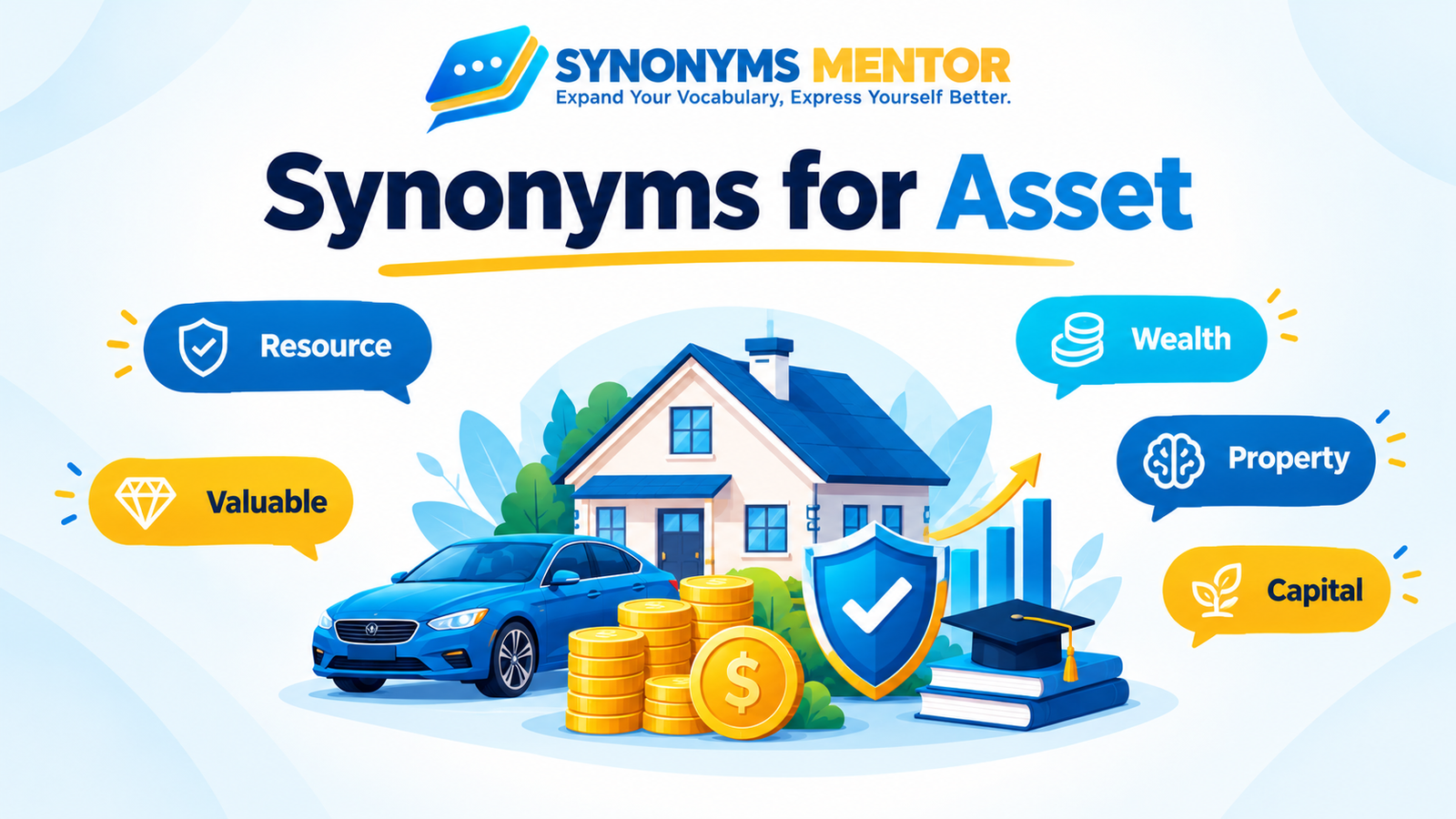
The best synonyms of asset depend on what you mean by the word. When asset refers to a useful person or quality, strong alternatives include advantage, benefit, strength, resource, and boon. When it refers to something valuable that someone owns, words such as property, possession, capital, wealth, and funds may be more appropriate.
Choosing the right alternative matters because these words overlap with asset without being interchangeable in every sentence.
Quick Answer: What Are the Best Synonyms of Asset?
The closest synonyms of asset include advantage, benefit, resource, strength, property, possession, capital, and wealth, depending on context.
Use advantage for something that gives you an edge, resource for something useful that can be relied on, and property or possession for something owned. In finance, capital and funds can be more precise alternatives.
What Does “Asset” Mean?
Asset is a noun with two major modern meanings.
First, an asset can be a person, quality, skill, or thing that is valuable or useful to someone or something. For example:
Her ability to communicate clearly is a valuable asset to the team.
Second, asset can mean something of value that a person or organization owns, especially property or another item that can contribute to financial value. In this sense, it is common in accounting, finance, business, and law.
Pronunciation
- US: /ˈæset/
- UK: /ˈæset/
Word Origin
Asset entered English in the mid-16th century through an Anglo-Norman French legal term. Its history is connected with Old French asez, meaning “enough,” ultimately related to Latin satis, meaning “enough.” Its early legal use concerned property sufficient to meet debts or obligations.
Core Synonyms of Asset
Not every word below is a direct replacement for asset. Some are near synonyms or contextual alternatives.
| Word | Relationship | Strength | Best Context |
|---|---|---|---|
| Advantage | Near synonym | Strong | Competitive or practical benefit |
| Benefit | Near synonym | Neutral–strong | Positive result or usefulness |
| Resource | Near synonym | Strong | Useful source, person, or capability |
| Strength | Near synonym | Strong | A valuable quality or ability |
| Property | Context-specific | Neutral | Something legally owned |
| Possession | Context-specific | Neutral | Something owned or held |
| Capital | Context-specific | Strong | Finance and business |
| Wealth | Context-specific | Strong | Overall financial value |
| Funds | Context-specific | Neutral | Available money |
| Aid | Contextual alternative | Neutral | Something that provides help |
| Help | Contextual alternative | Neutral | Practical assistance |
| Service | Contextual alternative | Neutral | Something useful or beneficial |
| Boon | Near synonym | Strong | Something especially helpful |
| Blessing | Contextual alternative | Strong | Something welcome or fortunate |
| Attraction | Contextual alternative | Neutral | A feature that draws interest |
| Strong point | Near synonym | Strong | A particular strength |
| Good point | Near synonym | Moderate | A favorable feature |
| Advantageous feature | Contextual alternative | Strong | Formal descriptive writing |
| Possessions | Context-specific | Neutral | Owned belongings |
| Goods | Context-specific | Neutral | Commercial or physical property |
Closest Synonyms for Asset
1. Advantage
Meaning: Something that puts a person or organization in a better position.
How it differs: Advantage emphasizes the positive effect or favorable position, while asset can emphasize the valuable thing, person, or quality itself.
Best used for: Competition, business, strategy, and general comparisons.
Example:
Her international experience is a major advantage in this position.
Choose “advantage” when you mean something that gives someone an edge.
2. Benefit
Meaning: A positive result, effect, or useful feature.
How it differs: Benefit focuses more on the positive outcome than on the valuable resource itself.
Example:
Flexible working hours are a major benefit for employees.
Use benefit when the emphasis is on what someone gains.
3. Resource
Meaning: Something available for use, support, or help.
How it differs: Resource often suggests something that can be drawn on or used to achieve a goal.
Example:
Her knowledge of local markets is an important resource for the company.
This is especially natural in business, education, technology, and organizational contexts.
4. Strength
Meaning: A quality or ability that gives someone or something an advantage.
How it differs: Strength usually identifies a specific positive quality rather than an owned financial item.
Example:
Creativity is one of his greatest strengths.
Use strength when talking about skills, abilities, qualities, teams, or organizations.
5. Boon
Meaning: Something extremely useful, helpful, or beneficial.
How it differs: Boon is often more expressive than asset and can suggest that something has been especially welcome.
Example:
The new software has been a boon to small businesses.
It works particularly well when you want to emphasize how helpful something has been.
Asset Synonyms by Context
When Asset Means “Advantage”
Use these alternatives when asset describes something that gives a person, team, or organization a favorable position:
- advantage
- benefit
- strength
- strong point
- good point
- boon
- resource
For example:
Her leadership experience is an asset to the organization.
Possible alternatives include:
Her leadership experience is an advantage to the organization.
Her leadership experience is a major strength of the organization.
Her leadership experience is a valuable resource for the organization.
The exact choice changes the emphasis.
When Asset Means “Something Valuable or Owned”
When asset refers to property or financial value, use:
- property
- possession
- capital
- wealth
- funds
- goods
- resources
For example:
The company sold several of its assets.
Depending on the intended meaning, you could say:
The company sold several of its properties.
or:
The company sold some of its capital assets.
These are not perfect substitutions because the financial meaning of asset is broader than any one of them. Oxford specifically distinguishes the general “valuable or useful” sense from the financial sense involving things of value owned by a person or company.
Formal and Professional Alternatives to Asset
For professional and business writing, the most useful alternatives are usually:
- resource
- advantage
- strength
- capital
- property
- financial resource
- valuable resource
Example
Instead of:
Experienced employees are an important asset to the company.
You could write:
Experienced employees are an important resource for the company.
Or:
Experienced employees are a major strength of the company.
The original sentence with asset is often the most natural, so do not replace it merely to avoid repetition.
Casual Alternatives to Asset
In everyday conversation, speakers may use simpler expressions such as:
- help
- advantage
- strong point
- good thing
- benefit
For example:
Her sense of humor is a real asset.
In casual speech:
Her sense of humor is a real strength.
or:
Her sense of humor is a real plus.
Plus is an informal alternative in contexts where you mean an additional favorable feature, but it is not a universal synonym for asset.
Which Word Should I Use?
Use “advantage” when:
Something gives a person or organization an edge.
Experience gives her an advantage over other candidates.
Use “benefit” when:
You are emphasizing a positive result or effect.
One benefit of remote work is greater flexibility.
Use “resource” when:
Something can be used for support, information, expertise, or capability.
The library is a valuable resource for students.
Use “strength” when:
You are describing a particularly good quality or ability.
Reliability is one of the company’s greatest strengths.
Use “property” when:
You mean something legally owned, especially real estate or other tangible property.
The company owns several commercial properties.
Use “capital” when:
You are discussing financial or business resources.
The company needs additional capital to expand.
Use “wealth” when:
You mean a large amount or overall accumulation of valuable possessions or financial resources.
The family built its wealth over several generations.
Use “boon” when:
You want to emphasize that something is especially helpful or welcome.
The scholarship was a boon to students from low-income families.
Asset vs Advantage
Asset and advantage are closely related, but their emphasis differs.
| Word | Main emphasis | Example |
| Asset | Something valuable or useful | Her experience is an asset to the team. |
| Advantage | A favorable position or benefit | Her experience gives her an advantage. |
A person, skill, quality, or resource can be an asset. An advantage is more specifically the favorable position or benefit created by something.
Asset vs Resource
These words overlap strongly in business and professional English.
An asset is something valuable or useful. A resource is something available to be used for a particular purpose.
Skilled employees are valuable assets.
Skilled employees are valuable resources.
Both sentences are natural, but resource emphasizes their usefulness and availability to the organization, while asset emphasizes their overall value.
Asset vs Property
These words should not normally be treated as interchangeable.
Property generally refers to something owned, especially land, buildings, or possessions.
Asset has a broader financial meaning and can include property, cash, investments, equipment, intellectual property, and other valuable items.
Therefore:
The company’s assets include property, equipment, and investments.
is more precise than treating property as a complete substitute for assets.
Asset vs Capital
Capital is a more specialized financial and business term.
An asset can be any item of financial value owned by an individual or organization. Capital generally concerns financial resources used to operate or invest in a business.
For example:
The company has several valuable assets.
does not mean exactly the same thing as:
The company has substantial capital.
Use capital when the financial-investment meaning is central.
Natural Collocations with Asset
Some common combinations include:
- valuable asset
- major asset
- important asset
- significant asset
- financial asset
- business asset
- company asset
- digital asset
- fixed asset
- capital asset
- intangible asset
- tangible asset
- strategic asset
- natural asset
- valuable asset to the team
- asset to the organization
- asset management
- asset value
- asset allocation
The construction “an asset to” is particularly useful when describing a person or quality that benefits an organization, team, or group. Oxford lists asset to somebody/something as a common pattern.
Common Mistakes with Asset Synonyms
Mistake 1: Treating “property” as a universal synonym
Incorrect reasoning:
Every asset is property.
Property is one type of asset in many contexts, but asset has a broader meaning.
Mistake 2: Using “benefit” for every financial asset
A company’s building may be an asset, but calling the building a benefit changes the meaning.
Mistake 3: Confusing “advantage” with “asset”
An asset can create an advantage, but the two words focus on different things.
Her experience is an asset.
focuses on the valuable quality.
Her experience gives her an advantage.
focuses on the favorable position it creates.
Mistake 4: Assuming “capital” always means asset
Capital is more specialized and usually belongs in financial or business contexts.
Mistake 5: Replacing asset simply for variety
Good writing does not require replacing every repeated word. If asset is the most precise word, keep it.
Real-World Examples
Workplace
Strong communication skills are a valuable asset for a project manager.
Alternative: Strong communication skills are a major strength for a project manager.
Business
The company’s brand is one of its most important assets.
Alternative: The company’s brand is one of its most valuable resources.
Education
Critical-thinking skills are an asset in academic research.
Alternative: Critical-thinking skills are a major advantage in academic research.
Finance
The company reported an increase in its total assets.
Here, property, wealth, or advantage would not necessarily preserve the financial meaning. Assets is the more precise term.
Everyday English
Her patience is a real asset when working with children.
Alternative: Her patience is a real strength when working with children.
Antonyms of Asset
The best antonym depends on the sense.
For the meaning something valuable or advantageous, useful opposites include:
- liability
- disadvantage
- drawback
- burden
- outdated disability
- hindrance
- weakness
For example:
His lack of experience became a liability rather than an asset.
Liability is particularly useful when contrasting something that creates a disadvantage with something that creates value. Collins lists liability, disadvantage, drawback, and hindrance among opposites associated with the benefit sense of asset.
FAQ About Synonyms of Asset
What is the closest synonym for asset?
There is no single synonym that works in every context. Advantage, benefit, resource, and strength are among the closest alternatives when asset means something valuable or useful. For financial property, property or capital may be more appropriate.
What is another word for asset in business?
Useful business alternatives include resource, advantage, strength, capital, property, and valuable resource. The best choice depends on whether you mean a useful capability, competitive advantage, or financial item.
What is another word for asset meaning advantage?
When asset means something that gives someone a favorable position, advantage is usually the most direct alternative. Strength, benefit, and strong point can also work in suitable contexts.
What is a formal synonym for asset?
Resource, advantage, strength, capital, and property can work in formal writing depending on the meaning. Resource is especially useful in professional and organizational contexts.
Is “resource” a synonym for asset?
Yes, in some contexts. A person, skill, source of information, or capability can be both an asset and a resource. However, resource emphasizes something available for use, while asset emphasizes value.
Is “property” a synonym for asset?
Only in the financial or ownership sense. Property is a type of asset, but asset can also refer to skills, people, investments, equipment, intellectual property, and other valuable things.
What is the opposite of asset?
Depending on context, common opposites include liability, disadvantage, drawback, burden, weakness, and hindrance. Liability is especially common in business and financial contrasts.
What is the difference between an asset and a liability?
An asset generally represents something valuable or useful, while a liability represents an obligation or something that creates a financial or practical burden. In everyday writing, the contrast can also describe something that helps versus something that works against a person or organization.
Conclusion
The best synonym of asset depends on the meaning you intend. Choose advantage when something gives you an edge, benefit when the focus is on a positive result, resource when something is available for use, and strength when describing a valuable quality or ability. For ownership and finance, property, capital, possessions, funds, and wealth may be more precise.

James Anderson is an English teacher and language researcher who creates easy synonym guides and vocabulary lessons. His goal is to help students and writers improve their language skills through simple and clear explanations.