Synonyms for Sure: Better Alternatives With Examples
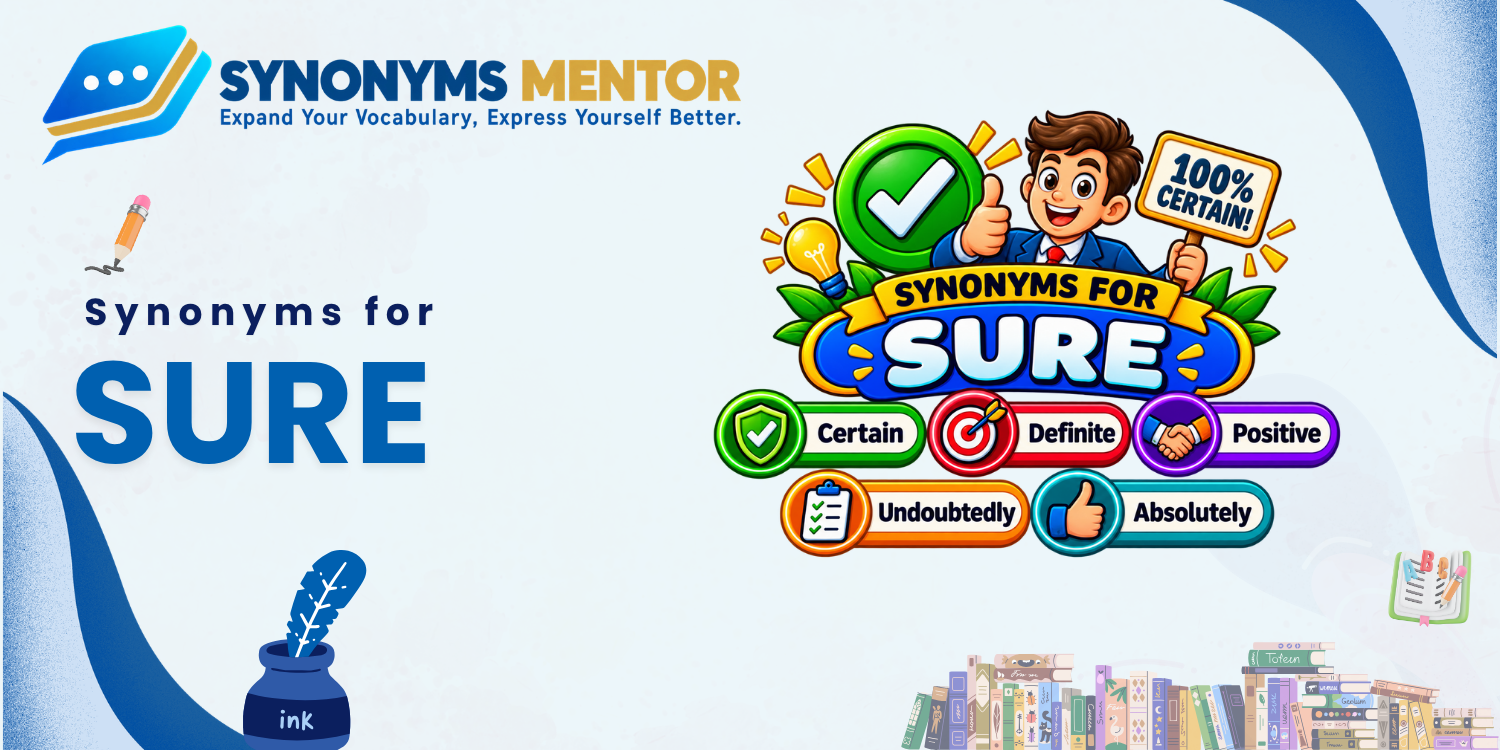
Finding the right synonym for sure depends on what you mean by the word. If you mean “without doubt,” alternatives such as certain, confident, convinced, positive, and assured may work. If you mean that something is dependable, words such as reliable, secure, or sound may be more appropriate. And when sure is used informally to mean “yes,” certainly, absolutely, of course, or okay can sometimes replace it.
The important distinction is that these alternatives are not interchangeable in every sentence. Sure is a broad, everyday word, while alternatives often add information about evidence, confidence, tone, reliability, or formality.
Quick Answer
The closest synonyms for sure include certain, confident, convinced, positive, and assured when the meaning is “without doubt.” Definitely, certainly, and surely work when sure functions as an adverb. For reliability, reliable or dependable may be better. For informal agreement, certainly, absolutely, of course, or okay can work depending on the situation.
Synonyms for Sure at a Glance
| Word | Relationship | Meaning | Strength | Formality | Best Context |
|---|---|---|---|---|---|
| Certain | Direct synonym | Having no doubt about something | Similar | Neutral–formal | General certainty |
| Confident | Near synonym | Strongly believing something will happen or is true | Strong | Neutral–professional | Expectations and outcomes |
| Convinced | Near synonym | Completely persuaded that something is true | Strong | Neutral | Beliefs based on evidence or persuasion |
| Positive | Near synonym | Completely sure, often emphatically | Stronger | Informal–neutral | Strong personal certainty |
| Assured | Near synonym | Confident and free from doubt | Strong | Neutral–formal | Professional writing, confidence |
| Definite | Contextual alternative | Certain, settled, or clearly established | Strong | Neutral | Plans, decisions, outcomes |
| Doubtless | Contextual alternative | Certainly true or expected | Strong | Formal/literary | Formal writing |
| Clear | Contextual alternative | Free from confusion or doubt | Similar | Neutral | Understanding and interpretation |
| Reliable | Contextual alternative | Consistently dependable or trustworthy | Different emphasis | Neutral–professional | People, methods, information |
| Definitely | Adverbial alternative | Without doubt; certainly | Strong | Neutral | Emphasizing certainty |
| Certainly | Adverbial alternative | Without doubt; unquestionably | Strong | Neutral–formal | Statements and agreement |
| Surely | Adverbial alternative | Certainly or as expected | Similar | Neutral–formal | Emphasis, expectation |
| Absolutely | Contextual alternative | Completely; without qualification | Strong | Neutral | Strong agreement or certainty |
| Of course | Contextual alternative | Naturally; certainly; yes | Context-dependent | Neutral | Agreement and obvious conclusions |
Cambridge’s thesaurus groups certain, positive, confident, convinced, and assured among the main alternatives for sure. Merriam-Webster likewise identifies confident, certain, assured, and positive as core adjective synonyms, while distinguishing adverbial alternatives such as definitely, certainly, and surely.
What Does “Sure” Mean?
Sure is primarily an adjective meaning certain or without doubt. It can describe someone’s belief that something is true, someone’s expectation that something will happen, or confidence in a fact or decision.
For example:
I am sure that she will arrive on time.
Are you sure about your answer?
We need to be sure that the information is accurate.
The word also has other uses. A sure way can mean a dependable or certain method, while a sure result can describe something expected to happen. As an informal adverb or response, sure can mean certainly or yes.
Because of these different meanings, there is no single synonym that works everywhere.
The Closest Synonyms for Sure
1. Certain
Certain is probably the closest general synonym for sure when you mean having no doubt.
Example:
I am certain that we made the right decision.
The two words are often interchangeable, but certain can sound slightly more formal and can suggest that a conclusion is supported by definite grounds or evidence.
Best for: general writing, academic writing, professional communication, and formal statements.
2. Confident
Confident means strongly believing that something is true or that something will happen successfully.
Example:
She is confident that the team will succeed.
Unlike sure, confident often emphasizes a person’s positive expectation about an outcome.
Compare:
I am sure he will come.
I am confident he will succeed.
The second sentence focuses more strongly on belief in a favorable result. Oxford specifically describes confident as emphasizing complete certainty that something will happen as expected.
Best for: predictions, abilities, performance, decisions, and professional communication.
3. Convinced
Convinced means completely sure that something is true or correct, often because of evidence or because someone has persuaded you.
Example:
The investigators were convinced that the explanation was correct.
This word suggests a process of reaching a belief.
Sure can describe simple certainty:
I’m sure he’s right.
Convinced more strongly suggests that something led you to that conclusion:
I’m convinced he’s right.
Oxford identifies convinced as a word for being completely sure, especially when evidence or persuasion supports the belief.
Best for: arguments, evidence, opinions, investigations, and strongly held beliefs.
4. Positive
Positive can mean completely sure, especially in informal or conversational English.
Example:
I’m positive I left my phone on the desk.
It is stronger and more emphatic than ordinary sure. Merriam-Webster notes that positive can intensify certainty and may sometimes suggest forceful or opinionated conviction.
Best for: emphatic personal certainty.
Register: Informal to neutral.
5. Assured
Assured is related to certainty and confidence but often has a more formal or polished tone.
Example:
The manager was assured that the project was on schedule.
It can also describe someone who behaves confidently:
She gave an assured presentation.
This makes assured useful when the emphasis extends beyond simply knowing something to having confidence or composure.
Best for: professional writing, formal descriptions, and confident behavior.
6. Definite
Definite works when something is settled, certain, clearly established, or not subject to change.
Example:
Do we have a definite answer yet?
The company has no definite plans to expand.
It is particularly natural with plans, decisions, dates, answers, arrangements, and information.
Oxford distinguishes definite as meaning certain to happen or something that is settled and not going to change.
7. Doubtless
Doubtless means certainly or without reasonable doubt.
Example:
She will doubtless have her own reasons.
It is grammatical and legitimate but more formal or literary than everyday sure.
Best for: formal writing, essays, and literary prose.
It would usually sound unnatural in casual conversation:
“Are you doubtless about that?”
Here, sure or certain is much more natural.
8. Clear
Clear can overlap with sure when the meaning is being free from confusion or doubt.
Example:
Are you clear about what needs to be done?
This does not always mean exactly the same thing as sure. Clear emphasizes understanding, whereas sure emphasizes certainty.
I am sure the answer is correct.
means I have no doubt about the answer.
I am clear about the answer.
can instead emphasize that I understand it.
Oxford includes clear in the same semantic group as sure, confident, convinced, and certain when discussing lack of doubt or confusion.
Contextual Alternatives for Sure
Reliable
Use reliable when sure means dependable rather than certain.
We need a reliable source of information.
You cannot normally replace sure with reliable when discussing personal certainty:
I am sure he is coming.
Not:
I am reliable he is coming.
The two words overlap in phrases such as a sure method and a reliable method, but their meanings are different.
Dependable
Dependable is similar to reliable and describes something or someone that can be trusted to perform consistently.
She is a dependable employee.
This is a contextual alternative, not a general synonym for sure.
Secure
Secure can overlap with sure when the idea is physical or financial safety, stability, or protection.
The building is secure.
But it is not normally a substitute for sure meaning “certain.”
Unquestionable
Unquestionable describes something that cannot reasonably be challenged or doubted.
His expertise is unquestionable.
It is stronger and more formal than everyday sure.
Unmistakable
Unmistakable means impossible or very difficult to mistake for something else.
There was an unmistakable change in her voice.
It overlaps with certainty but emphasizes clarity or recognizability rather than a person’s confidence.
Synonyms for “Sure” as an Adverb
Sometimes the search for a synonym for sure actually concerns its informal adverbial use.
For example:
Sure, I’ll help you.
Here, sure means something like certainly, of course, absolutely, or okay rather than “certain.”
Other examples include:
She sure knows how to solve a problem.
Here, sure is an informal intensifier.
Oxford labels this adverbial use informal, especially in North American English.
Better alternatives include:
- certainly
- definitely
- absolutely
- of course
- surely
- okay
- yes
The correct choice depends heavily on the sentence.
Which Word Should I Use?
Choose “certain” when:
You want a straightforward, slightly more formal alternative to sure.
I am certain that the information is correct.
Choose “confident” when:
You are expressing strong belief in a future result or successful outcome.
We are confident that the plan will work.
Choose “convinced” when:
Evidence or persuasion has led you to a strong conclusion.
She was convinced that something had gone wrong.
Choose “positive” when:
You want to emphasize that you are completely sure.
I’m positive I saw him there.
Choose “assured” when:
You want a more polished or formal expression of confidence.
The director sounded assured during the interview.
Choose “definite” when:
Something is settled, fixed, or certain to happen.
We don’t have a definite date yet.
Choose “reliable” when:
You mean dependable rather than certain.
We need a reliable supplier.
Choose “certainly” or “absolutely” when:
Sure means an affirmative response.
“Can you help me?”
“Certainly.”
or:
“Can you help me?”
“Absolutely.”
Sure vs. Certain
Sure and certain are the closest pair.
Both can express the absence of doubt:
I am sure she is right.
I am certain she is right.
The main difference is tone and nuance. Sure is the simpler, more common everyday word, especially in conversation. Certain is slightly more formal and can suggest that definite evidence or grounds support the conclusion.
Best rule: Use sure for natural everyday English and certain when a more formal or precise tone is useful.
Sure vs. Confident
Both express certainty, but confident often emphasizes belief in an expected outcome.
I’m sure she’ll pass.
I’m confident she’ll pass.
The second sentence can sound more deliberate and positive.
For professional communication, confident is often preferable:
We are confident that the new strategy will improve results.
Sure vs. Convinced
Convinced suggests that evidence, reasoning, or persuasion has produced the belief.
I’m sure he made the right choice.
I’m convinced he made the right choice.
The second statement sounds more strongly tied to a conclusion.
Use convinced when the reason for certainty matters.
Sure vs. Positive
Both can express strong personal certainty.
I’m sure that’s the correct address.
I’m positive that’s the correct address.
Positive is more emphatic and can sound forceful. It is especially natural in conversation.
Merriam-Webster notes that positive can intensify certainty and sometimes carry a sense of strong or dogmatic conviction.
Sure vs. Assured
Sure usually describes certainty about something. Assured can also describe a person’s confidence, manner, or composure.
I am sure about the decision.
She sounded assured during the presentation.
Because assured has this additional sense of confident manner, it should not automatically replace sure.
Sure vs. Definitely
These words can overlap, but their grammar differs.
Sure is commonly an adjective:
I am sure he will come.
Definitely is an adverb:
He will definitely come.
So you cannot simply substitute one for the other without changing the sentence structure.
Common Collocations With Sure
Some common patterns include:
- be sure
- feel sure
- seem sure
- make sure
- be sure of something
- be sure about something
- be sure that…
- be sure to…
- sure enough
- for sure
- a sure sign
- a sure way
- a sure thing
- a sure bet
Cambridge and Oxford both document common patterns such as be sure of, be sure about, be sure that, make sure, and be sure to.
Examples
Are you sure about your answer?
I’m sure that everything will be fine.
Make sure you save the document.
She is sure to notice the difference.
The result is a sure sign of improvement.
These fixed patterns matter because a synonym that works in one construction may not work naturally in another.
Common Mistakes With Sure Synonyms
Mistake 1: Treating “confident” and “sure” as identical
They overlap, but confident often emphasizes expectation of success, while sure is broader.
Mistake 2: Using “reliable” for personal certainty
I am sure he is correct.
does not become:
I am reliable he is correct.
Reliable describes dependability, not personal certainty.
Mistake 3: Replacing “sure” with “definitely” without changing grammar
I am sure.
cannot normally become:
I am definitely.
The words have different grammatical functions.
Mistake 4: Using “positive” in every formal context
Positive is strong and natural in conversation, but certain or confident may sound more appropriate in formal professional writing.
Mistake 5: Assuming “convinced” always means evidence-based certainty
Convinced often suggests evidence or persuasion, but it describes a person’s belief rather than guaranteeing that the belief is objectively correct.
Antonyms of Sure
The most direct opposites are:
- unsure
- uncertain
- doubtful
- dubious
- unconvinced
- hesitant
- indecisive
Cambridge and Merriam-Webster both list unsure, uncertain, and doubtful among the principal opposites or near-antonyms of sure.
The best antonym depends on the situation:
I’m unsure about the answer.
The outcome is uncertain.
She remained unconvinced by the explanation.
Pronunciation of Sure
The pronunciation varies between American and British English:
- US: /ʃʊr/
- UK: /ʃɔːr/
Cambridge gives these pronunciations for the adjective and related uses of sure.
Word Origin
Sure comes through Middle English and Old French from Latin securus, meaning “free from care.” Over time, the word developed its modern senses relating to certainty, confidence, reliability, and related ideas. Oxford gives the same Old French and Latin origin for the word.
Frequently Asked Questions
What is the closest synonym for sure?
Certain is generally the closest synonym for sure when the meaning is “without doubt.” Confident, convinced, positive, and assured are also close, but each adds a slightly different emphasis involving expectation, evidence, intensity, or confidence.
What is a formal synonym for sure?
Certain is one of the best formal alternatives. Depending on the context, assured, definite, unquestionable, or doubtless may also work. The best choice depends on whether you are describing a person’s belief, an expected event, or an established fact.
What is another word for sure in professional writing?
Certain and confident are particularly useful in professional writing. For example, “We are confident that the plan will succeed” sounds natural in business communication, while “The date is certain” emphasizes that the date is settled.
Is “certain” stronger than “sure”?
Not necessarily. They often express essentially the same degree of certainty. However, certain can sound more formal and may suggest that definite evidence or grounds support the conclusion, whereas sure often expresses a person’s subjective sense of certainty.
Is “confident” the same as “sure”?
They overlap, but confident often emphasizes belief in a favorable or expected outcome. “I am sure she will pass” expresses certainty, while “I am confident she will pass” can additionally suggest a positive expectation of success.
What is a synonym for “sure” meaning yes?
When sure is an informal affirmative response, alternatives include certainly, absolutely, of course, okay, and yes. The most natural choice depends on tone and situation. Oxford identifies this as an informal adverbial use of sure.
What is the difference between sure and positive?
Both can mean completely certain, but positive is generally more emphatic. “I’m positive” often communicates very strong personal conviction, while “I’m sure” is more neutral and versatile. Merriam-Webster notes that positive may imply especially forceful certainty.
Conclusion
The best synonym for sure depends on the meaning you want to express. Certain is the closest general alternative, confident emphasizes belief in an expected outcome, convinced suggests a strongly held conclusion, and positive adds emphatic certainty. Assured is useful for polished or professional contexts, while definite works especially well for settled plans and decisions.

James Anderson is an English teacher and language researcher who creates easy synonym guides and vocabulary lessons. His goal is to help students and writers improve their language skills through simple and clear explanations.