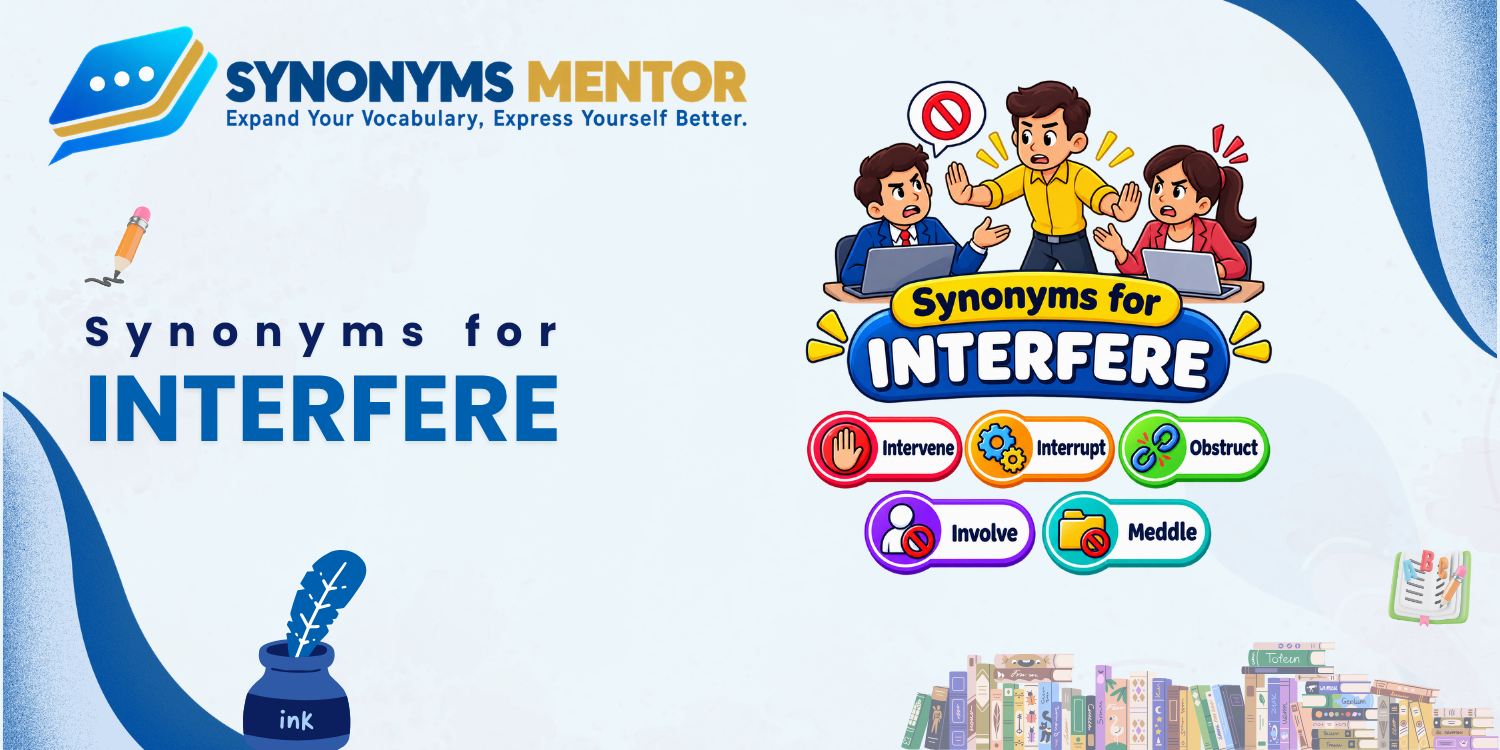
Synonyms for Interfere: Better Alternatives With Examples
The best synonym for interfere depends on what you mean. If you mean getting involved in someone else’s affairs when you are not wanted, useful alternatives include meddle, intrude, intervene, butt in, and pry.
If you mean getting in the way of a process or causing something to work less effectively, alternatives such as hinder, impede, obstruct, hamper, and disrupt are usually better.
Because interfere has several distinct uses, simply choosing a word from a thesaurus can produce an inaccurate or unnatural sentence. This guide separates the major meanings and shows which alternative works best in each context.
Quick Answer
The closest synonyms for interfere include meddle, intervene, intrude, interpose, and tamper when the word means getting involved in something.
For the sense of causing difficulty or preventing progress, use hinder, impede, obstruct, hamper, or disrupt. The right choice depends on whether you are describing unwanted involvement or an obstacle to a process.
Best Synonyms for Interfere
| Word | Relationship | Meaning | Strength | Formality | Best Context |
|---|---|---|---|---|---|
| Meddle | Direct/near synonym | Get involved in something that is not your concern | Similar | Neutral | Personal affairs, decisions |
| Intervene | Near synonym | Step into a situation, often to affect its outcome | Similar | Neutral–formal | Conflicts, disputes, crises |
| Intrude | Near synonym | Enter or involve yourself where you are unwanted | Similar | Neutral–formal | Privacy, personal matters |
| Interpose | Near synonym | Put yourself or something between people or things | Similar | Formal | Physical or figurative intervention |
| Intercede | Contextual alternative | Intervene on someone’s behalf | Narrower | Formal | Appeals, forgiveness, disputes |
| Mediate | Contextual alternative | Help opposing sides reach an agreement | Narrower | Formal | Conflicts, negotiations |
| Butt in | Contextual alternative | Interrupt or join a situation without invitation | Similar | Informal | Conversation, arguments |
| Pry | Contextual alternative | Try to discover private information | Narrower | Neutral | Personal affairs |
| Tamper | Contextual alternative | Improperly alter or interfere with something | Stronger | Neutral–formal | Equipment, evidence, systems |
| Hinder | Contextual alternative | Make progress or action more difficult | Similar | Neutral–formal | Work, progress, development |
| Impede | Contextual alternative | Slow or obstruct progress | Similar | Formal | Academic, professional writing |
| Obstruct | Contextual alternative | Block movement, action, or progress | Stronger | Neutral–formal | Processes, roads, investigations |
| Hamper | Contextual alternative | Make an activity more difficult | Similar | Neutral–formal | Work, performance, progress |
| Disrupt | Contextual alternative | Interrupt the normal operation of something | Stronger | Neutral–formal | Services, systems, activities |
| Thwart | Contextual alternative | Prevent an intended action or goal | Stronger | Formal | Plans, efforts, objectives |
These relationships are intentionally separated because dictionaries do not treat all of these words as interchangeable.
What Does Interfere Mean?
Interfere is a verb with several meanings. In everyday English, it commonly means either getting involved in a situation when your involvement is unwanted or unhelpful or hindering a person, activity, or process.
For example:
I wish my brother would stop interfering in my decisions.
Here, interfere means becoming involved in someone else’s affairs.
But:
Loud music interfered with my concentration.
Here, it means that something hindered or affected a process. Cambridge specifically distinguishes these uses through interfere in and interfere with.
Interfere in
Use interfere in when someone gets involved in a situation, activity, or person’s affairs.
The government should not interfere in private matters.
Interfere with
Use interfere with when a person or thing affects, disrupts, or hinders something.
Construction noise interfered with our work.
Oxford lists interfere in for unwanted involvement and separately identifies interfere with as a phrasal verb.
1. Meddle
Meddle is one of the closest everyday synonyms for interfere when someone gets involved in matters that do not concern them.
Stop meddling in their relationship.
The word usually carries a negative judgment: the person is involving themselves where they should not.
Best contexts
- family affairs
- relationships
- personal decisions
- other people’s business
- private matters
Register
Neutral, with a distinctly negative connotation.
Interfere vs meddle
Interfere is broader. Meddle more strongly suggests inappropriate or unwanted involvement.
I don’t want to interfere in their decision.
I don’t want to meddle in their personal affairs.
The second sentence sounds more critical.
2. Intervene
Intervene is related to interfere, but it often carries a more neutral or constructive meaning.
The teacher intervened when the students began arguing.
In many contexts, intervene describes stepping into a situation to stop a problem, resolve a conflict, or influence an outcome. Merriam-Webster also recognizes this sense of becoming involved in an existing situation.can imply stepping in to stop a conflict, while interfere tends to imply hindering.
Choose “intervene” when:
The person steps in deliberately to influence or improve a situation.
Police intervened to prevent the dispute from escalating.
Choose “interfere” when:
The involvement is unwanted, inappropriate, or obstructive.
The official was accused of interfering in the investigation.
3. Intrude
Intrude emphasizes entering someone’s space, privacy, or affairs without invitation.
I don’t want to intrude on your conversation.
It is particularly natural when discussing:
- privacy
- personal space
- private conversations
- personal affairs
Interfere vs intrude
Interfere focuses on involvement or influence.
Intrude focuses more strongly on unwanted entry or presence.
She interfered in their disagreement.
She intruded on their private conversation.
The second sentence highlights a boundary being crossed.
4. Interpose
Interpose is a more formal alternative that often means putting someone or something between two people or things.
The manager interposed himself between the two employees.
It can also be used figuratively:
She interposed an objection before the proposal was approved.
Merriam-Webster notes that interpose and interfere overlap, but interpose can simply mean coming or going between without necessarily carrying the negative implication of interference.
Best context
Use interpose mainly in formal, literary, legal, or carefully written contexts.
5. Intercede
Intercede is a specialized alternative. It means intervening on behalf of another person, particularly by asking someone with authority to show mercy or change a decision.
The lawyer interceded on behalf of his client.
This is not a general synonym for every use of interfere.
Choose “intercede” when:
Someone acts for another person in an appeal, dispute, or request for mercy.
Merriam-Webster specifically distinguishes intercede from the broader idea of interfering by noting its association with acting on behalf of someone seeking mercy or forgiveness.
6. Mediate
Mediate means helping opposing sides resolve a disagreement.
A neutral representative was asked to mediate the dispute.
It is therefore much narrower than interfere.
Choose “mediate” when:
The person is trying to bring two sides together or negotiate a solution.
The director mediated between the employees.
Do not use mediate simply because someone became involved in a situation.
7. Butt In
Butt in is an informal phrasal verb meaning to interrupt or join a conversation or situation without being invited.
I wish he wouldn’t butt in while we’re talking.
It is useful in casual American English.
Register
Informal.
Best context
- conversations
- arguments
- casual situations
- interruptions
Collins lists butt in among alternatives for interfere and identifies similar informal expressions such as poke your nose in.
8. Pry
Pry is a more specific alternative that means trying to discover information about someone’s private life or affairs.
She kept prying into my personal life.
Unlike interfere, pry focuses on unwanted curiosity or attempts to obtain private information.
Choose “pry” when:
Someone is asking intrusive questions or trying to learn something private.
Don’t pry into matters that don’t concern you.
9. Tamper
Tamper means to interfere with something improperly, especially by altering, handling, or changing it without authorization.
Someone had tampered with the equipment.
It is common with:
- evidence
- machinery
- records
- systems
- settings
- security devices
Interfere vs tamper
Interfere is broader.
Tamper suggests improper physical or technical manipulation.
The changes interfered with the system’s operation.
Someone tampered with the system.
The second sentence more strongly suggests unauthorized alteration.
Synonyms for “Interfere With” Something
When interfere with means make something harder, interrupt it, or prevent it from progressing, different synonyms become more natural.
The strongest choices include:
- hinder
- impede
- obstruct
- hamper
- disrupt
- frustrate
- inhibit
- thwart
- block
- get in the way of
Collins groups words such as hinder, impede, obstruct, hamper, disrupt, and thwart under the sense of interfering with or hindering something.
10. Hinder
Hinder means to make progress or action more difficult.
Heavy traffic hindered our progress.
It is a highly useful alternative in professional and academic writing.
Best contexts
- progress
- development
- work
- communication
- recovery
- growth
Strength
Usually similar to interfere with, without necessarily implying complete prevention.
11. Impede
Impede is a formal synonym for hinder or interfere with.
A lack of funding impeded the project’s development.
It works especially well in:
- academic writing
- professional reports
- formal analysis
- policy discussions
Choose impede when you want a more formal alternative to hinder.
12. Obstruct
Obstruct means to block or prevent movement, action, or progress.
The fallen tree obstructed the road.
It can also be figurative:
The regulations obstructed efforts to reform the system.
Compared with hinder, obstruct often suggests a stronger barrier.
13. Hamper
Hamper means to make something difficult to do or achieve.
A lack of reliable data hampered the research.
It is useful for professional and academic writing and often sounds natural with abstract nouns such as progress, development, efforts, and performance.
14. Disrupt
Disrupt emphasizes interruption of something that is normally operating or progressing.
The storm disrupted transportation services.
Technical problems disrupted the meeting.
Choose disrupt when normal activity is interrupted rather than merely slowed.
15. Thwart
Thwart is stronger and often means preventing someone from achieving a plan, objective, or intention.
The security measures thwarted the attempted attack.
Unexpected costs thwarted the company’s expansion plans.
It is more formal and often more forceful than hinder.
Which Word Should I Use?
Choose “meddle” when:
Someone is unnecessarily involving themselves in another person’s affairs.
He keeps meddling in my personal decisions.
Choose “intervene” when:
Someone steps into a situation to influence, stop, or resolve it.
The manager intervened in the dispute.
Choose “intrude” when:
Someone crosses a personal or private boundary.
I don’t mean to intrude on your privacy.
Choose “tamper” when:
Someone improperly alters or handles something.
Someone tampered with the records.
Choose “hinder” when:
Something makes progress more difficult.
The delay hindered our progress.
Choose “impede” when:
You want a more formal word for slowing or obstructing progress.
Poor infrastructure impeded economic development.
Choose “obstruct” when:
Something actively blocks a path, process, or action.
The debris obstructed the entrance.
Choose “disrupt” when:
Normal activity is interrupted.
The outage disrupted online services.
Choose “thwart” when:
Something prevents a plan or objective from succeeding.
The evidence thwarted the attempt to conceal the mistake.
Interfere vs. Meddle
Both words can describe unwanted involvement.
| Interfere | Meddle | |
|---|---|---|
| Core idea | Get involved or affect something | Get involved where you are not wanted |
| Tone | Neutral to negative | Usually negative |
| Scope | Broader | More specifically inappropriate involvement |
| Example | Don’t interfere in their affairs. | Don’t meddle in their affairs. |
Meddle usually makes the criticism stronger.
Interfere vs. Intervene
These words are closely related but differ in tone.
Intervene often suggests purposeful action to improve or resolve a situation.
Interfere often suggests unwanted involvement or hindrance.
The counselor intervened to help resolve the conflict.
The official interfered with the investigation.
This distinction is especially important in professional writing. Merriam-Webster explicitly notes that interfere implies hindering, while intervene can involve stepping in to stop a conflict.
Interfere vs. Intrude
Both can describe unwanted involvement, but intrude is more strongly associated with crossing boundaries.
He interfered in the discussion.
He intruded on their private conversation.
Use intrude when privacy or personal space is central.
Interfere vs. Hinder
These words overlap when something prevents smooth progress.
Noise interfered with my concentration.
Noise hindered my concentration.
But hinder more directly emphasizes making progress difficult, while interfere can also describe unwanted human involvement.
Interfere vs. Obstruct
Obstruct is stronger when something physically or figuratively blocks progress.
The construction interfered with traffic.
The construction obstructed the road.
The second sentence suggests a more direct barrier.
Interfere vs. Disrupt
Interfere can mean affecting or hindering something.
Disrupt emphasizes interruption of normal operation.
The noise interfered with my concentration.
The outage disrupted the service.
Use disrupt when an established activity, service, or system is interrupted.
Common Collocations With Interfere
Interfere in
- interfere in someone’s affairs
- interfere in someone’s life
- interfere in a dispute
- interfere in politics
- interfere in domestic affairs
- interfere in internal affairs
- interfere in a relationship
- interfere in a decision
Interfere with
- interfere with work
- interfere with progress
- interfere with concentration
- interfere with communication
- interfere with sleep
- interfere with operations
- interfere with a process
- interfere with someone’s plans
- interfere with a signal
- interfere with the functioning of a system
Oxford lists common patterns including interfere in and interfere with, along with collocations involving words such as seriously, directly, and constantly.
Common Mistakes
Mistake 1: Using “intervene” as if it always means “interfere”
They overlap, but intervene is often neutral or helpful, while interfere can imply unwanted or harmful involvement.
Mistake 2: Using “meddle” for technical problems
Meddle normally describes inappropriate human involvement.
Incorrect:
The software meddled with my concentration.
Better:
The software interfered with my concentration.
Mistake 3: Using “intrude” for every type of obstruction
Intrude usually concerns entering a place, situation, or person’s privacy without invitation.
Mistake 4: Treating “hinder” as a synonym for every use of interfere
Hinder is most appropriate when something makes progress or action more difficult.
Mistake 5: Confusing “interfere in” and “interfere with”
Use interfere in for involvement in a situation:
Don’t interfere in their personal affairs.
Use interfere with for hindering or affecting something:
Don’t interfere with the equipment.
Mistake 6: Using “tamper” when you only mean affect
Tamper implies improper handling or unauthorized alteration. It is stronger and more specific than interfere.
Antonyms of Interfere
The appropriate opposite depends on the sense.
For unwanted involvement, useful opposites include:
- stay out
- avoid
- ignore
- leave alone
- keep away
For hindering or obstructing something, useful opposites include:
- help
- assist
- support
- facilitate
- aid
Cambridge lists aid, help, and assist as antonyms in the sense where interfere means hindering or causing difficulty.
Pronunciation of Interfere
American English: /ˌɪn.t̬ɚˈfɪr/
British English: /ˌɪn.təˈfɪə/
Oxford and Cambridge both provide pronunciation information for interfere.
Frequently Asked Questions
What is the closest synonym for interfere?
There is no single closest synonym for every use. Meddle is very close when interfere means getting involved in someone’s affairs, while intervene is close when it means stepping into a situation. For the sense of hindering something, hinder is often a natural alternative.
What is a positive synonym for interfere?
Intervene can be a more neutral or positive alternative when someone steps in to prevent harm, resolve a dispute, or help someone. Interfere often carries a negative implication when it describes unwanted involvement.
What is a formal synonym for interfere?
The best formal alternative depends on context. Intervene, interpose, intercede, impede, and obstruct can all work in appropriate contexts. Intercede is especially specific because it means acting on behalf of someone.
What is another word for interfere with?
Depending on the sentence, alternatives include hinder, impede, obstruct, hamper, disrupt, inhibit, frustrate, and thwart. Hinder is a broad choice, while obstruct emphasizes blocking and disrupt emphasizes interruption.
What is another word for interfere in someone’s affairs?
Meddle is usually the closest everyday alternative. Intrude and pry can also work when the sentence emphasizes unwanted involvement or curiosity about private matters.
Is “meddle” stronger than “interfere”?
Usually, meddle carries a clearer negative judgment. It suggests that someone is involving themselves in matters that are not their concern. Interfere is broader and can describe both unwanted involvement and the effect of one thing on another.
Is “intervene” the same as “interfere”?
No. They overlap, but intervene often means deliberately stepping into a situation to stop a problem or resolve a conflict. Interfere more often suggests unwanted involvement or hindrance.
What is the difference between interfere in and interfere with?
Interfere in generally means getting involved in a situation or person’s affairs. Interfere with generally means hindering, disrupting, or affecting someone or something. For example, someone can interfere in a dispute but interfere with someone’s work.
Conclusion
The best synonym for interfere depends on the sense of the sentence. Use meddle for unwanted involvement in other people’s affairs, intervene for stepping into a situation, intrude for crossing personal boundaries, and tamper for improper alteration. When interfere with means making progress difficult, choose hinder, impede, hamper, obstruct, or disrupt according to the exact meaning.

David Wilson is a content strategist and SEO expert who focuses on creating structured vocabulary content. He combines keyword research with simple explanations to make learning English both effective and search-friendly.