Synonyms for Inflation: 15 Alternatives for Different Contexts
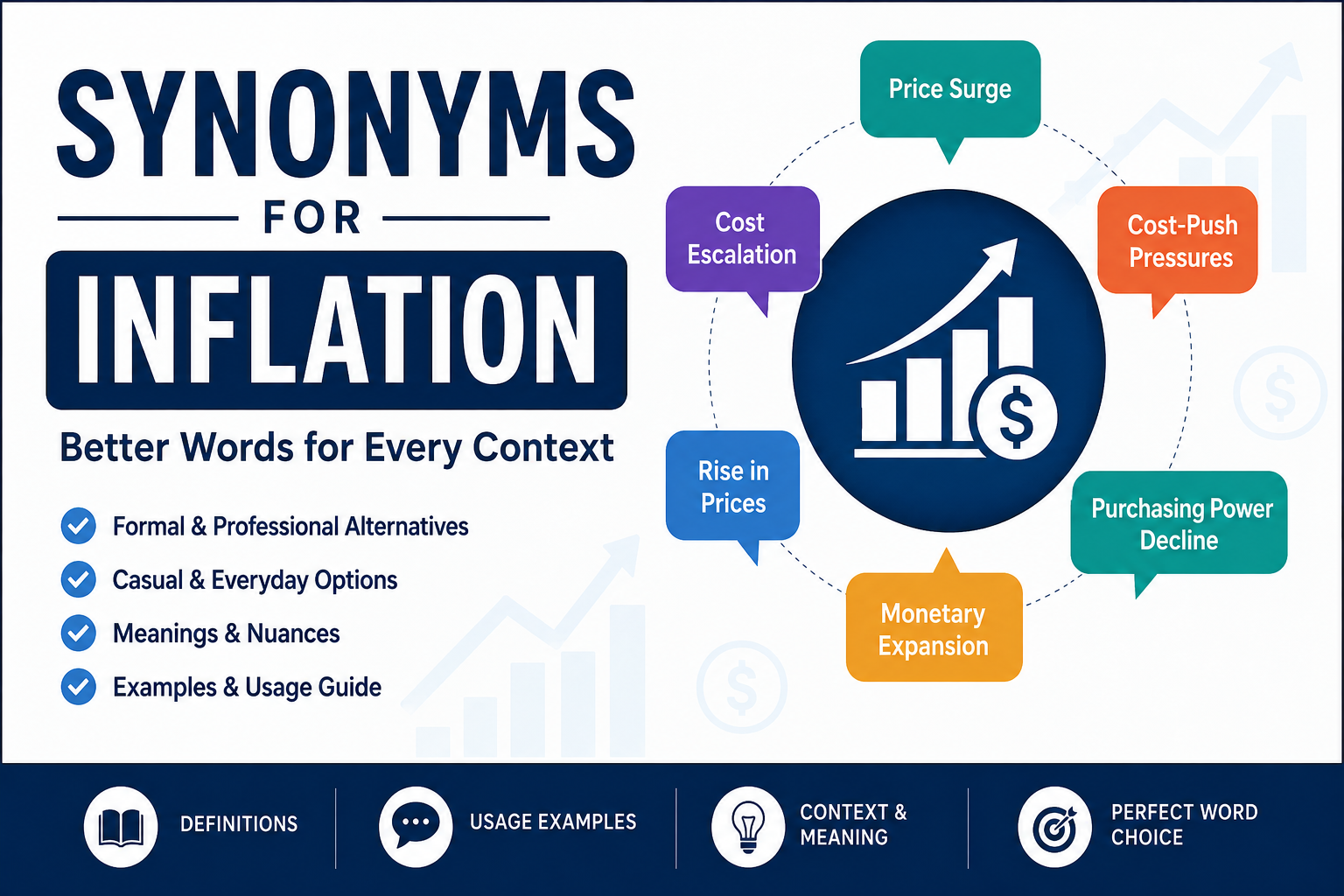
The best synonym for inflation depends on what you mean by the word. In economics, inflation refers to a sustained rise in the general price level, so terms such as rising prices, price increases, and inflationary pressure may work in particular contexts.
But inflation can also mean an increase in size, an exaggerated sense of self-importance, or an overstatement. In those contexts, words such as swelling, aggrandizement, exaggeration, and overstatement may be more appropriate.
The key is not to treat every thesaurus entry as interchangeable. A good alternative preserves the intended meaning, grammatical role, tone, and context.
Quick Answer
The closest synonym for inflation depends on the intended meaning. In an economic context, terms such as rising prices, price increases, and inflationary pressure work as useful contextual alternatives.
When inflation means exaggeration, consider overstatement, exaggeration, or magnification, while swelling, distension, and dilation may be appropriate when referring to physical enlargement. These terms are contextual alternatives rather than universal replacements for inflation.
What Does “Inflation” Mean?
Inflation is a noun with several established meanings.
In its economic sense, it describes a general increase in prices over time, which reduces the purchasing power of money. This is the meaning most commonly associated with economics and personal finance.
The word also has broader meanings. It can describe:
- an increase in size or volume
- physical swelling or distension
- exaggeration or overstatement
- an inflated sense of importance or self-worth
Major English thesauruses reflect these different senses rather than treating inflation as having one simple synonym. Cambridge, for example, groups related words under meanings including physical swelling, exaggeration, and fatness.
Pronunciation
US: /ɪnˈfleɪʃən/
UK: /ɪnˈfleɪʃən/
The Best Synonyms for Inflation
There is no single replacement that works in every sentence. The following table separates close alternatives from words that apply only in particular contexts.
| Word or phrase | Relationship | Strength | Formality | Best context |
|---|---|---|---|---|
| price increases | Contextual alternative | Neutral | Neutral | Economics, consumer prices |
| rising prices | Contextual alternative | Neutral | Neutral | Everyday and economic writing |
| inflationary pressure | Related economic term | Specific | Formal | Economics and policy |
| price rise | Contextual alternative | Neutral | Neutral | General economic discussion |
| exaggeration | Contextual alternative | Strong | Neutral | Statements, claims, descriptions |
| overstatement | Near synonym | Strong | Neutral/Formal | Writing, claims, reporting |
| magnification | Near synonym | Moderate | Formal | Exaggerating importance or scale |
| amplification | Contextual alternative | Moderate | Formal | Increasing or emphasizing something |
| embellishment | Contextual alternative | Moderate | Neutral | Stories, descriptions, accounts |
| hyperbole | Related rhetorical term | Strong | Formal/Academic | Deliberate exaggeration |
| swelling | Contextual alternative | Neutral | Neutral | Physical size or bodily changes |
| distension | Contextual alternative | Neutral | Technical | Physical expansion |
| dilation | Contextual alternative | Neutral | Technical | Expansion of an opening or structure |
| aggrandizement | Contextual alternative | Strong | Formal | Increasing status or importance |
| pretentiousness | Related word | Strong | Neutral/Formal | Excessive self-importance or affected behavior |
The distinction matters. Cambridge lists exaggeration, magnification, amplification, overstatement, and hyperbole under the exaggeration sense of inflation, while physical terms such as swelling, distention, and dilation belong to a different semantic field.
Synonyms for Inflation in Economics
When inflation refers to the economic increase in the general level of prices, many apparent synonyms are actually contextual alternatives rather than exact equivalents.
1. Rising prices
Meaning: Prices are increasing.
Best used for: General-audience writing and straightforward explanations.
Example:
Rising prices have made household budgeting more difficult.
This phrase is easy to understand, but it can be broader than the technical economic concept of inflation. A single product becoming more expensive is not necessarily inflation.
2. Price increases
Meaning: Increases in the prices of goods or services.
Best used for: Reports, business writing, and consumer-focused explanations.
Example:
The company attributed the higher costs to recent price increases.
Price increases describes the observable change but does not necessarily express the broader economic process represented by inflation.
3. Inflationary pressure
Meaning: Economic forces that tend to push prices upward.
Best used for: Economics, financial reporting, and policy discussions.
Example:
Higher energy costs could create additional inflationary pressure.
This is not a direct synonym for inflation. It describes a force or condition that can contribute to inflation.
4. Price rise
Meaning: An increase in price or prices.
Best used for: General and economic contexts.
Example:
Consumers are adjusting their spending after the latest price rise.
It is especially useful when discussing a particular price change rather than the entire economy.
Synonyms for Inflation Meaning Exaggeration
Inflation can also refer to making something appear larger, more important, or more significant than it really is.
In this sense, the strongest alternatives are different from economic vocabulary.
Exaggeration
Meaning: A statement or representation that makes something seem greater, more important, or more extreme than it really is.
Example:
Calling the minor delay a disaster was an exaggeration.
This is usually the clearest everyday alternative when inflation means making something seem greater than it actually is.
Overstatement
Meaning: A statement that presents something as more significant, serious, or impressive than it really is.
Example:
Saying the software completely transformed the industry would be an overstatement.
Overstatement is particularly natural in analytical, professional, and academic writing.
Magnification
Meaning: An increase in the apparent importance, size, or effect of something.
Example:
The report gave undue magnification to a relatively minor problem.
It is more formal and less conversational than exaggeration.
Embellishment
Meaning: Additional details that make a story or account more interesting, impressive, or elaborate, sometimes at the expense of strict accuracy.
Example:
His account contained some embellishment, but the main events were accurate.
Use embellishment when the exaggeration involves adding or enhancing details.
Hyperbole
Meaning: Deliberate and obvious exaggeration, often used for rhetorical or humorous effect.
Example:
Saying that the queue lasted forever is obvious hyperbole.
Hyperbole is not simply any exaggeration. It usually implies a rhetorical device or intentionally exaggerated expression.
Cambridge places hyperbole, overstatement, embellishment, magnification, and exaggeration within the relevant semantic group for this sense of inflation.
Inflation Meaning Physical Expansion
In older, technical, or literal contexts, inflation can refer to something becoming swollen or expanded.
Useful contextual alternatives include:
Swelling
The injury caused noticeable swelling around the joint.
Distension
The doctor noted abdominal distension.
Dilation
The medication can cause dilation of the blood vessels.
These words should not replace economic inflation. They belong to the physical-expansion sense.
Inflation Meaning Excessive Self-Importance
There is another figurative use in which inflation relates to an exaggerated sense of one’s own importance.
Depending on the sentence, useful alternatives may include:
- aggrandizement
- pretentiousness
- grandiosity
- self-importance
- vanity
- conceit
These are not interchangeable in every context.
For example:
The politician’s self-aggrandizement attracted criticism.
Here, self-aggrandizement emphasizes an attempt to increase one’s perceived importance or status.
By contrast:
His grandiosity made collaboration difficult.
Grandiosity emphasizes an exaggerated sense of importance or grandeur.
Merriam-Webster’s current thesaurus also associates inflation with words such as affectation, arrogance, pretense, pretension, and vanity for this figurative sense.
Closest Synonyms vs. Contextual Alternatives
One of the biggest mistakes with synonyms for inflation is assuming that every word in a thesaurus list can replace inflation.
Closest in economic contexts
There is no perfect one-word substitute for the technical economic sense. Depending on the sentence:
- rising prices — clear and accessible
- price increases — focuses on prices changing
- price rise — usually refers to a particular increase
- inflationary pressure — describes forces contributing to inflation
Closest for exaggeration
- exaggeration — broadest everyday choice
- overstatement — particularly useful in writing
- magnification — more formal
- embellishment — adding or enhancing details
- hyperbole — deliberate rhetorical exaggeration
Closest for physical expansion
- swelling
- distension
- dilation
These should be selected according to the physical process being described.
How Strong Are These Alternatives?
The following scale is an editorial guide rather than a scientific measurement.
| Word | Approximate intensity | Main nuance |
| rising prices | Neutral | Prices going upward |
| price increases | Neutral | Explicit price changes |
| exaggeration | Moderate–strong | Something represented as greater than reality |
| overstatement | Moderate–strong | An excessive claim |
| embellishment | Moderate | Added or enhanced details |
| magnification | Moderate | Importance or scale made larger |
| hyperbole | Strong | Deliberate rhetorical exaggeration |
| grandiosity | Strong | Excessive sense of importance |
| aggrandizement | Strong | Increasing perceived status or importance |
Which Word Should I Use?
Use rising prices when:
You want a simple, reader-friendly expression for increasing prices.
Rising prices are affecting household budgets.
Use price increases when:
You are focusing on specific changes in the prices of products or services.
The retailer announced price increases across several product categories.
Use exaggeration when:
Someone has represented something as more extreme or important than it really is.
The claim that the project was a complete failure was an exaggeration.
Use overstatement when:
You are evaluating a claim, statement, report, or piece of writing.
Calling the results revolutionary would be an overstatement.
Use embellishment when:
Someone has added details to make an account more impressive or interesting.
The story included some embellishment.
Use hyperbole when:
The exaggeration is clearly rhetorical, dramatic, humorous, or intentional.
“I’ve told you a million times” is a familiar example of hyperbole.
Inflation vs. Rising Prices
These expressions are closely related but not identical.
Inflation is the broader economic concept involving a sustained increase in the general price level.
Rising prices simply describes prices going up.
For example:
The price of coffee increased by 10%.
This is a price increase.
It does not, by itself, establish that the economy is experiencing inflation.
That distinction is important in professional, academic, and economic writing.
Inflation vs. Exaggeration
These two meanings should never be confused.
Inflation in the figurative sense can describe an increase or enlargement beyond what is appropriate or realistic.
Exaggeration directly refers to representing something as greater, more serious, or more impressive than it really is.
Compare:
The inflation of his achievements damaged his credibility.
The description of his achievements was an exaggeration.
The second sentence is more natural in ordinary modern English.
Natural Collocations with “Inflation”
Some common combinations are strongly associated with the economic sense:
- high inflation
- low inflation
- rising inflation
- falling inflation
- inflation rate
- inflation target
- inflation expectations
- inflation pressure
- inflationary pressure
- fight inflation
- control inflation
- reduce inflation
- inflation rises
- inflation falls
For example:
The central bank is closely monitoring inflation expectations.
In technical economic writing, replacing inflation with a loosely related word can make a sentence less precise. Sometimes keeping inflation is simply the best choice.
Common Mistakes
Mistake 1: Treating “price increase” as a perfect synonym
A price increase can concern one product, service, or category. Inflation is a broader economic phenomenon.
Better: Use price increase for a specific change and inflation for the broader economic concept.
Mistake 2: Using “hyperbole” for every exaggeration
Hyperbole usually suggests deliberate rhetorical exaggeration.
Better: Use exaggeration as the general term.
Mistake 3: Using “inflation” and “exaggeration” interchangeably
They overlap in one figurative sense but are not universally interchangeable.
Mistake 4: Using technical words simply to sound formal
Words such as distension, dilation, and aggrandizement have specific meanings.
Better: Choose the word that expresses the intended concept rather than the word that sounds most sophisticated.
Mistake 5: Calling every thesaurus entry a true synonym
Thesauruses often group words by semantic relationship. That does not mean every listed word can substitute naturally for the target word.
This is particularly important with inflation, which has several distinct senses. Cambridge’s thesaurus separates its entries according to meanings rather than presenting one undifferentiated list.
Real-World Examples
Economics
Persistent inflation has reduced consumers’ purchasing power.
Business
The company introduced price increases after production costs rose.
Everyday conversation
Rising prices are making groceries more expensive.
Professional writing
Describing the policy as an immediate solution would be an overstatement.
Creative writing
The hero’s reputation grew through years of embellishment.
Rhetorical language
“The best restaurant in the entire universe” is clearly hyperbole.
Physical description
The medication caused mild swelling.
Antonyms of Inflation
The appropriate antonym depends on the sense.
For economic inflation, related opposites include:
- deflation
- falling prices
- price decreases
For exaggeration, useful opposites include:
- understatement
- restraint
- moderation
Cambridge specifically lists restraint, underplaying, and understatement as antonymic concepts for the exaggeration sense.
Frequently Asked Questions
What is another word for inflation?
For the economic sense, rising prices or price increases may work in appropriate contexts. For the figurative sense of exaggeration, exaggeration and overstatement are stronger alternatives.
What is the closest synonym for inflation in economics?
There is no exact everyday replacement for the technical economic meaning. Rising prices is often the clearest accessible alternative, while inflationary pressure describes a related but different concept.
What is another word for rising prices?
Depending on context, you can use price increases, price rises, or increasing prices. In economic writing, inflation may be appropriate when referring to a broader general increase in prices.
What is a synonym for inflation meaning exaggeration?
Exaggeration is the most straightforward choice. Overstatement, magnification, embellishment, and hyperbole can be appropriate when their specific nuances fit.
Is “price increase” the same as “inflation”?
No. A price increase can refer to one item or category, whereas inflation refers to a broader sustained increase in the general price level.
What is a formal synonym for inflation?
There is no single formal synonym that works universally. In economic writing, terms such as inflationary pressure can be useful when that specific meaning is intended. For figurative exaggeration, overstatement or magnification may be suitable.
What is the strongest synonym for inflation?
There is no universally “strongest” synonym because inflation has multiple meanings. For exaggeration, hyperbole can indicate deliberate and extreme rhetorical exaggeration, while overstatement is usually more neutral.
What is the opposite of inflation?
For economics, deflation is the most relevant contrasting economic term. For exaggeration, understatement is a useful opposite.
Conclusion
The best synonym for inflation depends on its sense. In economics, rising prices and price increases are useful contextual alternatives, although neither is a perfect technical substitute. When inflation means exaggeration, exaggeration, overstatement, embellishment, and hyperbole offer more precise choices. For physical expansion, swelling, distension, and dilation may fit.

Our editorial team is dedicated to making English vocabulary easier to understand and use correctly. We research and review synonyms, antonyms, definitions, word usage, and example sentences to ensure our content is clear, accurate, practical, and useful for students, writers, professionals, and English learners.