Synonyms for Alliteration: Better Alternatives With Examples
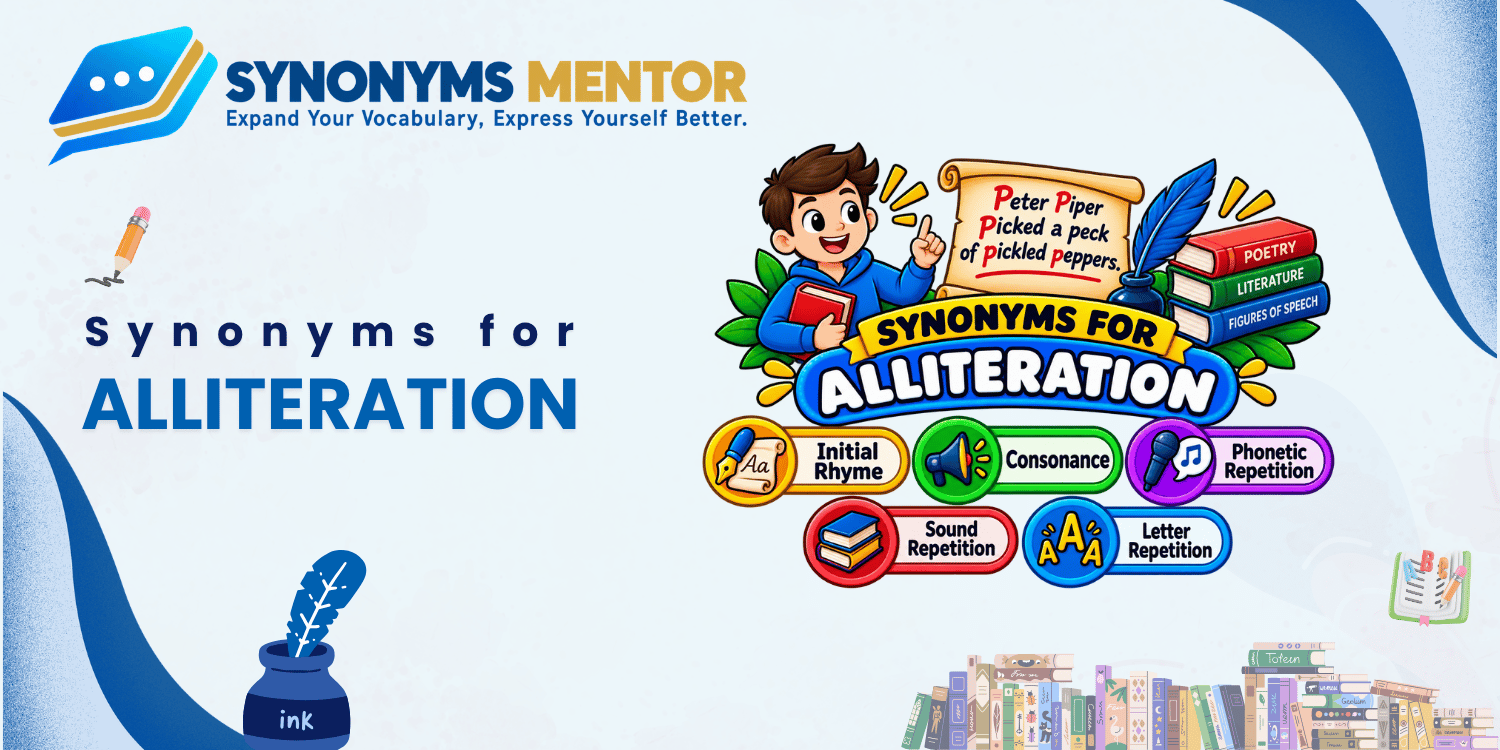
Finding a true synonym for alliteration is more difficult than it may seem. Unlike everyday words with many interchangeable alternatives, alliteration names a specific literary and phonological device: the repetition of the same initial consonant sound, or sometimes initial sound more broadly, in nearby words or stressed syllables.
The closest established alternatives are initial rhyme and head rhyme. Other terms such as assonance, consonance, and rhyme are related sound devices, but they should not normally be presented as exact synonyms.
Understanding these distinctions is especially useful when writing about poetry, rhetoric, advertising, literary analysis, or language.
Quick Answer
The closest synonyms for alliteration are initial rhyme and head rhyme. Both refer to the repetition of initial sounds in nearby words. Terms such as assonance, consonance, and rhyme are related but have different meanings, so they are not interchangeable with alliteration in precise literary or linguistic writing.
Core Synonyms for Alliteration
| Word | Relationship | Meaning | Strength | Formality | Best Context |
|---|---|---|---|---|---|
| Initial rhyme | Direct alternative | Repetition of initial sounds in nearby words | Same | Literary/technical | Poetry, literary analysis |
| Head rhyme | Direct alternative | Another term for repeated initial sounds | Same | Literary/technical | Poetry and rhetoric |
| Sound repetition | Descriptive alternative | Repetition of sounds for an effect | Broader | Neutral | General explanation |
| Initial sound repetition | Descriptive alternative | Repeated sounds at the beginnings of words | Broader but precise | Neutral–academic | Teaching and explanation |
| Consonance | Related term | Repetition of consonant sounds, not necessarily initially | Different | Literary/technical | Poetry, phonology |
| Assonance | Related term | Repetition of vowel sounds | Different | Literary/technical | Poetry, literary analysis |
| Rhyme | Related term | Correspondence of sounds, usually at word endings | Different | Neutral–literary | Poetry and verse |
| Repetition | Related term | Reuse of words, sounds, or structures | Much broader | Neutral | General writing |
| Onomatopoeia | Related term | Words that imitate or suggest natural sounds | Different | Literary/technical | Creative writing |
The first two entries are the important ones. Initial rhyme and head rhyme are alternative labels for alliteration, whereas the other terms describe broader or different sound relationships. Merriam-Webster specifically identifies head rhyme and initial rhyme as alternative names for alliteration.
What Does “Alliteration” Mean?
Alliteration is the use of the same sound or sounds at the beginning of several nearby words. It is especially common in poetry, slogans, headlines, speeches, names, and other forms of creative or persuasive language. Cambridge describes it as the use of the same sounds, especially consonants, at the beginnings of words that are close together.
For example:
Wild winds whistle through the trees.
The repeated initial w sound creates alliteration.
Another example is:
Bright blue birds crossed the sky.
The repeated b sound creates an obvious alliterative pattern.
Oxford similarly defines alliteration as using the same letter or sound at the beginning of nearby words.
The Closest Synonyms for Alliteration
Initial Rhyme
Initial rhyme is the closest direct alternative to alliteration. Merriam-Webster lists it as another name for the device.
The term highlights the fact that the repeated sound occurs at the beginning of words.
Example:
Silver snakes slide silently.
You could describe the repeated initial sounds as alliteration or, in terminology that recognizes the same device, initial rhyme.
Best context: literary analysis, poetry, rhetoric, and explanations of sound patterns.
Head Rhyme
Head rhyme is another established term for alliteration. Like initial rhyme, it emphasizes the beginning or “head” of words.
Example:
Peter picked purple peppers.
The repeated initial p sound creates the alliterative pattern.
Merriam-Webster explicitly gives head rhyme and initial rhyme as alternative names for alliteration.
Best context: traditional literary terminology and discussions of poetry or verse.
Sound Repetition
Sound repetition can explain what alliteration does, but it is not a precise dictionary synonym.
It is a useful phrase when explaining the concept to beginners:
The poet uses sound repetition to make the line more memorable.
However, sound repetition could refer to alliteration, assonance, consonance, rhyme, or other patterns. It is therefore broader than alliteration.
Best context: general explanations and educational writing.
Initial Sound Repetition
Initial sound repetition is a descriptive phrase that captures the central mechanism of alliteration.
The slogan uses initial sound repetition to create a memorable rhythm.
It is clearer than many supposed synonyms because it tells the reader exactly what is being repeated and where.
However, it is a description rather than a conventional synonym.
Best context: ESL instruction, classroom explanations, and introductory literary analysis.
Related Terms That Are Not Exact Synonyms
A major source of confusion is that several literary devices involve repeated sounds. They are related to alliteration, but they describe different patterns.
Consonance
Consonance refers to the repetition of consonant sounds. Unlike alliteration, the repeated consonants do not have to occur at the beginning of words.
For example, repeated consonant sounds can occur within or at the ends of words.
So:
Alliteration → focuses on repeated initial sounds.
Consonance → focuses more broadly on repeated consonant sounds.
Calling consonance a synonym for alliteration therefore loses an important distinction.
Assonance
Assonance involves repeated vowel sounds.
For example:
The mellow bells echoed.
The repeated vowel sounds may create an assonant effect.
Assonance and alliteration are both sound devices, but they focus on different types of repetition. Cambridge explicitly presents assonance as a related literary term when defining alliteration.
Alliteration: repeated initial sounds, especially consonants.
Assonance: repeated vowel sounds.
Rhyme
Rhyme is another related concept, but it is not equivalent to alliteration.
Traditional rhyme often involves corresponding sounds toward the ends of words or lines.
For example:
light / night
The matching ending sounds create rhyme.
Alliteration instead works primarily at the beginning of nearby words.
This is why initial rhyme can function as an alternative label for alliteration while ordinary rhyme cannot.
Repetition
Repetition is much broader than alliteration.
A writer can repeat:
- a word
- a phrase
- a sentence structure
- a sound
- an idea
- a grammatical pattern
Alliteration is one specific kind of sound-based repetition.
Therefore, saying “alliteration is repetition” is accurate at a broad conceptual level, but repetition is not a precise synonym for alliteration.
Onomatopoeia
Onomatopoeia is the use of words whose sounds imitate or resemble the noises they describe. Oxford treats it as a separate literary and linguistic concept.
Words such as hiss, buzz, or clang can be examples of onomatopoeia.
That has a completely different mechanism from alliteration.
Alliteration: repeated sounds between words.
Onomatopoeia: a word imitates or suggests a sound.
Which Word Should I Use?
Because alliteration is already a precise technical term, the best replacement depends on why you are avoiding the original word.
Choose “initial rhyme” when:
You need a recognized alternative that emphasizes repeated sounds at the beginnings of words.
The poet uses initial rhyme throughout the passage.
Choose “head rhyme” when:
You are discussing traditional poetic terminology and want to emphasize the initial position of the repeated sounds.
The verse relies heavily on head rhyme.
Choose “initial sound repetition” when:
You are explaining the concept to learners rather than using formal literary terminology.
The phrase contains initial sound repetition.
Keep “alliteration” when:
You are writing formal literary analysis, academic work, or a precise explanation of the device.
It is the clearest and most widely recognizable technical term for the concept.
Do not use “assonance” when:
You specifically mean repeated initial consonant sounds. Assonance concerns vowel-sound repetition and therefore changes the meaning.
Do not use “consonance” when:
You specifically mean repetition at the beginning of nearby words. Consonance is broader because consonant repetition can occur in other positions.
Alliteration vs. Initial Rhyme
These two terms are the closest match.
| Alliteration | Initial Rhyme |
|---|---|
| Standard modern term | Alternative literary term |
| Repetition of initial sounds | Repetition of initial sounds |
| Common in general writing about language | More specialized |
| Widely understood | Less common for general readers |
If your audience is general, alliteration is usually the safest term. If you are discussing poetic terminology or deliberately varying your wording, initial rhyme can be useful.
Alliteration vs. Head Rhyme
The distinction is mainly one of terminology rather than meaning.
Alliteration is the standard term most readers will recognize.
Head rhyme is an alternative name that focuses on the beginning or “head” of the words.
Merriam-Webster identifies both head rhyme and initial rhyme as alternative names for alliteration.
Alliteration vs. Assonance
These should not be treated as synonyms.
| Alliteration | Assonance |
|---|---|
| Repetition of initial sounds | Repetition of vowel sounds |
| Often consonants | Vowels are central |
| Common in slogans and poetry | Common in poetry and prose |
| Can create rhythm and emphasis | Can create musicality and cohesion |
A poem can use both alliteration and assonance at the same time.
Alliteration vs. Consonance
The key difference is where the repeated consonant sounds occur.
Alliteration traditionally emphasizes the beginnings of nearby words or stressed syllables. Consonance can occur in other positions.
So a passage can contain consonance without containing alliteration.
Alliteration vs. Rhyme
Rhyme generally concerns corresponding sounds, often near the ends of words or lines, while alliteration focuses on repeated initial sounds.
Poetry can use both:
Wild winds swept through the night.
The first two words demonstrate alliteration, while a different pattern elsewhere in a poem could create rhyme.
Common Collocations With Alliteration
These phrases are natural and useful for vocabulary learners:
- use alliteration
- employ alliteration
- create alliteration
- contain alliteration
- feature alliteration
- heavy alliteration
- repeated alliteration
- deliberate alliteration
- strong alliteration
- alliterative phrase
- alliterative expression
- alliterative verse
- alliterative poetry
- alliterative slogan
- alliterative headline
- alliterative name
- alliterative effect
- alliterative pattern
- alliterative style
Oxford lists alliterative as an adjective and gives alliterative verse as a collocation.
Common Mistakes
Mistake 1: Calling assonance a synonym for alliteration
Both involve sound patterns, but assonance specifically concerns repeated vowel sounds.
Mistake 2: Calling consonance an exact synonym
Consonance involves repeated consonant sounds more generally. It does not require the repetition to occur initially.
Mistake 3: Treating rhyme as the same thing
Rhyme and alliteration create different sound relationships.
Mistake 4: Assuming every repeated sound is alliteration
The location and type of the repeated sound matter. Alliteration traditionally involves initial sounds in nearby words.
Mistake 5: Using “initial rhyme” as though it were the only common term
Initial rhyme is a legitimate alternative, but alliteration remains the standard and more familiar term for most modern readers.
Mistake 6: Confusing the sound with the letter
Alliteration is fundamentally about sound, although spelling can sometimes make the pattern easier to see. Words beginning with different letters can potentially alliterate if their initial sounds match.
Pronunciation
Alliteration is pronounced:
- US: /əˌlɪt̬.əˈreɪ.ʃən/
- UK: /əˌlɪt.əˈreɪ.ʃən/
Cambridge gives these pronunciations and defines the word as a specialized literary noun.
The related adjective alliterative means using the same sound or sounds at the beginning of several nearby words.
Etymology of Alliteration
Alliteration entered English in the early 17th century. Oxford traces it to Medieval Latin alliteratio, ultimately involving Latin littera, meaning “letter.”
The modern concept, however, is concerned with sound as well as written letters, which explains why spelling alone is not a reliable test for alliteration.
Frequently Asked Questions
What is another word for alliteration?
The closest established alternatives are initial rhyme and head rhyme. Both refer to the repetition of initial sounds in nearby words. Merriam-Webster specifically lists these as alternative names for alliteration.
Is “initial rhyme” a synonym for alliteration?
Yes. Initial rhyme is an established alternative term for alliteration. It emphasizes that the repeated sound occurs at the beginning of words rather than at the ends, as in conventional rhyme.
Is “head rhyme” another name for alliteration?
Yes. Head rhyme is another established name for alliteration. It refers to the repetition of initial sounds in neighboring words or syllables.
Is assonance a synonym for alliteration?
No. Assonance is a related sound device involving repeated vowel sounds. Alliteration focuses primarily on repeated initial sounds, especially consonants. Cambridge distinguishes assonance from alliteration.
Is consonance the same as alliteration?
No. Consonance involves repetition of consonant sounds, but those sounds do not necessarily occur at the beginnings of words. Alliteration is more specifically associated with repeated initial sounds.
What is the difference between alliteration and rhyme?
Alliteration repeats initial sounds in nearby words, while rhyme usually involves matching or similar sounds toward the ends of words or lines. They are separate poetic devices and can appear together.
Can alliteration use vowel sounds?
Yes. Alliteration is often taught using repeated initial consonants, but broader definitions recognize repeated initial sounds, and Collins distinguishes consonantal and vocalic forms of alliteration.
Conclusion
The best synonyms for alliteration are initial rhyme and head rhyme. These are genuine alternative terms, whereas assonance, consonance, rhyme, and repetition describe related but different concepts.

James Anderson is an English teacher and language researcher who creates easy synonym guides and vocabulary lessons. His goal is to help students and writers improve their language skills through simple and clear explanations.