Synonyms of Discern: Better Alternatives With Examples
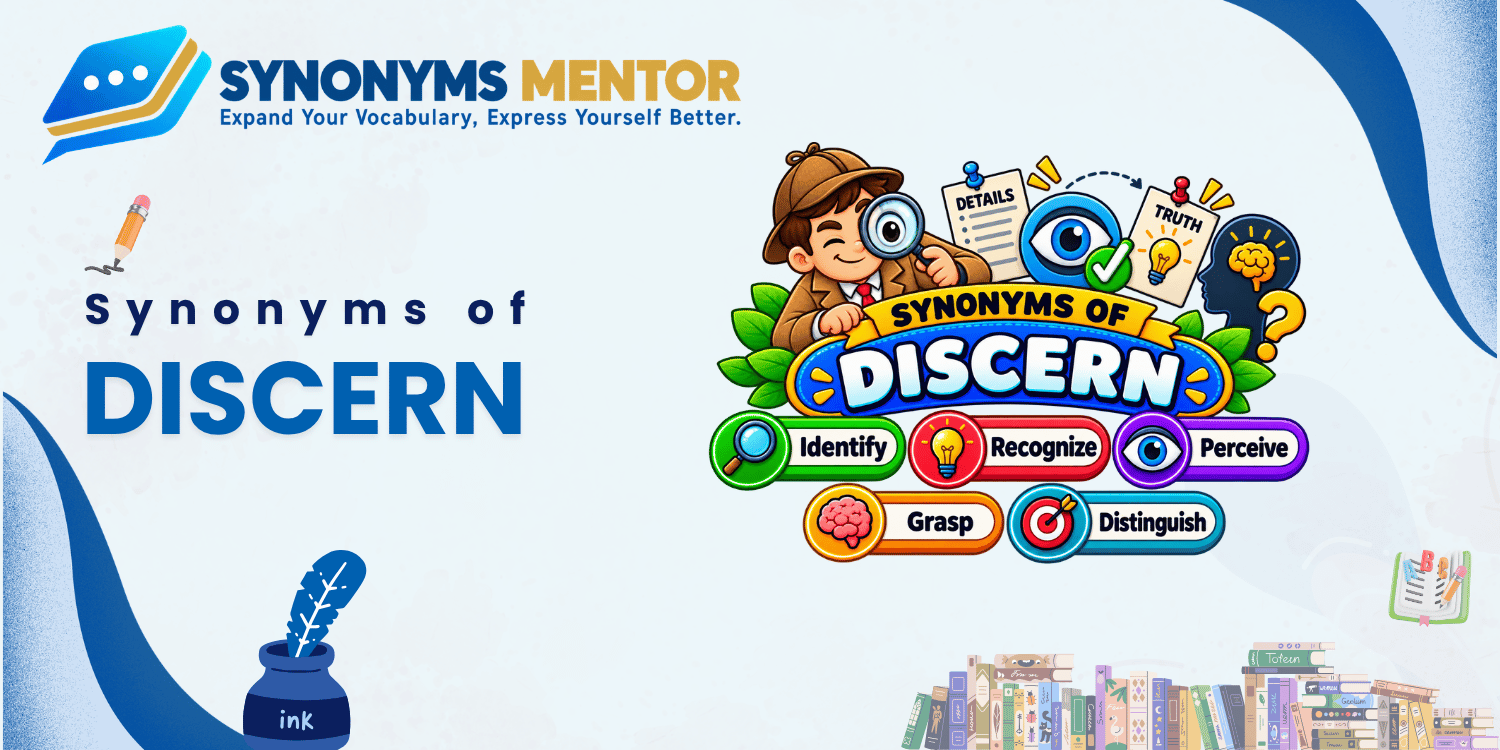
Finding the right synonym for discern depends on what you mean by it. You might discern a hidden pattern, discern a difference between two ideas, or barely discern a figure in the distance. Words such as detect, perceive, distinguish, recognize, notice, identify, and make out overlap with discern, but they are not interchangeable in every sentence.
Some emphasize careful recognition, some focus on sensory perception, and others highlight the ability to tell things apart. This guide explains the most useful synonyms of discern and shows when each one sounds natural.
Quick Answer
The closest synonyms of discern include detect, perceive, distinguish, recognize, identify, notice, and make out. The best choice depends on context: use detect for something discovered through careful observation, distinguish for recognizing a difference, perceive for becoming aware of something, and make out when something is difficult to see or hear.
Discern itself is formal and often suggests recognizing something that is not immediately obvious.
Core Synonyms of Discern
| Word | Relationship | Meaning | Strength | Formality | Best Context |
|---|---|---|---|---|---|
| Detect | Near synonym | Discover or notice something, especially something not obvious | Similar | Neutral | Problems, changes, patterns, signals |
| Perceive | Near synonym | Become aware of something through the senses or mind | Similar | Neutral–formal | Changes, attitudes, qualities |
| Distinguish | Near synonym | Recognize a difference between things | Similar | Neutral–formal | Differences, categories, sounds |
| Recognize | Near synonym | Identify or understand something as familiar or known | Similar | Neutral | People, facts, patterns, qualities |
| Notice | Contextual alternative | Become aware of something | Usually weaker | Neutral | Everyday observations |
| Identify | Contextual alternative | Establish exactly what something or someone is | More specific | Neutral | Objects, causes, people, problems |
| Differentiate | Contextual alternative | Recognize or establish differences | More analytical | Formal | Categories, products, concepts |
| Make out | Contextual alternative | See, hear, or understand something with difficulty | Similar in perception contexts | Informal–neutral | Faint sights, sounds, unclear words |
| Pick out | Contextual alternative | Select or recognize something from a group | More specific | Informal–neutral | Objects, people, details |
| Ascertain | Contextual alternative | Find out something with certainty | Stronger/more deliberate | Formal | Facts, causes, information |
| Observe | Related/near synonym | Watch or notice carefully | Different emphasis | Neutral–formal | Behavior, events, changes |
| Understand | Contextual alternative | Grasp the meaning or significance of something | Broader | Neutral | Ideas, meanings, implications |
Cambridge and Collins both list several of these words among alternatives related to discern, including detect, make out, perceive, distinguish, notice, pick out, ascertain, determine, and differentiate. Their groupings also show why no single synonym works equally well in every context.
What Does “Discern” Mean?
Discern is a formal verb meaning to recognize, perceive, or understand something, especially when it is not obvious. It can also mean to see or hear something when perception is difficult. Oxford gives these two major senses and notes that the verb is formal.
For example:
The analyst could discern a pattern in the data.
Here, discern means that the analyst recognized a pattern that was not immediately obvious.
It can also describe difficult physical perception:
We could barely discern the outline of the mountain through the fog.
In this sentence, discern means to see something, but not very clearly.
The word can also involve recognizing differences:
She could discern a subtle difference between the two designs.
This makes distinguish a particularly useful alternative when the focus is on separating one thing from another.
The Best Synonyms of Discern, Explained
1. Detect
Detect is one of the closest alternatives when discern means to discover something that is not immediately obvious.
The technician detected a problem with the machine.
Like discern, detect often suggests that careful observation, analysis, or sensitivity is required.
However, detect is especially common for problems, changes, signals, symptoms, patterns, or hidden conditions.
Best for: problems, changes, errors, signals, patterns, hidden features.
Compare:
The researcher discerned a pattern in the results.
The researcher detected a pattern in the results.
Both are natural. Discerned sounds somewhat more formal and can emphasize recognition or interpretation, while detected emphasizes discovery.
Oxford explicitly identifies detect as a synonym for the recognition sense of discern.
2. Perceive
Perceive means to become aware of something through the senses or through mental awareness.
She perceived a change in his attitude.
This is a strong alternative when discern refers to noticing a subtle quality, change, feeling, or situation.
Perceive can sound more analytical or formal than notice.
I noticed a change in his tone.
I perceived a change in his tone.
The first is ordinary everyday English. The second sounds more deliberate and analytical.
Best for: attitudes, changes, qualities, sensations, impressions, situations.
3. Distinguish
Use distinguish when discern means to recognize a difference between two or more things.
It was difficult to discern the difference between the two materials.
It was difficult to distinguish between the two materials.
Here, distinguish is arguably the more direct choice because the sentence is explicitly about telling things apart.
Best for: differences, categories, sounds, colors, types, similar objects.
A useful pattern is:
- distinguish A from B
- distinguish between A and B
Collins specifically groups distinguish with discern when the meaning involves recognizing or perceiving differences.
4. Recognize
Recognize means to identify something as familiar, known, or having a particular quality.
She recognized the signs of a serious problem.
This overlaps with discern, but recognize often implies that the person identifies something based on previous knowledge or familiarity.
Compare:
The doctor discerned a subtle change in the patient’s condition.
The doctor recognized the symptoms of the condition.
The first emphasizes noticing a subtle change. The second emphasizes identifying something based on knowledge.
Best for: people, signs, patterns, symptoms, facts, familiar qualities.
5. Notice
Notice is a simpler and more conversational alternative.
Did you notice the change in the schedule?
It means becoming aware of something, but it does not necessarily carry the same implication of subtle perception or careful recognition that discern can have.
Compare:
She noticed a small crack in the wall.
She discerned a small crack in the wall.
The first is much more natural in ordinary conversation. The second sounds more deliberate and formal.
Best for: everyday observations, visible changes, details, events.
6. Identify
Identify is useful when the intended meaning is to determine exactly what something is.
The scientists discerned the source of the contamination.
The scientists identified the source of the contamination.
The second sentence is more direct if the researchers successfully established the source.
Best for: people, objects, causes, sources, problems, locations, patterns.
Identify is more specific than discern, so it should not replace it in every context.
7. Differentiate
Differentiate is a formal, analytical choice when the focus is on recognizing differences.
The software can differentiate between genuine and altered images.
It works particularly well in technical, academic, scientific, and professional writing.
Best for: categories, products, concepts, characteristics, competing alternatives.
Use distinguish in general writing when you want a more natural and familiar word. Use differentiate when the analytical idea of separating or establishing differences is important.
8. Make Out
Make out is particularly useful for the sensory meaning of discern: seeing, hearing, or understanding something with difficulty.
We could barely discern the words on the old sign.
We could barely make out the words on the old sign.
The second sentence sounds more natural in everyday English.
Oxford specifically connects discern with make out when something can be seen or heard, but not clearly.
Best for: faint shapes, distant objects, quiet sounds, unclear speech, difficult-to-read text.
9. Pick Out
Pick out means to recognize or select something from among other things.
Can you discern the correct symbol in the image?
Can you pick out the correct symbol in the image?
The second is more conversational.
Best for: people, objects, details, symbols, choices within a group.
10. Ascertain
Ascertain means to find out or establish something with certainty. It is more formal and deliberate than discern.
Investigators tried to discern the cause of the failure.
Investigators tried to ascertain the cause of the failure.
The second suggests a stronger effort to establish the actual facts.
Best for: facts, causes, circumstances, details, responsibility.
Do not use ascertain simply because you want a more sophisticated-sounding synonym. In ordinary sentences, find out or determine may sound more natural.
Discern by Context
One of the easiest ways to choose the right synonym is to identify what you are actually doing.
When You Mean “Notice Something Subtle”
Choose detect, perceive, or notice.
The manager discerned a change in employee morale.
Possible alternatives:
- The manager detected a change in employee morale.
- The manager perceived a change in employee morale.
- The manager noticed a change in employee morale.
Detect sounds investigative.
Perceive sounds analytical.
Notice is the simplest everyday option.
When You Mean “Tell Things Apart”
Choose distinguish or differentiate.
The expert could discern the difference between the original and the copy.
More natural alternatives:
The expert could distinguish the original from the copy.
The expert could differentiate between the original and the copy.
Distinguish is generally the safest choice for everyday and professional English.
When You Mean “See Something Unclear”
Choose make out, perceive, or sometimes spot.
We could barely discern a figure in the distance.
We could barely make out a figure in the distance.
Here, make out is especially natural because the object is difficult to see.
When You Mean “Understand Something Hidden”
Choose understand, recognize, detect, or decipher, depending on what is being understood.
She eventually discerned the meaning behind his remarks.
Possible alternatives:
She eventually understood the meaning behind his remarks.
She eventually recognized the significance of his remarks.
She eventually deciphered the meaning of his remarks.
Decipher is particularly appropriate when something is difficult to interpret, such as coded language or obscure writing.
Which Word Should I Use?
Choose “discern” when:
You want a formal word for recognizing, perceiving, or understanding something that is subtle or not immediately obvious.
Choose “detect” when:
You are discovering a hidden problem, change, signal, pattern, or condition.
Choose “distinguish” when:
You need to emphasize a difference between similar things.
Choose “perceive” when:
You want to emphasize awareness of a quality, change, attitude, or impression.
Choose “recognize” when:
You are identifying something as known, familiar, or significant.
Choose “notice” when:
You want a straightforward everyday word.
Choose “make out” when:
Something is difficult to see, hear, read, or understand.
Choose “identify” when:
You need to establish exactly what something or someone is.
Choose “differentiate” when:
You are discussing distinctions in an analytical, technical, or professional context.
Choose “ascertain” when:
You are deliberately trying to establish something with certainty.
Discern vs. Distinguish
These words overlap strongly, but they are not identical.
Discern is broader. It can mean becoming aware of something subtle or recognizing something that is not obvious.
Distinguish focuses more specifically on telling things apart.
| Discern | Distinguish |
|---|---|
| Recognize something subtle | Recognize a difference |
| Notice or perceive | Tell things apart |
| Understand something not obvious | Separate similar things |
| Can involve sensory or mental perception | Often involves comparison |
Examples:
The analyst discerned a trend in the data.
The analyst distinguished between two types of trends.
The first focuses on recognizing the trend. The second focuses on separating one category from another.
Discern vs. Detect
Detect is one of the closest synonyms of discern, especially when something is hidden or subtle.
We could discern a slight change in temperature.
We could detect a slight change in temperature.
Both work well. However, detect often has a stronger association with discovering something through observation, measurement, testing, or investigation.
Use discern when the emphasis is on recognition or perception. Use detect when the emphasis is on discovery.
Discern vs. Perceive
Perceive emphasizes becoming aware of something through the senses or the mind.
She perceived tension in the room.
Discern can convey a similar idea:
She discerned tension in the room.
But discern often suggests that the quality is subtle or not immediately obvious.
Perceive is therefore broader, while discern can carry a stronger sense of careful recognition.
Discern vs. Notice
Notice is much more common in everyday conversation.
I noticed a strange sound.
I discerned a strange sound.
The first is natural and ordinary. The second sounds formal and deliberate.
This makes notice a good replacement when you want simpler language, but not necessarily when you want to preserve the formal nuance of discern.
Discern vs. Recognize
Recognize often means identifying something familiar or understanding what something represents.
She recognized the voice immediately.
Discern can instead emphasize detecting or perceiving something subtle:
She discerned uncertainty in his voice.
The distinction is important: recognize often answers “What is this?” while discern can answer “What subtle thing can I perceive or understand here?”
Common Collocations With “Discern”
Some combinations occur naturally in formal, academic, and professional English.
Common Uses of Discern
Discern a pattern:
Researchers were able to discern a pattern in the results.
Identifying a difference:
It was difficult to discern a difference between the two versions.
Noticing a change:
The team could discern a gradual change in customer behavior.
Recognizing a trend:
Analysts discerned a long-term trend in the data.
Making out a shape:
We could barely discern the shape of the building.
Seeing a figure:
A figure could be discerned through the mist.
Understanding the meaning:
Readers may need additional context to discern the meaning of the passage.
Determining the cause:
Investigators struggled to discern the cause of the failure.
Understanding someone’s intentions:
It was difficult to discern his true intentions.
These patterns reflect the two major sides of discern: perceiving something and recognizing or understanding something that is not immediately obvious. Collins gives examples involving discerning a pattern and recognizing or perceiving something clearly.
Common Mistakes With Discern Synonyms
Using “distinguish” when there is no comparison
Distinguish is especially useful when you are telling one thing apart from another.
Less natural:
She distinguished a change in his behavior.
Better:
She discerned a change in his behavior.
But:
She distinguished between the two types of behavior.
Here, distinguish is exactly right.
Using “notice” when a formal tone is required
Notice is perfectly correct, but it can lose the formal nuance of discern.
The researchers noticed a subtle pattern.
This is grammatical and natural, but:
The researchers discerned a subtle pattern.
sounds more formal and emphasizes recognition of something not immediately obvious.
Treating “detect” and “discern” as identical
They overlap, but detect often suggests finding or discovering something, while discern can emphasize recognizing or understanding it.
Using “make out” in formal academic writing
Make out is natural in conversation:
I could barely make out the sign.
For formal writing, discern is usually a better choice:
The researchers could barely discern the markings.
Confusing “discern” with “decide”
Discern can involve judgment or understanding, but it does not simply mean make a decision.
The committee discerned a significant difference.
does not mean:
The committee decided to make a significant difference.
The words belong to different semantic categories.
Related Words: Not Exact Synonyms
Some words are associated with discern but should not automatically be presented as synonyms.
- Analyze — examine something systematically.
- Examine — inspect something carefully.
- Study — look at something closely to learn about it.
- Judge — form an opinion or evaluation.
- Interpret — explain the meaning of something.
- Decipher — work out the meaning of something difficult to understand.
- Infer — reach a conclusion from evidence rather than directly perceive it.
These can overlap with discern in particular sentences, but each has a different core meaning.
Antonyms of Discern
The appropriate opposite depends on the sense being used.
When recognizing or perceiving something is the intended meaning, useful opposites include:
- miss
- overlook
- ignore
- fail to notice
- fail to recognize
When the idea involves telling things apart, consider these alternatives:
- confuse
- mix up
- mistake
- lump together
For example:
The subtle difference was difficult to discern.
Opposite idea:
The two features were easily confused.
Pronunciation and Word Origin
Discern is pronounced:
- US: /dɪˈsɝːn/
- UK: /dɪˈsɜːn/
Oxford lists the word as a formal verb and traces it to Late Middle English, through Old French from Latin discernere, meaning to separate or distinguish.
Its history helps explain why the modern word can refer both to recognizing something and to telling things apart.
Frequently Asked Questions
What is the closest synonym for “discern”?
There is no single perfect synonym for every use. Detect is one of the closest alternatives when discern means discovering something subtle. Distinguish is closer when the meaning is telling two things apart, while make out is especially close when something is difficult to see or hear.
Is “discern” a formal word?
Yes. Major learner dictionaries such as Oxford and Collins mark discern as formal. It is common in academic, professional, literary, and analytical writing but is less common than notice or see in casual conversation.
Is “distinguish” a synonym for “discern”?
Yes, in contexts involving recognizing or perceiving differences. For example, discern the difference and distinguish between the two can express closely related ideas. However, distinguish specifically emphasizes telling things apart, while discern has broader uses.
Is “detect” the same as “discern”?
They are close synonyms in many contexts, particularly when something subtle or hidden is being discovered. Detect tends to emphasize finding or discovering something, while discern can emphasize recognizing, perceiving, or understanding it.
What is a simple synonym for “discern”?
Notice, see, and recognize are simple alternatives, depending on the sentence. For something that is difficult to see or hear, make out is especially natural. Collins lists see, perceive, make out, and notice among alternatives for the sensory sense of discern.
What is a synonym for “discern a difference”?
The best alternatives are distinguish, differentiate, and tell apart.
It was difficult to discern the difference.
can become:
It was difficult to distinguish between the two.
or:
It was difficult to tell the two apart.
Distinguish is usually the strongest general-purpose choice.
What is a synonym for “discern a pattern”?
Depending on the context, you can use detect, identify, recognize, or notice.
Researchers discerned a pattern in the data.
Researchers detected a pattern in the data.
Detect is particularly natural in analytical or research contexts, while discern gives the sentence a more formal tone.
Conclusion
The best synonym for discern depends on the exact kind of recognition you want to express. Choose detect for discovering something subtle, distinguish for telling things apart, perceive for becoming aware of a quality or change, recognize for identifying something familiar, and notice for straightforward everyday observation. When something is difficult to see or hear, make out is often the most natural alternative.

Sophia Martinez is an ESL educator who specializes in teaching vocabulary and word meanings. She writes beginner-friendly content that helps learners understand synonyms and improve their English fluency step by step.