Synonyms for Awry: 15 Better Alternatives With Examples
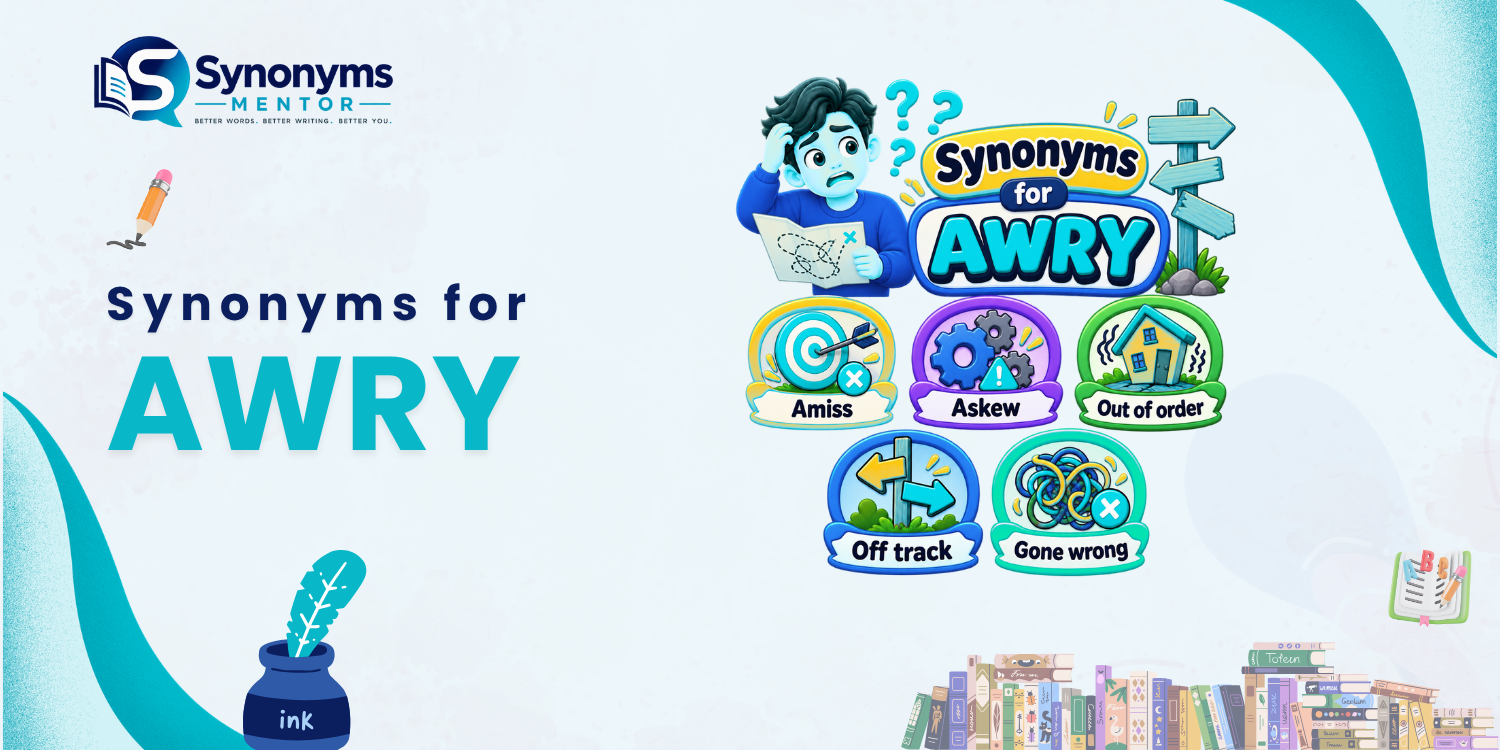
If you need synonyms for awry, the best choice depends on what you mean. When something does not happen as intended, useful alternatives include amiss, wrong, astray, off course, derailed, and misdirected.
When something is physically out of position, better choices include askew, crooked, tilted, skewed, and misaligned. The important distinction is that awry has two major uses: something can go awry by developing in the wrong way, or something can be physically positioned incorrectly.
Quick Answer: What Are the Best Synonyms for Awry?
The closest alternatives to awry include:
amiss, wrong, astray, askew, crooked, skewed, tilted, misaligned, off course, derailed, misdirected, out of kilter, improperly, incorrectly, and badly.
However, they are not interchangeable in every sentence. Amiss is especially useful when something is wrong, while askew usually describes something physically out of position. Astray works particularly well for movement or direction, and derailed is a natural metaphor for plans or projects that have gone seriously off track.
What Does “Awry” Mean?
Awry is an adjective and adverb meaning not in the intended way, off the expected course, or in an incorrect physical position. Cambridge gives examples involving plans or events going wrong as well as something being physically out of position.
The word is especially common in the expression:
go awry
For example:
- The plan went awry.
- Something went awry during the presentation.
- The experiment went awry.
- His hat was awry.
Merriam-Webster similarly defines one sense as being off the correct or expected course and another as being in a turned or twisted position.
Pronunciation
Awry: /əˈraɪ/
It is pronounced roughly like “uh-RYE,” with the stress on the second syllable. Cambridge lists this pronunciation for both UK and US English.
15 Synonyms for Awry
| Word or phrase | Relationship | Best use | Register |
|---|---|---|---|
| Amiss | Direct synonym | Something wrong or not as it should be | Neutral |
| Wrong | Direct synonym | Situations, decisions, results | Neutral |
| Askew | Close synonym | Physical position or alignment | Neutral |
| Astray | Near synonym | Direction, judgment, or course | Neutral/formal |
| Crooked | Contextual | Physically bent or not straight | Neutral |
| Skewed | Contextual | Alignment, data, perspective, position | Neutral/professional |
| Tilted | Contextual | Something leaning to one side | Neutral |
| Misaligned | Contextual | Parts or objects not correctly aligned | Professional/technical |
| Off course | Contextual | Plans, projects, movement, direction | Neutral |
| Derailed | Contextual | Plans, projects, progress | Neutral |
| Misdirected | Contextual | Effort, attention, movement, communication | Formal |
| Out of kilter | Near synonym | Something functioning or positioned incorrectly | Informal |
| Incorrectly | Contextual | Actions or procedures done wrongly | Formal/neutral |
| Improperly | Contextual | Actions, procedures, handling | Formal |
| Badly | Contextual | Something developing or being done poorly | Neutral |
Cambridge lists askew, crooked, uneven, twisted, out of kilter, wrong, amiss, and astray among words related to the two major senses of awry. Merriam-Webster’s thesaurus likewise separates words associated with physical misalignment from those associated with being off the intended course.
1. Amiss
Amiss is one of the closest general alternatives to awry when you mean that something is wrong, inappropriate, or not as it should be.
Example:
Something seems amiss with the new schedule.
Choose “amiss” when:
You want to emphasize that something is wrong or unusual rather than physically crooked.
Awry: The negotiations went awry.
Amiss: Something was amiss during the negotiations.
The two can overlap strongly in situations involving plans or events.
2. Wrong
Wrong is the simplest and most widely understood alternative.
The project went wrong after the supplier changed the delivery date.
Compared with awry, wrong is much broader and less stylistically distinctive.
Choose “wrong” when:
You want maximum clarity and everyday language.
Choose “awry” when:
You want a slightly more expressive way to describe something departing from its expected course.
3. Askew
Askew is particularly useful when something is physically out of position, crooked, or not properly aligned.
The picture frame was hanging askew.
This is one of the most important distinctions to remember: askew is usually a better replacement for the physical-position sense of awry than for “things went awry.”
Cambridge specifically lists askew with the physical-position sense of awry.
4. Astray
Astray means away from the correct path, direction, or course.
The discussion gradually went astray.
It can also describe someone’s judgment, thinking, or actions when they move away from what is considered correct.
Choose “astray” when:
The idea of direction or deviation from a path matters.
It is less natural than amiss for many ordinary situations involving plans.
5. Crooked
Crooked means bent, curved, or not straight.
The old sign was crooked.
It can sometimes replace awry when discussing physical positioning, but it is not a general substitute for phrases such as the plan went awry.
Best context:
Physical shape, alignment, or position.
6. Skewed
Skewed describes something that is not evenly aligned or has been shifted away from a balanced position.
The results were skewed by a small sample size.
It is particularly useful in professional, analytical, and technical contexts.
Best context:
- data
- statistics
- perspectives
- measurements
- alignment
It is not normally a direct replacement for awry in every everyday sentence.
7. Tilted
Tilted means leaning or sloping away from a level or upright position.
The monitor was slightly tilted.
It is a straightforward physical alternative to awry when the problem involves angle or position.
8. Misaligned
Misaligned means that parts are not positioned correctly in relation to one another.
The machine stopped because one of its components was misaligned.
This word is especially useful in technical, mechanical, medical, design, and professional contexts.
Choose “misaligned” when:
The specific problem is incorrect alignment rather than a plan or situation failing.
9. Off Course
Off course is a useful phrase when something has moved away from its intended direction.
The project has gone off course.
It can describe literal movement as well as plans, strategies, and projects.
Best use:
Plans, projects, strategies, journeys, and direction.
10. Derailed
Derailed is a strong contextual alternative when a plan, project, or process is seriously disrupted.
Unexpected delays derailed the project.
Unlike awry, derailed often suggests a more significant interruption rather than simply something going wrong.
Strength:
Derailed can sound stronger and more dramatic than awry.
11. Misdirected
Misdirected means directed toward the wrong target, destination, or purpose.
Their efforts were misdirected toward solving the wrong problem.
It is especially useful when the issue involves attention, effort, communication, or movement.
12. Out of Kilter
Out of kilter means not functioning, arranged, or operating correctly.
Something seems to be out of kilter with the system.
It is more conversational than awry and can describe both literal and figurative situations.
Cambridge includes out of kilter among alternatives associated with the physical-position sense of awry.
13. Incorrectly
Incorrectly means in a way that is not correct.
The form was completed incorrectly.
This is more precise and formal than awry when describing an action or procedure.
Best use:
- instructions
- forms
- calculations
- procedures
- technical work
14. Improperly
Improperly means in an incorrect, unsuitable, or inappropriate manner.
The equipment was improperly installed.
It is particularly useful in formal and professional writing.
15. Badly
Badly can sometimes replace awry when something develops or is performed poorly.
The negotiations went badly.
However, it is broader and less precise. Badly usually emphasizes poor quality or outcome, whereas awry emphasizes deviation from what was expected or intended.
Which Synonym Should You Use?
The easiest way to choose is to identify what has gone wrong.
For plans or situations
Use:
- amiss
- wrong
- off course
- derailed
Our plans went awry.
Our plans went off course.
Unexpected events derailed our plans.
For physical position
Use:
- askew
- crooked
- tilted
- misaligned
- skewed
The picture was awry.
The picture was askew.
Here, askew is usually the more precise choice.
For direction
Use:
- astray
- off course
- misdirected
The investigation went astray.
For procedures or actions
Use:
- incorrectly
- improperly
- wrong
The equipment was installed improperly.
Awry vs. Amiss
Awry and amiss overlap when something is not going as it should.
The main difference is emphasis.
Awry often suggests that a process, plan, event, or situation has departed from its expected course.
Amiss more often means that something is wrong, abnormal, or not as it should be.
Compare:
The launch plans went awry after the weather changed.
Something seems amiss with the launch plans.
Both are natural, but they frame the problem differently.
Awry vs. Askew
These words are especially easy to confuse.
Awry
Can mean that something has gone wrong or that something is physically out of position.
The negotiations went awry.
Askew
Primarily describes something physically crooked or incorrectly positioned.
The painting was hanging askew.
So:
Plans → awry
Picture frame → askew
Cambridge explicitly separates these two uses in its dictionary and thesaurus entries.
Awry vs. Astray
Both words can describe deviation from an intended direction.
Astray emphasizes moving away from the right path or direction.
Awry is broader and can describe a plan, event, process, or situation that fails to develop as intended.
The investigation went astray.
The investigation went awry.
The first focuses more strongly on direction; the second emphasizes an outcome that has gone wrong.
Common Collocations With “Awry”
The phrase go awry is especially important for natural usage. Cambridge and Merriam-Webster both provide examples involving plans, situations, and events going wrong.
Common combinations include:
- plans go awry
- things go awry
- something goes awry
- events go awry
- a plan goes awry
- a situation goes awry
- a project goes awry
- a strategy goes awry
- a process goes awry
- an experiment goes awry
Natural examples
Our carefully prepared plans went awry after the venue closed unexpectedly.
The experiment went awry when the equipment stopped working.
Things went awry during the final stage of the project.
Common Mistakes With “Awry”
Mistake 1: Treating every synonym as interchangeable
Not every word associated with awry works in every context.
For example:
❌ The business plan went askew.
This is possible only if you are deliberately using askew metaphorically, but went awry or went off course is much more natural for an ordinary business plan.
Mistake 2: Using “awry” as a direct replacement for “wrong” everywhere
Awry has a particular sense of deviation from an intended course or position.
The plan went awry.
is natural.
But replacing every instance of wrong with awry will create unnatural English.
Mistake 3: Forgetting the common “go awry” pattern
Learners often encounter awry through the expression go awry.
Natural: The plan went awry.
Less natural: The plan awryed.
Awry is not a verb.
Antonyms of Awry
The opposite depends on the sense.
For situations that go wrong:
- right
- correctly
- properly
- successfully
- as planned
- as intended
For physical position:
- straight
- even
- aligned
- level
- in line
Cambridge lists opposites including straight, even, in line, right, and properly, depending on the sense of awry.
Frequently Asked Questions
What is the closest synonym for awry?
Amiss is one of the closest general synonyms when awry means that something is wrong or not as intended. For physical misalignment, askew is often closer. The best synonym therefore depends on the context.
What is another word for “go awry”?
Depending on the sentence, alternatives include go wrong, go amiss, go off course, become derailed, or take a wrong turn. For plans and situations, go wrong is the simplest everyday alternative.
Is “askew” a synonym for “awry”?
Yes, but mainly in the physical-position sense. Both can describe something that is crooked or out of alignment. Awry also has a broader meaning involving plans, situations, and events going wrong, whereas askew is primarily associated with physical position.
Is “amiss” the same as “awry”?
They overlap significantly when something is wrong or not as it should be. However, awry often emphasizes a departure from an expected course, while amiss can simply indicate that something is wrong or unusual.
Is “astray” a synonym for “awry”?
Sometimes. Astray is especially appropriate when something or someone has moved away from the correct path, direction, or course. It is not a universal replacement for awry.
Is “wrong” a synonym for “awry”?
Yes, in the sense of something happening incorrectly or not according to plan. However, wrong is much broader and more common, while awry specifically conveys the idea of something departing from its intended course.
What does “things went awry” mean?
“Things went awry” means that a situation did not develop as expected or intended and problems occurred. It is a common expression used for plans, events, projects, and other situations.
Conclusion
The best synonym for awry depends on the kind of problem you are describing. Use amiss or wrong when something is simply not right; askew, crooked, tilted, or misaligned for physical positioning; astray or off course for direction; and derailed when a plan or project has been seriously disrupted.

David Wilson is a content strategist and SEO expert who focuses on creating structured vocabulary content. He combines keyword research with simple explanations to make learning English both effective and search-friendly.