Talk Soon Synonyms: 25 Natural Alternatives With Examples
“Talk soon” is a short, friendly way to end a conversation while suggesting that you expect to communicate again in the near future. It works naturally in texts, chats, phone calls, and informal emails. However, the best alternative depends on what you actually mean.
For example, “speak soon” is a close replacement, while “catch up soon” suggests reconnecting and sharing updates. “I’ll be in touch” is more professional and focuses on future contact rather than specifically talking. Understanding these differences helps you choose a phrase that sounds natural instead of simply replacing one expression with another.
Quick Answer
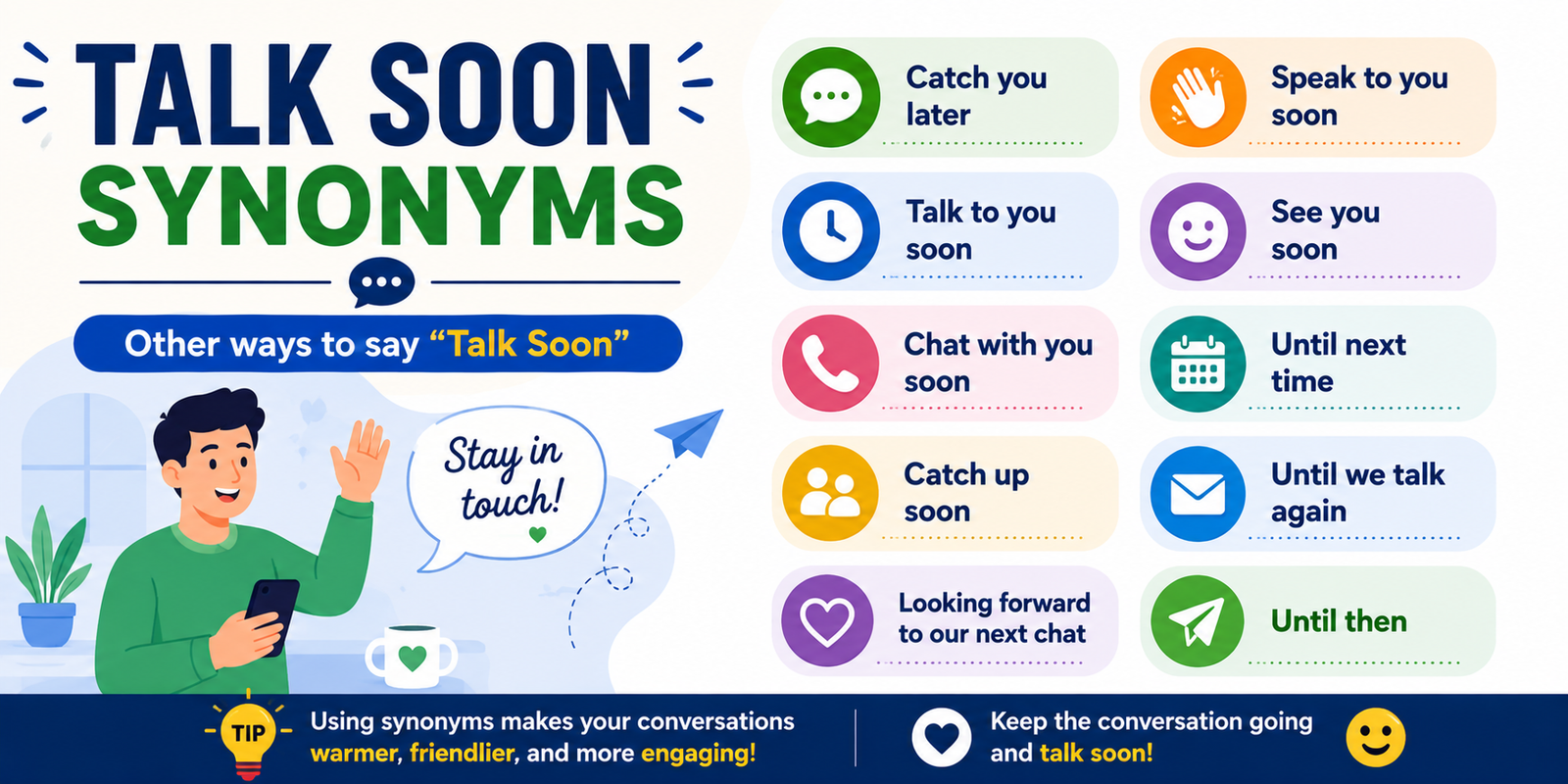
The closest talk soon synonyms are speak soon, chat soon, talk again soon, talk later, and speak with you soon. For friendly conversations, try catch up soon or let’s talk again soon. In professional communication, I’ll be in touch, I look forward to speaking with you again, and I’ll follow up shortly are usually more appropriate.
The Best Synonyms for “Talk Soon”
Use up and down arrow keys to resize the meta box pane.
| Alternative | Relationship | Tone | Best Context |
|---|---|---|---|
| Speak soon | Very close synonym | Neutral/friendly | General conversation, work |
| Chat soon | Close synonym | Casual | Texts and informal chats |
| Talk again soon | Close synonym | Friendly | General conversation |
| Talk later | Contextual alternative | Casual | When you expect to talk later |
| Speak with you soon | Close synonym | Professional | Work communication |
| Catch up soon | Contextual alternative | Warm/casual | Friends and acquaintances |
| Let’s talk soon | Close alternative | Friendly | Suggesting future conversation |
| I’ll be in touch | Contextual alternative | Professional | Emails and business |
| I’ll follow up shortly | Contextual alternative | Professional | Work and business |
| I’ll reach out soon | Contextual alternative | Professional | Future contact |
| Let’s reconnect soon | Contextual alternative | Professional/friendly | Re-establishing contact |
| Talk again shortly | Close alternative | Neutral | Professional/general |
| Chat again soon | Close synonym | Casual | Friends and messaging |
| Connect soon | Contextual alternative | Professional | Business communication |
| Looking forward to our next conversation | Contextual alternative | Polished | Professional communication |
| I look forward to speaking with you again | Contextual alternative | Formal | Business emails |
| I’ll call you soon | Contextual alternative | Neutral | Phone communication |
| I’ll message you soon | Contextual alternative | Casual | Texting and messaging |
| Catch you later | Related farewell | Very casual | Friends and informal chats |
| See you soon | Related phrase | Friendly | When you expect to meet |
| Until next time | Related farewell | Neutral/polite | General farewells |
| Stay in touch | Related phrase | Warm | Longer-term contact |
| Keep in touch | Related phrase | Friendly | Friends, colleagues |
| Hoping to speak soon | Contextual alternative | Polite | Emails |
| Looking forward to chatting again | Contextual alternative | Friendly | Informal/professional |
Important: These expressions are not interchangeable in every situation. Some specifically imply talking, while others mean contacting, meeting, or maintaining a relationship.
What Does “Talk Soon” Mean?
“Talk soon” means that you expect or hope to communicate with someone again in the near future.
It is an abbreviated conversational expression. The longer form is “talk to you soon.” The phrase normally carries a positive or friendly tone and leaves the exact timing unspecified. “Soon” does not necessarily mean immediately or later the same day.
Example
“Thanks for calling. Talk soon!”
This tells the other person that you expect another conversation.
The Closest Synonyms for “Talk Soon”
1. Speak Soon
Meaning: You expect to speak with the person again shortly.
Best contexts: General conversation, texts, and many workplace situations.
Example:
“Thanks for your help today. Speak soon.”
This is probably the closest direct alternative to “talk soon.”
2. Chat Soon
Meaning: You expect to have another informal conversation soon.
Best contexts: Text messages, online chats, and conversations with friends or familiar colleagues.
Example:
“Great catching up with you. Chat soon!”
“Chat” can sound more casual than “talk,” so it is not always the best choice for formal business communication.
3. Talk Again Soon
Meaning: You expect to have another conversation in the near future.
Example:
“It was great talking with you. Let’s talk again soon.”
This version makes the idea of another conversation especially clear.
4. Speak With You Soon
Meaning: You expect to speak with someone again soon.
Best contexts: Professional or semi-formal communication.
Example:
“Thank you for your time today. I look forward to speaking with you soon.”
It sounds more polished than the very short “Talk soon.”
Friendly and Casual Alternatives
Some expressions work particularly well when communicating with friends or people you know well.
Catch Up Soon
“Catch up” suggests talking about what has happened since you last communicated.
“It’s been a while. Let’s catch up soon.”
This is better than “talk soon” when the main idea is reconnecting and exchanging updates.
Chat Again Soon
“Thanks for the message. Chat again soon!”
This is natural for casual online communication.
Let’s Talk Soon
“I’ve got to go now, but let’s talk soon.”
Unlike “talk soon,” this version sounds more like an explicit suggestion or invitation.
Catch You Later
“I’ve got to head out. Catch you later!”
This is very informal. It can mean that you expect to see or speak with someone later, but it does not specifically promise a conversation soon.
Professional Alternatives to “Talk Soon”
“Talk soon” is perfectly understandable, but some professional situations benefit from a more specific closing.
I’ll Be in Touch
“Thank you for sending the information. I’ll be in touch.”
This means I will contact you again, without specifying whether the next contact will be a call, message, or email.
I’ll Follow Up Shortly
“I’ll review the proposal and follow up shortly.”
Use this when you intend to contact someone again after completing a task or reviewing information.
I’ll Reach Out Soon
“I’ll reach out soon to arrange the next meeting.”
This emphasizes that you will initiate future contact.
I Look Forward to Speaking With You Again
“Thank you for meeting with me today. I look forward to speaking with you again.”
This is more formal and works well in professional correspondence.
Looking Forward to Our Next Conversation
“Thank you for your time. I’m looking forward to our next conversation.”
This emphasizes anticipation of a future discussion rather than simply promising contact.
These kinds of professional alternatives are commonly recommended for business communication because they give the closing a clearer level of formality and intention.
Which “Talk Soon” Alternative Should You Use?
The easiest way to choose is to ask what you actually want to communicate.
Choose “Speak Soon” when:
You simply want a very close alternative to “talk soon.”
“Great speaking with you. Speak soon.”
Choose “Chat Soon” when:
The conversation is informal.
“Thanks for the update! Chat soon.”
Choose “Catch Up Soon” when:
You want to reconnect and exchange personal or general updates.
“It’s been ages. Let’s catch up soon.”
Choose “I’ll Be in Touch” when:
You are writing professionally and want to emphasize future contact.
“Thank you for your time. I’ll be in touch.”
Choose “I’ll Follow Up Shortly” when:
You need to perform an action before contacting the person again.
“I’ll review the document and follow up shortly.”
Choose “I Look Forward to Speaking With You Again” when:
You want a polished, professional closing.
“Thank you for the meeting. I look forward to speaking with you again.”
Choose “Talk Later” when:
You specifically expect to talk at a later time.
“I have class now. Talk later!”
“Talk Soon” vs. “Speak Soon”
These two phrases are extremely close.
| Phrase | Difference | Typical Tone |
|---|---|---|
| Talk soon | Casual, direct | Friendly |
| Speak soon | Slightly more polished | Neutral/friendly |
Both can signal that you expect another conversation.
Example:
“Thanks for calling. Talk soon!”
“Thanks for calling. Speak soon!”
The second can fit a professional setting slightly more comfortably, although neither is a highly formal email closing.
“Talk Soon” vs. “Catch Up Soon”
The distinction is more significant here.
Talk soon simply means you expect to communicate again.
Catch up soon suggests that you have not talked recently and want to exchange updates.
Compare:
“I need to go. Talk soon.”
with:
“It’s been six months since we talked. Let’s catch up soon.”
The second sentence carries the additional idea of reconnecting after some time apart.
“Talk Soon” vs. “See You Soon”
These phrases should not automatically be treated as exact synonyms.
Talk soon specifically concerns future communication.
See you soon generally suggests that you expect to meet in person, although the phrase can sometimes be used more loosely.
Compare:
“I’m heading home. Talk soon.”
with:
“I’m heading home. See you soon.”
The first focuses on future communication; the second more strongly suggests another meeting.
“Talk Soon” vs. “I’ll Be in Touch”
These phrases differ in what they emphasize.
Talk soon → future conversation.
I’ll be in touch → future contact.
For example:
“Thanks for the meeting. Talk soon.”
is conversational and warm.
“Thanks for the meeting. I’ll be in touch with an update.”
is more specific and professional.
Natural Collocations and Situations
Instead of treating every alternative as interchangeable, consider the situation.
After a phone call
- “Speak soon.”
- “Talk soon.”
- “Talk to you later.”
- “I’ll call you soon.”
After a casual text
- “Chat soon.”
- “Talk soon.”
- “Catch you later.”
- “Talk again soon.”
After reconnecting with an old friend
- “Let’s catch up soon.”
- “Let’s talk again soon.”
- “It was great catching up. Talk soon.”
After a professional meeting
- “I’ll be in touch.”
- “I’ll follow up shortly.”
- “I look forward to speaking with you again.”
- “I’ll reach out soon.”
Common Mistakes
1. Treating “See you soon” as an exact synonym
It often suggests seeing someone physically, so it may not fit a conversation that will happen by phone or email.
2. Using “Catch you later” in a formal email
“Catch you later” is casual and conversational. It is generally better suited to friends or informal colleagues.
3. Using “I’ll follow up shortly” without intending to follow up
This phrase implies that you will contact the person again. Do not use it simply because it sounds professional.
4. Assuming “soon” means today
“Soon” does not specify an exact time. The intended timeframe depends on context.
5. Calling every related phrase a synonym
“Stay in touch,” “see you soon,” and “until next time” are related expressions, but they do not have exactly the same meaning as “talk soon.”
FAQ
What is another way to say “talk soon”?
The closest alternatives are “speak soon,” “talk again soon,” “chat soon,” and “speak with you soon.” The best choice depends on the setting. “Chat soon” is more casual, while “speak with you soon” can sound more polished.
What is a professional way to say “talk soon”?
Try “I’ll be in touch,” “I’ll follow up shortly,” “I’ll reach out soon,” or “I look forward to speaking with you again.” These expressions are generally better suited to professional communication because they can make the intended follow-up clearer.
Is “speak soon” the same as “talk soon”?
They are very close. Both normally indicate that you expect to communicate again in the near future. “Speak soon” can sound slightly more polished, but the difference is small.
Is “catch up soon” the same as “talk soon”?
Not exactly. “Catch up soon” suggests reconnecting and exchanging updates, often after some time apart. “Talk soon” has the broader meaning of communicating again soon.
Can I use “talk soon” in a professional email?
Yes, particularly in an informal workplace or when you already have a friendly relationship with the recipient. For a more formal email, consider “I’ll be in touch” or “I look forward to speaking with you again.”
Is “talk soon” formal or informal?
“Talk soon” is generally casual to neutral. It is natural in everyday conversation, messaging, and friendly emails. It is less appropriate as a highly formal closing.
What is a warm alternative to “talk soon”?
“Let’s catch up soon,” “looking forward to chatting again,” and “let’s talk again soon” can sound warm and friendly. “Catch up soon” is particularly natural when you have not spoken with someone for a while.
Conclusion
The best talk soon synonym depends on the meaning and tone you want.
For a close replacement, choose “speak soon” or “talk again soon.” For casual conversations, “chat soon” and “catch up soon” work well. For professional communication, “I’ll be in touch,” “I’ll follow up shortly,” and “I look forward to speaking with you again” are stronger choices.

Olivia Brown is a vocabulary expert and content writer who focuses on synonyms, antonyms, and word usage. She helps learners understand English words in a simple and practical way, making communication clearer and more effective