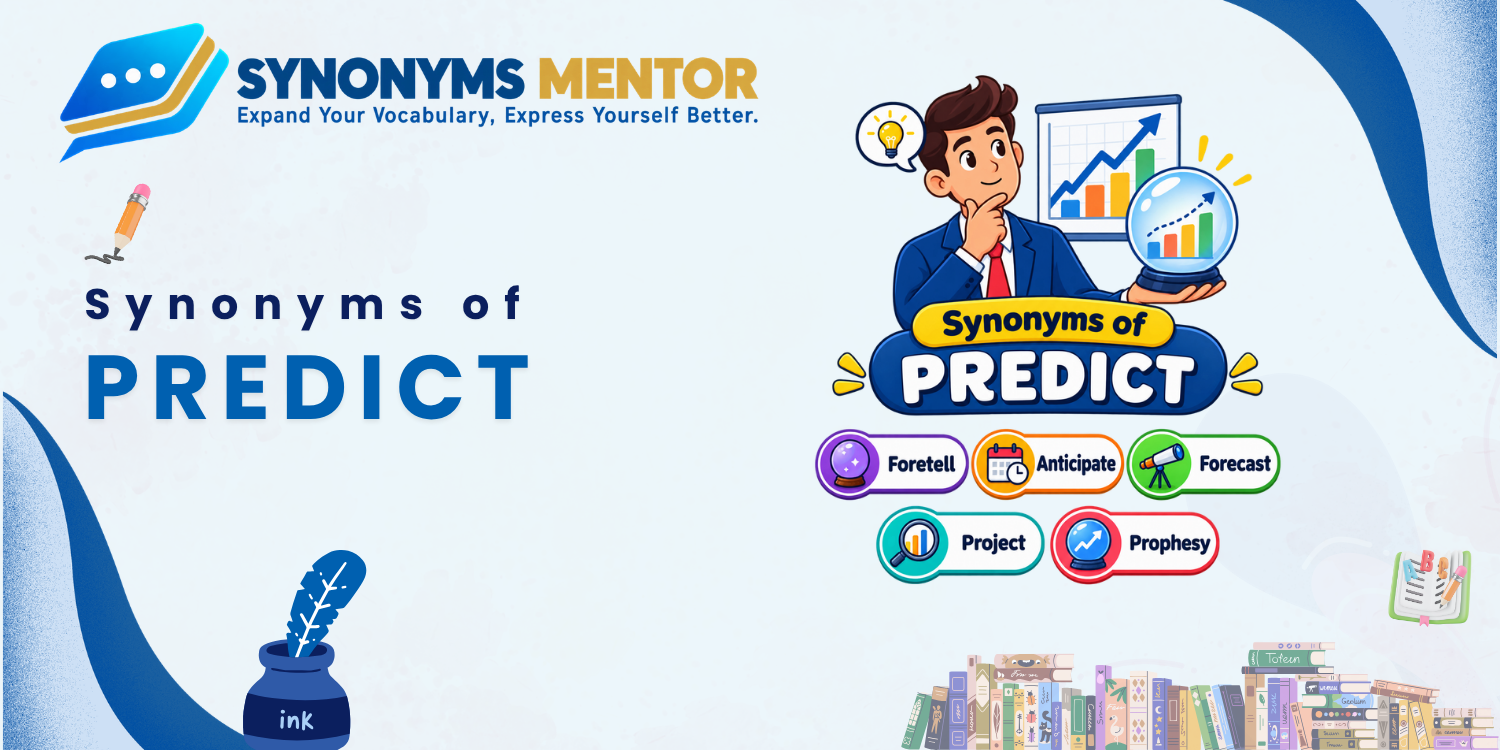
Synonyms of Predict: Better Alternatives With Examples
When you need another word for predict, the best choice depends on what kind of future statement you are making. Forecast is especially natural for weather, economics, and other measurable trends.
Foresee focuses on mentally recognizing what is likely to happen, while anticipate often suggests expecting something in advance. More specialized choices include foretell, prophesy, prognosticate, presage, and portend.
This guide explains the most useful synonyms of predict, shows how they differ, and gives natural examples so you can choose the right word instead of simply replacing one word with another.
Quick Answer
The closest synonyms of predict include forecast, foresee, anticipate, foretell, prophesy, and prognosticate. However, they are not interchangeable in every situation.
Use forecast for evidence-based expectations, foresee for seeing something in advance, anticipate for expecting something before it happens, and prophesy when the prediction has a prophetic or supernatural quality.
Synonyms of Predict at a Glance
| Word | Relationship | Meaning | Strength | Formality | Best Context |
|---|---|---|---|---|---|
| Forecast | Near synonym | Predict a future event or trend, often from information or evidence | Similar | Neutral/Formal | Weather, economics, business, trends |
| Foresee | Near synonym | Recognize or imagine something before it happens | Similar | Neutral | Problems, consequences, future events |
| Anticipate | Near synonym | Expect something in advance | Similar | Neutral/Formal | Events, needs, reactions, changes |
| Foretell | Direct/near synonym | Tell what will happen beforehand | Similar | Formal/Literary | Future events, storytelling |
| Prophesy | Contextual alternative | Predict through prophecy or strong belief | Strongly marked | Formal/Literary | Religious, prophetic, dramatic contexts |
| Prognosticate | Near synonym | Predict based on signs, knowledge, or interpretation | Similar | Formal | Analysis, commentary, formal writing |
| Presage | Contextual alternative | Be a sign that something will happen | Different focus | Formal/Literary | Signs and omens |
| Portend | Contextual alternative | Indicate that something, often significant, is likely to happen | Different focus | Formal | Negative or consequential events |
| Augur | Contextual alternative | Be a sign of a future outcome | Different focus | Formal/Literary | Signs, outcomes, prospects |
| Divine | Contextual alternative | Discover or guess something through intuition | Different focus | Literary/Formal | Intuition, hidden or future information |
Major dictionaries and thesauruses list many of these words as related to predict, but they also distinguish their meanings.
What Does Predict Mean?
Predict is a verb meaning to say or state that something will happen in the future. It can describe a conclusion based on evidence, experience, calculation, knowledge, or simply a person’s judgment.
For example:
Scientists can predict the path of a storm.
Nobody could predict the final outcome.
Analysts predict that prices will increase next year.
Oxford gives predict the sense of saying that something will happen in the future and provides examples involving outcomes, weather, business, elections, and scientific prediction. Its entry also records the pronunciation /prɪˈdɪkt/ and traces the word to Latin roots meaning roughly “made known beforehand.”
The important point is that predict is broad. It does not automatically imply scientific certainty, supernatural knowledge, or a particular method of reaching a conclusion.
The Best Synonyms of Predict
1. Forecast
Forecast is one of the closest everyday alternatives to predict. It is particularly common when the future outcome is estimated from data, trends, models, or other evidence.
Best for:
- Weather
- Economics
- Business
- Sales
- Demand
- Trends
- Population changes
Examples:
Meteorologists forecast heavy rain for tomorrow.
Analysts forecast slower economic growth next year.
The company forecasts higher sales in the next quarter.
Predict vs forecast:
The meanings overlap heavily, but forecast is especially natural for systematic estimates of future conditions. Merriam-Webster notes that forecast tends to emphasize anticipating probabilities, while predict can be broader.
2. Foresee
Foresee means to see, understand, or recognize something before it happens. Unlike predict, it does not necessarily mean that you publicly state the prediction.
Example:
She foresaw the problems that the new policy might cause.
We did not foresee such a strong reaction.
The distinction is subtle but important:
- Predict = state what will happen.
- Foresee = recognize or imagine what will happen.
Someone can foresee a problem without actually making a formal prediction about it. Collins specifically distinguishes foresee as referring to the mental act of seeing ahead, while predict generally involves telling what is expected to happen.
3. Anticipate
Anticipate means to expect something before it happens. It can overlap with predict, but it often includes an element of preparation or expectation.
Examples:
We anticipate strong demand for the new product.
The team anticipated several questions from the audience.
She anticipated that the journey would take longer than expected.
Predict vs anticipate:
Use predict when you are making a statement about a future outcome. Use anticipate when the idea of expecting or preparing for that outcome is important.
For example:
Scientists predict a rise in temperatures.
This focuses on the future outcome.
We anticipate a rise in temperatures and are preparing for it.
This adds an expectation and practical response.
Collins lists expect, predict, and forecast among the meanings associated with anticipate, while also noting that anticipate can mean preparing for something in advance.
4. Foretell
Foretell means to tell what will happen in the future. It is very close in meaning to predict, but it often sounds more formal, literary, or dramatic.
Examples:
The old legend was said to foretell a great disaster.
Few people could have foretold the scale of the change.
Predict vs foretell:
Predict is much more common in ordinary modern English. Foretell works well when the focus is specifically on telling about a future event, especially in literary, historical, or dramatic contexts.
Collins lists foretell as one of the principal synonyms of predict.
5. Prophesy
Prophesy means to say that something will happen in the future, especially with a prophetic, religious, or supernatural implication.
Examples:
The prophet prophesied that the kingdom would fall.
He confidently prophesied a major change in the industry.
The second example is possible, but it has a deliberately dramatic tone.
Predict vs prophesy:
The distinction is mainly about the source or implication of the prediction. Predict is neutral and can be based on evidence or reasoning. Prophesy commonly suggests prophecy, divine inspiration, or an unusually strong belief about the future. Merriam-Webster specifically identifies this supernatural or inspired connotation.
Spelling note:
The verb is prophesy. The noun is prophecy.
6. Prognosticate
Prognosticate means to predict a future event or outcome, often in a formal, analytical, or somewhat old-fashioned style.
Examples:
Economists prognosticated a difficult year for the industry.
It is difficult to prognosticate how the market will respond.
The word is grammatically correct but considerably less common than predict or forecast.
Merriam-Webster describes prognosticate as a less frequently used alternative that can suggest skilled or learned interpretation, although it is also used as a colorful substitute for predict or prophesy.
Best choice: Use prognosticate when you deliberately want a formal or distinctive tone. For ordinary professional writing, predict or forecast will usually sound more natural.
7. Presage
Presage is usually used when something serves as a sign or warning of a future event.
Example:
The sudden decline in sales presaged a difficult year for the company.
Notice the difference:
Analysts predicted a difficult year.
Here, the analysts make the prediction.
The decline in sales presaged a difficult year.
Here, the decline is itself a sign of what is coming.
That makes presage a contextual alternative rather than a universal replacement for predict. Collins lists presage among words connected with predicting or indicating future events.
8. Portend
Portend means to be a sign that something is likely to happen. It often appears with serious, undesirable, or consequential events.
Examples:
The sudden drop in consumer confidence portended trouble for the industry.
Dark clouds portended a storm.
Predict vs portend:
A person can predict an event. A situation, sign, or development can portend an event.
So this sounds natural:
Experts predict a recession.
But this is more natural:
The economic indicators portend a recession.
Collins places portend among words associated with indicating or foreshadowing future events.
9. Augur
Augur means to be a sign of what is likely to happen. It is often used to discuss whether something suggests a positive or negative future.
Examples:
The early sales figures augur well for the new product.
The team’s recent losses do not augur well for the playoffs.
Because augur describes a sign rather than simply the act of making a prediction, it is not a direct replacement for predict in every sentence.
For example:
❌ The scientist augured the exact temperature tomorrow.
✅ The early results augur well for the project.
Collins includes augur among words associated with predicting or signaling future outcomes.
10. Divine
Divine can mean discovering something through intuition, guessing, or unusual insight. In prediction-related contexts, it can suggest figuring out something that is not directly known.
Example:
She tried to divine what the committee would decide.
This is more literary than:
She tried to predict what the committee would decide.
Collins includes divine among words associated with predicting, but also gives it the separate sense of discovering something through intuition or guessing.
Which Word Should I Use?
The easiest way to choose is to identify how the future outcome is being approached.
Choose “predict” when:
You want a neutral, general word for saying what you think will happen.
Experts predict that demand will increase.
Choose “forecast” when:
The prediction is based on data, trends, models, or systematic analysis.
Economists forecast slower growth.
Choose “foresee” when:
You mean recognizing or imagining a future event before it occurs.
Nobody foresaw the consequences.
Choose “anticipate” when:
You mean expecting something in advance, especially when preparation is involved.
The company anticipated higher demand.
Choose “foretell” when:
You want a more literary or formal way to say that something was told beforehand.
The ancient text was believed to foretell the disaster.
Choose “prophesy” when:
The prediction has a prophetic, religious, mystical, or deliberately dramatic quality.
The prophet prophesied that the kingdom would fall.
Choose “prognosticate” when:
You want a formal or somewhat specialized alternative to predict.
Analysts prognosticated a difficult recovery.
Choose “presage,” “portend,” or “augur” when:
A sign or event indicates what is likely to happen rather than a person simply making a prediction.
Predict vs Forecast
These are probably the two most useful words to compare.
| Predict | Forecast |
|---|---|
| Broad and general | More specialized |
| Can be based on evidence, experience, or judgment | Often based on data, trends, or analysis |
| Common in everyday English | Common in weather, economics, and business |
| Can involve people, events, outcomes, and trends | Especially natural for future conditions and measurable trends |
Examples:
I predict that our team will win.
The weather service forecasts rain.
Both verbs can describe future expectations, but forecast is especially natural when there is a systematic basis for estimating what will happen.
Predict vs Foresee
The key distinction is saying versus seeing ahead.
We predicted that sales would fall.
This says that someone made a prediction.
We foresaw that sales would fall.
This emphasizes that someone recognized the possibility or likely outcome beforehand.
Oxford defines predict as saying that something will happen, while Collins distinguishes foresee as the mental act of seeing ahead.
Predict vs Anticipate
These words overlap, but anticipate can imply expectation, preparation, or awareness of something before it happens.
We predict heavy traffic tomorrow.
We anticipate heavy traffic tomorrow.
Both are possible. But:
We anticipated heavy traffic and left early.
The second sentence naturally includes the idea that the expectation affected what people did.
So use predict for the forecast itself and anticipate when expectation or preparation is important.
Predict vs Foretell
Foretell is close to predict, but it often has a more literary, dramatic, or prophetic flavor.
Scientists predict major changes in the climate.
The prophecy foretold major changes.
The first is neutral and analytical. The second sounds historical, literary, or prophetic.
Predict vs Prophesy
These words can overlap, but they do not have the same tone.
Predict is neutral:
The researchers predict that the treatment will improve recovery.
Prophesy is marked and often associated with prophecy:
The prophet prophesied that the kingdom would fall.
Using prophesy in an ordinary scientific or business context can therefore make the statement sound unnecessarily dramatic. Merriam-Webster specifically identifies the prophetic or mystical connotation of prophesy.
Predict vs Portend
The grammatical subject often reveals the difference.
Predict usually has a person, organization, model, or method as the source:
Analysts predict higher demand.
Portend commonly has an event, condition, or sign as the subject:
Falling demand portends trouble for the company.
This is why portend is better treated as a contextual alternative than as a universal synonym.
Common Collocations With Predict
Some combinations with predict are especially natural:
- predict the future
- predict the outcome
- predict the result
- predict the weather
- predict demand
- predict sales
- predict growth
- predict a change
- predict a trend
- predict an increase
- predict a decline
- predict what will happen
- predict that something will happen
- accurately predict
- reliably predict
- successfully predict
Examples:
It is difficult to predict the outcome.
The model accurately predicts consumer behavior.
Nobody can reliably predict what will happen next.
Oxford lists common patterns including predict something, predict what/whether, predict that, and constructions such as it is predicted that and something is predicted to do something.
Common Mistakes With Predict Synonyms
Mistake 1: Treating “foresee” as identical to “predict”
They overlap, but foresee emphasizes awareness or mental recognition rather than the act of stating a prediction.
Mistake 2: Using “prophesy” in ordinary professional writing
Prophesy carries a prophetic or mystical flavor. Predict is normally better for neutral business, academic, or scientific writing.
Mistake 3: Using “portend” as if a person makes the prediction
Usually, something portends an outcome; a person predicts it.
✅ The warning signs portended trouble.
✅ Experts predicted trouble.
Mistake 4: Assuming “anticipate” always means “predict”
Anticipate can mean expect something and prepare for it, so it has a broader practical sense.
We anticipated delays and added extra staff.
Here, predicted delays would not communicate the preparation as naturally.
Mistake 5: Overusing “prognosticate”
Although correct, prognosticate is much less common than predict. It can sound unnecessarily formal in everyday writing.
Related Words That Are Not Exact Synonyms
Some words appear close to predict but should not automatically replace it.
Expect
Expect means to believe something is likely to happen, but it can also describe ordinary expectations and does not always function as a prediction.
I expect the package tomorrow.
Analysts predict stronger growth.
Estimate
Estimate focuses on approximately calculating an amount, number, cost, time, or value.
We estimate that the project will cost $2 million.
It can overlap with predict, but the emphasis is usually on approximate measurement or calculation.
Project
Project can mean to calculate or estimate a future amount, especially in business, finance, and planning.
The company projects revenue growth of 8%.
It is therefore a useful contextual alternative in financial and business writing, but not a general synonym for every use of predict.
Guess
Guess involves forming an answer or opinion without enough certainty or information.
I guess it will rain tomorrow.
It can produce a prediction, but it is weaker and more informal than predict.
Pronunciation and Word Origin
Predict is pronounced /prɪˈdɪkt/ in both major English varieties listed by Oxford.
The word comes from Latin roots associated with saying or making something known beforehand. Oxford dates its English origin to the early 17th century.
FAQ
What is the closest synonym for predict?
Forecast is one of the closest everyday synonyms, especially when discussing future conditions, trends, weather, economics, or business. Foretell is also very close in basic meaning, while foresee emphasizes recognizing something before it happens.
What is a formal synonym for predict?
Prognosticate is a formal alternative, although it can sound less natural than predict in ordinary writing. Foretell can also sound formal or literary depending on the context.
What is another word for predict the future?
Depending on context, you can use forecast, foresee, foretell, anticipate, or prophesy. Prophesy is appropriate when the idea of prophecy or supernatural knowledge is intended; forecast is better for evidence-based future estimates.
Is “forecast” the same as “predict”?
They overlap substantially, but forecast is particularly associated with estimating future conditions from information, trends, or probabilities. It is especially common for weather, economics, sales, and demand. Predict is broader and works in many more situations.
Is “foresee” a synonym for “predict”?
Foresee is a near synonym, but it focuses more on recognizing or imagining a future event than on formally stating a prediction. You can foresee a problem without necessarily announcing a prediction.
What is the difference between predict and anticipate?
Predict focuses on saying what will happen. Anticipate often means expecting something before it happens and can also imply preparing for it. For example, a company may anticipate higher demand and increase production.
Is “prophesy” the same as “predict”?
Not exactly. Prophesy can mean predict, but it commonly carries a religious, prophetic, mystical, or strongly dramatic implication. Predict is the better neutral choice for scientific, academic, business, and everyday contexts.
What is the difference between predict and portend?
A person, organization, model, or expert typically predicts something. A sign, event, or condition can portend something. For example, “Experts predict a recession,” but “The falling indicators portend a recession.”
Conclusion
The best synonym for predict depends on what you want to emphasize. Forecast is excellent for data-driven trends and future conditions, foresee emphasizes recognizing what is coming, and anticipate often includes expectation or preparation. Foretell is more literary, prophesy carries a prophetic tone, and prognosticate is formal and less common.

Sophia Martinez is an ESL educator who specializes in teaching vocabulary and word meanings. She writes beginner-friendly content that helps learners understand synonyms and improve their English fluency step by step.