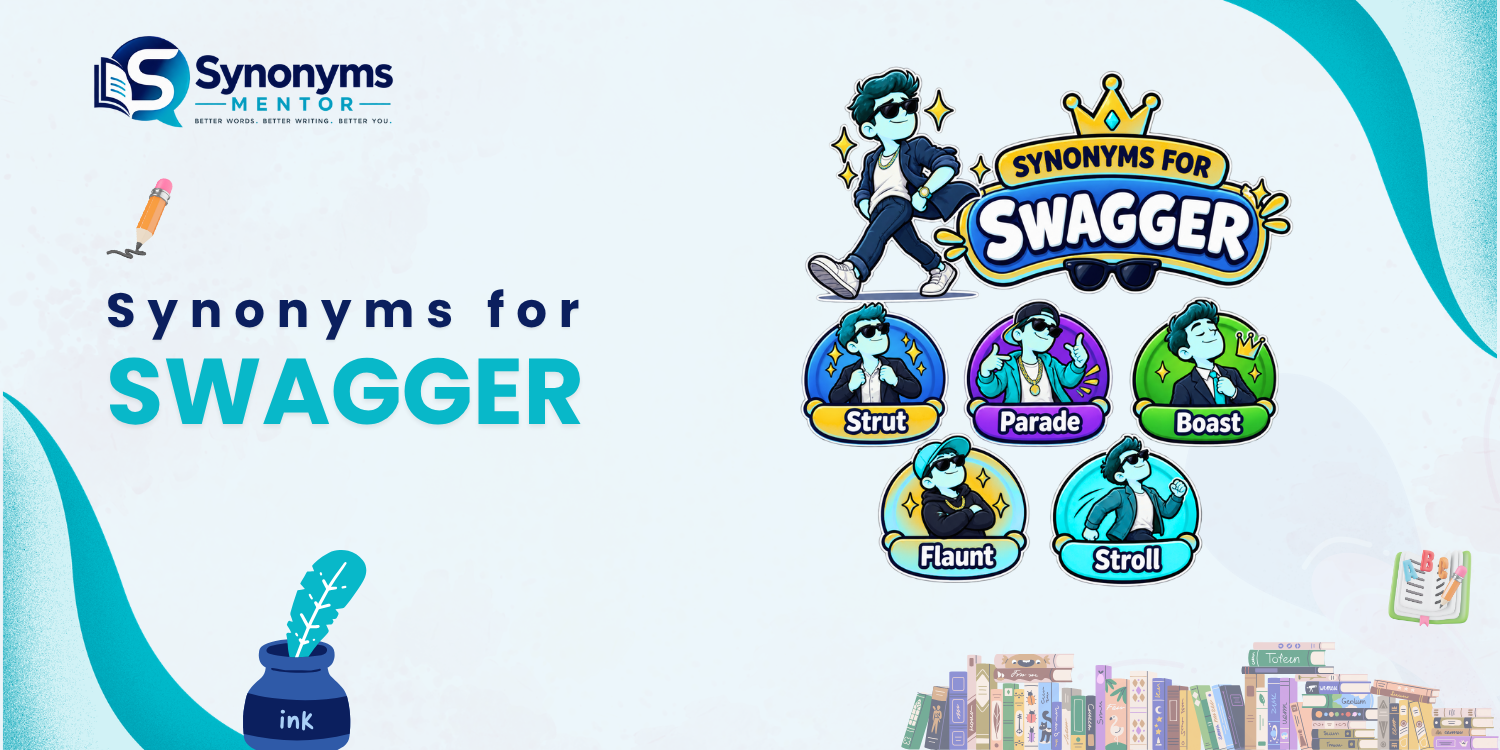
Synonyms for Swagger: 15 Better Alternatives With Examples
Looking for synonyms for swagger can be tricky because swagger combines more than simple confidence. It can describe a particular way of walking, a person’s manner or behavior, or the self-assured attitude communicated through that behavior. The word often carries a hint of arrogance or self-importance, although the exact tone depends on context.
The closest replacement is usually strut, especially when swagger describes a proud or exaggerated way of walking. Other alternatives, such as stride, parade, sashay, and swashbuckle, overlap with swagger but add different meanings. Choosing the right word therefore depends on whether you want to emphasize movement, confidence, arrogance, style, or flamboyance.
Quick Answer: What Are the Best Synonyms for Swagger?
The closest synonyms for swagger include strut, parade, swashbuckle, and sashay, depending on the context. Strut is usually the strongest direct alternative for walking in a very proud or confident manner. Stride describes confident, purposeful walking but does not necessarily imply arrogance. Parade emphasizes displaying oneself, while swashbuckle suggests flamboyant confidence or bravado.
Core Synonym Resource
| Word | Relationship | Main Meaning | Tone | Best Context |
|---|---|---|---|---|
| Strut | Direct synonym | Walk proudly and confidently | Often arrogant | Proud or showy walking |
| Parade | Near synonym | Walk or display oneself conspicuously | Showy | Displaying oneself |
| Swashbuckle | Contextual alternative | Behave with flamboyant confidence | Bold, theatrical | Adventure or bravado |
| Sashay | Contextual alternative | Walk with a noticeable, often stylish movement | Playful/showy | Stylish or dramatic movement |
| Stride | Near synonym | Walk with long, confident steps | Usually neutral/positive | Confident movement |
| Saunter | Near synonym | Walk in a relaxed, unhurried way | Relaxed | Casual movement |
| March | Contextual alternative | Walk with deliberate, regular steps | Firm | Determined movement |
| Prance | Contextual alternative | Walk or move with exaggerated, springy steps | Playful/showy | Exaggerated movement |
| Stalk | Contextual alternative | Move with controlled, deliberate steps | Intense | Aggressive or dramatic movement |
| Proud walk | Descriptive alternative | A walk showing pride | Neutral | Plain-language descriptions |
| Bravado | Related/near synonym | Confident or bold behavior, sometimes exaggerated | Often negative | Attitude rather than walking |
| Self-assurance | Related concept | Confidence in oneself | Positive/neutral | Personality |
| Confidence | Related concept | Belief in one’s abilities | Usually positive | General attitude |
| Arrogance | Related concept | Excessive belief in one’s importance | Negative | Critical descriptions |
| Showmanship | Related concept | Skill at attracting attention through performance | Neutral/positive | Performance or presentation |
The distinction matters: not all of these words can replace swagger in every sentence.
What Does “Swagger” Mean?
Swagger can function as both a verb and a noun.
As a verb, it means to walk or behave in a very confident way that suggests the person considers themselves important. Cambridge defines it in terms of walking or behaving with strong confidence and a sense of importance, while Oxford describes it as walking in an extremely proud and confident way and labels the usage as usually disapproving.
Example:
He swaggered into the room as if everyone had been waiting for him.
As a noun, swagger refers to a way of walking or behaving that appears excessively confident. Oxford specifically describes the noun as a manner of walking or behaving that seems too confident.
Example:
She walked onto the stage with unmistakable swagger.
Pronunciation
- US: /ˈswæɡər/
- UK: /ˈswæɡə/
The word dates to the early 16th century and is apparently related to the verb swag.
The Closest Synonyms for Swagger
1. Strut
Strut is the closest everyday synonym for the walking sense of swagger. It describes walking in a proud, confident, and often conspicuous manner.
Example:
He strutted across the stage like he owned it.
Choose “strut” when: you want to emphasize an exaggerated, proud way of walking.
Oxford explicitly gives strut as a synonym for swagger, making it the strongest direct replacement in many contexts.
2. Parade
Parade can overlap with swagger when someone deliberately displays themselves while walking or moving around.
Example:
He paraded around the office showing off his new award.
Unlike swagger, however, parade does not inherently mean arrogant confidence. The emphasis is more on displaying oneself.
Choose “parade” when: the person is deliberately putting themselves on display.
3. Swashbuckle
Swashbuckle is much more colorful than swagger. It suggests acting or behaving with flamboyant confidence, bravado, or adventurous boldness.
Example:
The fictional hero swashbuckled his way through every challenge.
It is not a universal replacement for swagger, but it works well in humorous, literary, or theatrical contexts.
Choose “swashbuckle” when: you want exaggerated, adventurous confidence rather than simply a confident walk.
Cambridge lists swashbuckle among words related to the verb swagger.
4. Sashay
Sashay describes walking with a noticeable, often stylish or dramatic movement. It can overlap with swagger when the movement is deliberately showy.
Example:
She sashayed across the room with theatrical confidence.
Unlike swagger, sashay does not necessarily imply arrogance.
Choose “sashay” when: the important feature is a stylish, playful, or conspicuous walk.
5. Stride
Stride means to walk with long, confident steps. It is an excellent alternative when you want the physical movement without swagger’s possible implication of arrogance.
Example:
She strode confidently into the meeting.
Compare:
She swaggered into the meeting.
The first sentence sounds purposeful and confident. The second suggests that her confidence may be excessive or self-important.
Choose “stride” when: you want confidence and purpose without necessarily criticizing the person.
Cambridge includes stride among words related to the walking sense of swagger.
6. Saunter
Saunter means to walk in a relaxed, unhurried way. It can sometimes overlap with swagger because both may describe an unconcerned manner of movement.
Example:
He sauntered into the room five minutes late.
However, saunter emphasizes relaxation and lack of haste, not pride or self-importance.
Choose “saunter” when: the person’s relaxed manner matters more than their confidence.
7. March
March describes deliberate, regular, purposeful walking. It can replace swagger only when the emphasis is on forceful or determined movement.
Example:
He marched into the office and demanded an explanation.
Unlike swagger, march does not inherently communicate self-importance.
Choose “march” when: you want to emphasize determination or force.
8. Prance
Prance describes an exaggerated, lively, or springy manner of moving. It may resemble swagger when a character is intentionally making their movement conspicuous.
Example:
He pranced around the room after winning the competition.
The word often sounds playful or mocking rather than genuinely confident.
Choose “prance” when: the movement is exaggerated, energetic, or humorous.
Swagger Synonyms by Context
For an arrogant walk
The best choices are:
- strut
- swagger
- parade
He strutted down the hallway as though he were the boss.
Here, strut is more precise than stride because the sentence implies exaggerated pride.
For a confident walk
Use:
- stride
- walk confidently
- march in a determined context
She strode into the interview with confidence.
Stride is preferable when you want a positive or neutral description rather than criticism.
For a stylish or dramatic walk
Use:
- sashay
- parade
- strut
The performer sashayed across the stage.
For flamboyant confidence
Use:
- swashbuckle
- strut
- parade
The hero swashbuckled through the scene with exaggerated confidence.
Which Word Should I Use?
Choose strut when:
The person is walking proudly, confidently, and somewhat showily.
Choose stride when:
You want to emphasize long, purposeful, confident steps without necessarily implying arrogance.
Choose sashay when:
The movement is stylish, playful, dramatic, or conspicuous.
Choose parade when:
The person seems deliberately intent on displaying themselves.
Choose saunter when:
The person is moving casually and without hurry.
Choose swashbuckle when:
The behavior is flamboyant, adventurous, theatrical, or full of bravado.
Choose confidence when:
You are describing the underlying positive quality rather than the person’s walk.
Choose arrogance when:
You specifically want to criticize an excessive sense of superiority.
Swagger vs. Strut
Swagger and strut are extremely close, especially when describing walking.
| Swagger | Strut |
| Can describe walking or behavior | Primarily emphasizes movement |
| Suggests strong confidence and self-importance | Suggests proud, conspicuous walking |
| Often carries a negative implication | Often sounds showy or arrogant |
| Can be a noun or verb | Can be a noun or verb |
Example:
He swaggered into the room.
He strutted into the room.
Both work naturally. Strut focuses more specifically on the manner of walking, while swagger can extend to the person’s broader manner or attitude.
Swagger vs. Stride
These words are related but are not interchangeable in every context.
Stride is generally neutral or positive:
She strode confidently toward the podium.
Swagger often suggests that the confidence is excessive or self-important:
He swaggered toward the podium.
If your sentence needs criticism or a sense of exaggerated pride, swagger is stronger. If it simply describes confident, purposeful movement, stride is usually better.
Swagger vs. Confidence
These words describe different things.
Swagger can describe an outward manner that communicates excessive confidence.
Confidence is the underlying belief in one’s ability or worth.
His confidence helped him perform well.
His swagger made him seem arrogant.
Someone can be confident without swaggering. In fact, swagger often draws attention to how confidence is displayed.
Swagger vs. Arrogance
Arrogance is a negative attitude involving an exaggerated sense of one’s importance or abilities.
Swagger can communicate arrogance, but it does not always mean arrogance.
For example:
The actor walked onto the stage with swagger.
This could be admiring, depending on context.
But:
The actor’s arrogance annoyed everyone.
Here, the writer is explicitly criticizing the person’s attitude.
So arrogance is a related concept, not a universal synonym for swagger.
Common Mistakes With Swagger Synonyms
Mistake 1: Treating “confidence” as an exact synonym
Confidence is usually more positive and refers to an internal quality. Swagger emphasizes how confidence is outwardly displayed.
Mistake 2: Using “stride” when arrogance matters
Stride describes purposeful walking but does not automatically communicate self-importance.
Mistake 3: Using “saunter” to mean arrogant walking
Saunter mainly communicates relaxed, unhurried movement. It lacks swagger’s characteristic sense of proud self-display.
Mistake 4: Assuming every walking synonym means swagger
Words such as walk, stroll, wander, and amble describe types of movement but do not inherently communicate swagger’s confidence or self-importance. Cambridge’s thesaurus groups many of these under the broader concept of walking, which illustrates why a thesaurus relationship does not necessarily make them interchangeable synonyms.
Mistake 5: Confusing “swagger” with “brag”
Brag means to talk boastfully about yourself, your achievements, or possessions. Swagger is more closely associated with a confident manner, especially the way someone walks or carries themselves.
Related Words That Are Not Exact Synonyms
Some words belong to the same semantic neighborhood but should not be presented as direct replacements:
- confidence — belief in oneself or one’s abilities
- self-assurance — confident belief in oneself
- arrogance — excessive belief in one’s importance
- bravado — bold behavior intended to impress or conceal uncertainty
- showmanship — ability to attract attention through performance
- boast — speak with excessive pride about oneself or one’s achievements
- brag — talk with excessive pride about oneself or one’s accomplishments
These can help explain swagger, but they do not preserve its meaning in every context.
Antonyms of Swagger
The best opposite depends on what aspect of swagger you mean.
For the walking style, possible contrasts include:
- slink
- creep
- sneak
For the attitude, possible contrasts include:
- humility
- modesty
- self-effacement
Cambridge lists slink, sneak, and creep as antonyms in its thesaurus treatment of the walking sense.
FAQ
What is the closest synonym for swagger?
Strut is usually the closest synonym when swagger means walking in a proud, confident, and conspicuous way. Oxford explicitly identifies strut as a synonym of the verb swagger.
Is “strut” the same as “swagger”?
They are very close, especially when describing someone’s walk. Strut focuses more specifically on proud or showy movement, while swagger can describe both movement and a broader manner of behaving.
What is a positive synonym for swagger?
Depending on the intended meaning, confidence, self-assurance, or style may work when you want a more positive interpretation. However, these are related concepts rather than exact synonyms because swagger can imply excessive self-importance.
What is a synonym for swagger in walking?
Strut is the strongest direct choice. Stride can work when you mean confident, purposeful walking without the negative implication of arrogance.
Is “confidence” a synonym for swagger?
Not exactly. Confidence describes a person’s belief in themselves or their abilities, while swagger often describes an outward display of confidence through behavior or movement.
What is a synonym for arrogant walking?
Strut is usually the most natural choice. Swagger itself is also appropriate, while parade can work when the person is deliberately displaying themselves.
What is the difference between swagger and bravado?
Swagger often describes a confident manner or way of carrying oneself, particularly through movement. Bravado refers more broadly to bold or confident behavior that may be exaggerated or intended to impress.
Can swagger be positive?
Yes. Although dictionaries commonly note a negative or disapproving implication, context can make swagger sound admiring, especially when it refers to charismatic confidence, style, or presence. Oxford marks the word as usually disapproving, while actual context determines the final tone.
Conclusion
The best synonym for swagger depends on what you want to emphasize. Strut is the closest replacement for a proud or showy walk. Stride works better for neutral confidence and purposeful movement, while sashay adds style and theatricality. Parade emphasizes self-display, and swashbuckle suggests flamboyant bravado.

David Wilson is a content strategist and SEO expert who focuses on creating structured vocabulary content. He combines keyword research with simple explanations to make learning English both effective and search-friendly.