Independent Variable Synonyms: 10 Alternatives With Examples
Looking for independent variable synonyms can be surprisingly confusing because different fields use different terms for variables that play similar roles. In a science experiment, you may hear manipulated variable; in regression, predictor or regressor may be more natural; in mathematics, input variable can be appropriate.
These terms overlap, but they are not always perfect substitutes. For example, controlled variable is often confused with independent variable even though a controlled variable is normally a factor deliberately kept constant. Likewise, covariate and feature have broader or more specialized uses.
The best alternative therefore depends on the context. This guide separates direct synonyms from near-synonyms and technical alternatives so you can choose the most accurate term for your writing.
Quick Answer
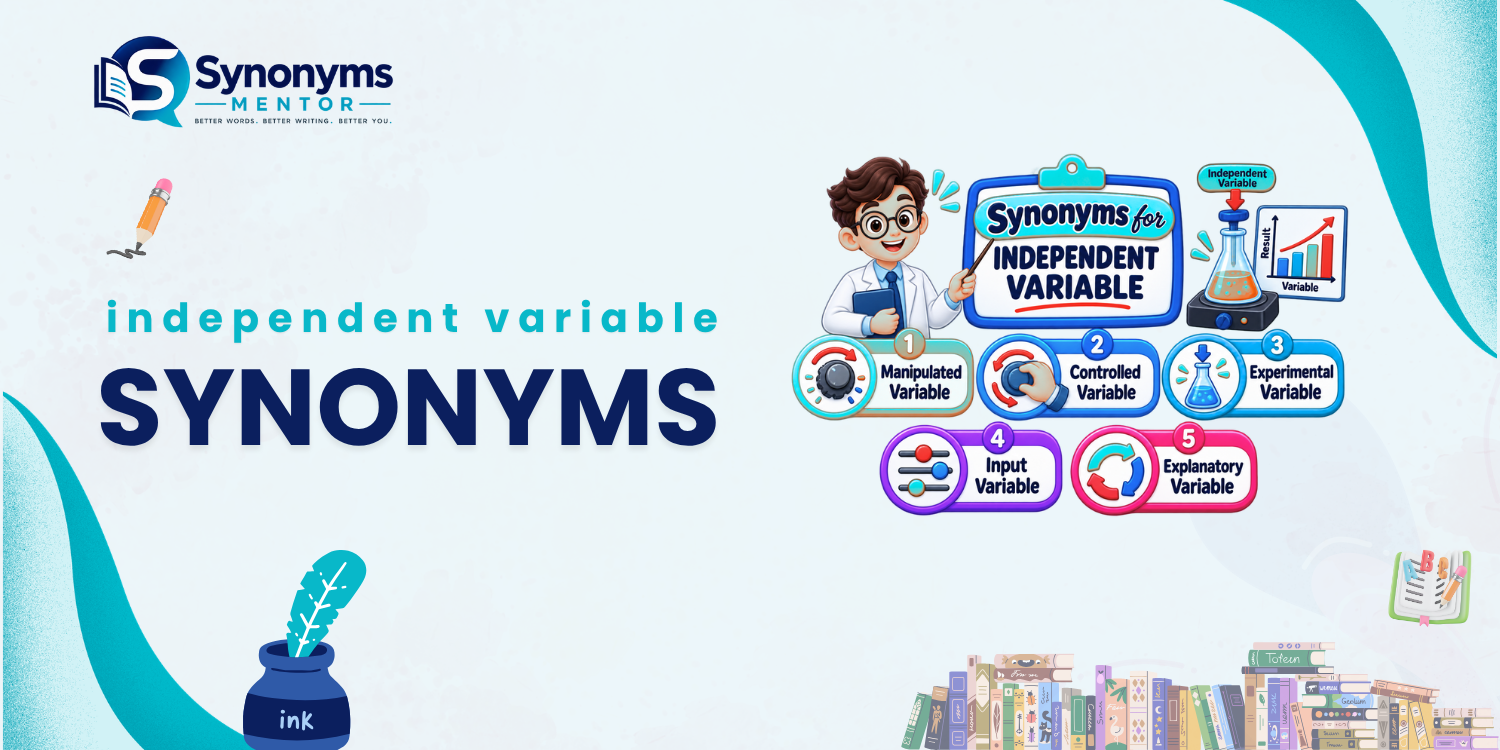
The most useful alternatives for independent variable include manipulated variable, predictor variable, explanatory variable, input variable, regressor, and feature. However, they are not universally interchangeable. Manipulated variable is especially appropriate in experiments, predictor and regressor are common in statistical modeling, and feature is widely used in machine learning. Controlled variable is not a true synonym because it normally refers to a factor kept constant.
Core Synonym Resource
| Word or phrase | Relationship | Meaning | Best context | Formality |
|---|---|---|---|---|
| Manipulated variable | Direct/contextual synonym | Variable deliberately changed by a researcher | Controlled experiments | Academic |
| Predictor variable | Near synonym | Variable used to predict or explain an outcome | Statistics, regression | Academic |
| Explanatory variable | Near synonym | Variable used to explain variation in an outcome | Statistics | Academic |
| Input variable | Contextual alternative | Variable supplied as an input to a function or model | Mathematics, computing, modeling | Neutral/technical |
| Regressor | Contextual alternative | Variable used on the right-hand side of a regression model | Regression analysis | Technical |
| Feature | Contextual alternative | Measured input used by a predictive model | Machine learning, data science | Technical |
| Covariate | Near/technical term | Variable included in an analysis, often to account for variation or adjust estimates | Statistics, research | Technical |
| Treatment variable | Contextual alternative | Variable representing a treatment or intervention | Experimental research, causal inference | Academic |
| Exogenous variable | Related technical term | Variable treated as determined outside the model or sufficiently independent of its error structure | Econometrics, modeling | Highly technical |
| X variable | Descriptive alternative | Conventional label for an independent/input variable | Mathematics, statistics | Neutral |
Important: These terms should not be treated as a simple interchangeable list. Their meanings depend on the research design, statistical model, or discipline.
What Does “Independent Variable” Mean?
An independent variable is a variable whose values are used to examine, explain, predict, or test changes in another variable. In a mathematical function such as y = f(x), x is commonly treated as the independent or input variable. In an experiment, the independent variable is typically the factor whose effect is being tested.
For example:
Researchers change the amount of fertilizer given to plants and measure plant growth.
Here:
- Independent variable: amount of fertilizer
- Dependent variable: plant growth
In a controlled experiment, the researcher deliberately changes the independent variable while measuring the response.
The exact terminology changes outside experimental research, which is why choosing the right synonym matters.
The Most Useful Independent Variable Synonyms
1. Manipulated Variable
Manipulated variable is one of the closest alternatives when discussing a controlled experiment.
It refers to the factor that the researcher deliberately changes to observe its effect on another variable. Educational science resources commonly use manipulated variable as another name for the independent variable.
Example:
The amount of water was the manipulated variable in the experiment.
Choose this term when: you are describing an experiment in which the researcher actively changes a factor.
2. Predictor Variable
Predictor variable is common in statistics and regression analysis. It refers to a variable used to predict or explain variation in an outcome.
Example:
Study time was used as a predictor variable for exam performance.
It is often treated as an alternative to independent variable, but the terms are not conceptually identical in every situation. A predictor does not necessarily have to be experimentally manipulated.
Choose “predictor variable” when: discussing statistical prediction or regression rather than a controlled experiment.
3. Explanatory Variable
Explanatory variable emphasizes the role a variable plays in explaining variation in another variable.
Example:
Age was included as an explanatory variable in the statistical model.
This term is particularly useful in statistical writing because it avoids implying that the variable was physically manipulated.
Choose “explanatory variable” when: the goal is to discuss statistical association or explanation rather than experimental manipulation.
4. Input Variable
Input variable describes a variable supplied to a function, model, system, or computational process.
Example:
In the equation, temperature is the input variable, while energy consumption is the output.
This is a good alternative in mathematics, programming, engineering, and modeling.
Choose “input variable” when: you want to emphasize what enters a mathematical or computational system.
5. Regressor
Regressor is a technical term used in regression analysis for a variable included as an explanatory variable in a regression model.
Example:
The model contains three regressors: age, income, and education.
This term is more specialized than independent variable and is most appropriate when discussing regression.
Choose “regressor” when: writing specifically about regression models.
6. Feature
In machine learning and predictive modeling, feature commonly refers to an input variable or measurable characteristic supplied to a model.
Example:
Age and annual income were used as features in the prediction model.
Feature is therefore a useful contextual alternative, but it should not automatically replace independent variable in traditional experimental writing.
Choose “feature” when: discussing machine learning, artificial intelligence, or predictive data analysis.
7. Covariate
Covariate is a statistical term for a variable included in an analysis alongside the main variables of interest. Depending on the analytical framework, it may be used to account for variation, improve precision, or adjust an estimated relationship.
Example:
Researchers included age and baseline score as covariates in the analysis.
A covariate can overlap with what someone informally calls an independent variable, but the terms are not universally equivalent.
Choose “covariate” when: the variable has a specific adjustment or modeling role in a statistical analysis.
8. Treatment Variable
Treatment variable is appropriate when the independent variable represents an intervention, exposure, or treatment.
Example:
The treatment variable indicated whether participants received the new program.
This is narrower than independent variable because not every independent variable represents a treatment.
Choose “treatment variable” when: describing experimental or causal research involving an intervention or treatment.
9. Exogenous Variable
Exogenous variable is a specialized statistical and econometric term. It should not be used casually as a synonym for every independent variable.
In technical modeling, exogenous describes assumptions about how a variable relates to the model and its error structure. Therefore, it carries a more specific meaning than simply “variable that affects another variable.”
Example:
The researchers treated the policy change as an exogenous variable in the model.
Choose “exogenous variable” only when: the relevant statistical or econometric assumptions actually apply.
10. X Variable
X variable is a simple descriptive term based on the common notation in which an independent or input variable is represented by x.
Example:
If
y = 3x + 2, x is the input or independent variable.
It is understandable but less precise than a technical term such as predictor, regressor, or manipulated variable.
Choose “X variable” when: explaining equations or basic mathematical relationships.
Which Word Should I Use?
The best synonym depends on what you are writing about.
Choose “manipulated variable” when:
You are describing a controlled experiment and the researcher deliberately changes the variable.
Choose “predictor variable” when:
You are discussing a statistical model that uses variables to predict an outcome.
Choose “explanatory variable” when:
You want to emphasize a variable’s role in explaining variation in an outcome.
Choose “input variable” when:
You are discussing mathematics, functions, software, systems, or computational models.
Choose “regressor” when:
You are specifically discussing regression analysis.
Choose “feature” when:
You are writing about machine learning or predictive modeling.
Choose “covariate” when:
The variable has a particular role in a statistical analysis, such as adjustment or accounting for additional variation.
Avoid “controlled variable” as a synonym when:
You mean the variable being changed.
A controlled variable is normally a factor deliberately held constant so that its influence does not interfere with the experiment. Calling it an independent variable can therefore reverse two important concepts.
Independent Variable vs. Manipulated Variable
These terms are extremely close in experimental science.
| Independent variable | Manipulated variable |
| General experimental term | Emphasizes deliberate change |
| Common across science education | Especially useful for controlled experiments |
| May describe the variable being tested | Specifically highlights researcher manipulation |
Example:
The temperature was the independent variable.
and:
The temperature was the manipulated variable.
In a typical controlled experiment, both statements can describe the same variable.
Independent Variable vs. Predictor Variable
These terms overlap but should not always be treated as exact equivalents.
An independent variable is strongly associated with experimental and explanatory terminology. A predictor variable is particularly common in statistical models and does not necessarily imply that researchers manipulated the variable.
For example, researchers might use a person’s age as a predictor of income without experimentally changing anyone’s age.
Simple rule: use independent variable for experimental or general research explanations; use predictor variable when the statistical prediction role is what matters.
Independent Variable vs. Explanatory Variable
Both terms can describe a variable used to understand variation in an outcome.
The distinction is mainly one of emphasis:
- Independent variable: emphasizes the variable’s role relative to a dependent variable.
- Explanatory variable: emphasizes its role in explaining variation.
For statistical writing, explanatory variable can be a useful choice when you want to avoid suggesting that the variable was experimentally manipulated.
Independent Variable vs. Covariate
A covariate is not simply another universal name for an independent variable.
The term describes a variable included in a statistical analysis with a particular analytical role. For example, researchers may include baseline measurements or demographic variables as covariates when estimating an effect.
Therefore:
Every covariate should not automatically be called an independent variable.
And:
Every independent variable should not automatically be called a covariate.
The appropriate term depends on the research design and model.
Independent Variable vs. Controlled Variable
These are not synonyms.
An independent variable is typically the factor being tested or varied.
A controlled variable is a factor intentionally kept constant.
For example, suppose researchers test whether fertilizer affects plant growth.
- Independent variable: amount of fertilizer
- Dependent variable: plant growth
- Controlled variables: plant species, soil type, container size, and other conditions kept consistent
Confusing these terms can make an explanation of an experiment scientifically inaccurate.
Independent Variable vs. Feature
A feature is a common machine-learning term for an input characteristic used by a predictive model.
For example:
Age, income, and number of previous purchases are features used to predict customer behavior.
In a traditional experiment, however, researchers would normally talk about independent variables rather than features.
So feature is best treated as a contextual alternative, not a universal synonym.
Common Mistakes
Mistake 1: Treating every related term as an exact synonym
Words such as predictor, covariate, and feature overlap with independent variable, but their technical meanings can differ.
Mistake 2: Calling a controlled variable an independent variable
A controlled variable is normally kept constant. It is not the factor whose effect is being tested.
Mistake 3: Using “predictor” to imply causation
A predictor variable can be statistically useful for prediction without proving that it causes the outcome.
Mistake 4: Using “exogenous” casually
Exogenous has technical implications in statistical and econometric modeling. It is not simply a more sophisticated word for independent variable.
Mistake 5: Using “regressor” outside regression
Although regressor is a legitimate technical term, it is unnecessary in a basic science experiment.
Examples in Different Fields
Science experiment
The amount of sunlight was the independent variable.
Best alternative: manipulated variable if the amount of sunlight was deliberately changed.
Statistics
Advertising expenditure was used as a predictor variable for sales.
Best alternative: explanatory variable may also work depending on the statistical context.
Regression
Income was included as a regressor in the model.
Best alternative: predictor in less technical statistical writing.
Mathematics
In
y = f(x), x is the input variable.
Best alternative: independent variable.
Machine learning
Age and income were included as model features.
Best alternative: input variables when explaining the concept to a general audience.
Antonyms and Contrasting Terms
The most important contrasting term is dependent variable.
An independent variable is generally the variable used to explain, predict, or test changes in an outcome, while the dependent variable is the outcome being measured or modeled.
For a simple experiment:
Independent variable → dependent variable
For example:
Study time → test score
The terminology can vary across disciplines, but this distinction is fundamental to understanding experimental and statistical relationships.
FAQ
What is another word for independent variable?
Common alternatives include manipulated variable, predictor variable, explanatory variable, input variable, and regressor. The best term depends on the context. Manipulated variable is especially suitable for experiments, while predictor and regressor are more natural in statistical modeling.
Is “manipulated variable” a synonym for independent variable?
In a typical controlled experiment, yes, the two terms can refer to the same variable. Manipulated variable specifically emphasizes that the researcher deliberately changes the factor being tested.
Is predictor variable the same as independent variable?
They often overlap, but they are not universally identical. Predictor variable is especially common in statistical and regression contexts and does not necessarily imply experimental manipulation. Therefore, it can be a useful alternative in some contexts but not every context.
Is explanatory variable another name for independent variable?
It can be used as a close alternative in statistical contexts. Explanatory variable emphasizes the variable’s role in explaining variation in an outcome, whereas independent variable is more broadly associated with experimental and statistical terminology.
Is controlled variable a synonym for independent variable?
No. A controlled variable is generally a factor that researchers deliberately keep constant during an experiment. The independent variable is the factor whose effect is being tested or varied.
What is an independent variable called in regression?
Depending on the field and model, it may be called a predictor, explanatory variable, regressor, or covariate. These terms overlap but can have different technical implications, so the terminology should match the statistical context. Wolfram MathWorld lists several of these terms as alternative terminology while noting the broader mathematical context.
What is an independent variable called in machine learning?
A machine-learning model will often refer to its input variables as features. However, feature belongs to machine-learning terminology and is not a universal replacement for independent variable in experimental science.
What is the opposite of an independent variable?
The usual contrasting term is dependent variable. In a basic experiment, the independent variable is changed or selected to test its relationship with the dependent variable, which is measured as the outcome.
Conclusion
The best independent variable synonym depends on the discipline and the role the variable plays. Manipulated variable is one of the closest choices for controlled experiments, while predictor variable and explanatory variable are common in statistics. Regressor belongs mainly to regression terminology, feature is especially useful in machine learning, and input variable works well in mathematics and computing.

James Anderson is an English teacher and language researcher who creates easy synonym guides and vocabulary lessons. His goal is to help students and writers improve their language skills through simple and clear explanations.