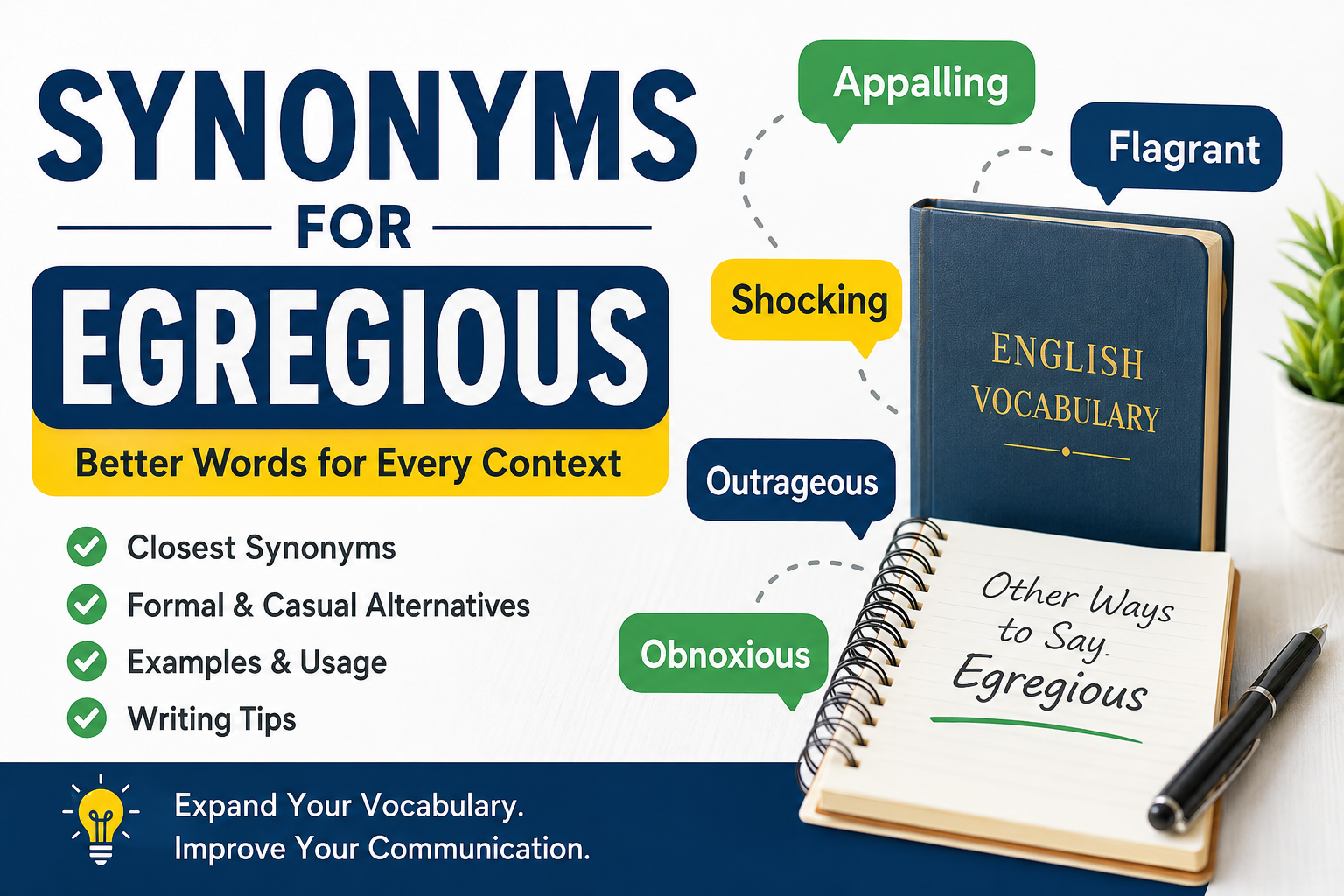
Synonyms for Egregious: Precise Alternatives for Every Context
Finding the right synonym for egregious is not simply a matter of replacing one strong adjective with another. Egregious describes something that is extremely bad and noticeably or conspicuously so, often with a formal or disapproving tone.
The best alternative depends on what you want to emphasize: obviousness, seriousness, offensiveness, moral wrongdoing, or sheer extremity.
This guide distinguishes close synonyms such as flagrant, glaring, and gross from stronger or more context-specific alternatives such as heinous, atrocious, and outrageous. It also explains which words work naturally with phrases such as egregious error, egregious misconduct, and egregious violation.
Quick Answer: What Are the Best Synonyms for Egregious?
The closest synonyms for egregious include flagrant, glaring, gross, outrageous, shocking, atrocious, heinous, deplorable, and appalling. The best choice depends on the nuance.
Use flagrant for an obvious and serious violation, glaring for an unmistakable error or problem, heinous for morally wicked acts, and outrageous for conduct that provokes strong disapproval.
What Does “Egregious” Mean?
Egregious is an adjective meaning extremely bad, especially in a way that is very noticeable. It is normally used with a negative or disapproving sense and is relatively formal.
Common examples include:
- an egregious error
- an egregious mistake
- egregious misconduct
- an egregious violation
- an egregious abuse of power
- an egregious example of negligence
Part of Speech
Egregious is an adjective.
The investigation uncovered an egregious violation of company policy.
It is not normally used as a noun or verb.
Pronunciation
US IPA: /ɪˈɡriːdʒəs/
UK IPA: /ɪˈɡriːdʒəs/
The stress falls on the second syllable: ih-GREE-jus. Cambridge and Oxford give essentially the same modern pronunciation.
A Brief Note on the History of “Egregious”
Egregious has an unusually interesting history. It comes from Latin egregius, meaning “distinguished” or “outstanding,” literally associated with standing apart from the flock. The modern negative meaning developed later, apparently through ironic use.
Today, the overwhelmingly normal meaning is negative: outstandingly bad, extreme, or shockingly unacceptable. Merriam-Webster still records the older positive sense as archaic.
The Best Synonyms for Egregious
Not every word listed in a thesaurus is an interchangeable synonym. The following are the most useful alternatives, separated according to their actual nuance.
| Word | Relationship | Strength | Formality | Best Context |
|---|---|---|---|---|
| flagrant | Close synonym | Very strong | Formal/neutral | Serious, obvious wrongdoing |
| glaring | Close synonym | Strong | Neutral | Errors, defects, problems |
| gross | Close synonym | Strong | Neutral/formal | Serious errors, misconduct, violations |
| outrageous | Near synonym | Very strong | Neutral | Offensive or unacceptable conduct |
| shocking | Near synonym | Very strong | Neutral | Actions producing surprise or alarm |
| atrocious | Near synonym | Very strong | Neutral/formal | Extremely bad quality or conduct |
| heinous | Contextual synonym | Extremely strong | Formal | Morally wicked crimes or acts |
| appalling | Near synonym | Very strong | Neutral | Extremely bad, disturbing situations |
| deplorable | Near synonym | Strong | Formal | Conduct deserving condemnation |
| grievous | Contextual synonym | Strong | Formal | Serious harm, error, or wrongdoing |
| monstrous | Contextual synonym | Extremely strong | Formal/literary | Exceptionally cruel or shocking acts |
| shameful | Near synonym | Strong | Neutral | Conduct causing disgrace |
| blatant | Contextual alternative | Strong | Neutral | Open, obvious wrongdoing |
| extreme | Near synonym | Variable | Neutral | Excessive degree or severity |
| intolerable | Contextual alternative | Very strong | Formal | Conditions or behavior that cannot reasonably be accepted |
1. Flagrant
Flagrant is one of the closest substitutes for egregious. It describes wrongdoing that is obvious, serious, and difficult to overlook.
Best used for: violations, abuses, misconduct, disregard of rules, and wrongdoing.
The company committed a flagrant violation of environmental regulations.
Egregious emphasizes extreme badness; flagrant especially emphasizes the obviousness and blatant nature of the wrongdoing.
Egregious: an extremely bad violation
Flagrant: an obvious and serious violation
2. Glaring
Glaring works particularly well when the problem is immediately obvious.
The report contained a glaring error in its financial calculations.
It is excellent for:
- errors
- inconsistencies
- omissions
- weaknesses
- defects
- problems
Compared with egregious, glaring places more weight on visibility or obviousness and less on moral seriousness.
3. Gross
Gross can mean extremely bad, serious, offensive, or excessive depending on context.
The investigation revealed gross negligence.
It is especially natural in established combinations such as:
- gross negligence
- gross misconduct
- gross error
- gross violation
Gross can therefore be a highly natural alternative, but it does not always carry exactly the same rhetorical force as egregious.
4. Outrageous
Outrageous describes something so unacceptable, unreasonable, offensive, or excessive that it provokes strong disapproval.
The court criticized the defendant’s outrageous conduct.
Use outrageous when the emotional reaction matters.
Egregious sounds more formal and evaluative.
Outrageous often sounds more expressive and emotionally charged.
5. Shocking
Shocking emphasizes the reaction something produces.
The audit uncovered a shocking level of financial mismanagement.
It is useful when something is:
- surprising
- disturbing
- alarming
- unexpectedly severe
Unlike egregious, shocking does not necessarily mean morally wrong; something can be shocking because it is unexpected or extreme.
6. Atrocious
Atrocious means extremely bad or unacceptable and is particularly strong.
The prisoners were subjected to atrocious conditions.
It works naturally for:
- conditions
- treatment
- behavior
- service
- performance
- acts of cruelty
Atrocious is usually stronger and more emotionally negative than egregious.
7. Heinous
Heinous is a very strong word associated with wicked, hateful, or morally reprehensible acts, especially serious crimes.
The judge described the crime as heinous.
It is not a universal replacement for egregious.
You can have an egregious accounting error, but heinous accounting error would normally sound absurd because heinous carries a strong moral dimension.
Use heinous for: crimes, cruelty, atrocities, and morally reprehensible conduct.
8. Appalling
Appalling means extremely bad, shocking, or disturbing.
The investigation uncovered appalling conditions at the facility.
It is natural in both formal and general English and often focuses on the emotional reaction to something extremely bad.
9. Deplorable
Deplorable means deserving strong disapproval or condemnation.
The organization condemned the deplorable treatment of its employees.
It is particularly useful in formal writing, reports, editorials, and public statements.
Compared with egregious, deplorable emphasizes condemnation more than conspicuousness.
10. Grievous
Grievous means very serious or severe, especially when referring to harm, wrongdoing, or an error.
The committee acknowledged the grievous consequences of the decision.
It is more formal and somewhat less common in everyday conversation.
It is a good alternative when the emphasis is on serious harm or severity, rather than obviousness.
11. Monstrous
Monstrous can describe something exceptionally cruel, wicked, shocking, or excessive.
The report documented monstrous acts of cruelty.
It is stronger and more emotionally charged than egregious and is often literary or rhetorical.
12. Shameful
Shameful describes behavior or actions that should cause shame or disgrace.
The committee called the treatment of the workers shameful.
It is useful when the central idea is disgrace or dishonor, rather than simply extreme badness.
13. Blatant
Blatant means very obvious and often offensively or improperly so.
The company engaged in blatant discrimination.
It overlaps strongly with egregious when the wrongdoing is conspicuous.
The distinction is useful:
- egregious → extremely bad
- blatant → openly and unmistakably obvious
14. Extreme
Extreme is broader and less specifically negative.
The policy imposed extreme restrictions on employees.
It can describe something very severe, excessive, or far beyond normal limits, but it does not automatically imply wrongdoing.
Therefore, extreme is a contextual alternative rather than a perfect substitute.
15. Intolerable
Intolerable means so bad, unpleasant, or unacceptable that it cannot reasonably be endured or accepted.
The workers complained about intolerable conditions.
It works especially well for:
- conditions
- behavior
- treatment
- delays
- circumstances
Its key nuance is unacceptability, not conspicuousness.
Closest Synonyms vs Stronger Alternatives
A useful way to choose among these words is to ask what you want to emphasize.
Closest in meaning
Flagrant, glaring, gross
These are usually the safest alternatives when you want to retain the basic meaning of egregious.
More emotionally forceful
Outrageous, shocking, appalling, atrocious
These emphasize emotional reaction or extreme severity.
More morally severe
Heinous, monstrous, deplorable
These are best when the subject involves serious wrongdoing, cruelty, or moral condemnation.
More focused on obviousness
Blatant, glaring
These highlight the fact that the problem is unmistakable.
More focused on severity
Extreme, grievous, intolerable
These emphasize degree, seriousness, harm, or unacceptability.
Egregious Synonyms by Context
For an Egregious Mistake
The most natural alternatives are:
- glaring mistake
- gross mistake
- flagrant error
- serious error
- shocking error
- atrocious mistake
The analyst made a glaring error in the final calculation.
Glaring is often better than heinous because mistakes are usually described in terms of obviousness or seriousness, not moral wickedness.
For Egregious Behavior
Good alternatives include:
- outrageous behavior
- appalling behavior
- deplorable behavior
- shameful behavior
- atrocious behavior
- flagrant misconduct
The manager was disciplined for outrageous behavior toward the staff.
For an Egregious Violation
The strongest natural alternatives include:
- flagrant violation
- gross violation
- blatant violation
- serious violation
- outrageous violation
The regulator found a flagrant violation of safety requirements.
Flagrant violation is particularly natural because the phrase captures both seriousness and obvious disregard.
For Egregious Misconduct
Consider:
- flagrant misconduct
- gross misconduct
- outrageous misconduct
- deplorable misconduct
- serious misconduct
Gross misconduct and flagrant misconduct are often more idiomatic than trying to substitute a highly emotional adjective.
Which Word Should I Use?
Choose flagrant when the wrongdoing is both obvious and serious. Glaring is more suitable for an unmistakable error, flaw, or problem. For serious negligence, misconduct, or violations, gross is often the stronger choice.
If you want to emphasize that something is offensive or unacceptable, outrageous works well. Shocking focuses more on the reaction of surprise, alarm, or disbelief. When something is exceptionally bad, atrocious is the most fitting choice.
For morally wicked or exceptionally cruel acts, heinous is particularly appropriate. Deplorable is useful when the subject deserves strong or formal condemnation. When wrongdoing is open, obvious, and impossible to hide, blatant is a natural choice. Finally, intolerable describes something so bad that it cannot reasonably be accepted or endured.
Egregious vs Flagrant
These words are close, but not identical.
| Word | Main emphasis | Example |
| Egregious | Extremely bad and conspicuous | an egregious error |
| Flagrant | Obvious and serious wrongdoing | a flagrant violation |
The company made an egregious error in its report.
The company committed a flagrant violation of the rules.
If the central idea is extreme badness, egregious is often better. If the central idea is open and obvious wrongdoing, flagrant is especially precise.
Egregious vs Glaring
Glaring focuses more strongly on obviousness.
There was a glaring error in the report.
Egregious adds a stronger sense of extreme badness.
There was an egregious error in the report.
A mistake can be glaring because everyone can see it. Calling it egregious suggests that it is not merely visible but particularly serious or unacceptable.
Egregious vs Outrageous
Egregious is generally more formal and analytical.
Outrageous is more emotionally expressive.
The investigation uncovered an egregious breach of procedure.
The executive’s demands were outrageous.
Use egregious naturally in formal reports, legal or regulatory contexts, professional writing, and serious analysis. Use outrageous when expressing stronger personal or public disapproval.
Egregious vs Heinous
These words should not be treated as interchangeable.
Egregious can describe:
- errors
- violations
- misconduct
- negligence
- mistakes
- abuses
Heinous is strongly associated with morally wicked, cruel, or horrific acts, particularly serious crimes.
an egregious accounting error
a heinous crime
The first is natural; the second is natural. Replacing egregious with heinous in every context would create unnatural English.
Natural Collocations with “Egregious”
Some combinations are particularly useful:
- egregious error
- egregious mistake
- egregious misconduct
- egregious violation
- egregious abuse
- egregious behavior
- egregious example
- egregious failure
- egregious negligence
- egregious breach
- egregious injustice
- egregious case
Oxford specifically notes collocations such as egregious error and egregious example, while dictionary examples also show common combinations involving misconduct and violations.
Common Mistakes When Using “Egregious”
1. Treating every synonym as interchangeable
Words such as heinous and glaring have different semantic focuses.
Better: Match the synonym to the context.
2. Using “egregious” simply to mean “very large”
This is sometimes seen in phrases such as:
an egregious amount of money
Such usage exists in contemporary English, but the core meaning remains strongly associated with something extremely bad or objectionable, rather than merely large.
3. Assuming “egregious” means “excellent”
The word historically had a positive sense meaning distinguished or outstanding, but that meaning is archaic in modern English. Modern readers overwhelmingly interpret egregious negatively.
4. Using “heinous” for ordinary mistakes
A spelling mistake can be egregious if it is particularly bad, but calling it heinous usually introduces an inappropriate moral meaning.
5. Using “blatant” when severity is the main point
Blatant emphasizes obviousness. If you need to stress that something is exceptionally bad, egregious may be more precise.
Real-World Examples
Workplace
The audit identified an egregious breach of company policy.
Alternative:
The audit identified a flagrant breach of company policy.
Academic Writing
The paper contained an egregious error in its statistical analysis.
Alternative:
The paper contained a glaring error in its statistical analysis.
Professional Communication
The regulator described the conduct as egregious and ordered an independent review.
Alternative:
The regulator described the conduct as deplorable and ordered an independent review.
Everyday English
That was an egregious mistake; we should have checked the figures first.
A more conversational alternative would usually be:
That was a terrible mistake.
This illustrates an important point: egregious is natural but relatively formal. The most accurate synonym is not always the most natural choice for every audience.
Antonyms of Egregious
Depending on the intended contrast, useful antonyms include:
- minor
- moderate
- tolerable
- acceptable
- insignificant
- slight
- inconsequential
- unremarkable
Cambridge lists tolerable, moderate, minor, and unnoticeable among antonyms or contrasting terms.
The best opposite depends on the specific sense being contrasted.
an egregious error → a minor error
egregious misconduct → acceptable conduct
an egregious problem → an insignificant problem
FAQ
What is the closest synonym for egregious?
The closest common alternatives are flagrant, glaring, and gross. All can describe something extremely bad or conspicuously wrong, although each emphasizes a slightly different aspect.
What is another word for egregious?
Depending on context, alternatives include flagrant, glaring, gross, outrageous, shocking, atrocious, heinous, deplorable, appalling, and blatant.
What is the strongest synonym for egregious?
For morally reprehensible conduct, heinous or monstrous can be stronger. For extreme badness more generally, atrocious or appalling can provide greater emotional force. Strength depends on context rather than forming an objective scale.
Is “flagrant” a synonym for “egregious”?
Yes, in many contexts. Both can describe serious and conspicuous wrongdoing. Flagrant places greater emphasis on the openness or obviousness of the offense.
Is “glaring” a synonym for “egregious”?
Often, but it is not identical. Glaring primarily means unmistakably obvious, whereas egregious also conveys extreme badness.
Is “heinous” always a synonym for “egregious”?
No. Heinous is much more strongly associated with moral wickedness, cruelty, and serious crimes. It should not normally replace egregious when describing ordinary mistakes or technical errors.
Is egregious a formal word?
Yes. Major dictionaries classify it as formal or associate it strongly with formal usage. It is particularly common in professional, academic, legal, regulatory, and serious journalistic writing.
Can egregious mean something good?
Historically, yes. The word originally had a positive sense meaning distinguished or outstanding. In modern standard English, however, the normal meaning is negative, and the positive sense is archaic.
Conclusion
The best synonyms for egregious are not interchangeable. Flagrant, glaring, and gross are among the closest alternatives, while outrageous, shocking, atrocious, heinous, and deplorable add different shades of emotional or moral meaning.

Olivia Brown is a vocabulary expert and content writer who focuses on synonyms, antonyms, and word usage. She helps learners understand English words in a simple and practical way, making communication clearer and more effective