Synonyms for Nuance: 15 Precise Alternatives for Subtle Differences
When you need another word for nuance, the best choice depends on what you mean by the word. Nuance usually refers to a subtle distinction, variation, quality, or shade of meaning that may be easy to overlook but still matters.
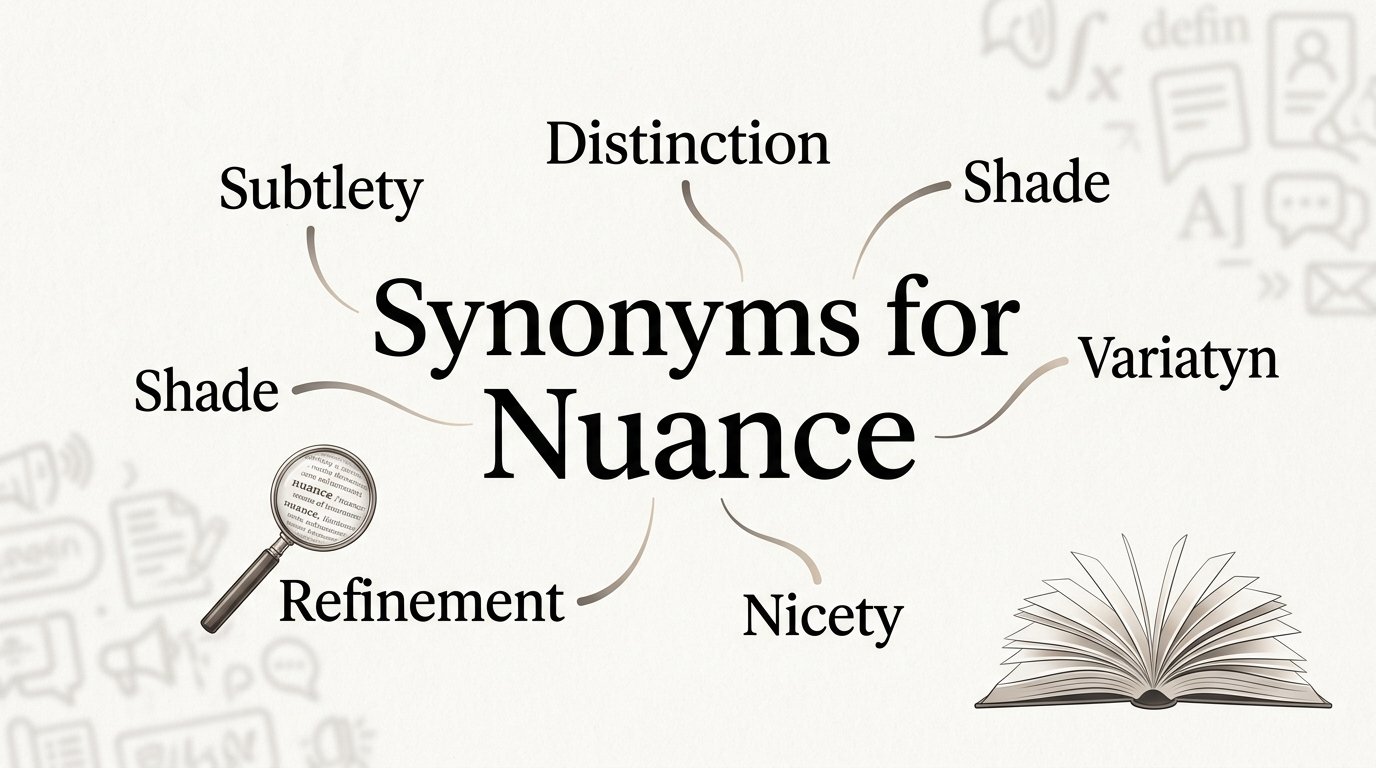
Strong alternatives include subtlety, distinction, refinement, nicety, shade, variation, delicacy, finesse, and modulation. However, these words are not interchangeable in every sentence. Some emphasize a difference, others a delicate quality, and others a particular effect in language, art, behavior, or expression.
This guide separates genuine synonyms from context-specific alternatives so you can choose the word that sounds most natural in English.
Quick Answer: What Are the Best Synonyms for Nuance?
The closest synonyms for nuance include subtlety, distinction, refinement, nicety, shade, and delicacy. Subtlety is often the closest general alternative, while distinction emphasizes a difference, shade emphasizes a slight variation in meaning or appearance, and refinement suggests a delicate or sophisticated quality. The right choice depends on the context.
What Does “Nuance” Mean?
Nuance is primarily a noun meaning a very slight difference or a subtle quality, especially one involving meaning, appearance, sound, tone, feeling, or value.
For example:
The translator understood every nuance of the original poem.
Here, nuance refers to subtle aspects of meaning that could easily be lost in translation.
Part of speech
- Noun: nuance
- Plural: nuances
- Adjective: nuanced
Example:
Her explanation captured the nuances of the issue.
The article offers a nuanced discussion of the problem.
The adjective nuanced means characterized by subtle, often complex distinctions or qualities.
Pronunciation
- US: /ˈnuː.ɑːns/
- UK: /ˈnjuː.ɒns/
Cambridge gives these standard British and American pronunciations.
The Best Synonyms for Nuance
Not every word below is a perfect one-for-one replacement. The table distinguishes the closest synonyms from alternatives that work especially well in particular contexts.
| Word | Relationship | Strength | Formality | Best Context |
|---|---|---|---|---|
| Subtlety | Direct/near synonym | Equal | Neutral–formal | Delicate differences or qualities |
| Distinction | Near synonym | Equal | Neutral–formal | Differences between ideas or things |
| Shade | Near synonym | Slight | Neutral–literary | Slight differences in meaning, tone, or appearance |
| Refinement | Near synonym | Slight | Formal | Sophistication or delicate detail |
| Nicety | Near synonym | Slight | Formal | Fine distinctions or details |
| Delicacy | Contextual alternative | Slight | Neutral–formal | Fine, sensitive qualities |
| Variation | Contextual alternative | Broader | Neutral | Differences or changes |
| Finesse | Contextual alternative | Strong | Neutral–formal | Skillful handling or expression |
| Hint | Contextual alternative | Weaker | Neutral | A slight suggestion |
| Touch | Contextual alternative | Weaker | Neutral | A small expressive element |
| Modulation | Contextual alternative | Specific | Formal/technical | Changes in tone, voice, music, or expression |
| Fineness | Near synonym | Slight | Formal/literary | Delicate quality or precision |
| Sophistication | Related/near synonym | Different emphasis | Neutral–formal | Complexity and refinement |
| Sensitivity | Related/near synonym | Different emphasis | Neutral–formal | Awareness of subtle distinctions |
| Discernment | Related/near synonym | Different emphasis | Formal | Ability to recognize fine differences |
1. Subtlety
Subtlety is usually the closest general synonym for nuance. It refers to the quality of being subtle or to a fine distinction that is not immediately obvious.
Best used for: meaning, humor, emotion, language, behavior, writing, and artistic expression.
The actor conveyed the subtlety of the character’s emotions beautifully.
Nuance vs. subtlety: Nuance often identifies the particular fine distinction itself, whereas subtlety can describe the quality of being difficult to detect.
I appreciated the nuance in her argument.
I appreciated the subtlety of her argument.
Both are natural, but the emphasis is slightly different.
2. Distinction
Distinction emphasizes a difference between two or more things.
The essay makes an important distinction between correlation and causation.
Use distinction when you want to make the difference itself the focus.
It is not always interchangeable with nuance. A distinction can be obvious and significant, whereas a nuance is typically subtle.
3. Shade
Shade can describe a slight variation or degree, particularly in meaning, tone, color, or feeling.
There was a darker shade of irony in his final remark.
The two expressions have slightly different shades of meaning.
This is especially useful in the phrase “a shade of meaning.”
The word can sound more literary or figurative than nuance.
4. Refinement
Refinement emphasizes delicacy, precision, sophistication, or an improved quality.
The revised argument contains several important refinements.
It works particularly well when subtle changes make an idea, design, technique, or argument more precise.
Do not use it automatically for every meaning of nuance. Refinement often suggests improvement or sophistication, while nuance does not necessarily imply either.
5. Nicety
Nicety can mean a fine or subtle distinction or detail.
The lawyer understood the niceties of contract language.
This is particularly natural in formal contexts involving rules, language, law, etiquette, or technical distinctions.
Nicety is less common in casual conversation than subtlety.
6. Delicacy
Delicacy can refer to a fine, subtle, or sensitive quality.
She handled the delicacy of the subject with care.
It is a useful alternative when the nuance involves something emotionally sensitive, aesthetically fine, or difficult to handle.
However, delicacy has several other meanings, including fragile quality and refined food, so context matters.
7. Variation
Variation refers more generally to a difference or change from one form, level, or example to another.
There are subtle variations in regional pronunciation.
It is broader and less inherently subtle than nuance.
Use variation when the emphasis is on differences or changes rather than on the delicate quality of those differences.
8. Finesse
Finesse refers to refined skill, tact, or subtle handling.
The negotiator handled the disagreement with considerable finesse.
It can overlap with nuance when discussing skillful communication or artistic expression, but it is not a universal synonym.
Nuance describes a subtle distinction or quality.
Finesse emphasizes skill in handling something delicately or effectively.
9. Hint
A hint is a slight suggestion or indication.
Her response contained a hint of sarcasm.
Hint is usually weaker and more specific than nuance. It works particularly well when the subtle element is an implied suggestion rather than a complex distinction.
10. Touch
Touch can describe a small element added to writing, speech, art, design, or performance.
The speech had a touch of humor.
This is a natural informal alternative when nuance refers to a small expressive feature.
However, touch does not generally mean a subtle distinction between ideas.
11. Modulation
Modulation is a more specialized alternative. It refers to a change or variation in tone, voice, musical expression, or another quality.
The singer used subtle modulation to convey uncertainty.
This word is particularly appropriate for music, speech, voice, and expressive performance.
12. Fineness
Fineness can describe a delicate degree of quality or distinction.
The critic admired the fineness of the author’s observations.
It is more formal and literary than everyday alternatives such as subtlety.
13. Sophistication
Sophistication overlaps with nuance when the idea involves complexity, refinement, or a lack of simplistic thinking.
The novel presents the issue with considerable sophistication.
However, sophistication does not mean nuance exactly. Something can be sophisticated without containing subtle distinctions, and something can have nuance without being sophisticated.
14. Sensitivity
Sensitivity can refer to an ability to notice or respond to subtle differences.
Her sensitivity to changes in tone made her an excellent editor.
This is especially useful when describing a person’s awareness of nuance, rather than the nuance itself.
His sensitivity to cultural differences was impressive.
Here, sensitivity means awareness, not simply a subtle distinction.
15. Discernment
Discernment refers to the ability to recognize and understand subtle differences, qualities, or distinctions.
The editor showed considerable discernment in choosing the final wording.
It is therefore related to nuance, but it usually describes the ability to perceive nuance, not the nuance itself.
Closest Synonyms vs. Contextual Alternatives
A useful way to avoid inaccurate synonym choices is to separate the words by how closely they match nuance.
Closest alternatives
These usually preserve the central idea most effectively:
- Subtlety
- Distinction
- Shade
- Refinement
- Nicety
Context-dependent alternatives
These work well in particular sentences:
- Delicacy
- Variation
- Finesse
- Hint
- Touch
- Modulation
- Fineness
Related concepts, not exact replacements
These are useful vocabulary relatives but should not automatically replace nuance:
- Sophistication
- Sensitivity
- Discernment
For example, saying someone has discernment means they can recognize subtle differences. It does not mean discernment itself is a synonym for every use of nuance.
Synonyms for “Nuances” in Different Contexts
Because nuances can refer to different kinds of subtle differences, the best alternative changes with the sentence.
Nuances in meaning
Best choices:
- shades
- subtleties
- distinctions
- refinements
The translator preserved the subtleties of the original text.
The two phrases have different shades of meaning.
Nuances in tone
Best choices:
- shades
- subtleties
- variations
- modulations
The editor noticed subtle variations in the author’s tone.
Nuances in emotion
Best choices:
- subtleties
- shades
- delicacies
- distinctions
The performance captured the emotional subtleties of the character.
Nuances in language
Best choices:
- distinctions
- subtleties
- shades
- niceties
Advanced learners often struggle with the niceties of English usage.
Nuances in art
Best choices:
- shades
- subtleties
- refinements
- variations
- touches
The painting contains delicate shades of blue and gray.
Nuances in an argument
Best choices:
- distinctions
- subtleties
- refinements
- qualifications
The revised article includes several important distinctions.
Nuance vs. Subtlety
These words are closely related, but they are not identical.
| Word | Main emphasis | Example |
| Nuance | A particular subtle distinction or quality | The speech contained political nuances. |
| Subtlety | The quality of being subtle or a delicate distinction | The writer handled the subject with subtlety. |
A useful rule is:
Use “nuance” for the fine detail or distinction; use “subtlety” for the delicate quality itself.
In many contexts, however, native speakers can use either naturally.
Nuance vs. Distinction
Distinction focuses on difference.
The article draws a distinction between the two concepts.
Nuance focuses on a subtle difference or additional layer of meaning.
The article explores the nuances between the two concepts.
A distinction can be clear and substantial. A nuance is normally more delicate.
Nuance vs. Shade
Shade is particularly useful when describing slight differences in meaning, tone, color, or feeling. For example, the two expressions may convey a different shade of meaning, even though their overall definitions are similar. By contrast, nuance has a broader range of uses and is more common in analytical, academic, and detailed discussions.
Nuance vs. Refinement
Unlike refinement, nuance does not necessarily suggest improvement. Instead, it highlights a subtle distinction, variation, or additional layer of meaning.
The critic noticed a nuance in the performance.
Refinement often suggests a fine adjustment, improvement, or sophisticated detail.
The designer introduced several refinements to the original concept.
Therefore, refinement is a good contextual alternative but not a universal substitute.
Nuance vs. Variation
Variation is broader.
There are regional variations in pronunciation.
The differences may be subtle, but they do not have to be.
By contrast, nuance inherently points toward a finer distinction or quality.
Nuance and “Nuanced”
The adjective nuanced is increasingly important in modern English, especially in journalism, criticism, academic writing, and professional analysis.
It describes something that recognizes or presents subtle distinctions rather than reducing an issue to a simple binary.
The report offers a nuanced analysis of the problem.
Her answer was more nuanced than the original proposal.
Good alternatives for nuanced depend heavily on context:
- subtle
- refined
- sophisticated
- complex
- qualified
- finely differentiated
- carefully considered
These are contextual alternatives rather than perfect substitutes.
Natural Collocations With “Nuance”
Some common combinations are particularly useful for writers and learners:
- subtle nuance
- political nuance
- cultural nuance
- linguistic nuance
- emotional nuance
- historical nuance
- semantic nuance
- nuance of meaning
- nuances of language
- nuances of tone
- nuances of expression
- capture the nuance
- understand the nuance
- appreciate the nuance
- miss the nuance
- add nuance
- lose the nuance
Examples:
A good translator must understand the cultural nuances of the source text.
The revised version adds nuance to the argument.
The actor captured every nuance of emotion in the scene.
Which Word Should You Use?
Choose the word according to the distinction you want to emphasize.
Use subtlety when:
You mean a delicate quality or fine distinction.
The subtlety of the performance was impressive.
Use distinction when:
You want to emphasize a difference between two ideas.
The author makes an important distinction.
Use shade when:
You mean a slight difference in meaning, tone, color, or feeling.
The phrase has a different shade of meaning.
Use refinement when:
You mean a delicate improvement or sophisticated detail.
The proposal needs a few refinements.
Use nicety when:
You mean a fine point or detail, especially in formal language or rules.
The lawyer understood the niceties of the agreement.
Use variation when:
You mean a difference or change more generally.
There are regional variations in pronunciation.
Use finesse when:
You mean skillful and delicate handling.
She handled the negotiation with finesse.
Use hint when:
You mean a slight suggestion or indication.
His answer contained a hint of sarcasm.
Common Mistakes With “Nuance” Synonyms
Mistake 1: Treating every related word as a direct synonym
Words such as sensitivity, discernment, and sophistication are related to nuance but do not replace it naturally in every sentence.
Better approach: Choose a word according to the specific meaning you want.
Mistake 2: Using “distinction” for every subtle difference
A distinction can be substantial or clearly defined.
Nuance usually suggests something finer or less immediately obvious.
Mistake 3: Using “hint” when the idea is complex
A hint is normally a suggestion or indication.
The statement contained a hint of criticism.
But:
The article explores the nuances of the debate.
Hint is too narrow for the second meaning.
Mistake 4: Assuming “refinement” always means nuance
Refinement often carries an additional idea of improvement, sophistication, or precision.
It is therefore a contextual alternative rather than a universal synonym.
Mistake 5: Using “variation” when subtlety matters
Variation simply indicates difference or change.
If the important point is a delicate layer of meaning, nuance or subtlety is usually more precise.
Real-World Examples
Academic writing
The study acknowledges the cultural nuances that earlier researchers overlooked.
Possible alternative:
The study acknowledges the cultural subtleties that earlier researchers overlooked.
Workplace communication
The manager understood the nuance of the client’s response.
Possible alternative:
The manager understood the subtlety of the client’s response.
Translation
A literal translation may lose important shades of meaning.
Here, shades is particularly natural because the phrase refers directly to fine differences in meaning.
Literature
The author captures the emotional nuances of family relationships.
Possible alternative:
The author captures the emotional subtleties of family relationships.
Art and design
The painter used subtle variations in color to create depth.
Here, variations is more precise than nuances because the sentence focuses on changes in color.
Antonyms of Nuance
The best opposite depends on the sense being discussed. Useful contrasts include:
- bluntness
- simplicity
- generality
- coarseness
- oversimplification
- lack of distinction
For example:
The article was criticized for its oversimplification of a complex issue.
This is often a more useful semantic opposite of nuance than a single dictionary-style antonym.
Frequently Asked Questions
What is the closest synonym for nuance?
Subtlety is usually the closest general synonym. Depending on context, distinction, shade, refinement, and nicety can also be very close alternatives.
What is another word for nuances?
Depending on the sentence, alternatives include subtleties, distinctions, shades, refinements, niceties, variations, and delicate differences.
What is a formal synonym for nuance?
Distinction, refinement, nicety, and delicacy can work in formal contexts. The best choice depends on the exact meaning.
Is “subtlety” the same as “nuance”?
They overlap substantially, but they are not identical. Nuance often refers to a particular subtle distinction or quality, while subtlety can refer to the quality of being subtle itself.
What is a synonym for “nuanced”?
Depending on context, possible alternatives include subtle, refined, sophisticated, complex, qualified, and carefully differentiated. They are not interchangeable in every sentence.
What is the difference between nuance and distinction?
A distinction is a difference between things or ideas. A nuance is generally a finer or less obvious distinction, often involving meaning, tone, feeling, or quality.
What is another word for a subtle difference?
Good choices include nuance, subtlety, distinction, shade, nicety, and fine distinction.
Can “variation” replace “nuance”?
Sometimes. Variation is appropriate when you mean a difference or change, but it does not necessarily imply the subtlety associated with nuance.
Conclusion
The best synonym for nuance depends on the kind of subtle difference you mean. Subtlety is the closest broad alternative; distinction emphasizes difference; shade works especially well for meaning, tone, and color; refinement suggests sophistication or fine adjustment; and nicety highlights a fine point or detail.
Contextual alternatives such as variation, delicacy, finesse, hint, and modulation can be more precise in particular situations.

James Anderson is an English teacher and language researcher who creates easy synonym guides and vocabulary lessons. His goal is to help students and writers improve their language skills through simple and clear explanations.