Synonyms for Theory: 20 Better Alternatives With Examples
Finding a synonym for theory is not simply a matter of choosing another word from a thesaurus. The word theory has several meanings, and the best replacement depends heavily on context.
In scientific and academic writing, theory can refer to a systematic explanation supported by evidence. In everyday English, it can mean an idea or explanation that someone believes may be true. It can also describe a body of principles in a subject, as in music theory. Cambridge and Collins both distinguish these different uses.
That is why hypothesis, concept, idea, notion, assumption, and speculation are not interchangeable in every sentence. This guide separates the strongest alternatives and shows when each one sounds natural.
Quick Answer: What Are the Best Synonyms for Theory?
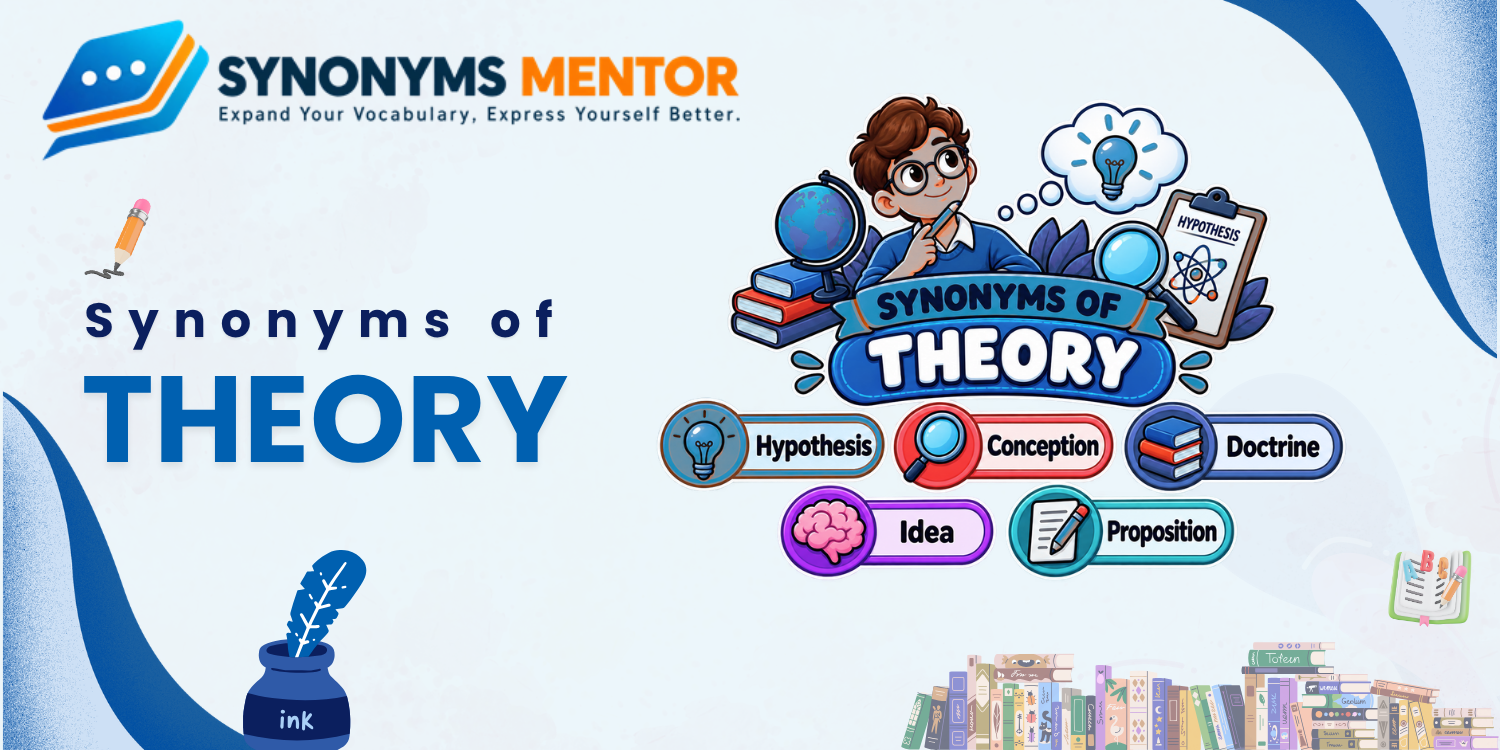
The closest alternatives to theory include hypothesis, idea, concept, notion, supposition, conjecture, assumption, speculation, proposition, thesis, and belief.
However, they are not equally interchangeable. Hypothesis is especially useful for a proposed explanation that can be tested, while idea and notion are broader and more informal. In everyday contexts, belief, assumption, or speculation may be more appropriate.
Core Synonym Resource
| Word | Relationship | Meaning | Strength | Formality | Best Context |
|---|---|---|---|---|---|
| Hypothesis | Near synonym | Proposed explanation that can be tested | Similar | Formal | Science, research |
| Idea | Contextual alternative | A thought or possible explanation | Broader/weaker | Neutral | General writing |
| Concept | Contextual alternative | An abstract idea or principle | Similar in some contexts | Neutral/Formal | Academic, professional |
| Notion | Near synonym | An idea or belief, often less definite | Weaker | Neutral | General discussion |
| Supposition | Near synonym | An assumption or idea accepted provisionally | Weaker | Formal | Academic/formal writing |
| Conjecture | Near synonym | An explanation or belief based on incomplete evidence | Weaker | Formal | Research, reasoning |
| Assumption | Contextual alternative | Something accepted as true without proof | Different emphasis | Neutral/Formal | Research, arguments |
| Speculation | Near synonym | An uncertain idea based on limited information | Weaker | Neutral/Formal | Predictions, discussion |
| Belief | Contextual alternative | An idea considered true | Different emphasis | Neutral | Personal views |
| Proposition | Contextual alternative | A statement or idea put forward for consideration | Similar | Formal | Academic, logical writing |
| Thesis | Contextual alternative | A central argument or claim | More specific | Formal | Academic writing |
| Principle | Contextual alternative | A fundamental rule or idea | More established | Formal | Science, philosophy |
| Framework | Contextual alternative | An organized structure for understanding something | Different emphasis | Formal | Research, business |
| Model | Contextual alternative | A representation used to explain or predict something | Different emphasis | Formal | Science, economics |
| Explanation | Contextual alternative | An account of why or how something happens | Broader | Neutral | General and academic |
| Philosophy | Contextual alternative | A system of ideas or guiding beliefs | Broader | Neutral/Formal | Ethics, politics, life |
| View | Contextual alternative | An opinion or way of understanding something | Broader/weaker | Neutral | General discussion |
| Supposition | Near synonym | Something provisionally believed or assumed | Weaker | Formal | Reasoning |
| Surmise | Contextual alternative | A conclusion reached without certainty | Weaker | Formal/Literary | General reasoning |
| Guess | Contextual alternative | An uncertain answer or explanation | Much weaker | Informal/Neutral | Everyday conversation |
The classification matters because major thesaurus sources themselves list alternatives according to different senses of theory. Collins, for example, groups hypothesis with the formal explanatory sense while placing words such as belief, speculation, assumption, conjecture, and supposition under the sense of an uncertain personal idea.
What Does “Theory” Mean?
Theory is a noun with several related meanings.
In one important sense, it means a formal set of ideas or principles intended to explain facts, events, or how something works. This is the sense found in expressions such as scientific theory, economic theory, and the theory of evolution.
In another sense, theory can mean a personal explanation or belief that has not been established as true:
She has a theory about why the project failed.
There is also a specialized sense referring to the principles or rules underlying a subject or practice, as in music theory.
This variation explains why there is no single synonym that works perfectly in every sentence.
The Most Useful Synonyms for Theory
1. Hypothesis
Meaning: A proposed explanation that can be investigated or tested.
Best contexts: Science, research, experiments, academic writing.
Example:
The researchers developed a hypothesis about why the plants grew more quickly.
How it differs from theory:
In technical scientific usage, a hypothesis is generally a proposed explanation that is still being tested, whereas a scientific theory is a broader explanatory framework supported by substantial evidence. Collins explicitly notes this distinction.
Best choice when: You mean a tentative explanation rather than an established explanatory framework.
2. Idea
Meaning: A thought, suggestion, or possible explanation.
Example:
She proposed an interesting idea about what caused the problem.
How it differs:
Idea is much broader than theory. It does not imply a systematic explanation or supporting evidence.
Best choice when: You want a simple, natural alternative in everyday English.
3. Concept
Meaning: An abstract idea or general understanding of something.
Example:
The concept of supply and demand is fundamental to economics.
How it differs:
A concept is usually an idea or mental abstraction rather than a complete explanation of how or why something happens.
Best choice when: You are discussing an abstract academic, scientific, or professional idea.
4. Notion
Meaning: An idea, belief, or understanding of something.
Example:
The notion that success comes easily is misleading.
How it differs:
Notion can suggest an idea that is somewhat vague, subjective, or not firmly established.
Best choice when: You want to describe an idea without presenting it as a rigorous theory.
5. Supposition
Meaning: Something believed or accepted temporarily without definite proof.
Example:
The investigation was based on the supposition that the data had been altered.
Register: Formal.
Best choice when: The emphasis is on an assumption made for the sake of reasoning.
6. Conjecture
Meaning: An opinion or explanation formed without enough evidence to establish certainty.
Example:
His explanation remains a conjecture because there is not enough evidence.
How it differs:
Conjecture strongly emphasizes uncertainty.
Best choice when: You want to make clear that an explanation is speculative.
7. Assumption
Meaning: Something accepted as true without proof.
Example:
The study was based on the assumption that participants answered honestly.
How it differs:
An assumption is something taken for granted; it is not necessarily an explanatory theory.
Best choice when: You mean a starting belief or premise rather than a complete explanation.
8. Speculation
Meaning: An idea or opinion based on incomplete information.
Example:
The report contains considerable speculation about the company’s future.
How it differs:
Speculation emphasizes uncertainty and limited evidence.
Best choice when: You are discussing possibilities rather than established explanations.
9. Belief
Meaning: Something a person accepts as true.
Example:
Her belief is that education should be accessible to everyone.
How it differs:
Belief focuses on what someone accepts as true, not necessarily on an organized explanation.
Best choice when: Theory means a personal view rather than a scientific or academic system.
10. Proposition
Meaning: An idea, statement, or claim put forward for consideration.
Example:
The researcher presented a new proposition about language development.
Best choice when: The idea is being formally presented or argued.
11. Thesis
Meaning: A central claim, argument, or proposition, particularly in academic writing.
Example:
The paper develops a thesis about the relationship between language and culture.
How it differs:
A thesis is usually an argument or central claim, not necessarily a comprehensive explanatory system.
Best choice when: Writing about an academic argument or central position.
12. Principle
Meaning: A fundamental rule, idea, or proposition.
Example:
The principle of conservation of energy is central to the field.
How it differs:
A principle generally expresses a fundamental rule or idea rather than a complete theory.
Best choice when: The emphasis is on an established underlying rule.
13. Framework
Meaning: A structured system used to organize or understand ideas.
Example:
The researchers developed a theoretical framework for analyzing the results.
How it differs:
A framework provides an organized structure for thinking about a subject. It does not necessarily make the same explanatory claims as a theory.
Best choice when: Discussing research, analysis, policy, or professional methodology.
14. Model
Meaning: A simplified representation used to describe, explain, or predict something.
Example:
The economists created a model to predict consumer behavior.
How it differs:
A model represents a system or process, while a theory may provide a broader explanation for why that system behaves as it does.
Best choice when: Discussing scientific, mathematical, economic, or analytical representations.
15. Explanation
Meaning: An account that makes something understandable or describes why it happened.
Example:
The new explanation accounts for several previously unexplained results.
How it differs:
Explanation is broader and more neutral than theory. An explanation does not necessarily form part of a systematic theoretical framework.
Which Word Should You Use Instead of “Theory”?
The easiest way to choose is to identify what you actually mean.
Choose hypothesis when:
You mean a proposed explanation that is open to testing.
Example:
The scientists tested the hypothesis.
Choose idea when:
You simply mean a thought or possible explanation.
Example:
I have an idea about what happened.
Choose concept when:
You mean an abstract idea or principle.
Example:
The concept is widely used in economics.
Choose assumption when:
You mean something accepted without proof.
Example:
The calculation relies on one important assumption.
Choose speculation when:
You want to emphasize uncertainty.
Example:
The claim is still speculation.
Choose thesis when:
You mean the central argument of academic work.
Example:
The thesis challenges the traditional interpretation.
Choose framework when:
You mean an organized structure for analysis.
Example:
The researchers used a theoretical framework.
Choose model when:
You mean a representation of a system or process.
Example:
The model predicts how the market may respond.
Theory vs. Hypothesis
This is one of the most important distinctions for writers and students.
| Theory | Hypothesis |
|---|---|
| Can be a broad explanatory framework | Usually a specific proposed explanation |
| In science, supported by substantial evidence | Typically still being tested |
| Can incorporate many findings | Often designed to be tested through investigation |
| Example: a scientific theory | Example: a testable research hypothesis |
The everyday meanings can overlap. Someone might casually call an unproven idea a theory, but scientific writing generally requires greater precision. Collins specifically distinguishes the more established scientific sense of theory from the tentative nature of a hypothesis.
Theory vs. Idea
Theory and idea overlap in everyday English, but idea is much broader.
Compare:
- I have an idea about what caused the problem.
- I have a theory about what caused the problem.
The first sounds like a possible thought or explanation. The second suggests a more developed explanation, even though in casual conversation it may still be speculative.
Use “idea” when simplicity and generality matter.
Use “theory” when the explanation has greater structure or significance.
Theory vs. Concept
A concept is an abstract idea, while a theory is generally a more developed system of ideas or an explanation.
For example:
- The concept of justice is difficult to define.
- The theory explains how social institutions influence behavior.
Calling a concept a theory can therefore make the claim sound more developed than it actually is.
Theory vs. Assumption
An assumption is something accepted as true for the purpose of reasoning or analysis.
A theory generally attempts to explain something.
For example:
The analysis assumes that prices remain stable.
Here, assumption is correct because the statement is being taken as a starting condition.
The theory explains why prices change.
Here, theory is appropriate because the statement provides an explanatory account.
Theory vs. Speculation
Both can refer to uncertain explanations, but speculation places more emphasis on uncertainty.
The theory suggests that the change was caused by environmental factors.
This may sound relatively structured.
There is speculation that the change was caused by environmental factors.
This explicitly signals that the claim is uncertain.
Common Collocations With “Theory”
Understanding common combinations helps you choose alternatives naturally.
Scientific theory
Use theory when referring to a developed scientific explanation.
The scientific theory has been supported by extensive evidence.
Theory of something
This is a common structure for formal theories.
a theory of language development
Depending on meaning, alternatives may include framework, model, or explanation, but they are not always interchangeable.
Theory about something
This commonly introduces an explanation or personal belief.
She has a theory about what happened.
Depending on certainty, hypothesis, idea, speculation, or conjecture may work.
In theory
This phrase means something is true or possible according to principles or an ideal situation, even if practical reality may differ.
In theory, the system should work efficiently.
Here, replacing theory with hypothesis would generally change the meaning.
Common Mistakes When Choosing a Synonym
Mistake 1: Calling every idea a hypothesis
A hypothesis normally suggests a proposition that can be investigated or tested. A casual thought is better called an idea or notion.
Mistake 2: Using “belief” in scientific writing
Belief describes acceptance of something as true. It does not automatically communicate the systematic, evidence-based meaning associated with a scientific theory.
Mistake 3: Treating “concept” and “theory” as identical
A concept can be one component of a theory, but a concept by itself does not necessarily explain a phenomenon.
Mistake 4: Using “speculation” when evidence is strong
Speculation highlights uncertainty. If the evidence supports a well-developed explanation, it may weaken the intended meaning.
Mistake 5: Replacing “theory” with “thesis” everywhere
A thesis is usually a central argument or claim. It is not a universal substitute for theory.
Words That Are Related to Theory but Are Not Universal Synonyms
Some words frequently appear alongside theory but should not automatically be treated as direct synonyms:
- Doctrine — a set of beliefs or principles taught or accepted by a group.
- Ideology — a system of ideas, especially concerning politics or society.
- Methodology — a system or approach used for conducting research or work.
- Law — in science, a description of a consistent relationship or regularity; it is not simply another word for theory.
- Evidence — information supporting or challenging a claim.
- Fact — something established as true; it is not a synonym for theory.
- Practice — the application or performance of ideas rather than the ideas themselves.
This distinction is particularly important because thesaurus lists can mix closely associated concepts with words that are interchangeable only in specific senses. Collins, for example, organizes its alternatives according to different meanings rather than presenting one universal substitution list.
Antonyms of Theory
There is no single perfect antonym for every meaning of theory.
Depending on context, contrasts may include:
- fact
- reality
- practice
- experience
- application
- certainty
For example, theory vs. practice contrasts abstract principles with their practical application, while theory vs. fact can contrast an explanatory proposition with an established fact.
These are contextual opposites rather than universal dictionary antonyms.
Pronunciation of “Theory”
- US: /ˈθɪr.i/
- UK: /ˈθɪə.ri/
Cambridge gives these pronunciations for the noun theory.
FAQ About Synonyms for Theory
What is the closest synonym for “theory”?
Hypothesis is one of the closest alternatives when theory means a proposed explanation. However, it is not always interchangeable. In scientific contexts, a hypothesis is generally more tentative, while a theory can refer to a broader, evidence-supported explanatory framework.
What is another word for theory in academic writing?
Depending on the intended meaning, useful alternatives include hypothesis, framework, proposition, thesis, model, and concept. The correct choice depends on whether you mean a testable explanation, an analytical structure, an argument, or an abstract idea.
What is a simple synonym for theory?
Idea is usually the simplest everyday alternative, especially when theory means a possible explanation. For example, “I have a theory about what happened” can become “I have an idea about what happened.”
Is “hypothesis” the same as “theory”?
No. The terms can overlap in everyday language, but scientific usage normally distinguishes them. A hypothesis is generally a proposed explanation that can be tested, whereas a scientific theory is a broader explanation supported by substantial evidence.
Is “concept” a synonym for “theory”?
Sometimes, but not generally. A concept is an abstract idea, while a theory usually involves a more developed explanatory system or set of principles. Therefore, concept is best treated as a contextual alternative rather than a universal synonym.
What is a synonym for theory that means “guess”?
Depending on the context, conjecture, speculation, supposition, surmise, or guess may work. However, guess is less formal and usually expresses less structure or confidence than theory.
What is a formal synonym for theory?
There is no single formal replacement that works in every context. Hypothesis, proposition, supposition, conjecture, thesis, and framework can work in particular academic contexts, but each carries a different meaning.
What is the difference between theory and speculation?
A theory can describe a structured explanation, while speculation emphasizes that an idea is uncertain or based on incomplete information. In scientific contexts, replacing theory with speculation can significantly weaken the claim.
Conclusion
The best synonym for theory depends on what you mean by the word. Hypothesis is a strong choice for a proposed explanation, idea works for a general thought, concept suits an abstract idea, assumption describes something accepted without proof, and speculation emphasizes uncertainty. For academic writing, thesis, proposition, framework, and model can be useful alternatives in specific contexts.

Sophia Martinez is an ESL educator who specializes in teaching vocabulary and word meanings. She writes beginner-friendly content that helps learners understand synonyms and improve their English fluency step by step.