Synonyms of Proud: 25 Better Words With Examples and Context
Finding the right synonym for proud is not simply a matter of replacing one word with another. Proud has several meanings, and the best alternative depends heavily on the situation.
You might be pleased about an accomplishment, satisfied with the quality of your work, self-respecting when protecting your dignity, or arrogant when you believe you are better than others. These words overlap with proud, but they are not interchangeable in every sentence.
This guide separates direct synonyms from near-synonyms and contextual alternatives so you can choose a word that communicates exactly the feeling or attitude you intend.
Quick Answer: What Are the Best Synonyms of Proud?
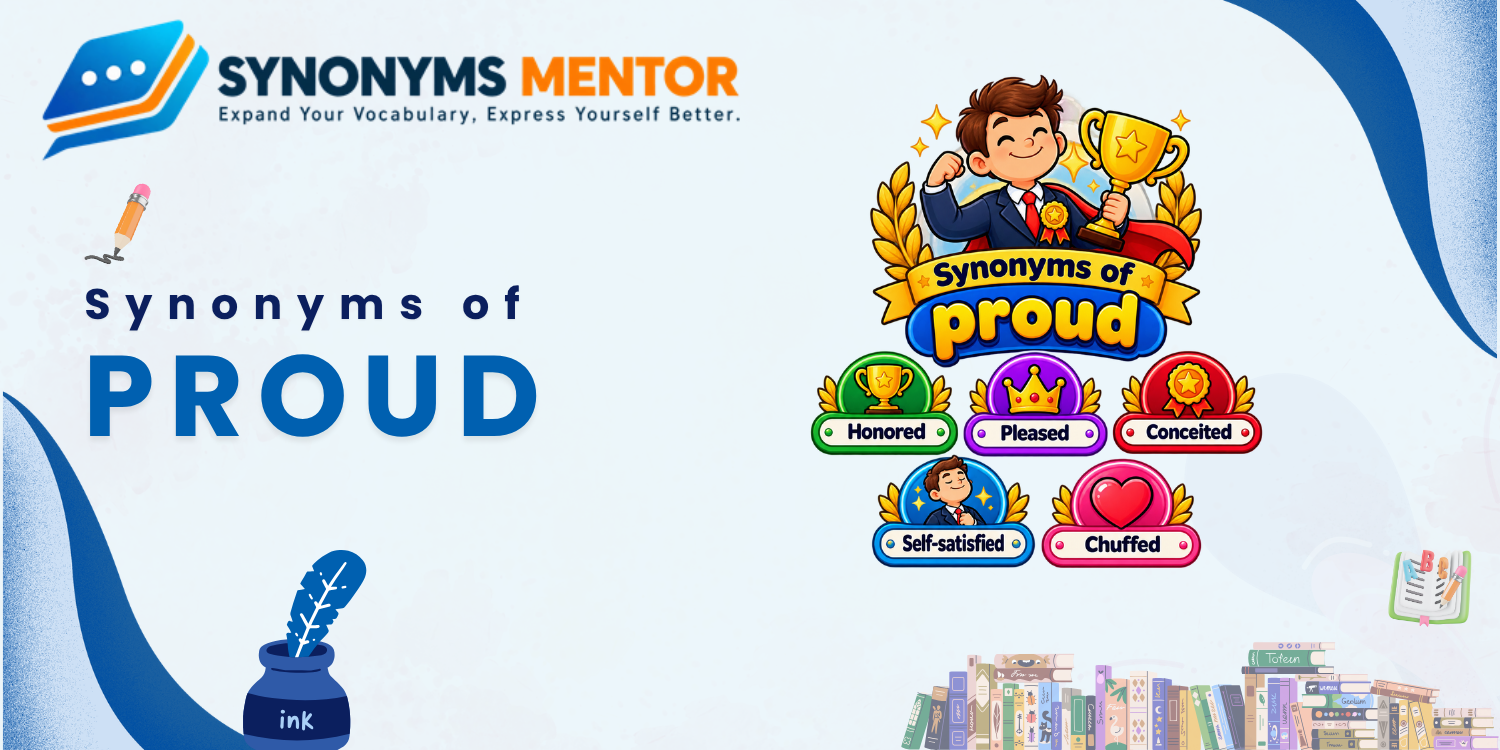
The closest synonyms of proud include pleased, satisfied, content, gratified, delighted, honored, self-respecting, dignified, confident, accomplished, arrogant, conceited, haughty, and self-important. The right choice depends on meaning: pleased and satisfied usually express positive pride, while arrogant and conceited describe an excessive sense of superiority. Cambridge and Collins make a similar distinction between these meanings.
Core Synonyms of Proud
Positive Synonyms for Pride and Satisfaction
Words in this group describe positive feelings such as happiness, satisfaction, confidence, achievement, and a sense of honor.
Formal and Honor-Related Alternatives
These words are more formal or elevated. They can express honor, distinction, success, noble qualities, or an impressive sense of achievement.
Negative Synonyms for Excessive Pride
The following terms describe pride that becomes excessive, unpleasant, self-centered, or dismissive toward others. They are useful when the intended meaning has a clearly negative tone.
The important point is that these 25 words do not have equal synonym strength. For example, pleased can often replace proud in an achievement-related sentence, whereas arrogant applies only when proud carries a negative meaning.
What Does Proud Mean?
Proud is an adjective describing a feeling of pleasure and satisfaction about something you or someone connected to you has achieved or possesses. It can also describe self-respect or, negatively, an excessive belief in one’s own importance. Cambridge lists these distinct senses, while Collins similarly separates satisfaction, self-respect, and superiority.
For example:
- Positive pride: She was proud of her academic achievement.
- Self-respect: He was too proud to accept charity.
- Negative pride: His proud attitude made him difficult to work with.
The context determines which meaning the reader understands.
Direct Synonyms for Proud
1. Pleased
Meaning: Happy or satisfied about something.
Best context: Achievements, relationships, results, or good news.
Example:
Her parents were pleased with her performance.
Difference: Pleased is usually more straightforwardly about happiness or satisfaction. Proud often adds a sense of achievement, honor, or personal significance.
2. Satisfied
Meaning: Content because something has met expectations.
Best context: Results, work, decisions, or achievements.
Example:
He was satisfied with the progress he had made.
Difference: Satisfied focuses on the result meeting expectations, while proud often expresses emotional attachment to an achievement.
3. Content
Meaning: Calmly satisfied with a situation.
Example:
She was content with what she had accomplished.
Difference: Content usually expresses a quieter, less intense feeling than proud.
4. Gratified
Meaning: Pleased because something you hoped for or expected has happened.
Example:
The teacher was gratified by her students’ progress.
Best for: Formal or professional writing.
5. Delighted
Meaning: Extremely pleased.
Example:
They were delighted with the team’s success.
Difference: Delighted emphasizes strong happiness, whereas proud emphasizes satisfaction connected with achievement, identity, or someone else’s success.
Synonyms for Proud When You Respect Yourself
Sometimes proud refers less to achievement and more to self-respect.
Self-respecting
A self-respecting person values their own dignity and will not easily accept treatment they consider unacceptable.
A self-respecting employee should be able to express concerns respectfully.
Dignified
Dignified emphasizes calm self-respect and appropriate behavior.
She remained dignified despite the criticism.
Confident
Confident means having a belief in your abilities or judgment.
He was confident in his ability to lead the project.
Be careful here: confident is not a direct synonym for proud. Someone can be confident without feeling proud, and someone can be proud without being particularly confident.
Synonyms for Proud of an Achievement
When someone has accomplished something worthwhile, these alternatives can work particularly well:
Accomplished
Best when emphasizing successful achievement.
She felt accomplished after completing the demanding project.
Gratified
Best when emphasizing satisfaction that a goal or expectation was fulfilled.
The researcher was gratified by the positive response.
Honored
Best when the pride comes from receiving recognition or being given an opportunity.
I am honored to be part of this important project.
Distinguished
Best when emphasizing a person’s notable achievements or reputation.
She has had a distinguished career in education.
Glorious
Best for highly celebratory or elevated descriptions.
It was a glorious moment for the team.
Negative Synonyms of Proud
The meaning changes considerably when proud describes someone who thinks they are superior to others.
Arrogant
Arrogant describes someone who has an exaggerated sense of their own importance or abilities and may treat others as inferior.
His arrogant behavior alienated his colleagues.
This is much more negative than ordinary proud.
Conceited
Conceited means excessively pleased with yourself or your abilities.
He was too conceited to consider anyone else’s advice.
Haughty
Haughty describes an attitude of superiority, often accompanied by coldness or disdain.
She gave him a haughty response.
Self-important
Self-important describes someone who considers themselves more important than they really are.
His self-important attitude frustrated the rest of the team.
Pompous
Pompous describes someone who behaves or speaks in an overly important, grand, or self-important manner.
His pompous speech made the simple issue sound complicated.
Supercilious
Supercilious is a formal word for an attitude of arrogant superiority or contempt.
His supercilious tone made the conversation uncomfortable.
Cambridge’s thesaurus specifically groups words such as arrogant, pompous, conceited, haughty, supercilious, and self-important under the negative sense of proud.
Which Word Should I Use?
Choose pleased when:
You simply want to express happiness or satisfaction.
I’m pleased with the results.
Choose satisfied when:
The emphasis is on a result meeting expectations.
She was satisfied with her performance.
Choose confident when:
You want to emphasize belief in your ability.
He is confident about the upcoming presentation.
Choose honored when:
Your pride comes from receiving recognition or being given an important opportunity.
I am honored to receive this award.
Choose accomplished when:
You want to emphasize successful achievement.
She felt accomplished after finishing the course.
Choose arrogant when:
The person believes they are superior to others.
His arrogant behavior offended the team.
Choose conceited when:
The emphasis is excessive admiration of oneself.
He sounds conceited whenever he talks about his abilities.
Choose haughty when:
The person behaves as though others are beneath them.
The haughty manager rarely listened to junior employees.
Proud vs. Confident
Proud and confident overlap, but they describe different ideas.
| Proud | Confident |
|---|---|
| Often connected to achievement or identity | Primarily connected to belief in ability |
| Can concern someone else’s success | Usually concerns one’s own ability or judgment |
| Can be positive or negative | Usually positive or neutral |
| May involve self-respect | Focuses more directly on certainty or self-belief |
Compare:
She is proud of the work she completed.
She is confident that she can complete the work.
The first sentence emphasizes achievement; the second emphasizes belief in future ability.
Proud vs. Arrogant
These words are not interchangeable in every context.
Proud can be completely positive:
His family is proud of his achievement.
Arrogant is normally negative:
His arrogant behavior upset his coworkers.
A person can be proud of an achievement without believing they are better than everyone else.
Proud vs. Boastful
Boastful focuses on talking excessively about your own achievements or qualities.
She was proud of her accomplishment.
She was boastful about her accomplishment.
The first expresses a feeling. The second suggests that the person talks about the achievement in a way that may seem excessive.
Proud vs. Satisfied
These words overlap when discussing accomplishments, but their emphasis differs.
Satisfied means that something meets your expectations.
Proud often carries a stronger sense of personal achievement, honor, or emotional significance.
I am satisfied with the final report.
I am proud of the final report.
The second sentence can suggest a deeper personal connection to the work.
Common Collocations With Proud
Some of the most natural patterns are:
- proud of yourself
- proud of your achievement
- proud of your work
- proud of your family
- proud of your team
- proud of your country
- proud to be involved
- proud to announce
- proud moment
- proud achievement
- proudest moment
Cambridge examples show common constructions such as proud of, proud to have, and proud to be, while Collins also identifies collocations such as enormously proud and extremely proud.
Which synonym works best with these phrases?
- proud of your work → satisfied with your work can work, but the emotional meaning changes slightly.
- proud of your achievement → pleased with your achievement is natural.
- proud of your team → pleased with your team is possible but does not always convey the same emotional connection.
- proud to announce → honored to announce can work when the announcement is considered a privilege.
- proud moment → memorable moment works when you want to emphasize lasting significance rather than pride.
Common Mistakes With Synonyms of Proud
Mistake 1: Treating “arrogant” as a positive synonym
Arrogant normally carries negative judgment. It should not replace proud when you are expressing admiration for an achievement.
Mistake 2: Assuming “confident” means “proud”
Confidence concerns belief in one’s abilities. Pride commonly concerns satisfaction, achievement, identity, or self-respect.
Mistake 3: Using “boastful” for ordinary pride
Someone can feel proud without boasting. Boastful specifically suggests talking about achievements or qualities in a self-promoting way.
Mistake 4: Using “satisfied” in every situation
Satisfied can describe a successful result, but it may sound too neutral when you want to express strong emotional pride.
Mistake 5: Ignoring context
The sentence “She is proud of her daughter” expresses positive affection and admiration. The sentence “He is too proud to apologize” can suggest excessive self-respect or stubbornness. The same word therefore requires different synonym choices. Cambridge explicitly recognizes these separate uses.
Antonyms of Proud
The appropriate antonym depends on which meaning of proud you mean.
For positive pride or self-importance, useful opposites include:
- humble
- modest
- unassuming
- meek
- unpretentious
For the sense of being pleased with an achievement, an opposite could be dissatisfied or disappointed, depending on context.
Cambridge and Collins both identify humble and related words as antonyms for relevant senses of proud.
Frequently Asked Questions
What is the closest synonym for proud?
There is no single synonym that works in every context. Pleased and satisfied are strong choices when proud means feeling pleasure about an achievement. Self-respecting fits the dignity-related meaning, while arrogant or conceited can fit the negative sense of excessive self-importance.
What is a positive synonym for proud?
Good positive alternatives include pleased, satisfied, gratified, delighted, honored, accomplished, and confident, depending on the sentence. Pleased is one of the most versatile choices when the meaning is simply feeling happy about something good.
What is a formal synonym for proud?
Depending on context, gratified, honored, distinguished, dignified, or self-respecting can work in formal writing. The choice depends on whether you mean satisfaction, recognition, reputation, or personal dignity.
Is “confident” a synonym for “proud”?
Sometimes the meanings overlap, but they are not exact synonyms. Confident refers primarily to belief in your abilities or judgment, whereas proud commonly expresses satisfaction with an achievement, person, identity, or quality.
Is “arrogant” the same as “proud”?
No. Proud can be positive or negative, while arrogant is normally negative. Arrogant suggests an exaggerated belief in one’s superiority and often implies disrespect toward others.
What is a synonym for “proud of yourself”?
Depending on the intended meaning, you could say pleased with yourself, satisfied with your achievement, accomplished, or confident in yourself. If the context suggests excessive self-admiration, conceited or self-important may be more appropriate.
What is a synonym for “proud of someone”?
Natural alternatives include pleased with someone, delighted with someone’s achievement, or admiring of someone’s accomplishment. The best choice depends on whether you want to emphasize happiness, admiration, or recognition.
What is the opposite of proud?
The answer depends on the sense. Humble, modest, and unassuming can oppose the negative sense of excessive self-importance. Dissatisfied can oppose the achievement-related sense of feeling pleased or proud.
Conclusion
The best synonym for proud depends on what kind of pride you want to express. Use pleased, satisfied, or gratified for positive satisfaction; honored for recognition; confident for belief in ability; and self-respecting or dignified for personal worth. When proud has a negative meaning, words such as arrogant, conceited, haughty, pompous, and self-important are more precise.

David Wilson is a content strategist and SEO expert who focuses on creating structured vocabulary content. He combines keyword research with simple explanations to make learning English both effective and search-friendly.