
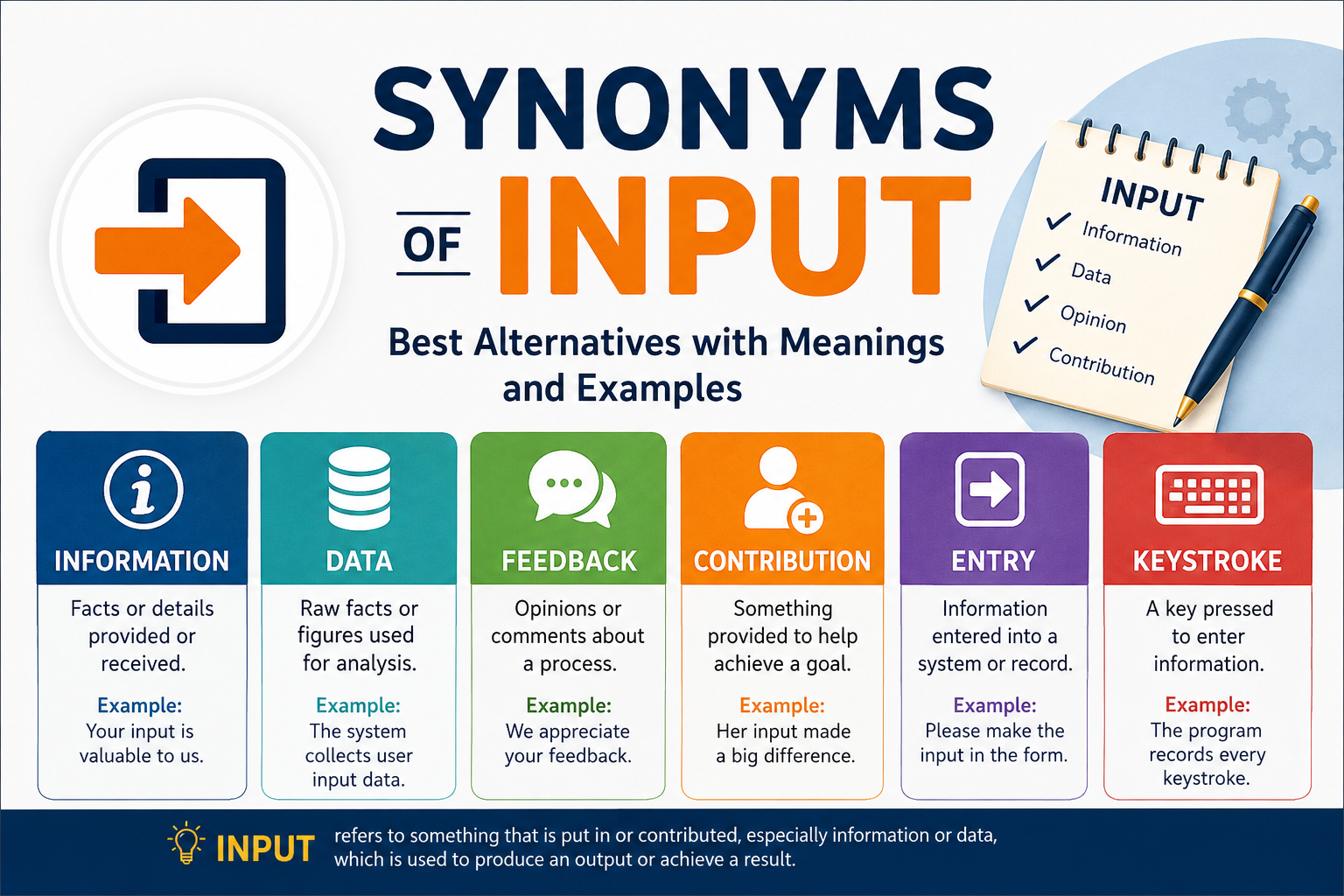
Synonyms of Input: 25 Better Alternatives With Examples
Finding the right synonym for input depends heavily on what you mean. If input means an opinion or idea, words such as feedback, advice, suggestion, and comment may work. If it means information entered into a computer, data, information, or entry may be more appropriate. In a project, input can also mean someone’s contribution or assistance.
Because these meanings are not interchangeable, the best synonym is the one that preserves the original context.
Quick Answer: What Are the Best Synonyms of Input?
The closest synonyms of input include feedback, contribution, information, advice, suggestion, comment, guidance, data, opinion, and assistance. However, the best choice depends on the meaning. Use feedback for a response or evaluation, contribution for someone’s involvement, data for factual information, and advice for recommendations.
Core Synonyms of Input
| Word | Relationship | Meaning | Best Context |
|---|---|---|---|
| Feedback | Near synonym | A response or evaluation | Projects, work, performance |
| Contribution | Near synonym | Something someone adds to a project or discussion | Teams, projects, discussions |
| Information | Contextual synonym | Facts or knowledge provided | Reports, research, communication |
| Advice | Contextual synonym | An opinion about what someone should do | Decisions, professional situations |
| Suggestion | Contextual synonym | An idea offered for consideration | Plans, discussions, improvements |
| Comment | Contextual synonym | An expressed observation or opinion | Discussions, documents |
| Guidance | Contextual synonym | Help in deciding what to do | Learning, work, decisions |
| Opinion | Contextual synonym | A personal view or judgment | Discussions, decisions |
| Data | Contextual synonym | Information used for analysis or processing | Research, computing, statistics |
| Assistance | Contextual synonym | Help given to someone or something | Projects, tasks |
| Recommendation | Contextual synonym | A suggested choice or course of action | Decisions, products, policies |
| Counsel | Contextual synonym | Considered advice | Formal or professional contexts |
| Commentary | Near synonym | Explanatory or evaluative remarks | Writing, media, analysis |
| Response | Near synonym | An answer or reaction | Surveys, discussions, communication |
| Observation | Contextual synonym | A remark based on noticing something | Analysis, research, discussion |
| Suggestion | Contextual synonym | An idea proposed for consideration | Brainstorming, planning |
| Direction | Contextual synonym | Instructions about what to do | Work, procedures |
| Instruction | Contextual synonym | Specific information about how to perform something | Education, software, procedures |
| Details | Contextual synonym | Specific pieces of information | Reports, forms, explanations |
| Facts | Contextual synonym | Information that can be established as true | Research, reporting |
| Material | Contextual synonym | Information or content used in creating something | Writing, research, projects |
| Intake | Near synonym | Something taken into a system or process | Nutrition, systems, technical contexts |
| Entry | Contextual synonym | Information entered into a record or system | Forms, databases, computing |
| Addition | Contextual synonym | Something added to an existing whole | General or technical contexts |
| Resource | Related/contextual | Something used to produce an outcome | Economics, production, projects |
Not all of these are interchangeable with input. They represent different senses or contexts, which is why simply choosing the first word in a thesaurus can produce an unnatural sentence. Merriam-Webster, for example, groups input with words such as advice, information, guidance, feedback, recommendation, suggestion, and data, while distinguishing its different meanings.
What Does “Input” Mean?
Input can be a noun or a verb.
As a noun, it can mean something put into a system, such as information, energy, money, materials, or ideas. It can also refer specifically to someone’s advice, opinion, or contribution. In computing, it can mean information entered into a computer or the connection through which information enters a device.
As a verb, input means to enter information into a computer or data-processing system.
Examples:
- We need your input before making the decision.
- The technician input the customer information into the system.
- The project requires additional financial input.
Because these sentences use different senses, they need different alternatives.
The Best Synonyms of Input by Context
1. Input Meaning “Advice”
When input means an opinion intended to help someone make a decision, advice is one of the closest alternatives.
Example:
We need your advice before we proceed.
Input: We need your input before we proceed.
Difference: Advice emphasizes guidance about what someone should do. Input is broader and can include opinions, ideas, information, or observations.
2. Input Meaning “Feedback”
Feedback is especially useful when someone is responding to work, a product, performance, or an idea.
Example:
The designer asked for feedback on the new website.
You could say:
The designer asked for input on the new website.
But the nuance changes slightly. Feedback suggests evaluation or reaction, whereas input can mean ideas or information provided before or during the work.
3. Input Meaning “Contribution”
Contribution works well when input describes what someone adds to a project, discussion, or group effort.
Example:
Her contribution helped improve the final proposal.
Compare:
Her input helped improve the final proposal.
Here, contribution emphasizes what she added, while input often emphasizes ideas, opinions, or expertise.
4. Input Meaning “Information”
Use information when the intended meaning is knowledge or facts provided to someone.
Example:
We need more information about the customer.
However, replacing input with information does not always work.
We value your input.
Here, information would change the meaning because the sentence can refer to the person’s ideas or opinions rather than factual information.
5. Input Meaning “Data”
Data is a strong alternative when input refers to information processed by a computer, model, database, or analytical system.
Example:
The program requires accurate data.
In computing, input specifically refers to information put into a computer or system, while data refers to the information itself.
6. Input Meaning “Suggestion”
Suggestion works when someone provides an idea about how something could be improved.
Example:
Thank you for your suggestion.
You could also say:
Thank you for your input.
The difference is that suggestion normally identifies a particular proposed idea, whereas input can cover a broader range of comments or information.
7. Input Meaning “Comment”
Comment is useful when input means an expressed observation or opinion.
Example:
She provided several helpful comments during the meeting.
Input is broader:
She provided helpful input during the meeting.
A comment may be one specific remark; input can represent a person’s overall contribution to a discussion.
8. Input Meaning “Guidance”
Guidance is appropriate when someone’s input helps another person decide what to do.
Example:
The manager provided guidance on how to handle the problem.
This is more directional than input. Guidance implies helping someone move toward an appropriate action.
Input Synonyms for Professional Writing
In workplace communication, the best alternative depends on the situation.
| If you mean… | Better word |
|---|---|
| Someone’s opinion | Opinion |
| Evaluation of work | Feedback |
| An idea for improvement | Suggestion |
| Expert help | Guidance |
| Factual material | Information |
| Numbers or machine-readable information | Data |
| Someone’s overall role in a project | Contribution |
| A recommended action | Advice or recommendation |
| Help with a task | Assistance |
Example
Instead of:
We appreciate your input on the proposal.
You could write:
We appreciate your feedback on the proposal.
if you are asking for evaluation.
Or:
We appreciate your contribution to the proposal.
if you are emphasizing the person’s work or participation.
Or:
We appreciate your recommendations for improving the proposal.
if you specifically want proposed changes.
Input Synonyms in Computing
The word input has a specialized computing meaning: information entered into a computer or another electronic system. Cambridge and Collins both identify this as a distinct use.
Useful contextual alternatives include:
- data
- information
- entry
- data entry
- command
- instruction
But these are not exact synonyms in every technical context.
Example
The user entered the data into the form.
Here, data refers to the information being entered.
The system received the user’s input.
Here, input can refer more broadly to what was supplied to the system.
Input vs. Feedback
These words overlap, but they are not identical.
| Input | Feedback |
|---|---|
| Broad contribution of ideas or information | Response or evaluation |
| Can happen before, during, or after a process | Usually responds to something already presented |
| May include suggestions and expertise | Often evaluates performance or a result |
Example:
We need your input while designing the product.
We need your feedback after you test the product.
The first asks for participation in the process; the second asks for a reaction to the result.
Input vs. Advice
Advice is narrower than input.
If someone says:
I’d like your input.
they may want ideas, opinions, observations, or information.
If they say:
I’d like your advice.
they are more specifically asking what the person thinks they should do.
Use “advice” when the focus is decision-making.
Input vs. Contribution
These words are particularly close in project-related contexts.
Input often focuses on ideas, knowledge, opinions, or expertise.
Contribution emphasizes what someone adds to a project, group, discussion, or result.
Compare:
The engineer’s input helped us solve the problem.
The engineer’s contribution helped us complete the project.
Both are natural, but the emphasis differs.
Input vs. Information
Information is one of the most useful contextual alternatives to input, but only when input means information being supplied.
Please provide additional information about the incident.
However:
We appreciate your input.
does not necessarily mean:
We appreciate your information.
The original sentence can include opinions, ideas, expertise, and suggestions. Cambridge specifically defines input in business contexts as help, ideas, or knowledge supplied to a project or organization.
Common Mistakes With Input Synonyms
Mistake 1: Treating every related word as an exact synonym
Words such as advice, feedback, data, and contribution overlap with input, but each has its own meaning.
Mistake 2: Using “feedback” for every type of input
Feedback usually implies a response or evaluation. It is not always appropriate when someone is contributing ideas before a decision.
Mistake 3: Using “data” for opinions
Data generally refers to information used for processing, analysis, or evidence. It is not a natural replacement for input when someone is giving an opinion.
Mistake 4: Confusing the noun and verb
As a verb, input means to enter information into a computer or data-processing system. Its noun uses are considerably broader.
Mistake 5: Assuming “inputted” is impossible
Both input and inputted occur as past-tense/past-participle forms of the computing verb. Cambridge and Merriam-Webster both list these forms.
Which Synonym of Input Should You Use?
A simple decision guide:
- Use “feedback” when someone is evaluating something.
- Use “advice” when someone recommends what to do.
- Use “suggestion” when someone proposes an idea.
- Use “information” when someone provides knowledge or facts.
- Use “data” for information used by a technical or analytical system.
- Use “contribution” when emphasizing someone’s addition to a project.
- Use “guidance” when someone helps direct another person’s actions.
- Use “comment” for a specific observation or remark.
- Use “opinion” when the focus is on someone’s personal view.
- Use “assistance” when the focus is practical help.
Antonyms of Input
The most direct opposite of input depends on its sense.
In a systems or computing context, output is the clearest opposite: information or results produced by a system rather than supplied to it.
For example:
Input: Data entered into a system
Output: Results produced by the system
Merriam-Webster also lists output, production, throughput, and outturn among antonyms or near-antonyms in relevant senses.
Frequently Asked Questions
What is the best synonym for input?
There is no single best synonym because input has several meanings. Feedback, contribution, advice, information, data, suggestion, and guidance can all work in different contexts. For opinions or ideas, feedback or suggestion may fit; for computer information, data or information may be more appropriate.
What is another word for input in a professional context?
Depending on the meaning, professional alternatives include feedback, contribution, guidance, advice, recommendation, information, and expertise. Contribution is useful for project participation, while feedback is particularly natural when discussing evaluation of work.
Is feedback a synonym for input?
Sometimes. Feedback is a type of input, especially when someone responds to or evaluates work, an idea, or a product. But input is broader and can include information, suggestions, opinions, expertise, and other contributions.
What is a synonym for input as information?
Information, data, details, facts, and material can work depending on the context. Data is particularly appropriate for technical or analytical information, while information is the most general choice.
What is a synonym for input in computing?
In computing, contextually related alternatives include data, information, entry, and data entry. However, they are not always interchangeable because input can describe the information supplied to a system as well as the process or point through which it enters.
What is the difference between input and contribution?
Input usually emphasizes ideas, opinions, knowledge, or information supplied to a process. Contribution emphasizes what someone adds to a project, discussion, or outcome. They can overlap, particularly in professional and collaborative contexts.
What is the opposite of input?
Output is the clearest opposite when discussing systems, computing, or processes. Input is what enters a system; output is what the system produces.
Conclusion
The best synonym for input depends on the meaning you want to preserve. Feedback is useful for evaluation, advice for recommendations, suggestion for proposed ideas, information for knowledge, data for technical information, and contribution for someone’s role in a project.

David Wilson is a content strategist and SEO expert who focuses on creating structured vocabulary content. He combines keyword research with simple explanations to make learning English both effective and search-friendly.