Synonyms for Unsafe: Better Words for Different Contexts
Finding the right synonym for unsafe depends on what makes something unsafe. You might mean that a place is dangerous, an activity involves risk, a structure is hazardous, or a person is vulnerable to harm. These words overlap, but they are not interchangeable in every sentence.
The closest everyday alternatives are dangerous, risky, hazardous, perilous, threatening, insecure, vulnerable, exposed, and unprotected. The best choice depends on whether you are describing actual danger, potential risk, lack of protection, or a person’s exposure to harm.
Quick Answer: What Are the Best Synonyms for Unsafe?
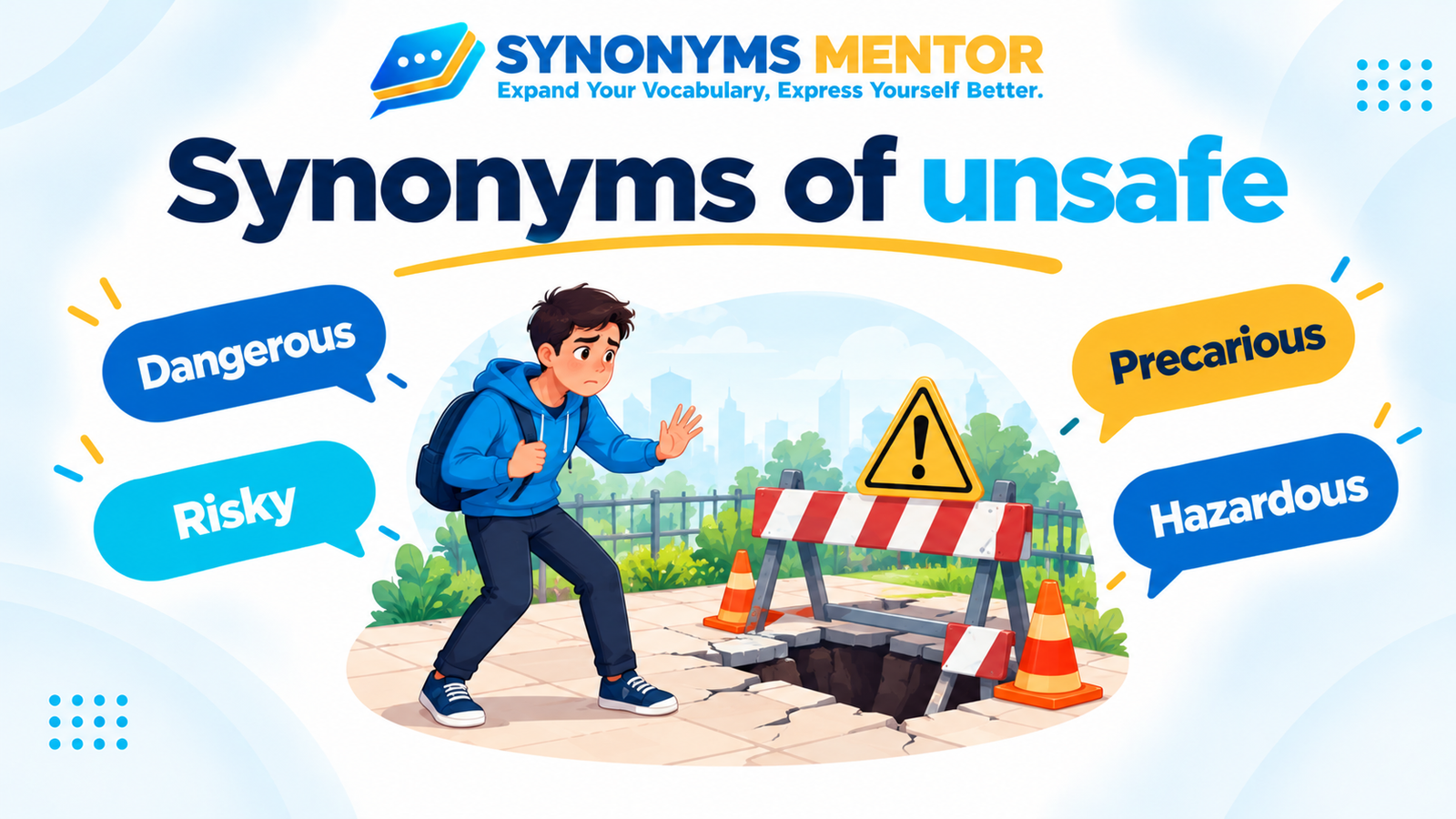
The closest synonyms for unsafe include dangerous, risky, hazardous, perilous, and threatening. For people who are at risk of harm, vulnerable, exposed, threatened, and unprotected can be more precise.
Dangerous is the most general alternative, while hazardous suits formal or technical contexts and risky emphasizes the possibility of a bad outcome.
What Does “Unsafe” Mean?
Unsafe is an adjective meaning not safe, dangerous, or likely to result in harm or danger. It can describe places, objects, activities, conditions, behavior, or situations. It can also describe a person who is in danger of being harmed.
Examples:
- The building was declared unsafe.
- It is unsafe to drive in these conditions.
- She felt unsafe walking home alone.
- The equipment could be unsafe if used incorrectly.
In British legal usage, unsafe can also describe a conviction or verdict that is considered unreliable because it rests on inadequate or false evidence.
Part of Speech
Unsafe is an adjective.
Pronunciation
- US: /ʌnˈseɪf/
- UK: /ʌnˈseɪf/
15 Synonyms and Alternatives for Unsafe
Not every word below is a perfect substitute. The table separates close synonyms from alternatives that add a specific nuance.
| Word | Relationship | Strength | Formality | Best Context |
|---|---|---|---|---|
| Dangerous | Direct/near synonym | Strong | Neutral | General danger |
| Risky | Near synonym | Moderate–strong | Neutral | Actions, decisions, activities |
| Hazardous | Near synonym | Strong | Formal/neutral | Conditions, substances, work |
| Perilous | Near synonym | Very strong | Formal/literary | Serious or extreme danger |
| Threatening | Contextual alternative | Strong | Neutral | People, situations, conditions |
| Precarious | Contextual alternative | Strong | Formal | Unstable or uncertain situations |
| Insecure | Contextual alternative | Moderate–strong | Neutral/formal | Lack of safety or protection |
| Vulnerable | Contextual alternative | Moderate | Neutral/formal | People or things exposed to harm |
| Exposed | Contextual alternative | Moderate | Neutral | Lack of protection |
| Unprotected | Contextual alternative | Moderate | Neutral | Lack of physical or other protection |
| Threatened | Contextual alternative | Strong | Neutral | A person or thing facing danger |
| Unstable | Contextual alternative | Context-dependent | Neutral | Structures, systems, conditions |
| Treacherous | Contextual alternative | Very strong | Neutral/formal | Roads, terrain, weather, conditions |
| Precarious | Contextual alternative | Strong | Formal | Unstable or dangerous circumstances |
| Dicey | Contextual alternative | Moderate | Informal | Risky situations or decisions |
Closest Synonyms for Unsafe
1. Dangerous
Dangerous is the broadest and most natural synonym for unsafe. It describes something that could cause injury, harm, or other serious negative consequences.
Best used for: people, animals, places, objects, activities, and situations.
Example:
It is dangerous to swim in the river after heavy rain.
Use dangerous when you want a straightforward description of potential harm. Cambridge defines dangerous in terms of something capable of causing harm.
2. Risky
Risky emphasizes the possibility of danger, loss, failure, or an undesirable outcome. It does not always mean that harm is certain or even likely.
Best used for: decisions, actions, investments, behavior, and activities.
Example:
Driving without checking the weather forecast would be risky.
Risky is especially useful when the focus is on taking a chance rather than on an existing dangerous condition. Collins defines it as dangerous or likely to fail.
3. Hazardous
Hazardous is a strong alternative that often appears in professional, technical, workplace, environmental, and safety contexts.
Best used for: substances, working conditions, roads, chemicals, machinery, and environments.
Example:
Workers must wear protective clothing in hazardous conditions.
It often sounds more formal and objective than unsafe. Collins describes hazardous as involving great risk.
4. Perilous
Perilous means extremely dangerous or involving serious risk. It is stronger and more formal than ordinary unsafe.
Best used for: journeys, situations, conditions, and circumstances involving significant danger.
Example:
The climbers began a perilous descent before sunset.
Choose perilous when you want to emphasize serious or potentially life-threatening danger.
5. Threatening
Threatening focuses on something that presents or suggests danger.
Best used for: situations, behavior, weather, people, or circumstances that appear likely to cause harm.
Example:
The dark clouds created a threatening atmosphere.
Unlike unsafe, threatening can emphasize the presence or appearance of a threat rather than simply the absence of safety.
Context-Specific Alternatives to Unsafe
Vulnerable
Vulnerable means susceptible to harm, attack, damage, or exploitation.
Young children are particularly vulnerable in dangerous environments.
It is usually better for describing people, groups, systems, or things that can easily be harmed rather than replacing unsafe in every sentence.
Exposed
Exposed emphasizes a lack of protection from danger or harmful conditions.
The workers were exposed to extreme temperatures.
This is particularly useful when something or someone is left without adequate protection.
Unprotected
Unprotected directly emphasizes the absence of protection.
The exposed wiring left the workers unprotected from electrical hazards.
It can refer to physical protection, security, or other forms of protection.
Insecure
Insecure has several meanings, so context matters. It can mean not safe or protected, but it can also describe a lack of confidence or something unstable or unreliable.
The wireless network is insecure.
Here, insecure does not mean emotionally uncertain. It means insufficiently protected.
Precarious
Precarious describes something unstable, uncertain, or dependent on circumstances in a way that could lead to danger or failure.
The workers stood on a precarious platform.
It is often a better choice than unsafe when instability is the central idea.
Treacherous
Treacherous describes conditions that are dangerous because they are difficult to predict, control, or navigate.
The mountain roads become treacherous during winter.
It works especially well with roads, terrain, weather, water, and journeys.
Dicey
Dicey is informal and means risky, uncertain, or potentially dangerous.
It would be dicey to drive there during the storm.
It works naturally in conversation but is generally unsuitable for formal academic or professional writing.
Synonyms for Unsafe by Context
Unsafe Places or Areas
When describing a location, the most natural choices are:
- dangerous
- hazardous
- insecure
- threatening
- unsafe
- high-risk
Examples:
The area became dangerous after dark.
The factory is located near a hazardous waste site.
Residents reported feeling unsafe in the neighborhood.
For a place where people may be exposed to crime or violence, dangerous, threatening, insecure, or unsafe may work depending on the intended meaning.
Unsafe Activities
For activities, choose according to the type of risk:
- dangerous — general danger
- risky — possibility of a bad outcome
- hazardous — serious physical or environmental risk
- perilous — extreme danger
- reckless — dangerously careless behavior
Examples:
Rock climbing without proper equipment can be dangerous.
It was risky to continue driving in the storm.
The workers were exposed to hazardous conditions.
Notice that reckless is not a direct synonym for unsafe. It describes behavior involving a lack of proper care for danger.
Unsafe Conditions
For professional or workplace writing, these alternatives are especially useful:
- hazardous conditions
- dangerous conditions
- high-risk conditions
- unsafe conditions
- precarious conditions
Hazardous conditions often sounds more formal and technical than unsafe conditions.
The inspection identified several hazardous working conditions.
Unsafe Behavior
For behavior, unsafe may be replaced by:
- dangerous
- risky
- reckless
- hazardous
- irresponsible
However, these words are not interchangeable.
His driving was dangerous.
His decision was risky.
His driving was reckless.
Reckless adds the idea of careless disregard for danger, so it is stronger and more judgmental than unsafe.
Synonym Strength: Which Word Is Strongest?
The following scale is an editorial guide rather than a scientific measurement.
| Word | Approximate Strength | Main Nuance |
|---|---|---|
| Unsafe | Moderate | Not sufficiently safe |
| Risky | Moderate–strong | Significant possibility of a bad outcome |
| Dangerous | Strong | Capable of causing harm |
| Hazardous | Strong | Involves a recognized or significant hazard |
| Threatening | Strong | Presents or suggests danger |
| Perilous | Very strong | Serious or extreme danger |
| Treacherous | Very strong | Danger that is difficult to predict or navigate |
The strongest choice depends on context. Perilous is often more dramatic than unsafe, while hazardous is more technical and risky focuses more on probability or uncertainty.
Formal and Professional Alternatives to Unsafe
For academic, business, technical, or workplace writing, consider:
- hazardous
- dangerous
- high-risk
- insecure
- precarious
- unprotected
- potentially harmful
- unsuitable for safe use
Examples
Informal or general:
The equipment is unsafe.
Professional:
The equipment presents a significant safety hazard.
Technical:
The device is unsuitable for safe operation under these conditions.
Workplace:
Employees were exposed to hazardous working conditions.
The best alternative depends on exactly what makes the situation unsafe.
Which Word Should I Use?
Use “dangerous” when:
You need the most general and natural alternative.
The road is dangerous at night.
Use “risky” when:
You want to emphasize the possibility of a bad outcome.
It would be risky to invest all your savings.
Use “hazardous” when:
You are writing about safety, chemicals, workplaces, equipment, or environmental conditions.
The laboratory contains hazardous materials.
Use “perilous” when:
You want to emphasize severe or extreme danger.
They faced a perilous journey through the mountains.
Use “vulnerable” when:
You mean someone or something is particularly open to harm.
Elderly residents may be vulnerable during extreme weather.
Use “exposed” when:
The important point is a lack of protection.
The workers were exposed to toxic fumes.
Use “precarious” when:
Instability or uncertainty creates the danger.
The ladder was in a precarious position.
Use “treacherous” when:
Conditions are dangerously difficult to navigate or predict.
The icy road was treacherous.
Unsafe vs Dangerous
Unsafe and dangerous are close synonyms, but they emphasize slightly different ideas.
- Unsafe: not sufficiently safe or involving a lack of safety.
- Dangerous: capable of causing harm.
Compare:
The building is unsafe.
This suggests that the building does not meet an acceptable level of safety.
The building is dangerous.
This more directly emphasizes its capacity to cause harm.
In everyday English, dangerous is often the easiest replacement for unsafe.
Unsafe vs Risky
These words overlap, but risky usually emphasizes uncertainty or the possibility of a negative result.
It is unsafe to enter the damaged building.
The building presents a safety problem.
It is risky to enter the damaged building.
Entering involves taking a significant chance.
Risky also works naturally with abstract decisions:
It was a risky business decision.
Unsafe would sound unnatural in that context.
Unsafe vs Hazardous
Hazardous is often more formal and technical.
The floor is unsafe.
General statement about safety.
The floor presents a hazardous condition.
More formal or professional description.
Hazardous is especially natural with:
- materials
- chemicals
- conditions
- work
- waste
- substances
- environments
Collins lists dangerous, risky, and unsafe among the synonyms associated with hazardous.
Unsafe vs Insecure
These words can overlap when referring to protection, but insecure has several additional meanings.
The network is insecure.
The network is not adequately protected.
The neighborhood feels unsafe.
People feel at risk of harm.
Do not automatically replace unsafe with insecure, especially when describing physical danger. Insecure can also mean lacking confidence, unstable, unreliable, or not firmly fixed.
Common Mistakes When Choosing a Synonym for Unsafe
Mistake 1: Using “risky” for every type of danger
Risky is especially natural for actions, choices, and situations involving uncertainty.
Investing all your money in one company is risky.
For a dangerous building, dangerous or unsafe is usually more natural.
Mistake 2: Using “vulnerable” as a direct replacement
Vulnerable describes susceptibility to harm, not necessarily the condition itself.
Less precise:
The bridge is vulnerable.
Better:
The bridge is unsafe.
But:
The bridge is vulnerable to flooding.
Here, vulnerable correctly identifies susceptibility to a specific threat.
Mistake 3: Using “perilous” in ordinary situations
Perilous is strong and often formal or literary.
Crossing that broken bridge was perilous.
Natural.
This chair is perilous.
Usually exaggerated unless the chair genuinely presents serious danger.
Mistake 4: Using “hazardous” when the meaning is emotional insecurity
Hazardous normally concerns danger or risk, not emotional uncertainty.
The chemicals are hazardous.
Correct.
For a person who lacks confidence, insecure is appropriate:
She feels insecure about her public-speaking skills.
Mistake 5: Treating related words as exact synonyms
Words such as reckless, unstable, vulnerable, exposed, and unprotected may describe particular aspects of an unsafe situation. They do not always replace unsafe naturally.
Precision matters more than producing a longer synonym list.
Natural Collocations With Unsafe
Some common phrases include:
- unsafe conditions
- unsafe environment
- unsafe behavior
- unsafe practices
- unsafe building
- unsafe equipment
- unsafe driving
- unsafe working conditions
- unsafe levels
- unsafe water
- unsafe area
- unsafe situation
- inherently unsafe
- potentially unsafe
- considered unsafe
Collins specifically records collocations such as “inherently unsafe,” “potentially unsafe,” and “unsafe building.”
Better Alternatives in Common Phrases
| Phrase | Natural Alternative |
|---|---|
| unsafe conditions | hazardous conditions |
| unsafe driving | dangerous or reckless driving |
| unsafe decision | risky decision |
| unsafe chemicals | hazardous chemicals |
| unsafe area | dangerous area |
| unsafe worker | reckless or careless worker, depending on meaning |
| unsafe network | insecure network |
| unsafe position | precarious position |
| unsafe road | dangerous or treacherous road |
| unsafe person | dangerous or threatening person |
The alternative should match the specific reason something is unsafe.
Real-World Examples
Workplace
The inspection found several hazardous conditions in the factory.
Academic Writing
The researchers warned that the procedure could be unsafe without appropriate protective equipment.
Everyday Conversation
I wouldn’t walk through that area alone at night; it doesn’t feel safe.
Professional Communication
The current system may be insecure and should undergo a security review.
Travel
The mountain road becomes treacherous after heavy snowfall.
Finance
Investing the entire budget in one project would be risky.
These examples show why a single synonym cannot replace unsafe in every context.
Antonyms of Unsafe
The main opposite of unsafe is safe.
Other useful opposites include:
- secure
- protected
- harmless
- stable
- reliable
- guarded
- safe and sound
- out of danger
Cambridge lists safe as the direct opposite of unsafe and provides related terms such as secure, protected, guarded, harmless, and reliable in different senses.
FAQ
What is the closest synonym for unsafe?
Dangerous is usually the closest general synonym for unsafe. Other close alternatives include risky and hazardous, but each adds a different nuance.
What is another word for unsafe?
Depending on context, another word for unsafe can be dangerous, risky, hazardous, perilous, threatening, insecure, vulnerable, exposed, or unprotected.
What is a formal synonym for unsafe?
Hazardous, perilous, and precarious can work as formal alternatives, depending on context. Hazardous is particularly useful in technical and workplace writing.
What is a professional word for unsafe?
Hazardous, high-risk, potentially harmful, or unsuitable for safe use can work in professional contexts. The best choice depends on the specific safety issue.
What is the strongest synonym for unsafe?
Perilous is one of the strongest alternatives because it emphasizes serious or extreme danger. Treacherous can also be strong when describing dangerous conditions that are difficult to navigate or predict.
Is “risky” the same as “unsafe”?
Not exactly. Risky emphasizes the possibility of a bad outcome, while unsafe emphasizes a lack of safety or the presence of danger. They overlap in many contexts but are not always interchangeable.
Is “hazardous” a synonym for unsafe?
Yes, in many contexts. Hazardous is especially appropriate for substances, working conditions, equipment, environments, and other situations involving significant risk.
What is the opposite of unsafe?
The direct opposite is safe. Depending on context, related opposites include secure, protected, harmless, stable, and reliable.
Conclusion
The best synonym for unsafe depends on the kind of danger you want to describe. Use dangerous for general danger, risky for uncertain actions or decisions, hazardous for formal and technical safety contexts, and perilous for serious danger. For people at risk, vulnerable, exposed, or unprotected may be more precise.

Sophia Martinez is an ESL educator who specializes in teaching vocabulary and word meanings. She writes beginner-friendly content that helps learners understand synonyms and improve their English fluency step by step.