Synonyms for Copacetic: Better Alternatives for Every Context
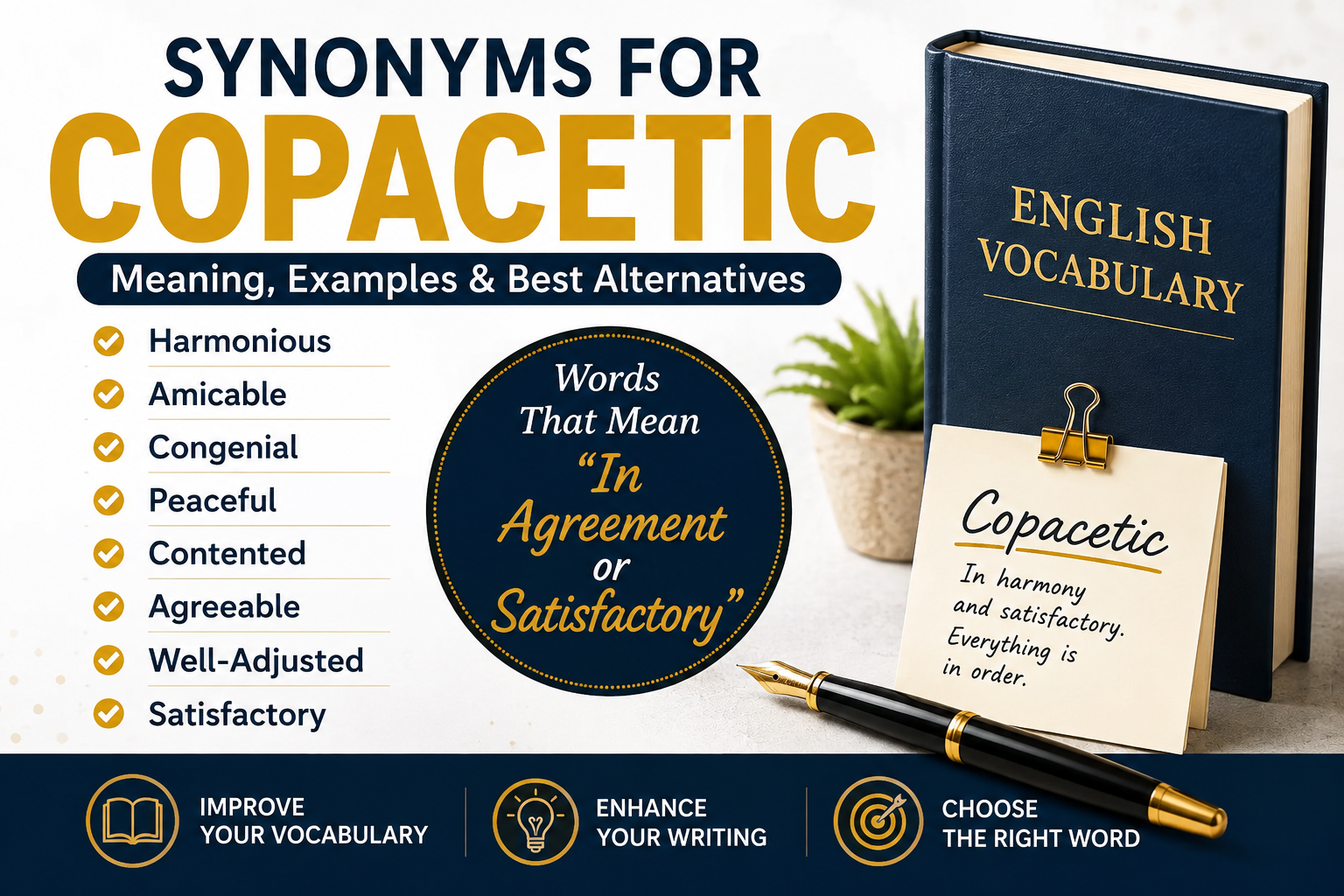
If you are looking for synonyms for copacetic, the best alternatives include fine, satisfactory, okay, all right, good, agreeable, acceptable, pleasant, and hunky-dory. However, these words are not interchangeable in every situation. Copacetic is a somewhat old-fashioned, informal American adjective meaning that something is very good, satisfactory, or going well.
The right replacement depends on what you want to emphasize. Fine and okay are natural everyday choices, satisfactory works better in formal or professional writing, while hunky-dory keeps the informal, slightly playful flavor of copacetic.
Table of Contents
- What does copacetic mean?
- Quick answer: closest synonyms
- Core synonyms for copacetic
- Closest alternatives by context
- Formal and professional alternatives
- Casual alternatives
- Copacetic vs. similar words
- How to choose the right synonym
- Common mistakes
- Copacetic examples
- FAQ
- Conclusion
Quick Answer: What Are the Closest Synonyms for Copacetic?
The closest synonyms for copacetic are fine, okay, all right, satisfactory, good, agreeable, acceptable, and hunky-dory. The best choice depends on context: satisfactory is more formal, fine and okay are more natural in everyday English, and hunky-dory has a similarly informal and slightly playful tone.
What Does “Copacetic” Mean?
Copacetic is an adjective meaning very satisfactory, very good, or going well. It is especially associated with US English and is described by Cambridge as old-fashioned and informal.
For example:
Everything is copacetic now.
This means that everything is fine, satisfactory, or in good order.
Another natural use is:
Things were copacetic between them after they talked.
Here, copacetic describes a situation or relationship that is going well.
Pronunciation
- US: /ˌkoʊ.pəˈset̬.ɪk/
- UK: /ˌkəʊ.pəˈset.ɪk/
The standard spelling is copacetic, although copasetic and copesetic are recognized variants.
Core Synonyms for Copacetic
Not every word listed by a thesaurus is an exact substitute. The table below separates close alternatives from words that introduce a slightly different nuance.
| Word | Relationship | Strength | Formality | Best Context |
|---|---|---|---|---|
| Fine | Direct/near synonym | Moderate | Neutral | Everyday situations |
| Okay / OK | Direct synonym | Moderate | Neutral | Conversation |
| All right | Direct synonym | Moderate | Neutral | Everyday English |
| Satisfactory | Near synonym | Moderate | Formal | Work, evaluation |
| Good | Near synonym | Moderate–strong | Neutral | General approval |
| Acceptable | Near synonym | Moderate | Formal/neutral | Standards, requirements |
| Agreeable | Near synonym | Moderate | Neutral/formal | Conditions, arrangements |
| Pleasant | Contextual alternative | Moderate | Neutral | Experiences, situations |
| Hunky-dory | Near synonym | Strong | Informal | Casual, playful English |
| Pleasing | Near synonym | Moderate | Neutral/formal | Results, experiences |
Merriam-Webster’s thesaurus includes many of these words among the similar terms associated with copacetic.
1. Fine
Meaning: Good enough, satisfactory, or in a satisfactory condition.
How it differs: Fine is much more common and less distinctive than copacetic.
Best used for: Everyday conversation and general situations.
Example:
Everything is fine now.
If you want the most natural everyday replacement for copacetic, fine is often the safest choice.
2. Okay / OK
Meaning: Acceptable, satisfactory, or not a problem.
How it differs: Okay is more conversational and can indicate anything from mild approval to simple acceptance.
Best used for: Informal speech, messages, and everyday communication.
Example:
Don’t worry. Everything is okay.
3. All right
Meaning: Satisfactory, acceptable, or in good condition.
How it differs: Like fine, it is much more common than copacetic and does not have the same unusual or playful flavor.
Example:
Things are all right between us now.
4. Satisfactory
Meaning: Good enough to meet a particular standard or requirement.
How it differs: This is more objective and evaluative than copacetic.
Best used for: Reports, assessments, workplace writing, and formal communication.
Example:
The final results were satisfactory.
Use satisfactory when you are evaluating whether something meets expectations rather than simply saying that everything is going well.
5. Good
Meaning: Of a positive quality or in a satisfactory condition.
How it differs: Good is broader than copacetic. It can describe quality, behavior, performance, health, and many other things.
Example:
Everything is good now.
6. Acceptable
Meaning: Good enough to be approved or accepted.
How it differs: Acceptable often implies that something meets a minimum standard. It does not necessarily suggest that it is especially good.
Example:
The revised proposal is acceptable to the client.
This makes acceptable a useful contextual alternative, but not always a perfect substitute.
7. Agreeable
Meaning: Pleasant, suitable, or acceptable.
How it differs: Agreeable can suggest willingness, compatibility, or pleasantness rather than simply saying that everything is fine.
Example:
We reached an agreeable arrangement.
8. Pleasant
Meaning: Enjoyable, comfortable, or agreeable.
How it differs: Pleasant focuses more on the quality of an experience or atmosphere.
Example:
We had a pleasant evening together.
It is therefore a contextual alternative rather than a universal synonym.
9. Hunky-dory
Meaning: Completely satisfactory or fine.
How it differs: It has a similarly informal, idiomatic flavor and can be used when everything is going well.
Example:
Don’t worry—the situation is hunky-dory.
It is closer to copacetic in tone than satisfactory is.
10. Pleasing
Meaning: Giving satisfaction or enjoyment.
How it differs: Pleasing usually describes something that produces satisfaction rather than simply saying that a situation is fine.
Example:
The client was pleased with the results.
Closest Synonyms for Copacetic
If your goal is to replace copacetic while keeping its basic meaning, these are the most useful choices:
Everyday English Alternatives
For everyday English, you can use simple and natural words such as fine, okay, all right, or good. These options work well in casual conversations and everyday situations.
Formal or Professional Alternatives
When writing in a formal or professional context, consider using satisfactory, acceptable, or agreeable. These words provide a more polished tone and are suitable for business communication and professional writing.
Informal or Playful Alternatives
For a more informal or playful tone, hunky-dory is a fun alternative. It is commonly used to describe a situation that is going well or is completely satisfactory.
The important point is that “closest” does not always mean “most natural.” Fine may be semantically close and much more natural in ordinary conversation, while satisfactory may be a better choice in a formal report.
Formal Alternatives to Copacetic
Because copacetic is generally informal and somewhat old-fashioned, it is not usually the first choice for formal or academic prose. Cambridge specifically labels it US old-fashioned informal.
Consider:
- satisfactory
- acceptable
- agreeable
- adequate — when the meaning is specifically “good enough”
- favorable — when describing conditions or circumstances
Example
Informal:
Everything is copacetic with the project.
More professional:
Everything is satisfactory with the project.
Even better, when the exact meaning is known:
The project is progressing as planned.
This illustrates an important principle: the best replacement is sometimes a natural phrase rather than a single synonym.
Casual Alternatives to Copacetic
For everyday conversation, these are generally more natural:
- fine
- okay
- all right
- good
- hunky-dory
For example:
“How’s everything going?”
“It’s all good.”
This is much more conversational than:
“Everything is copacetic.”
The latter is perfectly understandable, but its unusual and old-fashioned flavor may be intentional.
Context-Specific Alternatives
When describing a situation
Use:
- fine
- okay
- satisfactory
- all right
The situation is satisfactory.
When describing a relationship
Use:
- good
- fine
- amicable
- harmonious
Everything is fine between the two teams.
Amicable and harmonious are useful here, but they are contextual alternatives, not exact synonyms of copacetic.
When describing work or results
Use:
- satisfactory
- acceptable
- successful
- good
The results were satisfactory.
When describing an experience
Use:
- pleasant
- enjoyable
- agreeable
- satisfying
It was a pleasant afternoon.
These words focus on the experience itself rather than simply saying that everything is in order.
Copacetic vs. Similar Words
| Word | Main Meaning | Key Difference | Best Context |
|---|---|---|---|
| Copacetic | Very satisfactory; going well | Informal, old-fashioned flavor | Casual American English |
| Fine | Satisfactory or good | Much more common | Everyday English |
| Okay | Acceptable or satisfactory | Very conversational | Speech and messages |
| Satisfactory | Meets expectations | More objective/formal | Work and evaluation |
| Acceptable | Meets an acceptable standard | May imply only minimum adequacy | Formal evaluation |
| Hunky-dory | Completely fine | Informal and playful | Casual English |
| Pleasant | Enjoyable | Focuses on experience | People, events, experiences |
Copacetic vs. Fine
These are close, but fine is far more ordinary in modern everyday English.
Everything is fine.
sounds completely neutral.
Everything is copacetic.
sounds more distinctive, informal, and somewhat old-fashioned.
Copacetic vs. Satisfactory
Satisfactory is better when something has been evaluated against a standard.
The student’s performance was satisfactory.
Copacetic is more natural for a general situation:
Everything is copacetic now.
Copacetic vs. Hunky-dory
These two share an informal, idiomatic character. Hunky-dory can sound playful or deliberately cheerful, while copacetic has a more unusual vocabulary flavor.
Copacetic vs. Acceptable
These are not always equivalent.
Acceptable can mean merely “good enough.”
The solution is acceptable.
That does not necessarily mean the solution is excellent or that everything is going particularly well.
Which Word Should You Use?
A simple decision guide:
Use fine when:
You want the most natural general replacement.
Everything is fine.
Use okay when:
You are speaking casually or texting.
Everything’s okay now.
Use satisfactory when:
You are evaluating work, results, or performance against expectations.
The results were satisfactory.
Use acceptable when:
You mean something meets a required standard.
The proposed changes are acceptable.
Use hunky-dory when:
You want a casual, idiomatic, slightly playful expression.
Everything is hunky-dory.
Keep copacetic when:
You deliberately want an informal, distinctive, somewhat old-fashioned word for a situation that is going well.
After a difficult morning, everything was finally copacetic.
Common Mistakes with Copacetic Synonyms
Mistake 1: Treating every related positive word as an exact synonym
Words such as pleasant, harmonious, amicable, enjoyable, and successful can overlap with copacetic in particular contexts, but they do not carry exactly the same meaning.
Mistake 2: Using “acceptable” to mean “excellent”
Acceptable often means that something meets the necessary standard. It can be weaker than copacetic.
Mistake 3: Assuming “copacetic” is formal
It is not the best choice for formal or academic writing. Cambridge labels it US old-fashioned informal, while Collins describes it as US and Canadian slang.
Mistake 4: Forcing a synonym into an unnatural sentence
A synonym should fit the meaning and grammar of the original sentence.
Instead of mechanically replacing:
Everything was copacetic.
with:
Everything was pleasant.
you should consider what everything refers to. Fine, okay, or satisfactory may preserve the intended meaning better.
Copacetic in a Sentence
Here are natural examples:
Everyday situation:
Don’t worry; everything is copacetic now.
Relationship:
After they resolved the disagreement, things were copacetic between them.
Work:
The team assured us that everything was copacetic with the project.
Casual conversation:
Once the payment went through, everything was copacetic.
Alternative with “satisfactory”:
The final inspection found the work satisfactory.
Notice that the alternatives are not always simple word-for-word replacements. The surrounding context determines the most natural choice.
Antonyms of Copacetic
Depending on the context, useful opposites include:
- problematic
- unsatisfactory
- unacceptable
- difficult
- troublesome
- chaotic
- disorderly
- unpleasant
The strongest opposite depends on what copacetic describes. For example, unsatisfactory works well when discussing quality, while chaotic describes a situation lacking order.
What Is the Origin of “Copacetic”?
The origin of copacetic remains uncertain. Merriam-Webster describes it as having an obscure origin and records its first known use in 1919. Several theories about its origin have circulated, but they lack sufficient supporting evidence.
Collins likewise gives the word’s origin as unknown and dates it to the early 20th century.
So it is better to say “of uncertain or obscure origin” than to confidently attribute copacetic to Hebrew, Yiddish, French, Italian, or another language.
FAQ
What is another word for copacetic?
The most useful alternatives include fine, okay, all right, satisfactory, good, acceptable, agreeable, and hunky-dory. The best choice depends on context and formality.
What is the closest synonym for copacetic?
Fine, okay, and all right are among the closest everyday alternatives. Satisfactory is also close in meaning but is more formal and evaluative.
Is copacetic formal or informal?
Copacetic is informal and somewhat old-fashioned. Cambridge specifically labels it “US old-fashioned informal.”
Is “hunky-dory” a synonym for copacetic?
Yes, hunky-dory is a close informal alternative meaning that something is completely satisfactory or fine. It shares some of copacetic‘s playful, idiomatic character.
Can I use copacetic in academic writing?
You can, but it is usually not the most appropriate choice if you want a neutral academic style. Satisfactory, acceptable, or a more precise phrase will generally fit better.
Is copacetic still used?
Yes. Modern examples continue to appear in English-language publications, although the word has a distinctive informal and somewhat old-fashioned character. Merriam-Webster’s current entry includes recent usage examples.
What is the opposite of copacetic?
Depending on context, possible opposites include unsatisfactory, unacceptable, problematic, troublesome, and chaotic.
Is “copasetic” correct?
Copasetic is a recognized variant spelling, although copacetic is the standard spelling. Merriam-Webster also records copesetic as a less common variant.
Conclusion
The best synonym for copacetic depends on the sentence. Choose fine, okay, or all right for natural everyday English; satisfactory or acceptable for more formal evaluation; and hunky-dory when you want a similarly informal, idiomatic tone.

Sophia Martinez is an ESL educator who specializes in teaching vocabulary and word meanings. She writes beginner-friendly content that helps learners understand synonyms and improve their English fluency step by step.