Synonyms for Fuse: 20 Better Alternatives With Examples
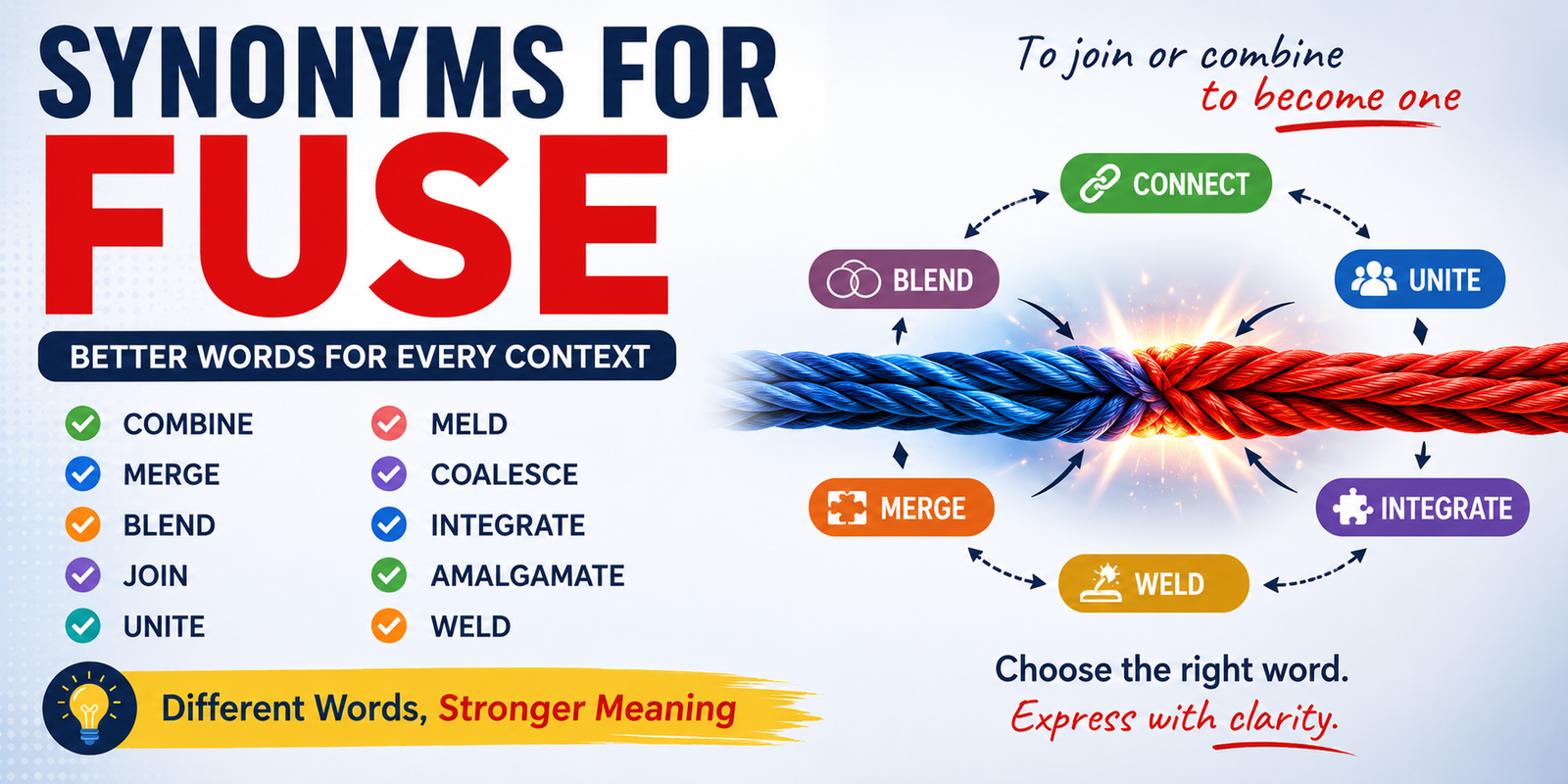
If you are looking for synonyms for fuse, the best alternatives include combine, merge, blend, join, unite, meld, coalesce, integrate, amalgamate, connect, and weld. However, these words are not interchangeable in every sentence.
Fuse often emphasizes bringing separate things together to form a unified whole, while merge stresses becoming one entity, and blend emphasizes combining elements into a mixture.
Quick Answer: What Are the Best Synonyms for Fuse?
The closest general synonyms for fuse are:
- Combine — put things together.
- Merge — join things into one entity.
- Blend — combine elements so their individual qualities become less distinct.
- Join — connect two or more things.
- Unite — bring separate people or things together.
- Meld — combine elements into a unified whole.
- Coalesce — come together to form one larger whole.
- Integrate — combine parts into a functioning whole.
- Amalgamate — combine organizations, groups, or systems.
- Weld — join materials, especially physically.
The most suitable choice depends on what is being fused and what kind of result you want to emphasize.
What Does “Fuse” Mean?
As a verb, fuse means to join things together physically or to cause separate things to become combined. It can also describe ideas, cultures, styles, or other abstract elements coming together. Cambridge gives examples involving physical fusion as well as the combination of cultural and musical styles.
For example:
The artist fused traditional techniques with modern design.
Here, fused suggests more than simply placing two things together. The two elements become closely integrated into something unified.
Pronunciation
US: /fjuːz/
UK: /fjuːz/
Core Synonyms for Fuse
| Word | Relationship | Main Meaning | Best Context |
|---|---|---|---|
| Combine | Direct synonym | Put things together | General use |
| Merge | Near synonym | Become one entity | Companies, groups, systems |
| Blend | Near synonym | Mix so elements become less distinct | Flavors, styles, colors |
| Join | Near synonym | Connect separate things | People, objects, parts |
| Unite | Near synonym | Bring together as one | People, groups, causes |
| Meld | Near synonym | Combine into a unified whole | Ideas, styles, materials |
| Coalesce | Near synonym | Come together into one whole | Groups, ideas, movements |
| Integrate | Contextual alternative | Incorporate into a functioning whole | Systems, communities, organizations |
| Amalgamate | Contextual alternative | Combine closely, often organizations or groups | Businesses, institutions |
| Connect | Contextual alternative | Establish a link | Systems, people, ideas |
| Weld | Contextual alternative | Join physically, often metal | Materials, engineering |
| Incorporate | Contextual alternative | Include as part of a larger whole | Ideas, features, elements |
Merriam-Webster lists several of these words among the similar terms associated with fuse, while Cambridge groups words such as merge, blend, meld, join, link, weld, combine, incorporate, amalgamate, and coalesce with the combining sense of fuse.
1. Combine
Combine is probably the safest general alternative to fuse.
It simply means to bring two or more things together.
Example:
The designer combined traditional patterns with modern typography.
Choose “combine” when:
You want a neutral word that works in many situations.
Fuse can suggest a stronger or more complete union, whereas combine is broader and more neutral.
2. Merge
Merge means to combine two or more things into a single entity.
Example:
The two departments merged into one larger team.
Therefore, merge is especially natural when separate organizations, groups, systems, or entities become one.
Fuse vs. merge
- Fuse: emphasizes close integration or union.
- Merge: emphasizes becoming one entity.
For example:
The two musical traditions fused.
sounds natural when emphasizing their creative combination.
Meanwhile:
The two companies merged.
is the natural choice for a corporate combination.
3. Blend
Blend means to combine things so that their individual characteristics become less distinct.
Example:
The restaurant blends traditional recipes with contemporary flavors.
As a result, blend is particularly useful for:
- colors
- flavors
- sounds
- styles
- cultures
- ingredients
Merriam-Webster notes that blend can be interchangeable with fuse in some contexts, but blend can imply that the individual elements become less distinguishable in the resulting mixture.
4. Join
Join is a straightforward synonym when the main idea is connection.
Example:
The engineer joined the two components together.
However, join does not necessarily imply that the two parts become a completely unified substance.
Therefore:
The two pieces were joined.
and
The two pieces were fused.
can describe similar situations, but fused usually gives a stronger impression of integration.
5. Unite
Unite emphasizes bringing separate people, groups, or things together.
Example:
The campaign united people from different communities.
It is especially natural when discussing:
- people
- organizations
- communities
- political or social groups
- common goals
Therefore, unite is often more natural than fuse when the subject involves people working together.
6. Meld
Meld means to combine different elements into a unified whole.
Example:
The film melds historical events with fictional characters.
It is a useful choice when you want to emphasize that different qualities or styles have been brought together successfully.
Fuse vs. meld
Both can describe strong combination. However, meld often sounds slightly more literary or descriptive.
7. Coalesce
Coalesce means to come together and form one larger whole.
Example:
Several small groups eventually coalesced into a single organization.
Because it has a somewhat formal tone, coalesce works particularly well in:
- academic writing
- journalism
- formal analysis
- discussions of movements or groups
It is less common in casual conversation.
8. Integrate
Integrate means to combine something with another system or whole so that it functions as part of it.
Example:
The company integrated the new software into its existing system.
Thus, integrate is usually better than fuse when talking about:
- technology
- systems
- organizations
- communities
- ideas
- processes
The important difference is that integration emphasizes successful incorporation into a larger whole.
9. Amalgamate
Amalgamate means to combine or unite things into one organization, group, or whole.
Example:
The two organizations amalgamated to create a larger institution.
It is more formal than combine or join.
Consequently, it is useful in professional, institutional, and academic writing.
Merriam-Webster notes that amalgamate can overlap with fuse, but it may suggest a close union while the individual identities are not necessarily completely lost.
10. Weld
Weld is a more specific alternative to fuse.
It means to join materials, especially metal, by applying heat or another process.
Example:
The technician welded the two metal pieces together.
It can also be used metaphorically:
The experience welded the team together.
However, weld should not normally replace fuse when discussing general combinations such as musical styles or ideas.
Context-Specific Synonyms for Fuse
The best synonym changes according to context.
For Ideas
Use:
- combine
- merge
- meld
- integrate
Example:
The author melded several philosophical ideas into one argument.
For Cultures or Traditions
Use:
- blend
- combine
- merge
- integrate
- meld
Example:
The city blends influences from several cultures.
For Companies or Organizations
Use:
- merge
- amalgamate
- combine
- unite
Example:
The two companies merged after months of negotiations.
Here, merge is usually more natural than fuse.
For Physical Materials
Use:
- fuse
- weld
- join
- meld
Example:
The heat caused the materials to fuse together.
If the material is specifically being joined through welding, weld is more precise.
For Colors, Sounds, or Flavors
Use:
- blend
- mix
- meld
Example:
The composer blended electronic sounds with classical instruments.
Fuse vs. Combine vs. Merge vs. Blend
These four words are closely related, but they are not identical.
| Word | Main Idea | Example |
|---|---|---|
| Fuse | Become closely unified | The styles fused together. |
| Combine | Put things together | We combined the two methods. |
| Merge | Become one entity | The departments merged. |
| Blend | Mix so distinctions become less obvious | The colors blended beautifully. |
Which should you choose?
“fuse” when you want to emphasize a strong or close union.
“combine” when you need the most general option.
“merge” when separate entities become one.
“blend” when the individual elements mix together and become less distinct.
Merriam-Webster specifically distinguishes these terms by noting that fuse stresses the oneness of the resulting product, while blend can suggest that the individual elements disappear into the mixture.
Fuse vs. Join
Fuse and join can both describe bringing things together.
However, join focuses primarily on connection.
The two parts were joined together.
Fuse suggests a more complete physical or conceptual union.
The two materials fused together.
Therefore, if the important idea is simply connection, choose join. If the important idea is becoming one, fuse may be more precise.
Fuse vs. Unite
The distinction is mainly contextual.
Unite is particularly natural for people, groups, or causes:
The community united around a common goal.
Fuse is more versatile for physical materials, ideas, styles, and abstract concepts:
The composer fused several musical traditions.
So, although they overlap semantically, they are not interchangeable in every sentence.
Fuse vs. Integrate
These words both describe combining elements into a whole.
However:
- Fuse emphasizes the resulting union.
- Integrate emphasizes incorporating something into an existing system or structure.
Compare:
The designer fused traditional and modern styles.
with:
The developer integrated the new feature into the website.
The second sentence is much more natural because integrate describes successful incorporation into an existing system.
Natural Collocations With “Fuse”
Some common structures include:
- fuse together
- fuse two ideas
- fuse different styles
- fuse cultures
- fuse traditions
- fuse technology with design
- fuse modern and traditional elements
- fuse art and technology
Examples:
The architect fused traditional materials with modern construction methods.
The album fuses several musical influences.
The project fuses creativity with technical expertise.
These patterns are useful because the best synonym often depends on the noun following the verb.
Common Mistakes With Synonyms for Fuse
1. Treating every combining word as an exact synonym
Words such as combine, merge, blend, unite, and integrate overlap with fuse, but they have different nuances.
2. Using “merge” for every type of combination
Merge is especially natural for entities becoming one. It may sound awkward for some physical or artistic combinations.
3. Using “blend” when the elements remain clearly separate
Blend often suggests that individual characteristics become less distinct.
4. Using “weld” for abstract combinations
You can use weld metaphorically, but it is primarily associated with physical joining.
5. Confusing the different meanings of “fuse”
Fuse is also a noun referring to a safety component in an electrical system, while the verb has several meanings. Cambridge lists these distinct senses separately.
For this reason, always check the sentence’s context before selecting a synonym.
Related Words That Are Not Always Direct Synonyms
Some words are associated with the general concept of combination but should not automatically replace fuse.
Mix
Usually means to put substances or elements together. It is broader and often less suggestive of permanent union.
Incorporate
Means to include something as part of a larger whole. It does not necessarily mean that the elements physically or conceptually become one.
Connect
Focuses on establishing a relationship or link rather than creating a unified whole.
Assemble
Means to bring parts together, but the individual parts generally remain identifiable.
These words can be useful alternatives in specific contexts, but calling all of them exact synonyms would be misleading.
Antonyms of Fuse
The main opposite of fuse in its combining sense is the idea of separation.
Useful antonyms include:
- separate
- divide
- split
- disconnect
- disunite
- detach
- disperse
- sever
For example:
The two groups fused into one organization.
Opposite:
The organization eventually split into two groups.
Cambridge lists separate, disunite, disperse, and diffuse among the antonyms associated with the combining sense of fuse.
Frequently Asked Questions
What is the closest synonym for fuse?
Combine is one of the closest general synonyms for fuse. However, the best choice depends on context. Merge works well for entities becoming one, blend for mixtures and styles, join for connections, and meld for elements forming a unified whole.
What is another word for fuse two things together?
Depending on context, you can use combine, join, merge, meld, weld, or unite. For physical materials, fuse or weld may be most precise. For abstract things such as ideas, combine or meld may sound more natural.
Is “merge” the same as “fuse”?
Not exactly. Both can mean becoming one, but merge commonly describes separate entities becoming a single entity. Fuse often emphasizes a closer or more complete union. Therefore, the words overlap but are not interchangeable in every context.
What is a formal synonym for fuse?
Depending on the context, coalesce, amalgamate, integrate, or meld can provide a more formal alternative. However, they have different meanings, so the choice should be based on what is being combined.
What is the difference between fuse and blend?
Fuse emphasizes a strong union into one whole, whereas blend often emphasizes mixing elements so that their individual characteristics become less distinct. For example, musical styles can be fused, while colors are commonly said to blend.
What is the difference between fuse and combine?
Combine is a broad, neutral word meaning to put things together. Fuse generally conveys a stronger sense of unity or integration. Consequently, combine is the safer general-purpose choice, while fuse is useful when the resulting union is important.
Can “unite” replace “fuse”?
Sometimes. Unite is especially natural when discussing people, groups, organizations, or causes. For example, The movement united several communities sounds natural. However, fuse is more flexible for physical materials, ideas, styles, and other combinations.
Conclusion
The best synonyms for fuse depend on the type of combination you are describing. Combine is the most general alternative, while merge works especially well for entities becoming one, blend for mixtures and styles, join for connections, unite for groups, meld for unified combinations, and integrate for incorporating something into an existing system.

Our editorial team is dedicated to making English vocabulary easier to understand and use correctly. We research and review synonyms, antonyms, definitions, word usage, and example sentences to ensure our content is clear, accurate, practical, and useful for students, writers, professionals, and English learners.