Trust Synonyms in English: Better Alternatives With Examples
Finding a good synonym for trust is more complicated than simply replacing it with confidence or faith. The word trust has several meanings and can function as both a noun and a verb.
You can trust a person because you believe they are honest and reliable. You can also trust information, rely on someone’s help, or entrust an important responsibility to another person. These meanings overlap, but they are not identical.
The best alternative therefore depends on what you mean by trust and what kind of sentence you are writing. Below, you’ll find direct synonyms, near-synonyms, contextual alternatives, examples, and clear comparisons to help you choose the most natural word.
Quick Answer: What Are the Best Synonyms for Trust?
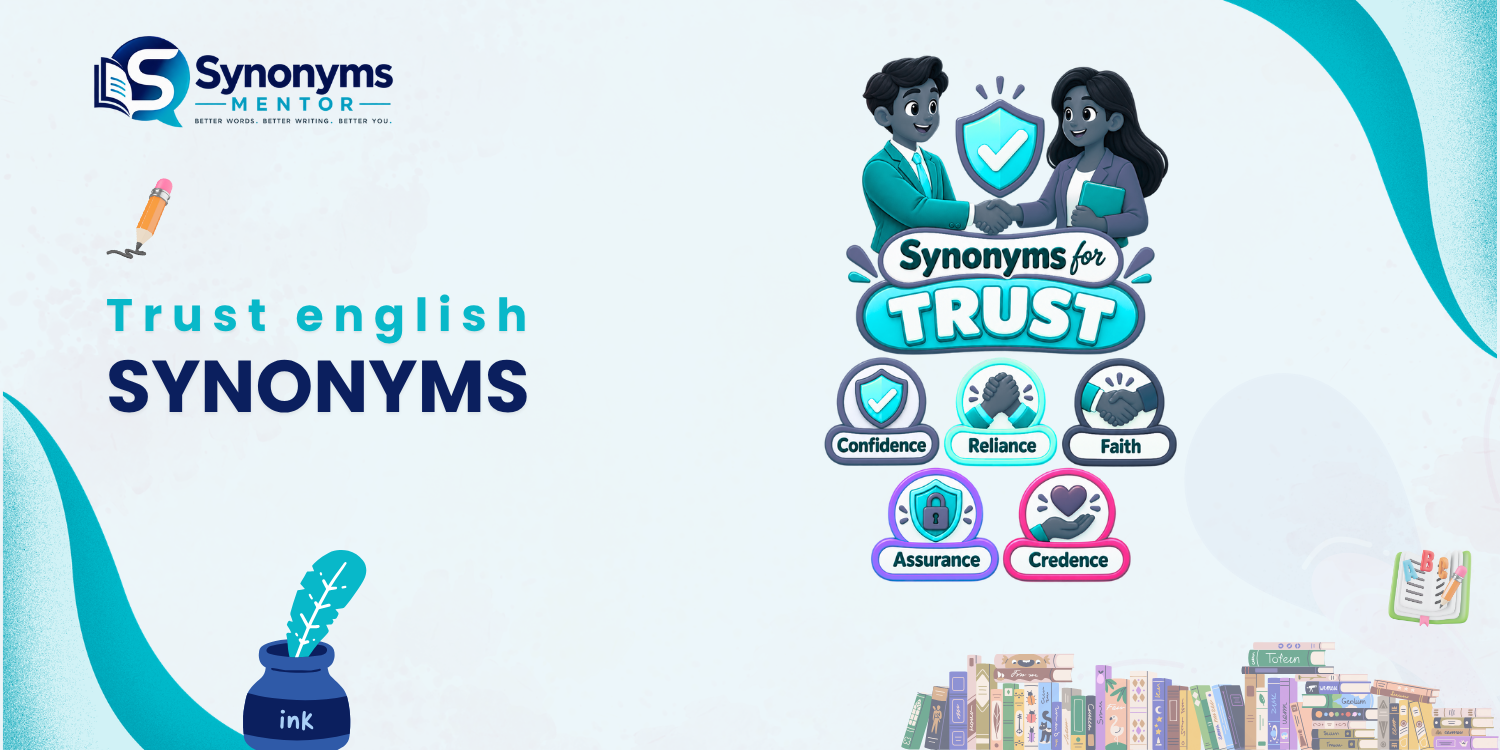
The closest synonyms for trust include confidence, faith, belief, reliance, credence, assurance, certainty, and conviction when trust is used as a noun. As a verb, useful alternatives include believe, rely on, depend on, have faith in, count on, and credit. However, these words are not interchangeable in every sentence.
Core Trust Synonyms
| Word | Relationship | Meaning | Strength | Formality | Best Context |
|---|---|---|---|---|---|
| Confidence | Direct/near synonym | Belief that someone or something is reliable | Similar | Neutral | People, abilities, institutions |
| Faith | Near synonym | Strong belief or confidence, sometimes without proof | Similar | Neutral | People, beliefs, future outcomes |
| Belief | Near synonym | Acceptance that something is true or trustworthy | Similar | Neutral | Claims, people, ideas |
| Reliance | Contextual synonym | Dependence on someone or something | Similar | Formal | Support, systems, responsibilities |
| Credence | Near synonym | Belief that something is true | Similar | Formal | Claims, reports, evidence |
| Assurance | Near synonym | Confidence or certainty about something | Similar | Neutral/Formal | Promises, outcomes |
| Conviction | Near synonym | Strongly held belief | Stronger in some contexts | Formal | Opinions, beliefs |
| Certainty | Related/near synonym | Complete confidence that something is true | Stronger | Neutral | Facts, predictions |
| Dependence | Contextual alternative | Need to rely on someone or something | Different emphasis | Neutral | Support and relationships |
| Entrust | Context-specific verb | Give someone responsibility or custody | Different meaning | Neutral/Formal | Duties, property, responsibilities |
Cambridge lists confidence, faith, belief, credence, and reliance among the noun-related synonyms of trust, while Merriam-Webster similarly includes confidence, faith, certainty, assurance, and reliance.
What Does “Trust” Mean?
As a noun, trust generally refers to a belief that someone or something is reliable, honest, capable, or genuine. Merriam-Webster defines one central noun sense as assured reliance on someone’s character, ability, strength, or truth.
Example:
Their friendship is built on mutual trust.
As a verb, trust can mean believing that someone is honest and will not harm you, or believing that something is safe or reliable. Cambridge gives examples involving trusting people, decisions, instincts, and things that are considered reliable.
Example:
I trust my sister to make the right decision.
Importantly, trust also has other meanings, including giving someone responsibility or placing something in their care.
The Best Trust Synonyms by Context
1. Confidence
Confidence is probably the closest general-purpose noun alternative to trust.
Use it when you want to emphasize your belief in someone’s ability, reliability, or competence.
Example:
I have complete confidence in our team.
This is especially natural in professional contexts:
The manager has confidence in her employees.
Choose “confidence” when:
You want to emphasize belief in ability or reliability rather than the emotional or relational aspect of trust.
2. Faith
Faith overlaps with trust but often suggests a stronger belief, sometimes without complete evidence.
Example:
She has faith in her friends.
It can also have religious or spiritual meanings, so context matters.
Choose “faith” when:
The idea involves strong belief, hope, loyalty, or conviction, especially when certainty is unavailable.
3. Belief
Belief is broader than trust. It means accepting or considering something to be true.
Example:
His belief in his team never disappeared.
However, belief is not always a direct substitute for trust.
You can say:
I trust her.
But:
I believe her.
usually means I believe what she says, rather than expressing the broader relationship of trust.
Choose “belief” when:
The emphasis is on accepting something as true, rather than depending on a person.
4. Reliance
Reliance emphasizes depending on someone or something.
Example:
The company’s success depends on its customers’ reliance on its services.
It is particularly useful in formal and professional writing.
Choose “reliance” when:
You want to emphasize dependence or the expectation that someone or something will provide support.
5. Credence
Credence means belief or acceptance that something is true.
Example:
The evidence gave credence to his explanation.
It is more formal than everyday trust.
Choose “credence” when:
You’re discussing whether a claim, explanation, report, or story deserves to be believed.
It is usually not the natural choice for personal relationships.
6. Assurance
Assurance emphasizes confidence or certainty.
Example:
The company gave customers assurance that their information was secure.
It can also refer to something said or done to remove doubt.
Choose “assurance” when:
The context involves certainty, reassurance, promises, or guarantees.
7. Conviction
Conviction can overlap with trust when it means a firmly held belief.
Example:
She expressed her conviction that the plan would succeed.
However, it is not normally a direct substitute for interpersonal trust.
Choose “conviction” when:
You want to emphasize a strongly held belief or opinion.
Trust Synonyms as a Verb
When trust is used as a verb, the best replacement depends heavily on its meaning.
Believe
I trust what she says.
→
I believe what she says.
Here, believe works because the meaning concerns accepting someone’s statement as true.
Rely on
I trust him to handle the project.
→
I rely on him to handle the project.
The emphasis shifts toward depending on him to perform a task.
Depend on
We trust our support team.
→
We depend on our support team.
This emphasizes the practical need for their assistance.
Count on
You can trust me to help.
→
You can count on me to help.
Count on is natural and conversational, especially when emphasizing dependable help.
Have faith in
She trusts her abilities.
→
She has faith in her abilities.
This emphasizes strong belief rather than simple reliability.
Entrust
They trusted him with the documents.
→
They entrusted him with the documents.
Entrust is especially useful when someone gives another person responsibility, property, information, or custody. Merriam-Webster specifically separates this sense of trust from its meaning of believing someone or something.
Which Word Should I Use?
A simple way to choose is:
Choose trust when:
You mean general confidence in someone’s honesty, reliability, safety, or character.
I trust my best friend.
Choose confidence when:
You emphasize ability or competence.
We have confidence in our new manager.
Choose faith when:
You emphasize strong belief, sometimes without proof.
She has faith in her team.
Choose belief when:
You mean accepting something as true.
I believe his explanation.
Choose reliance when:
You emphasize dependence.
The system’s reliability reduces our reliance on manual processes.
Choose credence when:
You’re discussing whether a claim or explanation is believable.
The new evidence gave credence to the theory.
Choose count on when:
You want a natural, conversational expression for dependability.
You can count on me.
Choose entrust when:
Someone is given responsibility or custody.
She entrusted him with the company’s records.
Trust vs. Confidence
These words overlap substantially, but their emphasis can differ.
Trust often concerns a person’s honesty, character, reliability, or willingness to act appropriately.
Confidence often emphasizes belief in someone’s ability, judgment, or performance.
Compare:
I trust David.
This can refer broadly to David’s character and reliability.
I have confidence in David.
This more readily suggests confidence in David’s ability or judgment.
The distinction is not absolute, and the two words frequently overlap. Merriam-Webster lists confidence among the principal noun synonyms of trust.
Trust vs. Faith
Faith can be stronger or less evidence-based than ordinary trust.
I trust my doctor.
This usually suggests confidence based on the doctor’s competence or character.
I have faith in my doctor.
This can express a deeper or more personal belief in the doctor.
Faith can also carry religious or spiritual meanings, whereas trust is much broader.
Trust vs. Belief
These words are related but not identical.
Trust usually involves confidence in a person, thing, or outcome.
Belief primarily concerns accepting something as true.
Compare:
I trust Sarah.
This means I consider Sarah reliable or worthy of confidence.
I believe Sarah.
This generally means I accept what Sarah says as true.
Cambridge distinguishes the central sense of trust as believing someone is good, honest, safe, or reliable.
Trust vs. Reliance
Reliance focuses on dependence.
I trust my brother.
This describes confidence in him.
I rely on my brother.
This emphasizes depending on him for help or support.
A person can therefore be trusted without necessarily being someone you regularly rely on.
Common Collocations With Trust
Some common expressions include:
- build trust
- earn trust
- gain trust
- develop trust
- establish trust
- maintain trust
- restore trust
- lose trust
- break trust
- betray someone’s trust
- mutual trust
- complete trust
- public trust
- trust in someone
- place your trust in someone
- put your trust in someone
Examples:
Good communication helps build trust.
The company needs to restore customers’ trust.
Their partnership is based on mutual trust.
These expressions are often better preserved as phrases rather than replaced word-for-word with a synonym.
Common Mistakes With Trust Synonyms
Mistake 1: Treating every related word as interchangeable
Trust, confidence, belief, and faith overlap, but they do not always mean exactly the same thing.
Choose according to the specific meaning.
Mistake 2: Using “trust on”
A common learner error is:
❌ I trust on him.
The natural construction is:
✅ I trust him.
or:
✅ I rely on him.
The verb trust normally takes the person or thing directly, while rely is followed by on.
Mistake 3: Using “entrust” as a universal synonym
Entrust has a specific meaning involving giving someone responsibility, custody, or possession.
She entrusted him with the keys.
It cannot replace trust naturally in every sentence.
Mistake 4: Assuming “believe” always means “trust”
I believe him.
usually concerns whether you accept what he says.
I trust him.
usually concerns whether you consider him reliable, honest, or safe.
The distinction matters.
Antonyms of Trust
The most useful opposites of trust include:
- distrust
- mistrust
- suspicion
- doubt
- disbelief
- skepticism
- uncertainty
The exact antonym depends on the sense. Cambridge and Merriam-Webster both list distrust, mistrust, doubt, and suspicion among the relevant opposites.
For example:
Trust allows a relationship to grow.
Suspicion can make a relationship difficult.
FAQ About Trust Synonyms
What is the closest synonym for trust?
Confidence is one of the closest general noun synonyms for trust. Depending on context, faith, belief, and reliance can also work. For the verb, believe, rely on, and have faith in are useful alternatives, but each emphasizes a slightly different idea.
What is a professional synonym for trust?
Confidence, reliance, assurance, and credence can work well in professional writing, depending on the context. For example, confidence in the leadership team sounds natural in business writing, while credence works better when discussing the credibility of a claim.
What is another word for trusting someone?
Depending on the meaning, you could say having confidence in someone, believing in someone, relying on someone, counting on someone, or having faith in someone.
Is confidence the same as trust?
Not always. Confidence often emphasizes belief in ability, competence, or performance, while trust can also involve honesty, character, safety, and reliability. The two overlap significantly, but context determines which sounds more natural.
Is faith a synonym for trust?
Faith can be a synonym for trust in contexts involving strong belief or confidence. However, faith can also have religious or spiritual meanings, so it is not interchangeable with trust in every sentence.
What is the difference between trust and belief?
Trust generally concerns confidence in someone’s reliability, honesty, safety, or character. Belief generally concerns accepting something as true. Thus, I trust her and I believe her can communicate different ideas.
What is the difference between trust and rely?
Trust is normally a verb meaning to have confidence in someone or something. Rely on emphasizes depending on someone or something for support or a particular outcome. I trust him and I rely on him overlap, but the second emphasizes dependence.
Conclusion
The best synonym for trust depends on what you want to emphasize. Confidence is a strong general alternative, while faith highlights strong belief, belief focuses on accepting something as true, reliance emphasizes dependence, and credence is useful for claims or statements. As a verb, believe, rely on, depend on, count on, and entrust can work in specific contexts.

Sophia Martinez is an ESL educator who specializes in teaching vocabulary and word meanings. She writes beginner-friendly content that helps learners understand synonyms and improve their English fluency step by step.