Synonyms for Distort: Better Alternatives With Examples
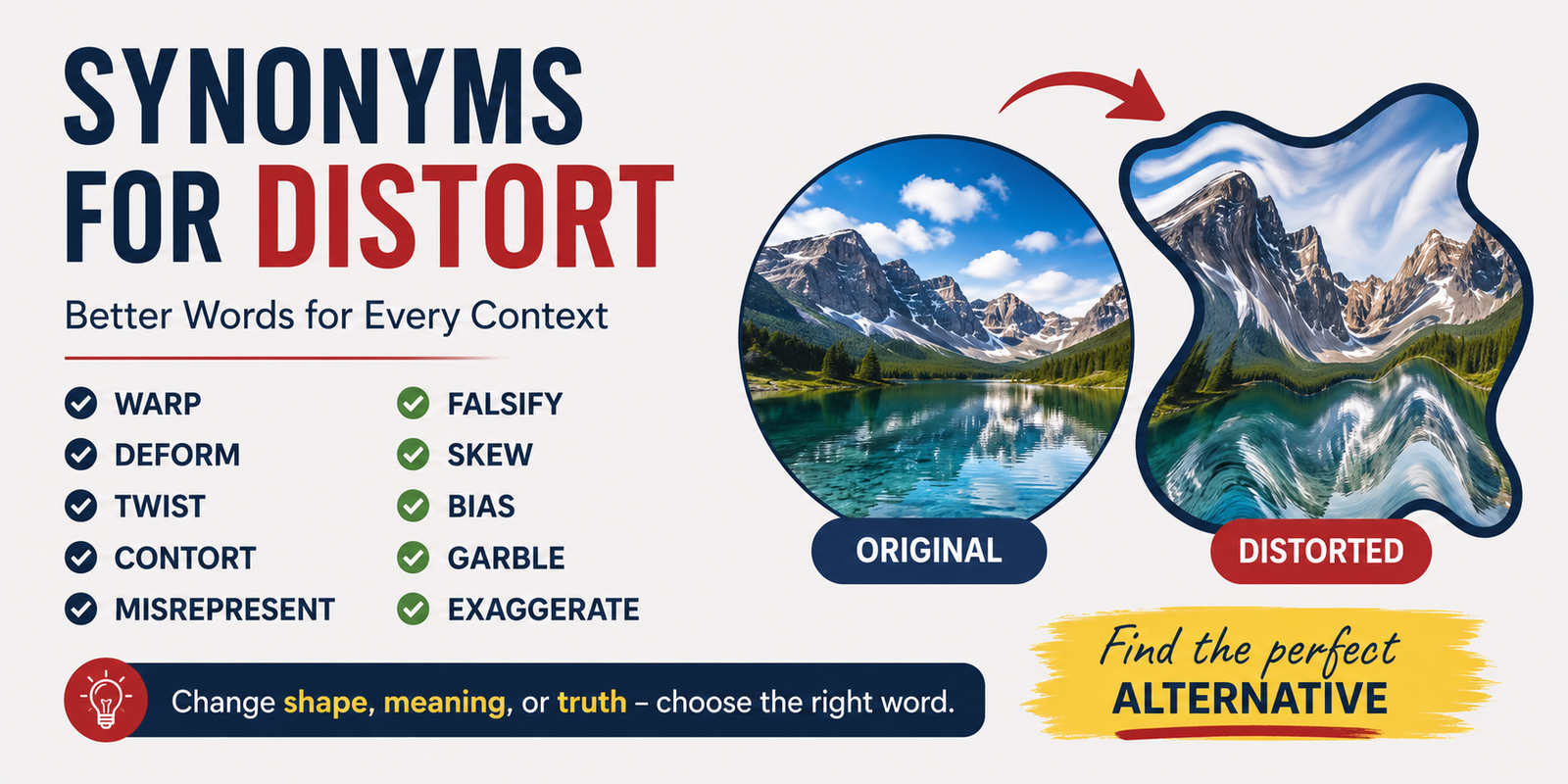
Looking for synonyms for distort? The best alternative depends on what you are describing. For example, you can warp an image, deform a shape, skew data, or misrepresent facts. However, these words are not interchangeable in every sentence.
The verb distort generally means to change something so that its shape, sound, appearance, meaning, or accuracy is affected. Dictionaries recognize both physical and informational uses.
Therefore, choosing the right synonym requires attention to context. The guide below separates the closest alternatives and explains when each one works naturally.
Quick Answer
The closest synonyms for distort include warp, deform, twist, contort, misrepresent, falsify, skew, bias, garble, and exaggerate. However, each has a different use. For physical shape, choose warp, deform, or contort. For facts or information, misrepresent, falsify, or twist may be better. For numerical information, skew is often the most precise choice.
Core Synonyms for Distort
| Word | Relationship | Meaning | Best Context | Formality |
|---|---|---|---|---|
| Warp | Near synonym | Bend or change something from its normal form | Shapes, images, perceptions | Neutral |
| Deform | Near synonym | Change something from its natural shape | Objects, bodies, structures | Neutral/Formal |
| Twist | Contextual synonym | Change or present something in a misleading way | Facts, words, meanings | Neutral |
| Contort | Contextual synonym | Twist something into an unnatural shape | Faces, bodies, physical forms | Neutral |
| Misrepresent | Contextual synonym | Present something inaccurately | Facts, people, events | Formal |
| Falsify | Contextual synonym | Deliberately make information false | Records, data, documents | Formal |
| Skew | Contextual synonym | Cause information or results to become unbalanced | Data, statistics, results | Formal |
| Bias | Near/contextual synonym | Influence something in a one-sided direction | Research, judgment, results | Formal |
| Garble | Contextual synonym | Make speech or information unclear or confused | Speech, messages, audio | Neutral |
| Exaggerate | Near synonym | Make something seem greater or more serious than it is | Claims, descriptions, problems | Neutral |
| Mangle | Contextual synonym | Damage or badly alter something | Text, speech, objects | Informal/Neutral |
Notably, major dictionaries divide distort into different senses rather than treating every related word as interchangeable. Cambridge, for instance, gives separate meanings for changing physical shape and changing meaning or truth.
What Does “Distort” Mean?
Distort is a transitive verb. It can mean to change the shape, appearance, or sound of something so that it becomes strange, unclear, or unnatural.
For example:
The curved lens distorted the image.
It can also mean to change facts, ideas, or information so that they are no longer accurate or true.
The article distorted the facts.
Oxford similarly identifies these two major uses: changing physical appearance or sound, and changing facts or ideas so that they are no longer correct or true.
The word therefore works across several fields. For instance, you might discuss distorted images, distorted sound, distorted data, distorted facts, or a distorted view of reality.
Synonyms for Distort When Talking About Shape
When something changes physical form, several alternatives work well.
1. Warp
Warp means to bend or change something from its normal shape.
Heat warped the plastic frame.
It is also useful figuratively:
Fear can warp a person’s perception of events.
Therefore, warp is one of the most versatile alternatives to distort.
2. Deform
Deform emphasizes a change to the natural or intended shape of something.
The impact deformed the metal panel.
This word sounds more technical than warp. As a result, it works particularly well in engineering, science, and formal descriptions.
3. Contort
Contort suggests twisting something into an unnatural or awkward shape.
The expression on his face became contorted with anger.
However, contort is usually more specific than distort. It strongly suggests twisting rather than simply changing form.
4. Twist
Twist can describe physical changes:
The force twisted the metal out of shape.
It can also describe language or information:
The report twisted her comments.
Consequently, twist is useful when both physical and figurative meanings matter.
Synonyms for Distort Facts, Information, or Meaning
When accuracy is the issue, physical synonyms such as deform usually do not work. Instead, use words related to inaccurate representation.
5. Misrepresent
Misrepresent means to present someone or something inaccurately.
The article misrepresented his position.
This is one of the strongest choices for formal writing about facts, people, statements, or events.
Therefore, use misrepresent when the key idea is inaccurate presentation.
6. Falsify
Falsify means to make something false or to deliberately provide false information.
The company was accused of falsifying records.
However, falsify can imply deliberate deception more strongly than distort.
So, if intentional deception matters, falsify may be more precise.
7. Twist
Twist is common when someone changes the meaning of words, statements, or events.
The politician accused the newspaper of twisting his words.
Unlike falsify, twist can sound less technical and more conversational.
8. Exaggerate
Exaggerate means to make something appear larger, more serious, more important, or more extreme than it really is.
The advertisement exaggerated the product’s benefits.
However, exaggeration is only one type of distortion. Therefore, exaggerate should not automatically replace distort.
Synonyms for Distort Data, Statistics, or Results
Data requires more precise vocabulary.
9. Skew
Skew means to cause data, results, or a distribution to become unbalanced or unrepresentative.
A small sample can skew the results.
As a result, skew is often a better choice than distort when discussing statistics, research, or numerical results.
10. Bias
Bias means to influence something toward a particular perspective or outcome.
The sampling method may bias the results.
However, bias focuses on directional influence. It does not always mean that the information has become generally false.
Therefore, use bias when one-sided influence is the important idea.
Synonyms for Distort Sound or Speech
The word also applies naturally to audio.
Cambridge gives examples involving distorted voices and sound, while Oxford specifically includes changes in sound as one meaning of distort.
11. Garble
Garble means to make speech, writing, or information confusing or difficult to understand.
The poor connection garbled his voice.
So, garble is useful when clarity is the problem rather than accuracy alone.
12. Mangle
Mangle means to badly damage, alter, or ruin something.
The software mangled the formatting of the document.
It is stronger and more informal than distort. Consequently, use it when the alteration is severe.
Which Word Should I Use?
The easiest way to choose is to identify what has been changed.
Choose “warp” when:
The emphasis is on bending or changing a shape.
The heat warped the wooden door.
Choose “deform” when:
The shape has been changed from its natural or intended form.
The collision deformed the vehicle’s frame.
Choose “misrepresent” when:
Facts, people, statements, or events are presented inaccurately.
The article misrepresented the research.
Choose “falsify” when:
Information has been deliberately made false.
Someone falsified the financial records.
Choose “skew” when:
Data or results become statistically unbalanced.
The unusual sample skewed the results.
Choose “garble” when:
Speech or information becomes confused or unclear.
Background noise garbled the announcement.
Choose “exaggerate” when:
Something is presented as greater or more serious than it really is.
The report exaggerated the risks.
Choose “twist” when:
Someone changes the meaning or interpretation of words or events.
She accused him of twisting her comments.
Distort vs. Warp
Both words can describe changes to shape or perception. However, warp often emphasizes bending or twisting from a normal form.
The heat distorted the plastic.
The heat warped the plastic.
Both are natural. Nevertheless, warp can sound more specific when something bends out of shape.
In figurative contexts, warp can also describe a person’s perception:
Anger warped his judgment.
Distort vs. Deform
Deform focuses strongly on physical shape. By contrast, distort has a much wider range of meanings.
The pressure deformed the container.
The camera distorted the image.
Therefore, deform is usually inappropriate when the subject is facts, opinions, or information.
Distort vs. Misrepresent
These words overlap when information becomes inaccurate. However, misrepresent specifically focuses on presenting something inaccurately.
The article distorted the facts.
The article misrepresented the facts.
Both sentences work. Still, misrepresent is often the clearer choice when discussing inaccurate reporting or portrayal.
Collins likewise identifies misrepresented as a synonym in the informational sense of distort.
Distort vs. Exaggerate
Exaggerate is narrower.
If someone changes facts in any inaccurate way, they may distort them. If they specifically make something seem larger, worse, better, or more important than it is, they exaggerate it.
The report distorted the facts.
The report exaggerated the financial losses.
Therefore, exaggerate is a contextual synonym, not a universal replacement.
Common Mistakes
Mistake 1: Treating every synonym as interchangeable
Not every dictionary synonym works in every sentence. For example, deform works naturally with physical objects, while misrepresent works with information.
Mistake 2: Using “falsify” whenever you mean “distort”
Falsify often suggests deliberate falsification. However, something can become distorted without someone intentionally creating a falsehood.
Mistake 3: Using “exaggerate” for every type of distortion
Exaggeration is only one form of distortion. A distorted image does not necessarily involve exaggeration.
Mistake 4: Using “bias” as a complete synonym
Bias involves directional influence. Therefore, it is better for research, judgment, sampling, and results than for ordinary physical distortion.
Mistake 5: Ignoring the context
Before choosing an alternative, ask what changed: shape, sound, facts, meaning, data, or perception? That simple question usually identifies the best synonym.
Related Words
Some words are closely connected to distort, but they should not be treated as exact synonyms in every context.
- Alter — change something, without necessarily making it inaccurate.
- Change — broadest and most neutral option.
- Modify — make a change, often deliberately and without a negative implication.
- Manipulate — control or influence something, sometimes deceptively.
- Misinterpret — understand something incorrectly rather than necessarily changing it.
- Clarify — make something clearer; this is often an opposite action.
- Accurate — describing something that correctly represents reality.
This distinction matters because a thesaurus can contain words that are related without being fully interchangeable. Current thesaurus results for distort include many such context-dependent alternatives.
Antonyms of Distort
The best antonym depends on the sense.
For information, useful opposites include:
- represent accurately
- clarify
- correct
- preserve
- tell the truth
For physical shape, possible opposites include:
- straighten
- restore
- preserve
- maintain
Therefore, there is no single antonym that works perfectly in every context.
Pronunciation
Distort
- US: /dɪˈstɔːrt/
- UK: /dɪˈstɔːt/
The word is normally stressed on the second syllable. Cambridge and Oxford provide these pronunciation forms in their dictionary entries.
FAQ
What is the closest synonym for distort?
There is no single closest synonym for every context. Warp is a strong alternative for physical shape, while misrepresent works well for facts or information. Similarly, skew is more precise for data, and garble is useful for unclear speech or messages.
What is another word for distort the truth?
Misrepresent, twist, and falsify can work, depending on the meaning. Misrepresent emphasizes inaccurate presentation, while falsify can imply deliberate deception. Twist is more conversational and often describes changing the meaning of someone’s words.
What is a synonym for distort an image?
Warp is often the most natural alternative. Deform can also work when the image shows a change in physical form. For example, you can say, “The lens warped the image.”
What is a synonym for distort data?
Skew is often the most precise choice. You can also use bias when a particular factor pushes the results in one direction. However, these words have different technical meanings, so they should not be treated as interchangeable.
Is “twist” a synonym for “distort”?
Yes, in some contexts. Twist can mean to change the meaning of facts, words, or events in a misleading way. However, it can also describe physical movement. Therefore, context determines whether it is an appropriate replacement.
Is “deform” the same as “distort”?
Not exactly. Deform primarily focuses on changing physical shape, whereas distort can describe shape, sound, appearance, facts, information, and meaning. As a result, distort has a broader range of uses.
What is the opposite of distort?
For information, useful opposites include represent accurately, clarify, correct, and preserve. For physical form, straighten or restore may be more appropriate. The best antonym depends on the particular meaning.
Conclusion
The best synonym for distort depends on what you are describing. For physical changes, choose warp, deform, or contort. For inaccurate information, consider misrepresent, falsify, or twist. Meanwhile, skew works particularly well for data, and garble fits unclear speech or messages.

Our editorial team is dedicated to making English vocabulary easier to understand and use correctly. We research and review synonyms, antonyms, definitions, word usage, and example sentences to ensure our content is clear, accurate, practical, and useful for students, writers, professionals, and English learners.