Synonyms for Verse: Better Alternatives With Meaning & Examples
Finding the right synonym for verse can be surprisingly difficult because the word has several meanings. In literature, verse can refer to poetry or a line of metrical writing. In a song, it can mean one of the sections that comes before the chorus. It can also refer to a short numbered section of a sacred text.
Therefore, there is no single replacement that works in every sentence. For example, poem may work when verse means a piece of poetry, while stanza is more appropriate when referring to a section of a poem. Similarly, lyric can work in some musical contexts, but it is not an exact synonym for every meaning of verse.
The best alternative depends on what kind of verse you mean.
Quick Answer: What Are the Best Synonyms for Verse?
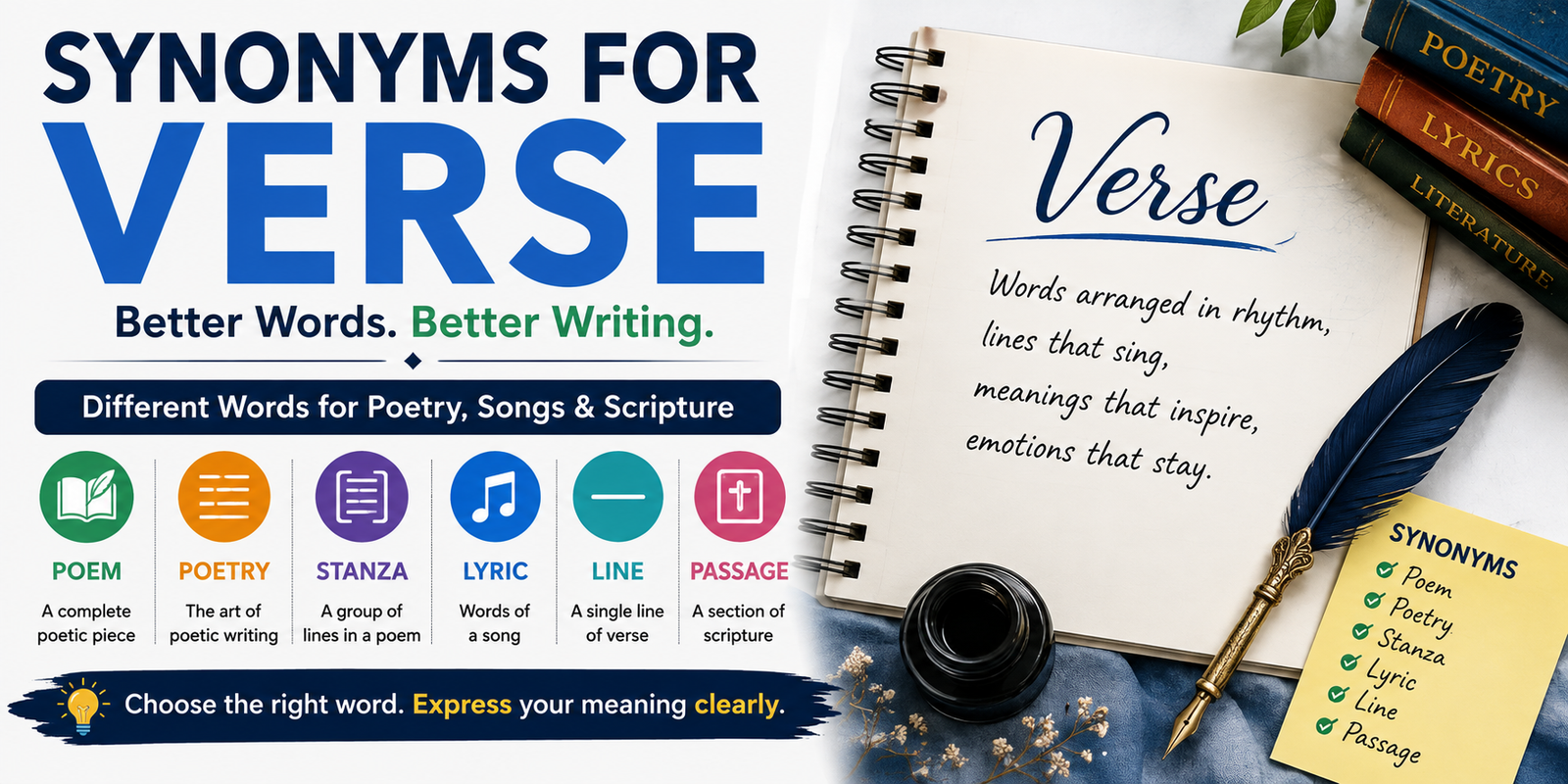
The closest alternatives to verse include poem, poetry, stanza, lyric, line, and passage, but they are not interchangeable in every context. Poem works when verse refers to a complete poetic composition; stanza refers to a section of a poem; lyric usually refers to words written or sung for a song; and passage can describe a section of a sacred text.
Core Synonyms for Verse
| Word | Relationship | Meaning | Best Context | Formality |
|---|---|---|---|---|
| Poem | Near synonym | A complete composition written in poetry | Literary writing | Neutral |
| Poetry | Near synonym | Writing expressed through poetic language | Literature generally | Neutral |
| Stanza | Contextual alternative | A grouped section of lines in a poem | Poetry | Neutral/Formal |
| Lyric | Contextual alternative | Words of a song, especially expressive words | Music | Neutral |
| Line | Contextual alternative | A single line of poetry | Poems and verse | Neutral |
| Passage | Contextual alternative | A section of a larger written work | Scripture or literature | Neutral |
| Song | Contextual alternative | A musical composition containing verses and other sections | Music | Neutral |
| Poetic writing | Descriptive alternative | Writing expressed in poetic form | Literature | Formal |
| Metrical writing | Descriptive alternative | Writing organized around meter or rhythmic patterns | Literary analysis | Formal |
Important: Words such as sonnet, ode, ballad, elegy, haiku, and limerick are related to verse, but they are types or forms of poetry, not general synonyms for verse. Merriam-Webster’s thesaurus, for example, lists many of these alongside verse, but that does not mean each one can replace verse in every sentence.
What Does “Verse” Mean?
The noun verse has several established meanings.
First, it can mean writing arranged in rhythmic or metrical form, especially poetry. Cambridge defines it as writing arranged in short lines with a regular rhythm and gives poetry as the associated concept.
Second, verse can mean a part of a poem or song. For example:
The singer repeated the first verse before the chorus.
Third, verse can refer to a short numbered section of a sacred text, such as a verse from the Bible or Quran.
Because these meanings differ, the best synonym changes with the context.
The Best Synonym for Verse in Different Contexts
1. Verse Meaning “Poem”
When verse refers to a complete poetic composition, poem can often be a natural alternative.
Example:
She wrote a beautiful verse for her friend.
A natural alternative is:
She wrote a beautiful poem for her friend.
However, the two words are not always identical. Verse can emphasize poetic form, rhythm, or metrical writing, whereas poem generally refers to the composition itself.
Best choice: poem
Use poem when you are talking about an individual poetic composition.
2. Verse Meaning “Poetry”
When verse refers to poetry as a form of writing, poetry is often the better alternative.
Example:
Shakespeare wrote much of his work in verse.
You could say:
Shakespeare wrote much of his work in poetry.
However, the original sentence sounds more natural because in verse is a conventional expression meaning in poetic form. So, although poetry is semantically related, it is not always a clean grammatical substitution.
Best choice: poetry
Use poetry when discussing the literary form generally.
3. Verse Meaning “Stanza”
When verse means a section of a poem, stanza may be the more precise word.
A stanza is a grouped set of lines within a poem.
Example:
The final verse describes the poet’s childhood.
Depending on the intended meaning, this could become:
The final stanza describes the poet’s childhood.
This distinction matters because stanza specifically identifies a structural section of a poem.
Best choice: stanza
Use stanza when discussing the structure of a poem.
4. Verse Meaning “Song Section”
In music, verse usually refers to one of the recurring sections of a song. It commonly appears alongside sections such as the chorus. Cambridge specifically identifies verse as one of the parts into which a song or poem is divided.
Example:
The second verse introduces a new character.
Possible alternatives include:
- song section
- section
- lyric section
However, lyric is not always interchangeable with verse. Lyrics can refer to the words of a song as a whole.
Best choice: song section
Use this when you need maximum clarity rather than a direct synonym.
5. Verse Meaning “Lyrics”
In some musical contexts, lyric can be a useful alternative.
For example:
The verse contains emotionally powerful words.
Depending on the intended meaning:
The lyrics contain emotionally powerful words.
This changes the meaning slightly. Verse identifies a particular section, whereas lyrics refers to the words of a song.
Best choice: lyrics
Use lyrics when the emphasis is on the words rather than the song’s structural section.
6. Verse Meaning “Line of Poetry”
In literary contexts, verse can refer to a line of metrical writing. Merriam-Webster explicitly gives this as one of its meanings.
For example:
The poet carefully revised every verse.
Depending on the intended meaning, you could say:
The poet carefully revised every line.
However, line is narrower. A verse can refer to a line, but it can also refer to a larger poetic unit.
Best choice: line
Use line when you specifically mean one line of poetry.
Verse Synonyms by Context
The easiest way to choose the right word is to start with your context.
For poetry
Use:
- poem
- poetry
- stanza
- line
- metrical writing
- poetic writing
For songs
Use:
- song section
- lyrics
- lyric section
- section
For scripture
Use:
- passage
- scriptural passage
- quotation
- text
For example:
She memorized a verse from the Bible.
You could use:
She memorized a passage from the Bible.
The meaning becomes slightly broader, because a passage can contain more than one verse.
Which Word Should I Use Instead of “Verse”?
Choose “poem” when:
You mean an individual work of poetry.
Example:
He wrote a short poem about winter.
Choose “poetry” when:
You mean the literary form in general.
Example:
She enjoys reading poetry.
Choose “stanza” when:
You mean a structured section of a poem.
Example:
The final stanza changes the mood of the poem.
Choose “line” when:
You mean one line of poetic writing.
Example:
That line is particularly memorable.
Choose “lyric” or “lyrics” when:
You mean the words of a song.
Example:
The song’s lyrics tell a story about friendship.
Choose “passage” when:
You mean a section of a larger written or sacred text.
Example:
He read a passage from the Bible.
Important Comparisons
Verse vs. Poem
These words overlap, but they are not identical.
A poem is generally a complete poetic composition. Verse can refer to a poem, but it can also mean poetic writing generally or a section of a poem or song. Merriam-Webster lists poem as a synonym in one sense of verse.
Simple rule:
Poem = a complete poetic work.
Verse = poetic writing or a poetic section, depending on context.
Verse vs. Stanza
A stanza is specifically a grouped section of lines in a poem.
A verse has a wider range of meanings.
Therefore, stanza is a good replacement only when verse refers to a section of poetry.
Example:
The final stanza contains four lines.
This is more precise than simply saying final verse.
Verse vs. Lyric
A lyric generally refers to the words of a song, while a verse can refer to one structural part of that song.
For example:
The second verse comes after the first chorus.
This describes song structure.
By contrast:
The lyrics are emotionally powerful.
This describes the song’s words.
Therefore, verse ≠ lyric, although they overlap in musical contexts.
Verse vs. Rhyme
These words are frequently associated with poetry, but they are not synonyms.
Verse describes poetic writing or a poetic section.
Rhyme describes a sound relationship between words, particularly matching or similar ending sounds.
For example:
The poem is written in verse and uses extensive rhyme.
Because the two concepts can appear together, rhyme should be treated as a related word, not a direct synonym.
Verse vs. Prose
These are generally contrasting literary forms.
Verse uses poetic structures such as rhythm, meter, or lineation.
Prose is ordinary written or spoken language that is not organized as verse.
For example:
The novel combines prose with verse.
Therefore, prose is not a synonym for verse; it is often its contrast.
Related Words That Are Not Exact Synonyms
A strong vocabulary resource should distinguish synonyms from related terms.
Sonnet
A specific type of poem.
Ode
A type of lyrical poem, traditionally written in praise or reflection.
Ballad
A type of poem or song, often narrative in character.
Elegy
A poem associated with mourning or reflection, particularly following death.
Haiku
A specific Japanese poetic form.
Limerick
A five-line poetic form with a characteristic rhythm and rhyme scheme.
Rhyme
A sound relationship between words.
Meter
The rhythmic structure of poetry.
Chorus
A recurring section of a song, distinct from the verse.
These words belong to the same semantic field, but they should not be presented as universal replacements for verse.
Common Mistakes With “Verse”
Mistake 1: Treating every poetry word as a synonym
Words such as sonnet, haiku, and limerick describe particular poetic forms. Therefore, they cannot normally replace verse.
Incorrect approach:
“Verse” means sonnet, haiku, or limerick.
Better understanding:
A sonnet, haiku, or limerick can be a type of verse.
Mistake 2: Assuming “verse” always means “stanza”
A verse can refer to a section of a poem or song, but the meanings overlap differently depending on context.
Therefore, stanza is more precise when discussing the formal structure of a poem.
Mistake 3: Confusing verse with lyric
A song’s verse is a structural section, while its lyrics are its words.
Consequently, replacing verse with lyrics can change the meaning.
Mistake 4: Confusing “verse” with “versus”
Verse and versus are different words.
- verse = poetry, a poetic line, a song section, or a scriptural section
- versus = against or in opposition to
This distinction is especially important in writing.
Pronunciation of “Verse”
US: /vɝːs/
UK: /vɜːs/
The pronunciation is essentially one syllable.
Etymology of “Verse”
The word verse has a long literary history. Merriam-Webster traces it through Middle English and Anglo-French to Latin versus, associated with a line or row of writing and ultimately connected with vertere, meaning “to turn.” The historical connection reflects the idea of a line of writing returning or turning to begin another line.
FAQ: Synonyms for Verse
What is the closest synonym for “verse”?
The closest synonym depends on the meaning. Poem is a useful alternative when verse means a poetic composition. Stanza is better when it means a section of a poem, while lyric or lyrics may work in a musical context.
What is another word for a verse in a poem?
Stanza is often the most precise alternative when you mean a group of lines forming a section of a poem. If you mean one individual line, line is more accurate.
What is another word for a verse in a song?
Depending on the context, you can use song section or section. If you mean the words rather than the structural part of the song, lyrics is more appropriate.
Is “poem” a synonym for “verse”?
Sometimes. Verse can mean a poem or poetic composition, so poem can work in that sense. However, verse also has other meanings, including a section of a song or a short division of scripture.
Is “stanza” the same as “verse”?
Not always. A stanza is a grouped section of lines in a poem, whereas verse has several meanings. In poetry, the two can overlap, but stanza is usually more structurally precise.
Is “lyric” a synonym for “verse”?
Only in certain contexts. Lyric generally refers to the words of a song, whereas a verse is a particular section of the song. Therefore, they should not be treated as exact synonyms.
Is “rhyme” another word for “verse”?
No. Rhyme refers to a sound relationship between words, while verse refers to poetic writing, a poetic line, or a section of a poem or song. They are related concepts rather than synonyms.
What is another word for a Bible verse?
Depending on context, scriptural passage, passage, or scripture can work as broader alternatives. However, these terms may refer to more than one verse, so Bible verse remains the most precise expression when referring to one numbered section.
Conclusion
The best synonym for verse depends on what you mean. If you are referring to a complete poetic work, poem is often the natural choice. If you mean a section of a poem, stanza is more precise. For music, lyrics may work when you mean the words, while song section is clearer when you mean the structural part. Finally, for scripture, passage can be a useful broader alternative.

Sophia Martinez is an ESL educator who specializes in teaching vocabulary and word meanings. She writes beginner-friendly content that helps learners understand synonyms and improve their English fluency step by step.