Synonyms for Optional: 20 Better Alternatives for Every Context
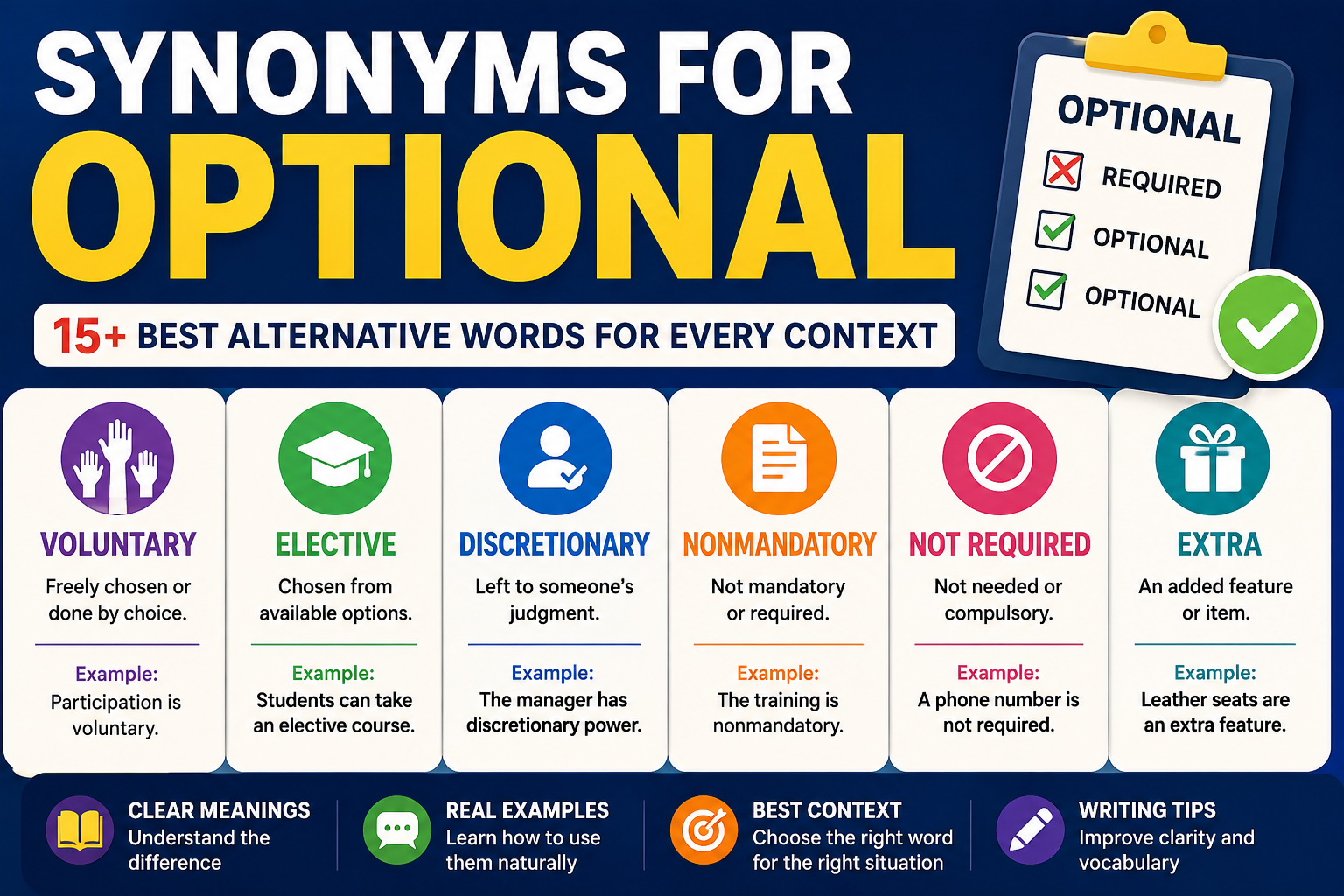
If you need a different way to say optional, the best choices include voluntary, elective, discretionary, nonmandatory, nonobligatory, and not required. However, these words are not always interchangeable. Voluntary emphasizes free choice, elective often refers to a choice among available options, and discretionary suggests that someone has the authority or freedom to decide.
Choosing the right synonym depends on what you mean by “optional,” as well as the context, tone, and level of formality.
Table of Contents
- What Does “Optional” Mean?
- Quick Answer: Best Synonyms for Optional
- Closest Synonyms for Optional
- Formal and Professional Alternatives
- Context-Specific Alternatives
- Optional Synonyms by Meaning
- How to Choose the Right Synonym
- Optional vs Voluntary vs Elective vs Discretionary
- Common Mistakes
- Examples in Real-World Contexts
- Antonyms of Optional
- FAQ
- Conclusion
Quick Answer: What Are the Best Synonyms for Optional?
The closest synonyms for optional are voluntary, elective, discretionary, nonmandatory, nonobligatory, noncompulsory, and not required. The best choice depends on context. Use voluntary for something chosen freely, elective for a selectable option or course, and discretionary when the decision is left to someone’s judgment or authority.
What Does “Optional” Mean?
Optional is an adjective meaning not compulsory or not required; something that can be chosen or done if desired.
For example:
Attendance at the evening session is optional.
This means people may attend, but they are not required to do so.
Cambridge defines optional as something a person can choose whether to do, pay for, or buy, while Merriam-Webster defines it as involving an option and being “not compulsory.”
Part of speech: Adjective
US pronunciation: /ˈɑːp.ʃə.nəl/
UK pronunciation: /ˈɒp.ʃə.nəl/
Common examples include:
- an optional course
- optional equipment
- optional training
- an optional feature
- an optional payment
- an optional activity
The word can describe something that is available but not required, such as an optional feature on a product, or an activity that people may choose to join.
Closest Synonyms for Optional
Not every thesaurus entry is a perfect substitute for optional. The following words are the most useful alternatives, grouped by how closely they match the original meaning.
| Word or phrase | Relationship | Formality | Best context |
|---|---|---|---|
| Voluntary | Direct/near synonym | Neutral | Actions, participation, contributions |
| Elective | Direct/near synonym | Neutral | Courses, choices, procedures |
| Discretionary | Near synonym | Formal | Decisions, spending, authority |
| Nonmandatory | Direct synonym | Formal/technical | Rules, requirements, policies |
| Nonobligatory | Direct synonym | Formal | Duties, payments, requirements |
| Noncompulsory | Direct synonym | Formal | Education, rules, participation |
| Not required | Direct equivalent | Neutral | Everyday and professional writing |
| Not obligatory | Direct equivalent | Formal | Duties, procedures, policies |
| Open to choice | Contextual alternative | Neutral | Decisions and participation |
| Left to one’s choice | Contextual alternative | Neutral | Personal decisions |
| Discretional | Near synonym | Formal | Decisions and authority |
| Elective | Contextual alternative | Neutral | Courses and selected options |
| Unforced | Contextual alternative | Neutral | Actions or decisions |
| Uncompelled | Near synonym | Formal/literary | Actions taken freely |
| Available at additional cost | Contextual alternative | Neutral | Products and services |
| Extra | Contextual alternative | Neutral | Features, services, additions |
| Additional | Related/contextual | Neutral | Features or components |
| Dispensable | Related but different | Formal | Something that can be done without |
| Unneeded | Related but different | Neutral | Something unnecessary |
| Unnecessary | Related but different | Neutral | Something not needed |
Cambridge’s thesaurus specifically lists voluntary, elective, nonobligatory, discretionary, nonmandatory, and not required, among others, as words related to optional. Merriam-Webster likewise highlights voluntary, elective, and discretionary as its principal synonyms.
1. Voluntary
Voluntary is one of the closest alternatives to optional when something is done by personal choice rather than because it is required.
Participation in the survey is voluntary.
Use voluntary especially for:
- participation
- work
- contributions
- activities
- service
- actions
Difference: Optional emphasizes that something is not required. Voluntary emphasizes that a person freely chooses to do it.
2. Elective
Elective describes something that can be selected rather than something imposed as a requirement.
Students can take an elective course in photography.
It is particularly natural in:
- education
- healthcare
- formal choices
- selected options
For example, an elective course is chosen by a student rather than being a required course.
3. Discretionary
Discretionary means dependent on someone’s judgment or choice.
The manager has discretionary authority over the budget.
This is more formal than everyday optional and is especially useful in:
- business
- finance
- government
- law
- policy
- management
Do not automatically replace optional with discretionary. The latter can imply that a person or institution has decision-making authority.
4. Nonmandatory
Nonmandatory directly means not mandatory or not required.
Attendance at the workshop is nonmandatory.
It works particularly well in formal, administrative, educational, and policy contexts.
5. Nonobligatory
Nonobligatory means not imposed as an obligation.
The donation is nonobligatory.
It is accurate but more formal and less common in everyday conversation than optional or not required.
6. Noncompulsory
Noncompulsory means not compulsory.
The school offers several noncompulsory activities after class.
It is particularly useful when discussing:
- education
- attendance
- rules
- participation
- requirements
7. Not Required
Sometimes the most natural replacement for optional is simply not required.
Additional documentation is not required.
This phrase is clear, direct, and highly useful in professional communication.
It is often preferable to an obscure synonym because readers immediately understand it.
8. Not Obligatory
Not obligatory is a more formal way to express the idea that something is not required.
Attendance at the reception is not obligatory.
It works well in formal writing but can sound somewhat stiff in casual conversation.
9. Open to Choice
Open to choice emphasizes that people are free to select an option.
The format of the presentation is open to choice.
This is a useful contextual alternative, but it is not a universal replacement for optional.
10. Left to One’s Choice
This phrase emphasizes personal decision-making.
Whether to attend the meeting is left to your choice.
It is natural when the important idea is freedom to decide, rather than simply the absence of a requirement.
Formal and Professional Alternatives to Optional
For business, academic, administrative, and professional writing, these choices are particularly useful:
- discretionary
- nonmandatory
- nonobligatory
- noncompulsory
- not required
- not obligatory
- elective
The best choice depends on the noun.
For example:
Optional training is available.
could become:
Voluntary training is available.
But:
Optional spending is available.
may be better expressed as:
Discretionary spending is available.
And:
Optional documentation is permitted.
may be clearer as:
Additional documentation is not required.
The goal is not to replace optional mechanically. It is to select the word that expresses the exact relationship between choice and requirement.
Casual Alternatives to Optional
In everyday English, simple phrases are usually more natural than formal synonyms.
Useful choices include:
- not required
- up to you
- your choice
- if you want
- if you wish
- you don’t have to
- voluntary
For example:
Attendance is optional.
In casual conversation, you could say:
Attendance is up to you.
Or:
You don’t have to attend.
These are not single-word synonyms, but they often communicate the same idea more naturally.
Optional Synonyms by Context
For Education
Use:
- elective
- voluntary
- noncompulsory
- not required
Examples:
Spanish is an elective subject.
Attendance at the review session is voluntary.
For Work
Use:
- voluntary
- discretionary
- not required
- nonmandatory
Example:
The training session is voluntary.
For Payments
Use:
- voluntary
- discretionary
- not required
- additional, depending on meaning
Example:
The service charge is optional.
If the meaning is that a payment is entirely up to the customer, voluntary may work. If it is an added cost for an extra feature, additional or extra may be more precise.
For Product Features
Use:
- optional
- additional
- extra
- available at additional cost
Example:
Leather seats are an optional extra.
Here, extra does not simply mean “not required”; it refers to an added feature or cost. Collins treats extra as a contextual sense of optional in commercial situations.
For Decisions
Use:
- discretionary
- elective
- open to choice
- left to one’s choice
Example:
The final decision is discretionary.
This means the decision depends on someone’s judgment, so discretionary carries more nuance than ordinary optional.
Optional vs Voluntary vs Elective vs Discretionary
These four words are closely related but should not be treated as identical.
| Word | Main idea | Example |
| Optional | Not required | Attendance is optional. |
| Voluntary | Freely chosen | Participation is voluntary. |
| Elective | Selected from available choices | Biology is an elective course. |
| Discretionary | Determined by someone’s judgment | The payment is discretionary. |
Optional vs Voluntary
Optional means you do not have to do something.
Voluntary emphasizes that participation is freely chosen.
Attendance is optional.
Participation is voluntary.
Both can be correct, but voluntary often sounds more natural when discussing people’s actions.
Optional vs Elective
Elective is especially common when someone chooses from a set of alternatives.
Students must take three required courses and two electives.
You would not normally use elective for every situation in which something is optional.
Optional vs Discretionary
Discretionary means a decision depends on someone’s judgment, authority, or personal choice.
The manager approved discretionary spending.
Calling something optional simply says that it is not required. Calling it discretionary can suggest that someone has the authority to decide whether it happens.
When “Extra” Means Optional
Extra can sometimes replace optional, especially when talking about products, services, features, or costs.
Heated seats are optional.
Heated seats are an extra.
However, the meanings are not identical.
Optional focuses on choice.
Extra focuses on something added beyond the standard package.
That distinction matters in commercial writing.
Words That Are Related but Not Exact Synonyms
Some words appear in thesauruses because they overlap with one sense of optional, but they should not automatically be presented as direct substitutes.
Unnecessary
Unnecessary means not needed.
The additional step is unnecessary.
Something can be unnecessary without being optional in the practical sense.
Unneeded
Unneeded similarly means not needed.
Remove any unneeded files.
It describes lack of necessity rather than freedom of choice.
Dispensable
Dispensable means something can be done without.
The extra feature is dispensable.
This can imply that the thing is not essential, but it does not necessarily mean that someone has a choice about whether to use it.
Possible
Possible means capable of happening or being done.
It does not normally mean optional.
An optional upgrade is available.
does not mean:
A possible upgrade is available.
The second sentence changes the meaning.
How to Choose the Right Synonym for Optional
Use this quick decision guide:
Choose “optional” when something is simply not required, as in, “The final section is optional.” Use “voluntary” when people freely decide whether to participate or act; for example, “Contributions are voluntary.”
Choose “elective” when someone selects an option from a set of alternatives, such as, “Students can choose an elective.” By contrast, “discretionary” describes something that depends on personal judgment or authority, as in, “The manager controls discretionary spending.”
When maximum clarity matters, “not required” is a straightforward choice: “A cover letter is not required.” For formal or administrative language, “nonmandatory” may be more appropriate, as in, “The training is nonmandatory.” Finally, use “extra” when referring to an added feature, service, or cost—for example, “Wi-Fi is available as an extra.”
Common Mistakes When Using Synonyms for Optional
Mistake 1: Treating Every Thesaurus Entry as an Exact Synonym
Words can overlap in meaning without being interchangeable.
For example, unnecessary means “not needed,” while optional means “not required or left to choice.” Those concepts overlap, but they are not identical.
Mistake 2: Using “Elective” Everywhere
Elective is particularly natural for selected courses, procedures, or choices.
She took an elective course.
Replacing every occurrence of optional with elective can make the sentence unnatural.
Mistake 3: Using “Discretionary” for Simple Choices
Discretionary can imply judgment or authority.
The manager has discretionary spending authority.
For an ordinary personal choice, optional or up to you may be better.
Mistake 4: Choosing Formal Words When Plain English Is Better
Nonobligatory is technically useful, but not required is often clearer.
Instead of:
Submission of the form is nonobligatory.
consider:
Submission of the form is not required.
Mistake 5: Confusing Optional With Unnecessary
Something can be optional but still useful.
For example:
The practice exercise is optional but recommended.
It is not required, but that does not mean it is unnecessary.
Real-World Examples
Workplace
Attendance at the Friday workshop is optional.
Participation in the mentoring program is voluntary.
Managers may approve discretionary expenses.
Academic Writing
Students may choose an elective course.
The supplementary reading is optional.
Attendance at the discussion session is not required.
Business
Customers can purchase optional accessories.
Premium support is available as an additional service.
The upgrade is available at an additional cost.
Everyday Conversation
You don’t have to come.
The extra activity is completely optional.
It’s up to you.
You can join us if you want.
These conversational expressions are often more natural than formal alternatives.
Antonyms of Optional
The main opposites of optional are:
- mandatory
- required
- compulsory
- obligatory
- necessary
- essential
The strongest antonym depends on context.
Attendance is mandatory.
Registration is required.
Safety training is compulsory.
Cambridge lists compulsory, mandatory, and obligatory as opposites of optional, while Merriam-Webster also identifies required, necessary, essential, requisite, and related terms as antonyms or near-antonyms.
FAQ
What is the closest synonym for optional?
The closest common synonyms are voluntary, elective, discretionary, nonmandatory, nonobligatory, and not required. Voluntary is often the most natural choice when discussing participation or actions.
What is another word for optional?
Depending on context, another word for optional can be voluntary, elective, discretionary, nonmandatory, noncompulsory, or not required.
What is a formal synonym for optional?
Discretionary, nonmandatory, nonobligatory, and noncompulsory are formal alternatives. In many professional contexts, however, the simple phrase not required is clearer.
What is a professional synonym for optional?
Discretionary, nonmandatory, and not required can work well in professional writing. The correct choice depends on whether you mean free participation, lack of obligation, or a decision left to someone’s judgment.
Is voluntary the same as optional?
They are closely related but not identical. Optional means something is not required, while voluntary emphasizes that someone freely chooses to participate or act.
Is elective a synonym for optional?
Sometimes. Elective is especially appropriate when someone chooses from available alternatives, particularly in education. It is not a universal substitute for optional.
Is discretionary a synonym for optional?
In some contexts, yes. Discretionary emphasizes that something is determined by someone’s judgment or authority, so it has a more specific meaning than ordinary optional.
What is the opposite of optional?
Common antonyms include mandatory, required, compulsory, obligatory, necessary, and essential.
What is a simple way to say optional?
In everyday English, you can often say not required, up to you, your choice, or you don’t have to.
Conclusion
The best synonym for optional depends on the context. Voluntary works especially well for freely chosen participation, elective for selected options or courses, and discretionary for decisions made according to judgment. Nonmandatory, nonobligatory, and not required are useful when the main idea is that something is not compulsory.

Sophia Martinez is an ESL educator who specializes in teaching vocabulary and word meanings. She writes beginner-friendly content that helps learners understand synonyms and improve their English fluency step by step.