Synonyms to Trust: 25 Better Alternatives With Examples & Context
Finding the right synonyms to trust is more complicated than replacing one word with another. The word trust can describe confidence in a person, belief in information, reliance on something, or even the act of giving someone responsibility. Therefore, the best alternative depends on the sentence and the meaning you want to express.
For example, confidence works well when you believe someone is capable. Faith can express stronger personal belief, while reliance emphasizes depending on someone or something. Similarly, the verb rely on can replace trust in some situations, but it does not carry exactly the same emotional meaning.
This guide separates the closest synonyms from near-synonyms and contextual alternatives. As a result, you can choose the word that sounds natural rather than simply picking the longest thesaurus list.
Quick Answer: What Are the Best Synonyms to Trust?
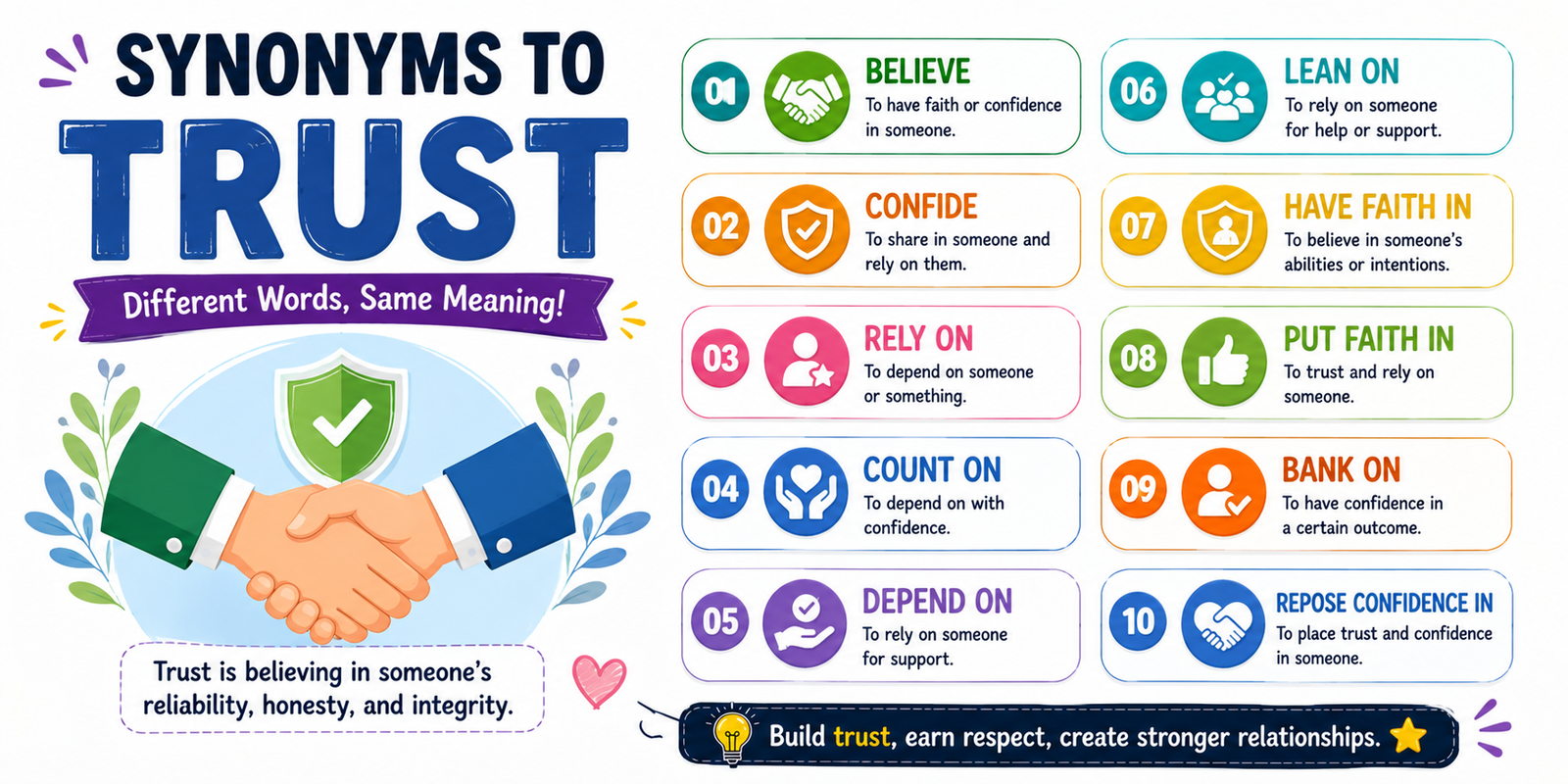
The closest synonyms to trust include confidence, faith, belief, reliance, credence, rely on, depend on, count on, believe, and have confidence in.
However, they are not interchangeable in every sentence. For instance, confidence emphasizes belief in someone’s ability, while rely on emphasizes dependence. Likewise, faith often carries a stronger personal or emotional meaning.
Core Synonym Resource
| Word | Relationship | Main Meaning | Best Context | Formality |
|---|---|---|---|---|
| Confidence | Direct/near synonym | Belief in someone’s ability or reliability | People, skills, decisions | Neutral |
| Faith | Near synonym | Strong belief or trust | People, principles, beliefs | Neutral |
| Belief | Near synonym | Acceptance that something is true | Information, people, ideas | Neutral |
| Reliance | Near synonym | Dependence on someone or something | Systems, people, support | Formal |
| Credence | Near synonym | Belief that something is true | Claims, evidence, reports | Formal |
| Rely on | Direct/contextual | Depend on someone or something | People, systems, support | Neutral |
| Depend on | Contextual alternative | Need or rely upon | People, systems, outcomes | Neutral |
| Count on | Contextual alternative | Expect someone to be dependable | People, informal/professional speech | Neutral |
| Believe | Contextual alternative | Accept something or someone as true | Statements, people, claims | Neutral |
| Have confidence in | Direct phrase | Feel confident about someone/something | Professional and personal contexts | Neutral/Formal |
| Be confident in | Contextual alternative | Feel sure about ability or outcome | Skills, decisions, results | Neutral |
| Assurance | Related/near synonym | A statement or feeling that creates confidence | Promises, communication | Formal |
| Certainty | Related/near synonym | Strong absence of doubt | Facts, predictions | Formal |
| Conviction | Near synonym | Firm belief | Ideas, principles, judgments | Formal |
| Credit | Contextual alternative | Believe or accept as true | Statements, explanations | Formal/Neutral |
The distinction matters. Cambridge’s thesaurus separates trust into several senses and lists different alternatives for each one, including confidence, faith, belief, reliance, credence, rely on, depend upon, count upon, and believe.
What Does “Trust” Mean?
Trust can function as both a noun and a verb.
As a verb, trust means believing that someone is honest, reliable, safe, or capable of doing something correctly. For example:
I trust my manager to make the right decision.
As a noun, trust refers to the belief that someone or something is reliable, honest, or safe:
Their relationship is based on trust.
Cambridge also identifies another important use of trust: a formal legal arrangement in which property or money is controlled for another person’s benefit. That meaning has a completely different synonym set and should not be mixed with ordinary interpersonal trust.
Pronunciation
US: /trʌst/
UK: /trʌst/
The Most Useful Synonyms to Trust
1. Confidence
Meaning: A strong belief that someone or something is capable, reliable, or likely to succeed.
How it differs: Confidence often focuses on ability or expected success, whereas trust can also involve honesty, safety, or personal reliability.
Example:
I have complete confidence in her ability to lead the project.
This is especially useful in professional writing.
2. Faith
Meaning: Strong belief or trust in someone, something, or an idea.
How it differs: Faith can sound more personal, emotional, or idealistic than trust.
Example:
She has faith in her team’s ability to overcome the challenge.
Therefore, use faith when the belief itself is important, particularly when evidence may be limited.
3. Belief
Meaning: Acceptance that something is true or real.
Example:
His belief in the team’s potential never disappeared.
However, belief is broader than trust. You can have a belief about a fact without trusting a person.
4. Reliance
Meaning: Dependence on someone or something for support, performance, or results.
Example:
The company’s reliance on a single supplier creates a risk.
Consequently, reliance is often better than trust in formal or analytical writing when dependence is the main idea.
5. Credence
Meaning: Belief that something is true or worthy of acceptance.
Example:
The new evidence gave credence to his explanation.
This is a formal word. Moreover, it usually applies to claims, explanations, reports, or evidence, rather than ordinary relationships.
6. Rely On
Meaning: Depend on someone or something.
Example:
You can rely on Maria to finish the report on time.
This is one of the most useful alternatives to trust. Nevertheless, rely on emphasizes dependable support rather than the emotional or interpersonal element that trust can express.
7. Depend On
Meaning: Need or rely on someone or something.
Example:
The team depends on accurate data to make decisions.
Therefore, choose depend on when the idea of necessity or dependence is stronger than personal confidence.
8. Count On
Meaning: Expect someone to be dependable or to do what they promised.
Example:
You can count on James to help when deadlines get tight.
Count on is natural in everyday English. It can also work in professional communication, although it is generally less formal than rely on.
9. Believe
Meaning: Accept something as true or consider someone honest or truthful.
Example:
I believe her explanation.
However, believe and trust are not always identical. You can believe someone’s statement without necessarily trusting that person in every situation.
10. Have Confidence In
Meaning: Believe strongly in someone’s ability, judgment, or potential.
Example:
The board has confidence in the new director.
This phrase is particularly useful in professional and formal writing.
Contextual Alternatives to Trust
Not every useful alternative is a true synonym. Some words work only in particular situations.
For trusting someone’s ability
Use:
- confidence
- have confidence in
- be confident in
- rely on
Example:
I have confidence in her technical skills.
For trusting someone’s reliability
Use:
- rely on
- depend on
- count on
Example:
We can rely on our supplier to deliver on time.
For trusting information
Use:
- believe
- accept
- give credence to
- credit
Example:
The researchers gave credence to the new findings.
For strong personal belief
Use:
- faith
- conviction
- belief
Example:
He has strong faith in his team’s future.
As a result, choosing the synonym should begin with the meaning, not the word itself.
Which Word Should I Use?
The following quick guide makes the choice easier.
Choose confidence when:
You want to emphasize someone’s ability, judgment, or potential.
I have confidence in our design team.
Choose faith when:
You want to emphasize strong personal belief.
She has faith in her friends.
Choose rely on when:
You want to emphasize dependability or practical support.
We rely on this software every day.
Choose count on when:
You want a natural, conversational expression for dependability.
You can count on me.
Choose believe when:
You mean that you accept something as true.
I believe his explanation.
Choose credence when:
You are writing formally about evidence, claims, or explanations.
The evidence lends credence to the theory.
Choose reliance when:
You want a formal noun describing dependence.
Excessive reliance on technology can create problems.
Trust vs. Confidence
These words overlap, but they are not identical.
Trust often involves believing that someone is honest, reliable, safe, or dependable.
Confidence more often emphasizes belief in someone’s ability, judgment, or expected success.
Compare:
I trust David with my personal information.
Here, honesty and reliability are central.
I have confidence in David’s leadership.
Here, his ability is central.
Therefore, confidence is usually the better choice when discussing skills or performance.
Trust vs. Faith
Both words can describe strong belief. However, faith can carry a more personal, emotional, philosophical, or religious sense.
I trust my doctor.
This suggests confidence in the doctor’s reliability or judgment.
I have faith in my doctor.
This can sound more like a strong personal belief in the doctor, especially when certainty is difficult to establish.
Thus, the two words overlap, but they create different shades of meaning.
Trust vs. Rely On
These words are particularly close when discussing dependable people.
I trust Sarah.
This focuses broadly on your confidence in Sarah.
I rely on Sarah.
This focuses more specifically on your dependence on her.
For example, a manager might trust an employee’s judgment and rely on that employee to complete an important task.
Consequently, rely on is often the stronger choice when the sentence emphasizes practical dependence.
Common Collocations With Trust
Natural collocations can help you choose the right replacement.
Common phrases with trust
- build trust
- earn trust
- gain trust
- lose trust
- break trust
- betray someone’s trust
- mutual trust
- complete trust
- place trust in someone
- trust someone’s judgment
- trust someone’s advice
- trust a source
- trust a decision
Useful alternatives
Instead of:
trust someone’s judgment
you can sometimes write:
have confidence in someone’s judgment
Instead of:
trust a source
you may write:
believe a source is reliable
Instead of:
trust a system
you might use:
rely on a system
The best replacement changes with the noun that follows it.
Common Mistakes When Choosing a Synonym
1. Treating every related word as an exact synonym
Words such as certainty, reliability, and credibility are related to trust. Nevertheless, they do not always replace trust grammatically or semantically.
2. Using “faith” in every situation
Faith can sound more personal or idealistic. Therefore, confidence or reliance may be more natural in professional writing.
3. Using “depend on” when emotional trust is the point
I depend on my best friend.
This emphasizes support.
I trust my best friend.
This emphasizes confidence and personal trust.
The difference is subtle but important.
4. Using “credence” casually
Credence is formal. For everyday conversation, believe or trust usually sounds more natural.
5. Confusing “trustworthy” with “trust”
Trust is a noun or verb.
Trustworthy is an adjective describing someone or something that deserves trust.
I trust him.
He is trustworthy.
Therefore, they are related, but they have different grammatical roles.
Related Words: Not Exact Synonyms
Some words belong to the same semantic field but should not be presented as direct replacements.
Trustworthy
Deserving of trust.
Reliable
Consistently dependable.
Credible
Believable or worthy of confidence.
Dependable
Able to be relied upon.
Credibility
The quality of being believable or trustworthy.
Loyalty
Strong commitment to a person, group, or cause.
These words help describe why someone may be trusted. However, they do not always mean trust itself.
Antonyms of Trust
The clearest opposites include:
- distrust
- mistrust
- suspicion
- disbelief
- skepticism
- doubt
The exact antonym depends on the meaning. For example, distrust is the direct opposite of interpersonal trust, while disbelief is more appropriate when someone rejects a claim as untrue. Cambridge lists distrust, suspicion, uncertainty, misgiving, and skepticism among antonyms for relevant senses of trust.
FAQ: Synonyms to Trust
What is the closest synonym for trust?
The closest synonym depends on the sentence. For interpersonal trust, confidence and faith can be close alternatives. For practical dependence, rely on, depend on, and count on are often more natural. Therefore, there is no single replacement that works perfectly in every context.
What is a formal synonym for trust?
Formal alternatives include reliance, credence, confidence, conviction, and have confidence in. However, credence is normally used for claims or evidence, while reliance emphasizes dependence. As a result, the appropriate formal synonym depends on the intended meaning.
What is another word for trusting someone?
Depending on context, you can say having confidence in someone, believing someone, relying on someone, depending on someone, or counting on someone. Nevertheless, these expressions emphasize different aspects of trust.
Is “confidence” the same as “trust”?
Not exactly. Confidence often focuses on someone’s ability or expected success, whereas trust can include honesty, safety, reliability, and personal confidence. For example, you can have confidence in someone’s skills without necessarily trusting that person with sensitive information.
Is “rely on” a synonym for trust?
Sometimes. Rely on is a strong contextual alternative when trust means depending on someone or something. However, it usually emphasizes practical dependence rather than the broader interpersonal meaning of trust.
What is the difference between trust and belief?
Belief means accepting something as true or real. Trust usually adds confidence in a person, source, system, or outcome. Therefore, you can believe a statement while still questioning whether the person who made it is trustworthy.
What is the adjective form of trust?
The most common adjective is trustworthy, meaning deserving of trust. For example: She is a trustworthy colleague. Other related adjectives include trusting and trusted, although their meanings differ.
Can “faith” replace “trust”?
Sometimes, but not always. Faith often suggests strong personal belief and can carry emotional, philosophical, or religious associations. Therefore, confidence, reliance, or trust may be more precise in professional or practical contexts.
Conclusion
The best synonyms to trust depend on what you actually mean. Confidence works well for ability and judgment; faith emphasizes strong personal belief; rely on and depend on highlight practical dependence; count on emphasizes expected reliability; and credence works particularly well for formal discussions of claims or evidence.

James Anderson is an English teacher and language researcher who creates easy synonym guides and vocabulary lessons. His goal is to help students and writers improve their language skills through simple and clear explanations.