Synonyms of Compare: Better Alternatives With Examples
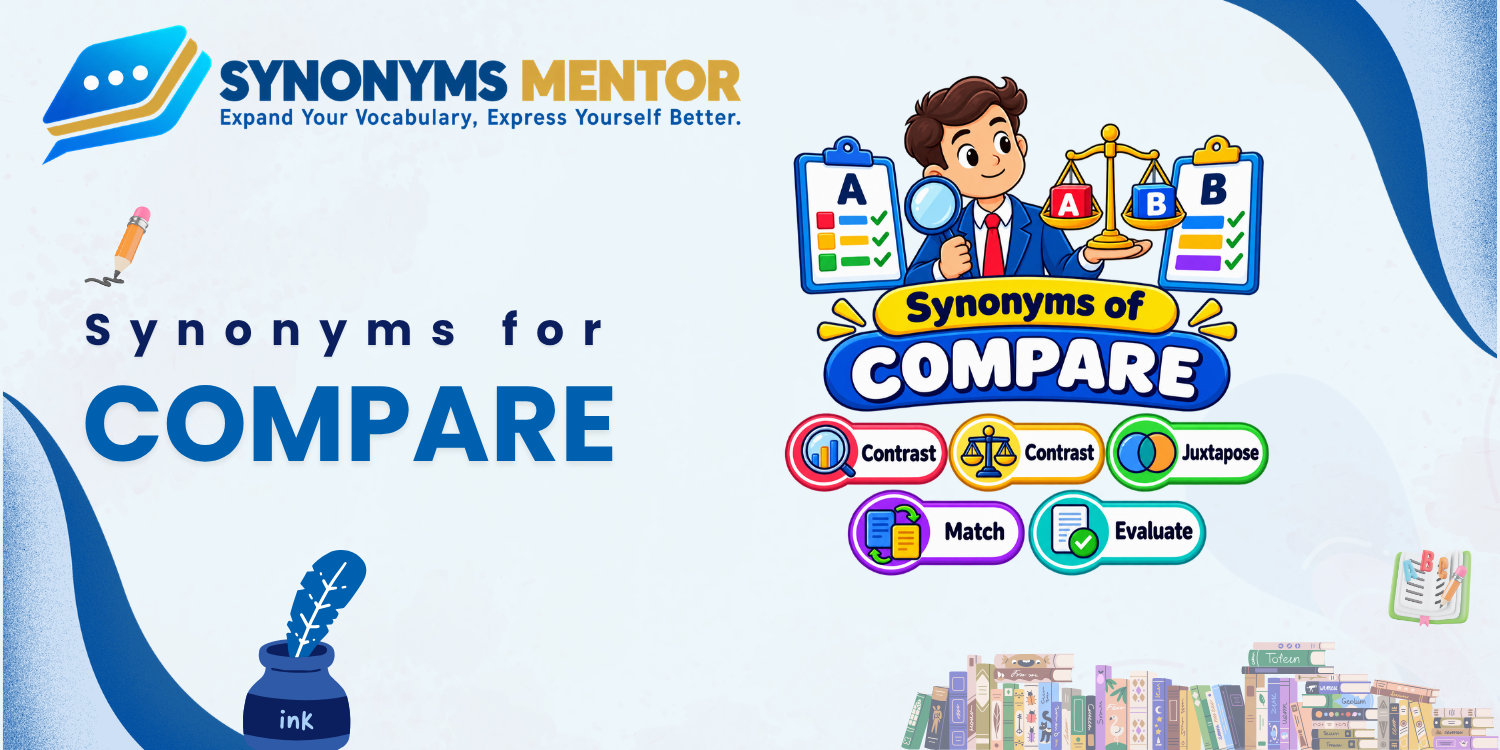
The best synonym for compare depends on what you are trying to express. If you are examining two things to find similarities or differences, contrast, assess, evaluate, weigh, or juxtapose may work. If you mean saying that one thing is similar to another, liken, equate, parallel, or resemble can be more precise.
In some contexts, compare also means that something is as good as or equal to something else, where match, equal, or compete with may be better alternatives. Choosing the right word depends on meaning, context, and tone.
Quick Answer
Common synonyms of compare include contrast, examine, assess, evaluate, weigh, balance, juxtapose, collate, liken, equate, parallel, correlate, resemble, match, equal, and compete with. However, these words are not interchangeable.
Contrast emphasizes differences, weigh emphasizes relative advantages and disadvantages, liken emphasizes similarity, and evaluate focuses on judging value or quality.
Synonyms of Compare at a Glance
| Word | Relationship | Meaning | Strength | Formality | Best Context |
|---|---|---|---|---|---|
| contrast | Near synonym | Examine differences between things | Similar | Neutral/Formal | Differences |
| examine | Near synonym | Look at something carefully | Broader | Neutral | Detailed inspection |
| assess | Contextual alternative | Judge value, quality, or importance | Similar | Formal | Performance, options |
| evaluate | Contextual alternative | Judge something against criteria | Similar | Formal | Quality, effectiveness |
| weigh | Contextual alternative | Consider relative advantages and disadvantages | Similar | Neutral/Formal | Decisions, pros and cons |
| balance | Contextual alternative | Consider two sides or factors against each other | Similar | Neutral | Costs and benefits |
| juxtapose | Contextual alternative | Place things together for comparison | Similar | Formal | Art, writing, analysis |
| collate | Contextual alternative | Collect and compare information systematically | Specialized | Formal | Documents, data |
| liken | Near synonym | Say that one thing is similar to another | Similar | Neutral/Formal | Analogies, descriptions |
| equate | Near synonym | Treat two things as equal or equivalent | Stronger | Formal | Ideas, values, concepts |
| parallel | Contextual alternative | Show similarities between things | Similar | Formal | Events, developments |
| correlate | Contextual alternative | Identify a relationship between variables or patterns | Specialized | Formal | Research, statistics |
| resemble | Contextual alternative | Be similar in appearance or characteristics | Narrower | Neutral | People, objects |
| match | Contextual alternative | Be equal or comparable in quality or performance | Similar | Neutral | Products, performance |
| equal | Contextual alternative | Be as good as or have the same value | Stronger | Neutral | Quality, value |
| compete with | Contextual alternative | Be capable of performing at a similar level | Similar | Neutral | Products, businesses |
What Does “Compare” Mean?
Compare generally means to examine two or more people or things in order to identify their similarities, differences, or relative qualities. It can also mean describing one person or thing as similar to another.
Cambridge defines compare in one major sense as examining or looking for differences between two or more things. Its American Dictionary also recognizes the use of compare for considering or suggesting that something is similar or equal to something else.
For example:
Compare the two reports before making a decision.
Here, the focus is on examining the reports.
But:
Critics compared the young actor to a famous Hollywood star.
Here, the focus is on similarity.
And:
The new model doesn’t compare with the older version.
Here, compare with expresses relative quality or performance.
Because these meanings are different, there is no single synonym that works perfectly in every sentence.
The Most Useful Synonyms of Compare
1. Contrast
Contrast is one of the closest alternatives when you want to examine differences between two or more things.
Compare the two designs carefully.
can become:
Contrast the two designs carefully.
The difference is that compare can focus on both similarities and differences, while contrast puts the emphasis on differences.
Best for: differences, opposing characteristics, styles, opinions, results, and conditions.
Collins lists contrast as a synonym of compare in the sense of examining things to observe their differences or similarities.
2. Examine
Examine means to look at something carefully and systematically. It can replace compare when the comparison involves detailed inspection.
Researchers compared the results of the two experiments.
Researchers examined the results of the two experiments.
The second sentence does not necessarily say that the results were compared with each other, so examine is broader than compare.
Best for: reports, evidence, data, documents, objects, and research.
3. Assess
Assess means to judge or determine the value, quality, importance, or effectiveness of something.
The committee compared the two proposals.
The committee assessed the two proposals.
The second sentence emphasizes judgment, not simply identifying similarities and differences.
Best for: proposals, risks, performance, candidates, options, and situations.
4. Evaluate
Evaluate is similar to assess and means to judge something carefully, often according to specific criteria.
We compared the two systems.
We evaluated the two systems.
Use evaluate when the purpose of the comparison is to determine quality, effectiveness, usefulness, or value.
Compare asks:
How are these two systems alike or different?
Evaluate asks:
How good or effective is each system?
5. Weigh
Weigh is a useful alternative when comparing the relative advantages, disadvantages, importance, or consequences of different choices.
We compared the advantages and disadvantages of each option.
We weighed the advantages and disadvantages of each option.
Decision-making contexts are particularly well suited to weigh.
Common expressions include:
- weigh the options
- weigh the benefits
- weigh the costs
- weigh the risks
- weigh the pros and cons
Collins specifically includes weigh and balance among alternatives for the sense of comparing relative importance.
6. Balance
Balance works when two or more competing factors are considered against each other.
We compared the costs with the potential benefits.
We balanced the costs against the potential benefits.
The verb is especially useful when competing considerations need to be assessed rather than simply described.
7. Juxtapose
Juxtapose means to place two or more things together so that their similarities or differences become noticeable.
The article compares traditional and modern architecture.
The article juxtaposes traditional and modern architecture.
Because of its formal tone, juxtapose is especially common in:
- art criticism
- literary analysis
- journalism
- academic writing
- visual analysis
For casual conversation, a simpler verb such as compare is usually more natural.
8. Collate
Collate means to collect, arrange, and compare information, documents, or data.
The researchers compared the data from several studies.
The researchers collated the data from several studies.
The meaning extends beyond simple comparison. Collate often suggests collecting and organizing information before examining it.
Formal and technical contexts are generally the best settings for this verb.
9. Liken
Liken is used when describing one person, thing, or experience as similar to another.
Critics compared the singer to a young Elvis Presley.
Critics likened the singer to a young Elvis Presley.
Rather than presenting two things side by side for detailed examination, liken focuses on their similarity.
Cambridge and Collins both identify liken as an alternative for the sense of describing something as similar to something else.
10. Equate
Equate means to treat two things as equal or equivalent.
It would be wrong to compare popularity with quality.
It would be wrong to equate popularity with quality.
A stronger claim is made with equate than with compare. Two things can be compared without being considered equal.
The distinction becomes clearer in these examples:
The study compared the two methods.
This means the researchers examined the methods.
The study equated the two methods.
Here, the wording suggests that the researchers treated the methods as equivalent.
11. Parallel
Parallel can describe similarities between two situations, developments, or ideas.
Historians compared the two economic crises.
Historians drew parallels between the two economic crises.
This wording is particularly effective when discussing recurring patterns or developments that share important similarities.
12. Correlate
Correlate is a specialized alternative used in scientific, statistical, and analytical contexts. It describes a relationship or association between variables or patterns.
Researchers compared exercise levels with sleep quality.
Depending on the intended meaning, the sentence could instead be written as:
Researchers correlated exercise levels with sleep quality.
Keep in mind that correlate does not simply mean compare. The verb suggests an association or relationship between variables.
13. Resemble
Resemble means to be similar to someone or something in appearance or characteristics.
The two paintings can be compared stylistically.
The two paintings resemble each other.
A narrower meaning applies to resemble than to compare. Two things may be compared even when they are very different, whereas one thing resembles another only when they share meaningful similarities.
14. Match
Match can be used when two things are comparable in quality, ability, size, or performance.
Few competitors can compare with the company.
Few competitors can match the company.
The verb often implies that one person or thing can reach or equal the level of another.
15. Equal
Equal is appropriate when a comparison establishes that two things are the same in value, amount, quality, or status.
The new product compares favorably with the leading brand.
In a different context, the sentence could be expressed as:
The new product equals the leading brand in quality.
Because equal indicates equivalence, it makes a stronger claim than compare. A comparison can identify differences, while equal indicates that the relevant qualities or values are the same.mparison itself does not establish equality.
16. Compete With
Compete with works when compare with means that one person, product, company, or performance is good enough to challenge another.
Few restaurants can compare with this one.
Few restaurants can compete with this one.
This use is especially natural when discussing quality, performance, success, or market position.
Synonyms of Compare by Context
For Comparing Two Products
The best choices for comparing two products include:
- compare
- assess
- evaluate
- weigh
- contrast
- match
We compared the two smartphones before buying one.
When the goal is to determine which product performs better, evaluate is a strong choice:
We evaluated the two smartphones before buying one.
For a comparison that highlights differences, contrast works well:
We contrasted the two smartphones.
A focus on relative performance makes match a suitable option:
We matched the two smartphones feature for feature.
For Comparing Prices
Best choices:
- compare
- contrast
- assess
- weigh
Always compare prices before making a purchase.
Compare is the most natural general choice here.
For a formal report:
The study assessed prices across several markets.
For Comparing Data
Best choices:
- compare
- contrast
- analyze
- correlate
- collate
The right word depends on what the researcher is actually doing.
Researchers compared the data from both groups.
means they examined the two sets together.
Researchers correlated the data.
suggests they examined relationships between variables.
For Comparing People
Best choices:
- compare
- contrast
- liken
- resemble
Critics compared the two athletes.
If the point is similarity:
Critics likened the younger athlete to a former champion.
If you are describing appearance:
The two athletes resemble each other.
For Comparing Ideas
Best choices:
- compare
- contrast
- examine
- equate
- parallel
The author compares the two theories.
The author contrasts the two theories.
The author draws a parallel between the two theories.
These alternatives communicate different relationships and should not be treated as interchangeable.
For Professional or Academic Writing
Good choices include:
- compare
- contrast
- assess
- evaluate
- examine
- weigh
- juxtapose
- correlate
The best choice depends on the analytical task.
For example:
The researchers evaluated the effectiveness of both methods.
is more precise than:
The researchers compared the effectiveness of both methods.
when the actual purpose is to judge effectiveness.
Which Word Should I Use?
Choose “compare” when:
You want a neutral word for examining two or more things to identify similarities, differences, or relative qualities.
Choose “contrast” when:
The main focus is on differences.
Choose “assess” when:
You want to judge value, quality, risk, or importance.
Choose “evaluate” when:
You are judging something against criteria or determining how effective it is.
Choose “weigh” when:
You are considering competing advantages, disadvantages, costs, or benefits.
Choose “juxtapose” when:
You deliberately place things together to make similarities or differences noticeable.
Choose “liken” when:
You want to say that one thing is similar to another.
Choose “equate” when:
You are treating two things as equal or equivalent.
Choose “resemble” when:
You mean that two people or things are similar in appearance or characteristics.
Choose “match” when:
You mean that something reaches or equals another thing in quality, ability, or performance.
Compare vs. Contrast
Compare is broader than contrast.
To compare two things is to examine their similarities, differences, or both.
To contrast two things is to emphasize their differences.
For example:
The report compares the two education systems.
This could discuss both similarities and differences.
The report contrasts the two education systems.
This signals that the differences are the main focus.
Cambridge’s thesaurus explicitly groups contrast with compare for examining differences.
Compare vs. Assess
Compare focuses on examining relationships between things.
Assess focuses on judging something.
The manager compared the two candidates.
The manager may simply have examined their differences.
The manager assessed the two candidates.
The manager likely judged their suitability, ability, or performance.
Use assess when the comparison leads to a judgment.
Compare vs. Evaluate
These words overlap strongly, especially in academic and professional writing.
Compare:
We compared the two proposals.
Evaluate:
We evaluated the two proposals.
The first emphasizes examining similarities and differences. The second emphasizes deciding how good, useful, effective, or suitable the proposals are.
A comparison can be part of an evaluation, but the two processes are not identical.
Compare vs. Liken
Compare can mean examining two things side by side.
Liken means describing one thing as similar to another.
The critic compared the two paintings.
The critic likened the second painting to a work by Picasso.
The first suggests an examination of the paintings. The second makes an analogy or identifies a resemblance.
Compare vs. Equate
Compare does not imply equality.
Equate does.
The researcher compared the two approaches.
This simply means the approaches were examined together.
The researcher equated the two approaches.
This means they were treated as equivalent.
Therefore, equate should not be used as a casual replacement for compare.
Compare vs. Resemble
Compare is an action performed by a person or group.
We compared the two photographs.
Resemble describes a similarity.
The two photographs resemble each other.
You can compare things even when they are completely different. You generally use resemble only when there is an actual similarity.
Common Mistakes With Synonyms of Compare
Mistake 1: Treating “contrast” as exactly the same as “compare”
Contrast focuses on differences. Compare is broader and can include both similarities and differences.
Mistake 2: Assuming “equate” simply means “compare”
It does not. Equate suggests treating two things as equal or equivalent.
Mistake 3: Using “correlate” for every comparison
Correlate is specialized. It usually describes a relationship between variables, measurements, or patterns. A simple side-by-side comparison does not necessarily establish correlation.
Mistake 4: Using “resemble” when describing an analytical comparison
You cannot always replace:
Researchers compared the two methods.
with:
Researchers resembled the two methods.
Resemble describes similarity; it does not mean “examine two things.”
Mistake 5: Overusing “juxtapose”
Juxtapose is formal and often implies deliberately placing things side by side for contrast or comparison. It can sound unnatural in everyday sentences.
Mistake 6: Assuming a synonym preserves the exact meaning
For example:
We compared the two candidates.
can mean the candidates were examined side by side.
We assessed the two candidates.
suggests that their suitability or performance was judged.
The second sentence adds an evaluative meaning.
Common Collocations With Compare
Some phrases naturally occur with compare:
- compare prices
- compare products
- compare options
- compare results
- compare data
- compare performance
- compare costs
- compare benefits
- compare features
- compare methods
- compare approaches
- compare two studies
- compare two companies
- compare favorably
- compare directly
- compare side by side
- compare with
- compare to
Context-specific alternatives can be useful:
| Common Phrase | More Precise Alternative |
|---|---|
| compare prices | assess prices |
| compare options | weigh the options |
| compare performance | evaluate performance |
| compare differences | contrast |
| compare people to others | liken |
| compare statistical variables | correlate |
| compare documents systematically | collate |
| compare artistic elements side by side | juxtapose |
| compare quality | match / evaluate |
| compare two similar things | examine / contrast |
The original compare is often still the most natural choice. A synonym should improve precision rather than merely replace the word.
Antonyms of Compare
There is no single universal antonym for compare because its meaning changes by context.
Depending on the intended sense, useful opposites include:
- ignore
- distinguish
- separate
- differentiate
- disregard
For example, if you deliberately avoid comparing two things, you might treat them separately. If the goal is to emphasize that two things are fundamentally different, differentiate may be useful.
Cambridge’s thesaurus gives oppositional expressions such as be unlike, be dissimilar, be incomparable, and be unequal for relevant senses of compare.
Pronunciation of Compare
Compare
- US: /kəmˈper/
- UK: /kəmˈpeər/
The stress falls on the second syllable: com-PARE. Cambridge provides these US and UK pronunciations.
FAQ About Synonyms of Compare
What is the closest synonym for compare?
There is no single synonym that works in every context. Contrast is close when examining differences, weigh works for competing options, and liken works when saying that one thing is similar to another. The best choice depends on the specific meaning of compare.
What is another word for compare two things?
Depending on the purpose, you can use contrast, examine, assess, evaluate, weigh, or juxtapose. If you are simply examining similarities and differences, examine or contrast may work. If you are judging quality, assess or evaluate is more precise.
What is a formal synonym for compare?
Formal alternatives include contrast, assess, evaluate, juxtapose, collate, and correlate, although each has a different meaning. Compare itself is already appropriate for both professional and academic writing, so a more formal synonym should only be used when it adds precision.
Is “contrast” a synonym for “compare”?
Yes, in some contexts. Both can describe examining two things, but contrast emphasizes their differences. Compare is broader because it can focus on similarities, differences, or both.
Is “liken” a synonym for “compare”?
It can be when compare means saying that one person or thing is similar to another. Liken is narrower because it specifically emphasizes similarity or analogy rather than a general side-by-side examination.
Is “equate” the same as “compare”?
No. Compare means examining two or more things. Equate means treating two things as equal or equivalent. You can compare two things without concluding that they are equal.
What is a synonym for compare prices?
The most natural phrase is still compare prices. Depending on the context, you could say assess prices, evaluate prices, or weigh costs, but these alternatives introduce slightly different meanings.
What is a synonym for compare performance?
Useful alternatives include evaluate performance, assess performance, and measure performance. Evaluate is particularly useful when the purpose is to judge how well someone or something performs.
Conclusion
Compare is a broad verb with several useful alternatives, but the right choice depends on what the comparison is meant to accomplish. Use contrast for differences, assess or evaluate for judgment, weigh for competing considerations, juxtapose for deliberate side-by-side presentation, liken for similarity, and equate when two things are treated as equivalent.

Our editorial team is dedicated to making English vocabulary easier to understand and use correctly. We research and review synonyms, antonyms, definitions, word usage, and example sentences to ensure our content is clear, accurate, practical, and useful for students, writers, professionals, and English learners.