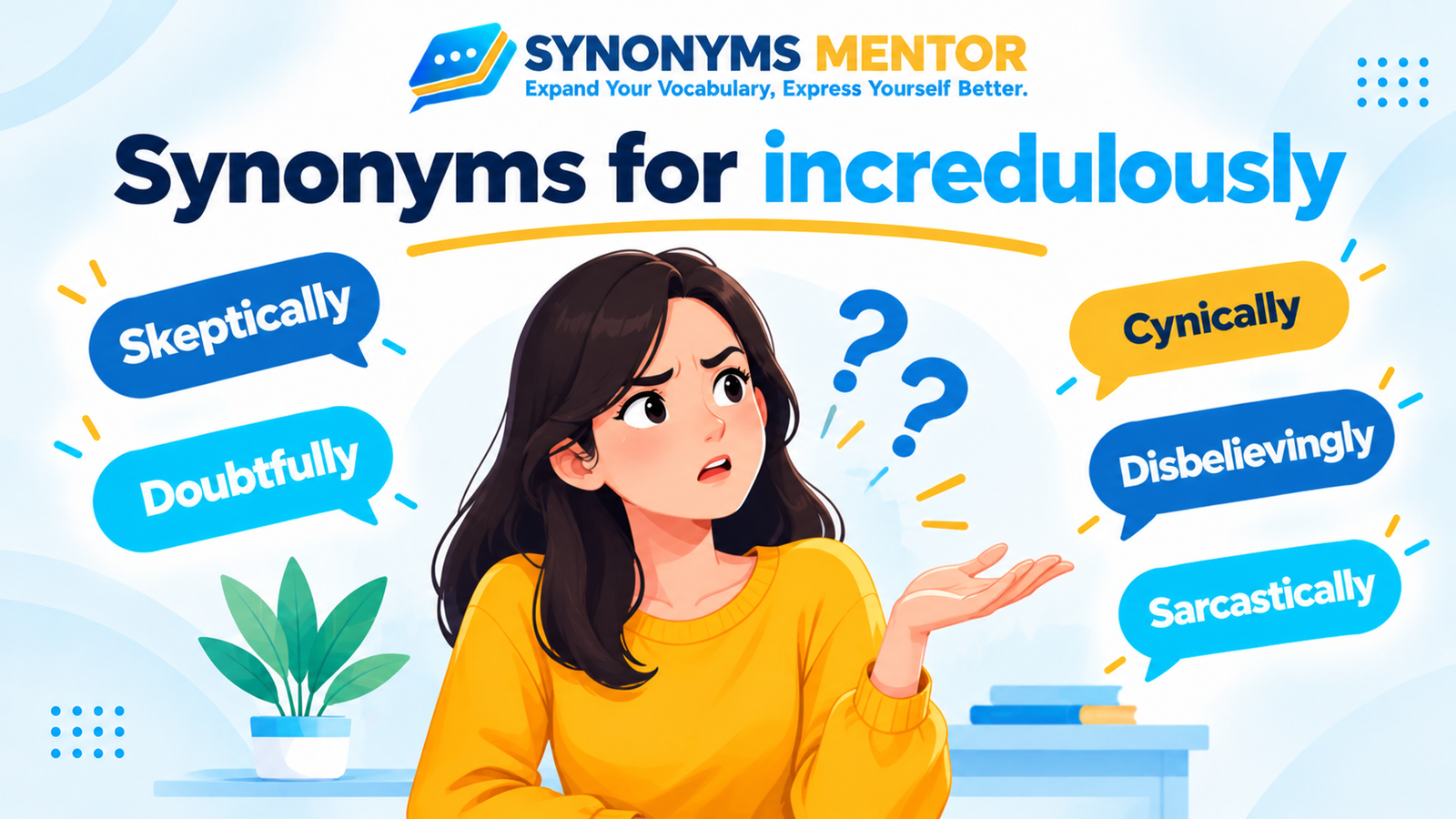
Synonyms of Incredulously: Better Alternatives With Examples
If you are looking for synonyms of incredulously, the closest choices include disbelievingly, unbelievingly, skeptically, and, depending on context, doubtfully or suspiciously. However, these words are not interchangeable in every sentence.
Incredulously is an adverb describing an action, expression, or response that shows someone is unable or unwilling to believe something.
The best alternative therefore depends on what you want to emphasize: disbelief, skepticism, doubt, suspicion, or simply a questioning reaction.
Quick Answer
The closest synonyms of incredulously are disbelievingly and unbelievingly. Skeptically is a strong alternative when the emphasis is on doubt rather than surprise. Doubtfully works when uncertainty is central, while suspiciously adds distrust.
Quizzically can describe a questioning look or response, but it does not necessarily mean the person disbelieves what they have heard.
Core Synonym Resource
| Word | Relationship | Meaning | Strength | Formality | Best Context |
|---|---|---|---|---|---|
| disbelievingly | Direct synonym | In a way that shows disbelief | Similar | Neutral | Reactions to surprising claims |
| unbelievingly | Direct synonym | In a way that shows an inability to believe | Similar | Neutral | Spoken or written reactions |
| skeptically | Near synonym | With doubt about whether something is true | Similar | Neutral | Claims, explanations, evidence |
| doubtfully | Near synonym | With uncertainty or lack of confidence | Slightly weaker | Neutral | Uncertain judgments |
| suspiciously | Contextual alternative | With distrust or suspicion | Different emphasis | Neutral | Situations involving possible deception |
| dubiously | Near synonym | With doubt about truth, quality, or validity | Similar | Neutral/formal | Claims, proposals, explanations |
| quizzically | Contextual alternative | In a questioning or puzzled manner | Usually weaker | Neutral | Expressions, looks, reactions |
| cynically | Contextual alternative | With distrust based on a negative view of motives | Stronger/different | Neutral | Motives, institutions, claims |
| mistrustfully | Contextual alternative | With lack of trust | Different emphasis | Formal | People, intentions, assurances |
| doubtingly | Near synonym | In a way that expresses doubt | Similar | Neutral | Literary or descriptive writing |
The first two—disbelievingly and unbelievingly—are the safest replacements when you want to preserve the core meaning of incredulously.
What Does “Incredulously” Mean?
Incredulously is an adverb meaning in a way that shows disbelief or an inability or unwillingness to believe something. It comes from the adjective incredulous.
For example:
She stared at him incredulously.
This means that her expression showed that she found what he said difficult to believe.
Pronunciation
US: /ɪnˈkredʒ.ə.ləs.li/
UK: /ɪnˈkredʒ.ə.ləs.li/
The Best Synonyms of Incredulously
1. Disbelievingly
Meaning: In a way that shows you do not believe something.
This is probably the closest straightforward replacement for incredulously.
Example:
He looked at the strange photograph disbelievingly.
Best for: facial expressions, reactions, dialogue, and narrative writing.
Difference: There is very little semantic distance between disbelievingly and incredulously. The former simply makes the disbelief especially explicit.
2. Unbelievingly
Meaning: In a way that shows that someone cannot believe something.
This is another close synonym and is particularly natural when describing a person’s reaction to unexpected information.
Example:
She read the message unbelievingly.
Best for: reactions to surprising or unexpected information.
Difference: Unbelievingly emphasizes the person’s inability to accept what they are seeing or hearing.
3. Skeptically
Meaning: In a way that shows doubt about whether something is true or reliable.
Example:
The scientist looked skeptically at the claim.
Best for: claims, evidence, explanations, promises, and arguments.
Difference: Skeptically does not necessarily imply shock or surprise. Someone can be skeptical before hearing surprising news because they already have doubts.
4. Doubtfully
Meaning: In a way that expresses uncertainty or doubt.
Example:
“Are you sure?” she asked doubtfully.
Best for: uncertain responses and situations where someone is not convinced.
Difference: Doubtfully can be milder than incredulously. A doubtful person may simply be uncertain; an incredulous person often finds something difficult to believe.
5. Suspiciously
Meaning: In a way that shows distrust or suspicion.
Example:
He looked at the unfamiliar caller suspiciously.
Best for: situations involving possible dishonesty, danger, hidden motives, or deception.
Difference: This is not an exact synonym. Suspiciously introduces distrust. You can be incredulous without suspecting anyone of wrongdoing.
6. Dubiously
Meaning: In a doubtful or uncertain manner.
Example:
She regarded the explanation dubiously.
Best for: formal or analytical writing involving claims, explanations, proposals, or evidence.
Difference: Dubiously often sounds more evaluative or formal than incredulously. It can suggest that something appears questionable rather than simply unbelievable.
7. Quizzically
Meaning: In a questioning, puzzled, or curious manner.
Example:
He looked at her quizzically after hearing the unusual question.
Best for: facial expressions and reactions that communicate puzzlement or a request for clarification.
Important distinction: Quizzically is not a direct synonym for incredulously. Someone can look quizzically at another person simply because they are confused.
8. Cynically
Meaning: In a way that reflects distrust of people’s motives or sincerity.
Example:
He laughed cynically at the politician’s promise.
Best for: situations where the speaker believes people are motivated by self-interest or dishonesty.
Difference: Cynically expresses a particular attitude toward motives. It is considerably more specific than incredulously.
9. Mistrustfully
Meaning: In a way that shows a lack of trust.
Example:
She watched the stranger mistrustfully.
Best for: people, intentions, promises, and situations involving trust.
Difference: The central idea is lack of trust, not simply disbelief.
10. Doubtingly
Meaning: In a manner that expresses doubt.
Example:
He repeated the explanation doubtingly.
Best for: literary, narrative, or descriptive writing.
Difference: It is semantically close to doubtfully, but generally less common in everyday American English.
Which Word Should You Use?
The easiest way to choose is to identify why the person does not accept something.
Choose “disbelievingly” when:
You want the closest everyday replacement for incredulously.
She stared at the result disbelievingly.
Choose “unbelievingly” when:
You want to emphasize that something seems impossible to believe.
He read the announcement unbelievingly.
Choose “skeptically” when:
The person doubts the truth or reliability of a claim.
The reviewer responded skeptically to the company’s claims.
Choose “doubtfully” when:
The person is uncertain rather than completely astonished.
“That should work,” she said doubtfully.
Choose “suspiciously” when:
The reaction involves distrust.
The guard looked suspiciously at the package.
Choose “quizzically” when:
The person is puzzled or questioning rather than necessarily disbelieving.
She looked quizzically at the complicated diagram.
Choose “cynically” when:
The reaction expresses distrust of someone’s motives.
He responded cynically to the politician’s promise.
Incredulously vs. Skeptically
These words overlap, but they are not identical.
| Feature | Incredulously | Skeptically |
|---|---|---|
| Core idea | Difficulty believing | Doubt about truth or reliability |
| Surprise | Often present | Not required |
| Distrust | Not required | Possible |
| Typical use | Reactions and expressions | Claims, evidence, arguments |
| Example | She stared incredulously. | He examined the claim skeptically. |
Simple rule: Use incredulously when something seems hard to believe; use skeptically when someone evaluates whether something should be believed.
Incredulously vs. Suspiciously
These are sometimes confused because both can occur in reactions involving doubt.
He looked at the stranger incredulously.
The person finds something difficult to believe.
He looked at the stranger suspiciously.
The person does not trust the stranger or suspects something may be wrong.
Therefore, suspiciously should not automatically replace incredulously.
Incredulously vs. Quizzically
This distinction is especially useful in descriptive writing.
Incredulously indicates disbelief:
“You did what?” she asked incredulously.
Quizzically indicates puzzlement or questioning:
She looked at him quizzically.
A person can be quizzical without being disbelieving. That is why quizzically is better treated as a contextual alternative rather than a direct synonym.
Natural Collocations With “Incredulously”
Certain constructions are especially useful in narrative and descriptive writing:
- looked incredulously
- stared incredulously
- asked incredulously
- responded incredulously
- said incredulously
- shook his head incredulously
- watched incredulously
- reacted incredulously
- gaped incredulously
- laughed incredulously
For example:
She stared incredulously at the unexpected result.
Depending on the intended meaning, alternatives could include:
- stared disbelievingly — closest replacement
- looked skeptically — emphasizes doubt
- looked suspiciously — emphasizes distrust
- looked quizzically — emphasizes puzzlement
This is more useful than simply replacing incredulously with whichever thesaurus entry happens to appear first.
Common Mistakes
1. Treating “incredible” as a synonym
Incredible and incredulous are different words.
- incredible = difficult to believe or extraordinary
- incredulous = unwilling or unable to believe
2. Using “suspiciously” for every doubtful reaction
Suspicion implies distrust. A person can be incredulous without suspecting deception.
3. Assuming “quizzically” always means disbelief
A quizzical expression can simply indicate confusion or curiosity.
4. Using “skeptically” when the main idea is surprise
If someone is shocked because they cannot believe what they just heard, incredulously or disbelievingly may be more precise.
5. Confusing “incredulously” with “credulously”
These words have opposite directions of belief:
- incredulously = with disbelief
- credulously = with a willingness to believe
Antonyms of Incredulously
The clearest opposites are believingly and credulously, although their naturalness depends on the sentence.
Other contrasting ideas include:
- confidently
- trustingly
- unquestioningly
- acceptingly
The strongest direct conceptual contrast is credulously, meaning with a tendency to believe rather than doubt.
FAQ
What is the closest synonym for “incredulously”?
Disbelievingly is one of the closest natural synonyms. Unbelievingly is also very close. Both describe an action or reaction that shows disbelief. The best choice depends on the sentence, but neither introduces the additional idea of distrust that comes with suspiciously.
What is another word for “looked incredulously”?
Good alternatives include looked disbelievingly, looked skeptically, looked doubtfully, or looked quizzically. Choose according to meaning: disbelievingly preserves the original meaning most closely, while quizzically emphasizes puzzlement rather than disbelief.
Is “skeptically” the same as “incredulously”?
Not exactly. They overlap because both can describe doubt. Incredulously usually emphasizes difficulty believing something, often as a reaction to surprising information. Skeptically emphasizes questioning whether something is true, reliable, or valid.
Is “suspiciously” a synonym for “incredulously”?
It can overlap in some contexts, but it is not a direct synonym. Suspiciously means with distrust or suspicion, whereas incredulously primarily expresses disbelief. Use suspiciously when the person suspects something is wrong or deceptive.
Is “quizzically” a synonym for “incredulously”?
Only in some contexts. Quizzically describes a questioning, puzzled, or curious manner. It does not necessarily indicate disbelief, so it is better classified as a contextual alternative.
What is the difference between “incredulous” and “incredulously”?
Incredulous is an adjective, while incredulously is an adverb.
She was incredulous.
She looked at him incredulously.
The adjective describes the person or their state; the adverb describes how an action is performed.
What does “incredulously” mean in simple English?
It means in a way that shows you do not believe something. For example, if someone tells you something extremely surprising and you stare at them because you cannot believe it, you might stare at them incredulously.
Conclusion
The best synonyms of incredulously are not all interchangeable. Disbelievingly and unbelievingly are the closest direct alternatives. Skeptically emphasizes doubt, doubtfully emphasizes uncertainty, suspiciously emphasizes distrust, and quizzically emphasizes puzzlement or questioning.

James Anderson is an English teacher and language researcher who creates easy synonym guides and vocabulary lessons. His goal is to help students and writers improve their language skills through simple and clear explanations.