Synonyms for Beverage: 15+ Alternatives and How to Use Them
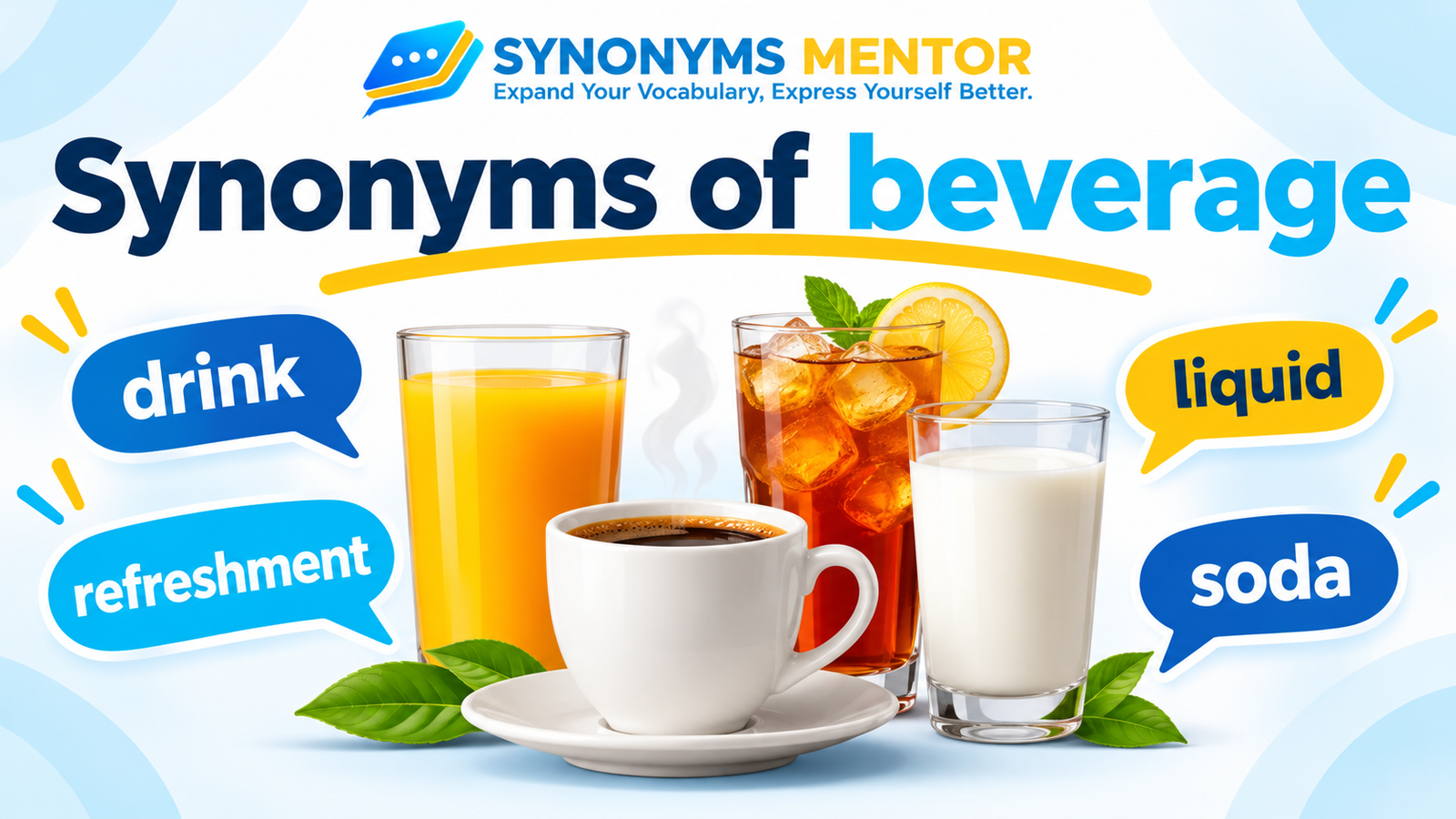
If you need a different word for beverage, the best choice depends on context. Drink is the closest and most natural everyday synonym, while refreshment emphasizes something served to drink, potable stresses suitability for drinking, and libation has a more formal, literary, or sometimes humorous tone.
Words such as brew, liquor, and cooler are more specific and should not be treated as universal replacements.
This guide explains the strongest synonyms for beverage, their differences, formality, natural collocations, and the situations in which native English speakers would actually use them.
Quick Answer: What Are the Best Synonyms for Beverage?
The closest synonyms for beverage are drink, refreshment, liquid, potable, libation, potation, and brew. Drink is the safest everyday replacement. Refreshment works well for drinks served at an event, potable emphasizes that something is safe or suitable to drink, and libation is more formal or literary.
Liquor specifically refers to alcoholic drinks, so it cannot replace beverage in every context.
What Does “Beverage” Mean?
Beverage is a noun meaning a liquid intended for drinking. It is a broad term that can refer to many kinds of drinks, including water, tea, coffee, juice, soft drinks, and alcoholic drinks.
For example:
The hotel offers complimentary beverages to its guests.
The word is generally more formal and institutional than drink. That is why beverage is common in menus, hospitality, business, packaging, regulations, and phrases such as food and beverage industry.
Best Synonyms for Beverage
Not every word found in a thesaurus is an interchangeable synonym. Some describe a particular kind of beverage, while others emphasize a specific characteristic.
| Word | Relationship | Strength | Formality | Best Context |
|---|---|---|---|---|
| Drink | Direct synonym | Equal | Neutral | Everyday speech and writing |
| Refreshment | Near synonym | Similar | Neutral/Formal | Events, hospitality, light drinks |
| Liquid | Contextual alternative | Broader | Neutral | Scientific or descriptive contexts |
| Potable | Near synonym | Similar | Formal/Technical | Water or liquids suitable for drinking |
| Libation | Near synonym | Similar | Formal/Literary | Ceremonial, literary, humorous contexts |
| Potation | Near synonym | Similar | Formal/Archaic | Literary or specialized writing |
| Brew | Contextual alternative | Narrower | Neutral | Beer, coffee, tea, or brewed drinks |
| Liquor | Contextual alternative | Narrower | Neutral/Formal | Alcoholic drinks, especially spirits |
| Refreshment drink | Contextual alternative | Narrower | Neutral | Hospitality and events |
| Cooler | Contextual alternative | Narrower | Informal/Neutral | Cold drinks or certain mixed drinks |
| Draught/Draft | Contextual alternative | Narrower | Literary/Traditional | A quantity or serving of a drink |
| Tipple | Contextual alternative | Narrower | Informal | Alcoholic drinks |
| Quencher | Contextual alternative | Narrower | Informal/Descriptive | Something that satisfies thirst |
| Potable drink | Contextual alternative | Narrower | Formal | Drinkable liquid |
| Liquid refreshment | Near synonym | Similar | Formal | Hospitality, events, descriptive writing |
Major dictionaries support several of these distinctions. Cambridge lists drink, libation, liquid, draft, brew, liquor, and potation as words related to beverage, while Collins includes drink, liquid, liquor, refreshment, draught, libation, potable, and potation.
1. Drink
Drink is the closest and most useful synonym for beverage.
It is considerably more common in ordinary conversation and works for almost any general drinking context.
Examples:
- Would you like a drink?
- She ordered a cold drink with her meal.
- The restaurant offers a wide selection of drinks.
Best choice when:
You want a simple, natural word that almost anyone will understand.
Beverage: Please select a beverage from the menu.
Drink: Please select a drink from the menu.
The second sentence sounds more conversational.
2. Refreshment
Refreshment can refer to a drink, especially one served to guests, but it can also refer to food served along with drinks.
This makes it less interchangeable with beverage.
Example:
Light refreshments will be served after the presentation.
Here, refreshments could include drinks and small snacks, so replacing it with beverages would change the meaning.
Best choice when:
You are talking about hospitality, meetings, receptions, parties, or something provided to guests.
3. Liquid
Liquid is broader than beverage. A beverage is a drinkable liquid, but not every liquid is a beverage.
For example, soup, cooking oil, and cleaning fluid are liquids but not beverages.
Example:
The laboratory analyzed the liquid before determining whether it was safe to drink.
Best choice when:
The physical state of the substance matters more than its role as a drink.
Do not use it as a universal replacement for beverage.
4. Potable
Potable is a useful formal or technical alternative when the emphasis is on whether a liquid is suitable for drinking.
Example:
The treatment process produces potable water.
Unlike beverage, potable can function as an adjective:
The water is potable.
It can also be used as a noun in some contexts, but this usage is much less common in ordinary English.
Best choice when:
You are discussing water quality, sanitation, public health, engineering, or technical matters.
5. Libation
Libation is a more elevated word for a drink. It can also refer specifically to a drink offered as part of a religious or ceremonial act.
In modern English, it is sometimes used humorously or playfully to mean an alcoholic drink.
Example:
Guests gathered on the terrace for an evening libation.
Best choice when:
You want a literary, formal, ceremonial, or deliberately playful tone.
It is not the natural choice for everyday conversation.
6. Potation
Potation is a formal and relatively uncommon word referring to the act or instance of drinking or a drink.
It is far less natural than drink in modern everyday English.
Best choice when:
You deliberately want an elevated, literary, or specialized expression.
For normal writing, drink is usually better.
7. Brew
Brew is a contextual alternative rather than a universal synonym.
It usually refers to something made by brewing, particularly beer, but it can also refer informally to coffee or tea.
Examples:
- He ordered a local brew.
- She made a fresh brew before starting work.
Best choice when:
The preparation method or type of drink matters.
You should not replace beverage with brew when referring generally to juice, water, or milk.
8. Liquor
Liquor is narrower than beverage. It generally refers to alcoholic drinks, especially distilled spirits.
Example:
The restaurant has a large selection of liquor.
Because beverage includes nonalcoholic drinks, these words are not interchangeable in general contexts.
Beverage can mean:
tea, coffee, juice, water, soda, beer, wine, or spirits.
Liquor normally points specifically toward alcoholic drinks.
Collins similarly treats liquor as a narrower sense involving alcoholic drinks.
9. Cooler
Cooler can refer to a cold drink or, in some contexts, a particular type of mixed alcoholic drink.
Example:
We grabbed a fruit cooler on the way to the beach.
It is much more context-dependent than beverage.
Best choice when:
You specifically want to emphasize a cold, refreshing drink.
10. Draught or Draft
Draught in British English and draft in American English can refer to a serving or quantity of a drink drawn from a container, particularly beer.
Example:
He ordered a draught beer.
Because draught/draft has several unrelated meanings, it should not normally replace beverage in a general sentence.
11. Tipple
Tipple is an informal or somewhat playful word for an alcoholic drink.
Example:
He enjoys a quiet tipple after dinner.
It has a noticeably different tone from the neutral beverage.
Best choice when:
Writing informally about alcohol.
12. Quencher
Quencher is a descriptive word for something that satisfies thirst.
Example:
This lemonade is a refreshing thirst quencher.
It is not a standard one-word replacement for beverage in formal writing.
Closest Synonyms vs. Contextual Alternatives
This distinction matters because online thesauruses often place many loosely related words under the same heading.
Closest alternatives
- drink
- refreshment
- potable
- liquid refreshment
- libation
Context-dependent alternatives
- brew
- liquor
- cooler
- draught/draft
- tipple
- quencher
Related words that should not normally be treated as direct synonyms
Words such as tea, coffee, juice, soda, beer, wine, and water are types of beverages, not universal synonyms for beverage.
This distinction is important for accurate vocabulary learning. A word can belong to the same semantic category without being interchangeable with the target word.
Beverage vs. Drink
Beverage and drink are the closest pair.
| Word | Difference |
|---|---|
| Beverage | More formal and often used in commercial, hospitality, and institutional contexts |
| Drink | More common, natural, and conversational |
Compare:
The hotel provides complimentary beverages.
Can I get you a drink?
Both are natural, but the register differs.
In everyday English, drink is usually the better choice.
Beverage vs. Refreshment
These words overlap, but they are not identical.
Beverage specifically identifies a drink.
Refreshment can refer to something consumed to refresh someone and may include both food and drinks.
Compare:
The conference provides beverages.
This clearly means drinks.
The conference provides refreshments.
This may mean drinks, snacks, or both.
Beverage vs. Potable
These words have different grammatical and semantic functions.
Beverage names a drink.
Potable primarily describes something that is suitable for drinking.
Compare:
Bottled water is a beverage.
The water is potable.
The first identifies what the substance is; the second describes its suitability for drinking.
Beverage vs. Liquor
Beverage is broad.
Liquor is much narrower and generally refers to alcoholic drinks, particularly distilled spirits.
Therefore:
The hotel offers several beverages.
does not mean the hotel offers only alcoholic drinks.
But:
The hotel offers several liquors.
specifically points toward alcoholic spirits.
Which Word Should I Use?
Choose drink when you want the most natural everyday alternative. For a more formal, commercial, hospitality, or institutional tone, beverage is usually the better choice.
When referring to drinks or light food served to guests, refreshment fits the context well. If the key idea is that a liquid is safe or suitable for drinking, potable is the more precise term.
A literary, ceremonial, elevated, or humorous reference to a drink can be expressed with libation. For beer, coffee, tea, or another brewed drink, brew may be appropriate.
When specifically referring to alcoholic spirits, use liquor. An informal reference to an alcoholic drink can be expressed with tipple. When the emphasis is on satisfying thirst, quencher can be a suitable choice.
Natural Collocations With “Beverage”
Some combinations are especially useful in professional and commercial English:
- hot beverage
- cold beverage
- alcoholic beverage
- nonalcoholic beverage
- carbonated beverage
- beverage industry
- beverage company
- beverage menu
- beverage options
- beverage service
- food and beverage
- beverage production
- beverage consumption
For example:
The hotel offers a range of hot and cold beverages.
The company specializes in nonalcoholic beverages.
Food and beverage services are available throughout the conference.
These contexts help explain why beverage remains useful even though drink is more common in ordinary conversation. Merriam-Webster’s current examples also show beverage naturally occurring in contexts such as menus, hospitality, and the food-and-beverage industry.
Common Mistakes With Beverage Synonyms
Mistake 1: Treating every drink as a synonym
Tea, coffee, juice, beer, and water are beverages, but they are not interchangeable synonyms for beverage.
Incorrect:
The restaurant has many beverages, including tea. Tea is another word for beverage.
Better:
Tea is a type of beverage.
Mistake 2: Using “liquor” for every beverage
Liquor normally refers to alcoholic drinks, particularly spirits.
Incorrect:
Water is a type of liquor.
Better:
Water is a type of beverage.
Mistake 3: Using “potable” as a casual replacement
Although potable is related to drinkability, it sounds technical or formal.
Instead of:
Would you like a potable?
say:
Would you like a drink?
Mistake 4: Using “libation” in ordinary conversation
Libation can sound literary or deliberately humorous.
Instead of:
Could you pass me a libation?
ordinary conversation would normally use:
Could you pass me a drink?
Mistake 5: Assuming “refreshment” always means a drink
Refreshments may include food as well as drinks.
Refreshments will be served.
does not necessarily mean only beverages will be served.
Beverage Synonyms by Context
| Context | Best Choice |
|---|---|
| Everyday conversation | drink |
| Restaurant menu | drink / beverage |
| Hotel or hospitality | beverage / refreshment |
| Business writing | beverage |
| Food industry | beverage |
| Water-quality discussion | potable |
| Literary writing | libation |
| Beer or brewed drink | brew |
| Alcoholic spirits | liquor |
| Informal alcohol reference | tipple |
| Thirst-focused description | quencher |
Antonyms of Beverage
There is no perfect everyday antonym for beverage because the word names a category of drink rather than a quality with a direct opposite.
Some thesauruses list food or victuals as opposites because they contrast what is eaten with what is drunk, but this is a category contrast rather than a strict lexical antonym.
A useful semantic distinction is:
- Beverage → something consumed as a drink
- Food → something primarily consumed as nourishment by eating
FAQ
What is the closest synonym for beverage?
Drink is the closest and most natural everyday synonym for beverage. The two words can replace each other in many general contexts, although beverage is usually more formal.
What is another word for beverage?
Common alternatives include drink, refreshment, potable, libation, potation, liquid refreshment, and brew. Some are context-specific rather than direct replacements.
What is a formal synonym for beverage?
Potation and libation can have a formal or literary tone, while beverage itself is already more formal than the everyday word drink.
What is a professional word for drink?
Beverage is often the most appropriate professional alternative, especially in hospitality, food service, manufacturing, retail, and business contexts.
Is “drink” the same as “beverage”?
They overlap substantially when drink is used as a noun meaning a liquid consumed by drinking. Drink is more common in everyday English, while beverage often sounds more formal or commercial.
Is “refreshment” a synonym for beverage?
Refreshment can mean a drink, but it is not always interchangeable with beverage. In event and hospitality contexts, refreshments may include both drinks and light food.
Is “potable” a synonym for beverage?
Only in certain contexts. Potable primarily means suitable or safe for drinking, so it emphasizes drinkability rather than simply naming a drink.
Is “liquor” another word for beverage?
Only in a narrow sense. Liquor generally refers to alcoholic drinks, especially distilled spirits, whereas beverage includes alcoholic and nonalcoholic drinks.
Conclusion
The best synonym for beverage is usually drink because it is natural, familiar, and broadly applicable. Choose refreshment for hospitality and events, potable for technical discussions about drinkability, libation for literary or ceremonial contexts, brew for brewed drinks, and liquor when specifically discussing alcoholic spirits.

James Anderson is an English teacher and language researcher who creates easy synonym guides and vocabulary lessons. His goal is to help students and writers improve their language skills through simple and clear explanations.