Synonyms for Sentiment: 20 Best Words With Examples & Context
The word sentiment can be surprisingly difficult to replace because it has more than one closely related meaning. Depending on context, sentiment can describe a feeling, an emotionally influenced opinion, a general attitude, or a particular view about something.
That means there is no single synonym that works perfectly in every sentence. Feeling, emotion, opinion, attitude, view, and belief can all overlap with sentiment, but each carries its own nuance.
This guide separates genuine synonyms from near-synonyms and contextual alternatives so you can choose the word that best fits your meaning.
Quick Answer: What Are the Best Synonyms for Sentiment?
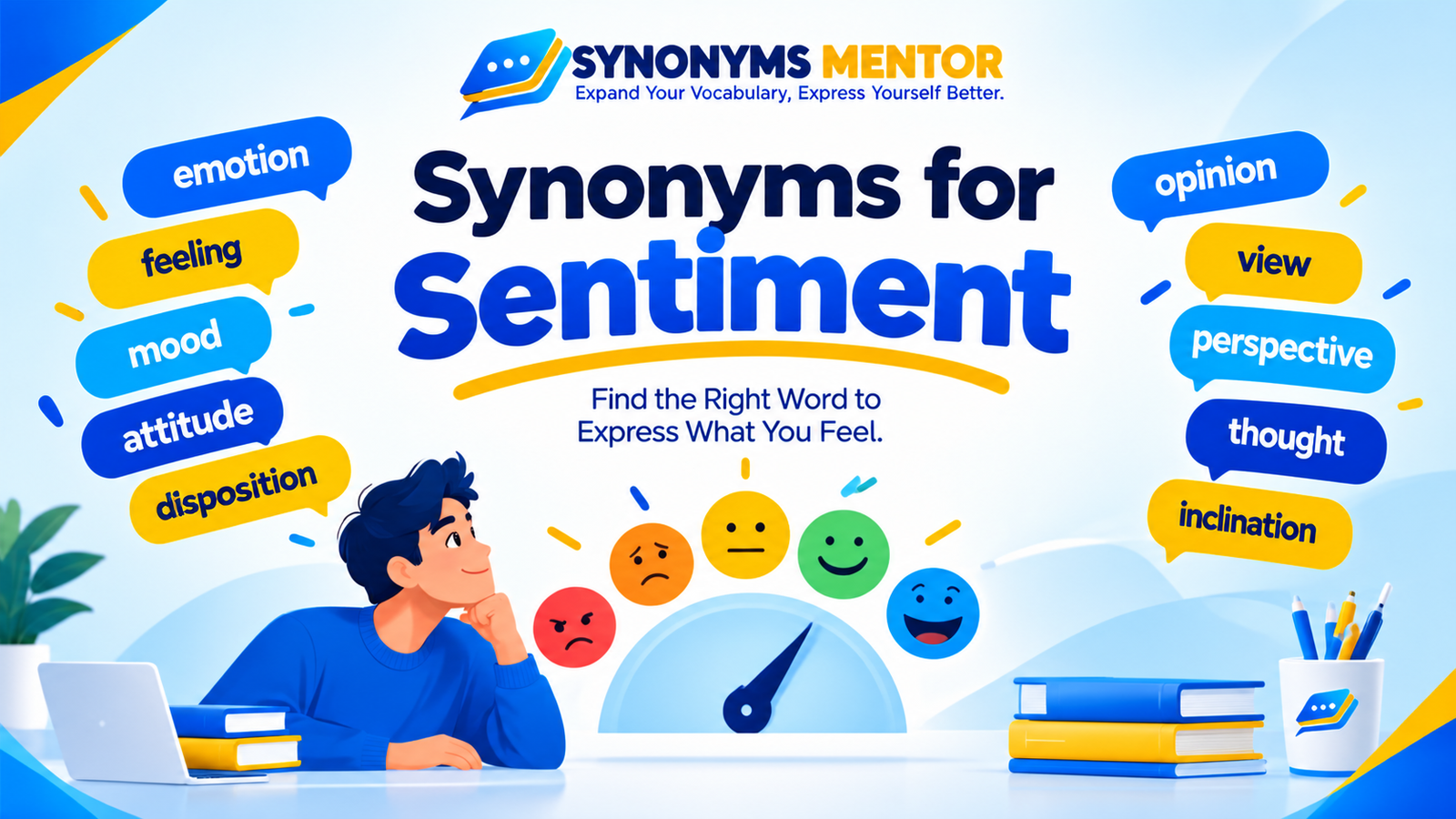
The closest synonyms for sentiment include feeling, emotion, opinion, attitude, view, belief, viewpoint, perspective, thought, notion, and affection.
The best replacement depends on meaning: use feeling for a general emotional response, emotion for a stronger emotional state, opinion for a stated judgment, and attitude for a general way of thinking or feeling about something.
Core Synonyms for Sentiment
| Word | Relationship | Main Meaning | Best Context | Formality |
|---|---|---|---|---|
| Feeling | Direct/near synonym | An emotional or subjective response | Personal reactions | Neutral |
| Emotion | Direct/near synonym | A strong or identifiable feeling | Emotional states | Neutral |
| Opinion | Contextual synonym | A belief or judgment about something | Views and judgments | Neutral |
| Attitude | Near synonym | A way of thinking or feeling | General outlook toward something | Neutral |
| View | Contextual synonym | A particular opinion | Discussions and arguments | Neutral |
| Viewpoint | Contextual synonym | A particular perspective or position | Analysis and debate | Neutral/Formal |
| Perspective | Near synonym | A way of seeing or interpreting something | Analysis and broader context | Neutral/Formal |
| Belief | Contextual synonym | Something accepted as true | Convictions and ideas | Neutral |
| Thought | Near synonym | An idea or mental impression | Writing and discussion | Neutral |
| Notion | Near synonym | An idea or conception | General ideas | Neutral |
| Affection | Contextual synonym | Feelings of liking or fondness | People and relationships | Neutral |
| Passion | Near synonym | Very strong emotion or enthusiasm | Strong commitments | Neutral |
| Conviction | Contextual synonym | A firmly held belief | Serious opinions | Formal |
| Impression | Contextual synonym | An idea or feeling formed about something | Personal judgments | Neutral |
| Sensation | Related/limited synonym | A physical or emotional feeling | Physical or subjective experience | Neutral |
| Nostalgia | Contextual alternative | Affectionate longing for the past | Memories and past experiences | Neutral |
| Sentimentality | Related word, not a general synonym | Excessive or conspicuous emotion | Emotional expression | Neutral |
| Sensitivity | Related word | Awareness or responsiveness to feelings | Emotional/social contexts | Neutral |
| Sensibility | Near/related synonym | Capacity to perceive or respond to feelings | Literary/formal contexts | Formal |
The distinction matters because dictionary sources group these words according to different senses of sentiment, rather than treating them as universally interchangeable.
What Does “Sentiment” Mean?
Sentiment is a noun with two particularly important modern uses.
First, it can mean an opinion, attitude, or idea influenced by feelings. For example:
Public sentiment has shifted on the issue.
Here, sentiment is close to opinion, attitude, or view.
Second, sentiment can refer to emotion or tender feeling, especially in contexts involving affection, sympathy, romance, or nostalgia. Cambridge notes that this sense can sometimes carry a disapproving suggestion of excessive or inappropriate emotion.
Merriam-Webster similarly distinguishes between sentiment as an attitude or judgment prompted by feeling and sentiment as emotion or refined feeling.
Pronunciation
US: /ˈsen.t̬ə.mənt/
UK: /ˈsen.tɪ.mənt/
Direct and Near Synonyms for Sentiment
1. Feeling
Meaning: A subjective emotional response or reaction.
How it differs: Feeling is broader than sentiment. It can describe almost any emotional response without necessarily implying an idea or opinion behind it.
Best contexts: Personal emotions, reactions, relationships.
Example:
She expressed her feelings about the decision.
Choose feeling when you mean the person’s emotional response itself.
2. Emotion
Meaning: A conscious emotional state or strong feeling.
How it differs: Emotion often emphasizes the emotional experience itself. Sentiment more readily suggests a feeling connected to an idea, attitude, or viewpoint. Merriam-Webster notes that emotion can carry a stronger implication of excitement or agitation.
Example:
The speech stirred strong emotions among the audience.
Choose emotion when the emotional experience is the main focus.
3. Opinion
Meaning: A judgment, belief, or view about something.
How it differs: Opinion is more directly intellectual or judgment-based. Sentiment often suggests that feelings have influenced the opinion. Merriam-Webster specifically distinguishes sentiment as a settled opinion reflective of one’s feelings.
Example:
Public opinion changed after the announcement.
Use opinion when you mean what someone thinks rather than how they feel.
4. Attitude
Meaning: A person’s general way of thinking or feeling about something.
How it differs: Attitude usually describes a broader or more persistent orientation, while sentiment can refer to a particular expressed feeling or opinion.
Example:
The company’s attitude toward customer complaints has improved.
Use attitude when discussing someone’s general stance or approach.
5. View
Meaning: A particular opinion or way of thinking about something.
How it differs: View is usually more neutral and direct than sentiment.
Example:
She expressed her view on the proposed changes.
Use view when you simply mean an opinion or position.
6. Viewpoint
Meaning: A particular position or perspective from which something is considered.
Example:
The article presents the issue from a different viewpoint.
Best use: Formal writing, analysis, discussion, and contrasting perspectives.
7. Perspective
Meaning: A particular way of understanding or interpreting something.
How it differs: Perspective emphasizes the framework through which someone sees an issue, rather than merely the emotion behind it.
Example:
The experience changed her perspective on education.
Use perspective when you want to emphasize a broader way of seeing an issue.
8. Belief
Meaning: Something a person accepts as true or holds as an idea.
How it differs: Belief generally suggests stronger intellectual commitment than sentiment.
Example:
His belief in equal opportunity influenced his decisions.
Use belief when the idea is held as true or important.
9. Thought
Meaning: An idea or mental impression.
Example:
I share the same thought about the proposal.
Thought can replace sentiment in some contexts, particularly when sentiment means an expressed idea. It is not interchangeable in every emotional context.
10. Notion
Meaning: An idea, conception, or belief.
Example:
She rejected the notion that success happens overnight.
Notion works best when sentiment means an idea rather than an emotion.
Contextual Alternatives: Choose According to Meaning
Some words overlap with sentiment only in specific contexts.
For emotional feelings
Use:
- feeling
- emotion
- affection
- passion
- tenderness
Example:
The letter expressed deep affection for his family.
Affection is more specific than sentiment: it indicates liking, fondness, or warm feelings. Merriam-Webster makes this distinction explicitly.
For opinions and public attitudes
Use:
- opinion
- view
- attitude
- perspective
- viewpoint
- stance
Example:
Public sentiment toward the proposal has changed.
Possible alternatives include:
Public opinion toward the proposal has changed.
or:
Public attitudes toward the proposal have changed.
The choice depends on whether you mean people’s judgments, their general orientation, or the broader public mood.
For strong emotional commitment
Use:
- passion
- conviction
- enthusiasm
But these are not interchangeable with sentiment in every sentence.
For example:
Her passion for music was obvious.
You would not normally replace passion with sentiment without changing the meaning.
Which Word Should I Use?
A quick decision guide makes the distinctions easier:
Choose “feeling” when:
You mean a person’s emotional response.
I understand your feelings.
Choose “emotion” when:
You want to emphasize an identifiable or intense emotional state.
The news triggered strong emotions.
Choose “opinion” when:
You mean someone’s judgment about an issue.
What’s your opinion of the proposal?
Choose “attitude” when:
You mean a general way of thinking or feeling.
His attitude toward criticism changed.
Choose “view” when:
You simply mean an individual’s opinion.
That’s my view on the matter.
Choose “perspective” when:
You mean a broader way of interpreting an issue.
Travel gave her a new perspective on culture.
Choose “belief” when:
You mean something someone accepts or holds to be true.
His belief in the project never changed.
Choose “passion” when:
You mean unusually strong emotion, enthusiasm, or commitment.
She has a passion for photography.
Sentiment vs. Feeling
These words overlap, but they are not identical.
Feeling is the broader term. It can refer to an emotional response without saying anything about the idea behind that response.
Sentiment often connects emotion with an idea, attitude, or judgment.
Compare:
I have a feeling that something is wrong.
Here, feeling can even mean an intuition.
The speech reflected widespread public sentiment against the proposal.
Here, sentiment describes a broader emotional or attitudinal position.
Merriam-Webster describes feeling as a broad subjective response, whereas sentiment often involves emotion inspired by an idea.
Sentiment vs. Emotion
Emotion focuses more directly on the emotional state.
Sentiment can describe emotion, but it can also describe an opinion or attitude influenced by emotion.
The announcement caused strong emotion.
versus:
The announcement reflected public sentiment.
The first focuses on emotional reaction; the second can describe the broader feeling or attitude held by a group.
Sentiment vs. Opinion
This is one of the most important distinctions.
Opinion = what someone thinks.
Sentiment = an opinion or attitude that is often colored by feeling.
For example:
Her opinion is that the policy is ineffective.
Her sentiment toward the policy is negative.
The second expression can suggest an emotional stance rather than a purely analytical judgment. Merriam-Webster distinguishes opinion as a judgment that is open to dispute and sentiment as an opinion reflective of feelings.
Sentiment vs. Attitude
Attitude generally describes a person’s broader orientation toward something.
He has a positive attitude toward learning.
Sentiment can describe the feeling or opinion expressed about a particular subject.
Public sentiment toward the new policy is mixed.
Both can overlap, but attitude often sounds more personal and persistent, while sentiment works especially well for collective reactions and public opinion.
Common Collocations With “Sentiment”
Understanding common combinations is often more useful than memorizing isolated synonyms.
Public sentiment
Public sentiment has shifted since the announcement.
Usually means the general feelings or opinions of a population.
Consumer sentiment
Consumer sentiment improved during the quarter.
Common in economics and business.
Market sentiment
Market sentiment remains cautious.
Usually refers to the collective outlook or mood of investors and market participants. Cambridge specifically identifies this business use of sentiment.
Positive sentiment
The campaign generated positive sentiment online.
Negative sentiment
The announcement triggered negative sentiment among customers.
Anti-government sentiment
Anti-government sentiment increased in the region.
Public opinion
In many contexts, public opinion is a natural alternative to public sentiment, but the two are not always identical. Public opinion emphasizes judgments or views, while public sentiment can emphasize the emotional or attitudinal climate.
Common Mistakes With Sentiment Synonyms
Mistake 1: Treating “opinion” and “sentiment” as identical
They overlap, but sentiment often contains an emotional or attitudinal element.
Mistake 2: Using “passion” as a universal replacement
Passion is much stronger. It suggests powerful emotion or enthusiasm.
Mistake 3: Using “sentimentality” as a synonym
Sentimentality is not a neutral synonym for sentiment. It often refers to excessive or overly emotional expression.
Mistake 4: Assuming “perspective” means exactly the same thing
A perspective is a way of interpreting or seeing an issue. It does not necessarily contain an emotional component.
Mistake 5: Using “belief” whenever you see “sentiment”
A belief usually involves accepting something as true. A sentiment can be an emotional attitude without being a firm belief.
Related Words That Are Not Universal Synonyms
Some words appear in thesaurus results because they are semantically connected to sentiment, but that does not mean they can replace it everywhere.
Sentimentality
A tendency toward excessive or conspicuous emotion.
Nostalgia
A sentimental longing for the past.
Sensitivity
The ability or tendency to respond strongly to feelings or circumstances.
Sensibility
The capacity to perceive or respond to emotional, aesthetic, or moral qualities.
Tenderness
Gentle affection or kindness.
These can be useful alternatives in specific contexts, but they should not be presented as universal replacements for sentiment. Cambridge’s thesaurus likewise separates emotional terms such as sentimentality, nostalgia, and tenderness from opinion-related alternatives.
Antonyms of Sentiment
There is no single perfect antonym because sentiment has several meanings.
Depending on context, contrasting concepts may include:
- indifference — lack of interest or concern
- detachment — emotional distance
- dispassion — absence of strong emotion
- objectivity — judgment less influenced by personal feelings
- fact — something presented as objectively true rather than as an opinion
For example:
The report attempted to replace emotional sentiment with objective analysis.
The correct opposite therefore depends heavily on which sense of sentiment you mean.
FAQ: Synonyms for Sentiment
What is the closest synonym for sentiment?
There is no single closest synonym in every context. Feeling and emotion are strong choices when sentiment means an emotional response, while opinion, view, and attitude are better when it means an emotionally influenced opinion or general stance.
What is another word for sentiment in writing?
Depending on the sentence, alternatives include feeling, emotion, opinion, view, attitude, perspective, thought, and belief. For literary writing, feeling, emotion, or tenderness may work when the focus is emotional; view or perspective may work when the focus is an idea.
Is “opinion” a synonym for “sentiment”?
Sometimes. Opinion refers primarily to a judgment or view, while sentiment can suggest that the judgment is influenced by feelings. In discussions of public attitudes, the two can overlap but are not always interchangeable.
Is “feeling” the same as “sentiment”?
Not exactly. Feeling is broader and can describe many kinds of subjective emotional or physical responses. Sentiment often connects a feeling with an idea, opinion, or attitude.
What is a formal synonym for sentiment?
Depending on meaning, viewpoint, perspective, conviction, or opinion can provide a more formal alternative. However, the correct choice depends on whether you mean an emotion, an opinion, or an attitude.
What is a synonym for positive sentiment?
Depending on context, alternatives include positive feeling, favorable attitude, optimism, goodwill, approval, and support. They are not exact replacements in every sentence, so choose according to the intended meaning.
What is a synonym for negative sentiment?
Possible alternatives include negative feeling, unfavorable attitude, disapproval, hostility, opposition, or resentment. Each adds a different degree or type of negativity, so they should not be treated as interchangeable.
What is the difference between sentiment and sentimentality?
Sentiment can be neutral and may mean a feeling, attitude, or emotionally influenced opinion. Sentimentality generally refers to an excessive, conspicuous, or overly emotional quality. Cambridge marks the emotional sense of sentiment as sometimes disapproving, while sentimentality is more specifically associated with emotional excess.
Conclusion
The best synonym for sentiment depends on what you actually mean. If you’re describing an emotional response, feeling, or emotion may be the natural choice. If you’re describing an opinion, use opinion, view, or viewpoint. For a broader way of thinking or feeling, attitude or perspective may work better. For a firmly held idea, belief, or conviction may be more precise.

James Anderson is an English teacher and language researcher who creates easy synonym guides and vocabulary lessons. His goal is to help students and writers improve their language skills through simple and clear explanations.