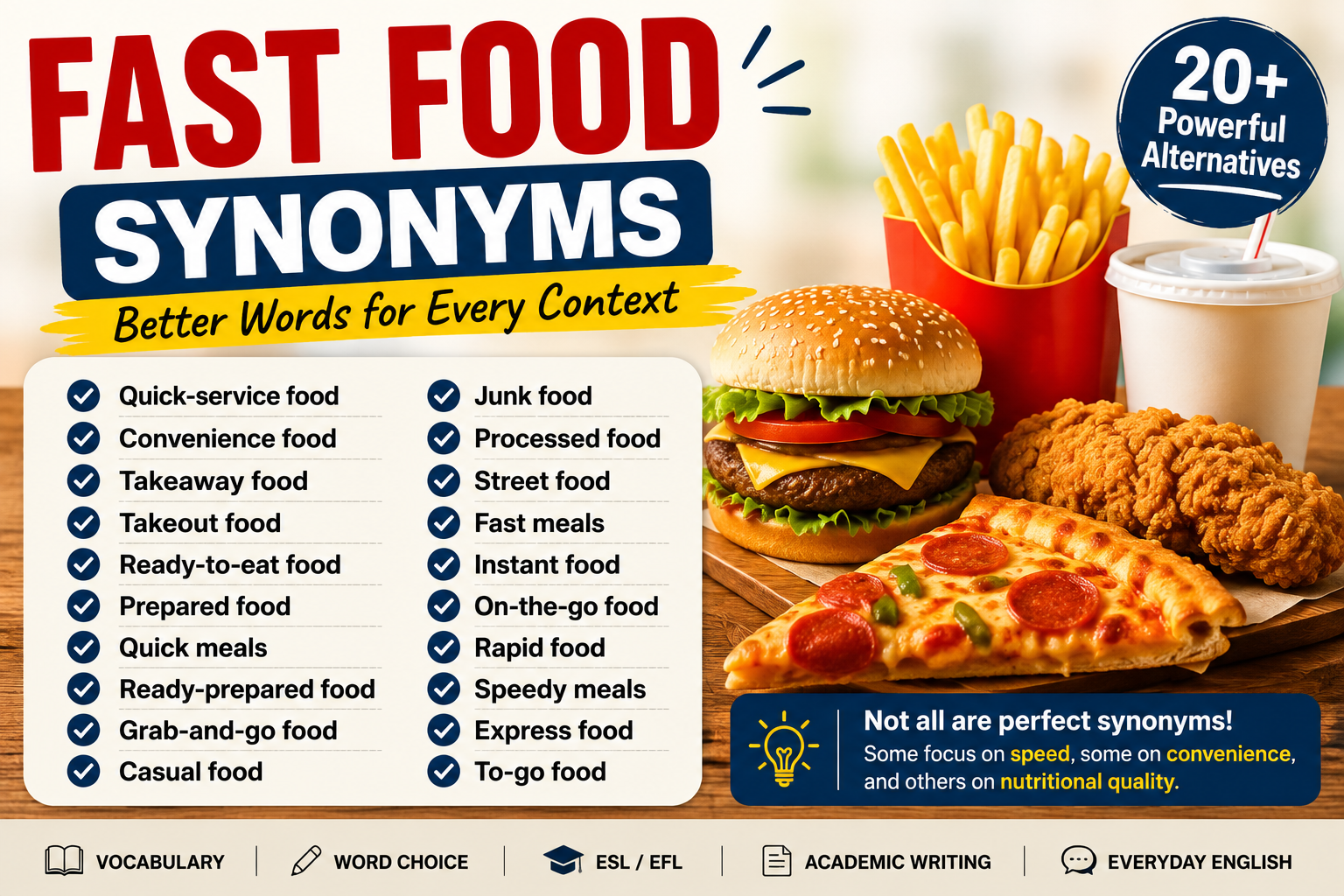
Fast Food Synonyms: 20+ Alternatives With Meanings and Examples
Looking for the best fast food synonyms depends on what you mean by fast food. The term normally refers to food that can be prepared and served quickly, particularly in restaurants designed for rapid service.
Useful alternatives include quick-service food, convenience food, takeaway food, ready-to-eat food, prepared food, quick meals, and, in some contexts, junk food. However, these expressions are not interchangeable. Junk food focuses on nutritional quality, while fast food focuses primarily on speed and service.
This guide separates genuine alternatives from related expressions and explains which words are most natural in everyday English, academic writing, professional contexts, and essays.
Quick Answer: What Are the Best Synonyms for Fast Food?
The closest alternatives to fast food include quick-service food, quick meals, and prepared food served quickly. Takeaway food is a useful contextual alternative when the food is bought to eat elsewhere.
Convenience food emphasizes ease and convenience rather than restaurant service, while junk food is only a partial synonym because it describes food considered nutritionally poor rather than food served quickly.
What Does “Fast Food” Mean?
Fast food is a noun referring to food that is prepared or already prepared and served very quickly, commonly in restaurants offering rapid service. Typical examples include hamburgers, fried chicken, pizza, fries, and similar quick-service meals.
Pronunciation: /ˌfɑːst ˈfuːd/ in British English and /ˌfæst ˈfuːd/ in American English.
The related adjective fast-food describes something connected with this type of food or restaurant:
We stopped at a fast-food restaurant.
Merriam-Webster defines fast-food as relating to or specializing in food that can be prepared and served quickly.
Fast Food Synonyms and Related Alternatives
The most important distinction is between true alternatives and related terms.
| Word or phrase | Relationship | Main nuance | Formality | Best context |
|---|---|---|---|---|
| Quick-service food | Near synonym | Emphasizes speed of service | Formal/professional | Business, restaurant industry |
| Quick meals | Near synonym | Emphasizes speed of eating/preparation | Neutral | Everyday English |
| Prepared food | Contextual alternative | Food prepared in advance | Neutral | General/retail contexts |
| Takeaway food | Contextual alternative | Food bought to eat elsewhere | Neutral | British English |
| Takeout food | Contextual alternative | Food ordered to take away | Neutral | American English |
| Convenience food | Near/related term | Emphasizes convenience | Neutral/formal | Food industry, writing |
| Ready-to-eat food | Contextual alternative | Food ready for immediate consumption | Neutral/formal | Retail, food descriptions |
| Ready-prepared food | Contextual alternative | Food prepared before consumption | Formal | Food industry |
| Quick-service restaurant food | Near synonym | Restaurant-service model | Professional | Business writing |
| Grab-and-go food | Contextual alternative | Designed for quick purchase and departure | Casual | Everyday/retail |
| Junk food | Related/partial synonym | Emphasizes poor nutritional quality | Neutral | Health-related contexts |
| Processed food | Related term | Emphasizes processing | Neutral/formal | Nutrition and food science |
| Street food | Related term | Food sold by street vendors | Neutral | Food culture |
| Casual food | Related term | Informal dining style | Neutral | Restaurant descriptions |
| Quick food | Informal/contextual | Emphasizes speed | Casual | General conversation |
Important distinction
There is no single perfect one-word synonym for fast food. Most alternatives change one part of the meaning: speed, convenience, takeaway service, preparation method, or nutritional quality.
That distinction is essential for accurate vocabulary use.
1. Quick-Service Food
Quick-service food is one of the closest formal alternatives to fast food, particularly in professional and restaurant-industry contexts.
A quick-service restaurant (QSR) is a restaurant model built around rapid service and limited table service.
Example:
The company operates several quick-service food outlets.
Best used for
- business writing
- restaurant-industry discussions
- professional reports
- formal descriptions
Fast food is more common in everyday English, while quick-service sounds more industry-specific and professional.
2. Quick Meals
Quick meals refers to meals that can be prepared, obtained, or eaten in a short amount of time.
Example:
Busy families often look for quick meals during the week.
This is a useful alternative when the focus is on speed, but it is broader than fast food. A homemade sandwich can be a quick meal without being fast food.
Best used for
- everyday conversation
- food blogs
- recipes
- lifestyle writing
3. Convenience Food
Convenience food refers to food that has been prepared or processed to make preparation and consumption easier.
Example:
Frozen meals are a common type of convenience food.
This is not a perfect synonym for fast food. Convenience food can include supermarket products prepared at home, whereas fast food usually refers to food served through a rapid-service food outlet.
Fast food vs convenience food
Fast food: emphasizes quick preparation and service.
Convenience food: emphasizes ease and reduced preparation effort.
4. Takeaway Food
Takeaway food is especially common in British English and refers to food bought from a restaurant or food outlet to eat somewhere else.
Example:
We ordered takeaway food after work.
It overlaps strongly with fast food but is not identical. A restaurant meal can be takeaway without being traditional fast food.
Best used for
- British English
- restaurant orders
- food delivery
- casual conversation
5. Takeout Food
Takeout food is the common American English equivalent of takeaway food.
Example:
We ordered takeout food because nobody wanted to cook.
The distinction is mainly regional:
- British English: takeaway
- American English: takeout
Both refer primarily to the method of purchasing or consuming food, not necessarily how quickly it was prepared.
6. Ready-to-Eat Food
Ready-to-eat food describes food that is ready for consumption without significant additional preparation.
Example:
The supermarket sells a range of ready-to-eat foods.
This expression is useful in formal, retail, food-safety, and product-description contexts.
It is broader than fast food because ready-to-eat products can include salads, packaged meals, sandwiches, and other foods that are not normally classified as fast food.
7. Prepared Food
Prepared food is a broad expression for food that has already been cooked, assembled, processed, or otherwise prepared.
Example:
The store offers freshly prepared food throughout the day.
It should not automatically be treated as a direct synonym for fast food.
The key difference is:
Prepared food focuses on preparation.
Fast food focuses strongly on rapid preparation and service.
8. Grab-and-Go Food
Grab-and-go food is an informal expression for food that can be purchased quickly and taken away immediately.
Example:
The café sells sandwiches and other grab-and-go foods.
This expression is especially natural when describing:
- convenience stores
- cafés
- supermarkets
- airports
- stations
- workplace cafeterias
It emphasizes speed and convenience, not necessarily the traditional fast-food restaurant model.
9. Junk Food
Junk food is one of the most common words people associate with fast food, but it should not be treated as a perfect synonym.
Example:
He is trying to eat less junk food.
The important difference is:
- Fast food → emphasizes speed and service.
- Junk food → emphasizes low nutritional value or poor dietary quality.
Many fast foods can be described as junk food, but the categories are not identical.
For example, a fast-food restaurant can offer a relatively nutritious salad, while some junk food can be purchased from a supermarket rather than a fast-food restaurant.
Best used for
- nutrition discussions
- health-related writing
- informal conversation
- discussions of unhealthy eating
10. Processed Food
Processed food is a related expression that refers to food altered from its original form through preparation or manufacturing processes, so it should not be confused with fast food.
Example:
The report discusses the consumption of highly processed foods.
Fast food may contain processed ingredients, but not all processed food is fast food.
For example, canned beans are processed food but are not normally called fast food.
Fast Food Synonyms by Context
For Everyday Conversation
The most natural choices include:
- fast food
- takeaway
- takeout
- quick meals
- grab-and-go food
Example:
Let’s get some takeaway tonight.
For Academic Writing
For essays and formal writing, consider:
- quick-service food
- convenience food
- prepared food
- ready-to-eat food
- processed food — when processing is the intended meaning
Be careful with junk food because it carries a negative evaluative meaning.
Example:
Increased consumption of convenience foods has changed eating habits in many urban communities.
This is more precise than replacing every occurrence of fast food with junk food.
For Professional or Business Writing
The most useful terms are:
- quick-service food
- quick-service restaurant food
- prepared food
- ready-to-eat food
- convenience food
The restaurant industry commonly uses quick-service restaurant (QSR) as a professional term for this type of operation.
For IELTS and Essay Writing
If you need alternatives to avoid repeating fast food, choose the expression according to the exact meaning.
Original
Fast food consumption has increased among young people.
Better alternatives
Consumption of quick-service food has increased among young people.
Consumption of convenience food has increased among young people.
Consumption of highly processed food has increased among young people.
These sentences are not perfectly interchangeable. The first emphasizes food-service speed, the second convenience, and the third processing.
That distinction makes your vocabulary more precise.
Fast Food vs. Junk Food
This is the most important comparison for learners.
| Feature | Fast food | Junk food |
| Main idea | Quick preparation/service | Poor nutritional quality |
| Meaning | Descriptive | Often evaluative |
| Restaurant connection | Strong | Not required |
| Can be homemade? | Usually not in the conventional sense | Yes |
| Tone | Neutral | Often negative |
| Example | Burger from a quick-service restaurant | Sugary snacks with little nutritional value |
Example
We bought fast food because we were in a hurry.
The sentence says nothing directly about nutritional quality.
He eats too much junk food.
The sentence clearly suggests concern about the food’s nutritional quality.
Fast Food vs. Convenience Food
Although fast food and convenience food can overlap, they emphasize different characteristics. Fast food primarily refers to food that is prepared and served quickly, whereas convenience food focuses on ease of preparation or consumption. In other words, fast food highlights speed and service, while convenience food emphasizes convenience and practicality.
Examples
We stopped at a fast-food restaurant for lunch.
She bought a convenience meal that only needed to be heated.
The second product can be convenience food without being fast food.
Fast Food vs. Takeaway
These terms overlap but emphasize different things.
Fast food describes a type of food/service model.
Takeaway describes food purchased to eat somewhere else.
A pizza from a restaurant can be takeaway without being considered traditional fast food.
Likewise, a customer can eat fast food inside the restaurant.
Fast Food vs. Processed Food
Processed food focuses on how food has been altered or manufactured.
Fast food focuses on rapid preparation and service.
Therefore:
Most fast food is not automatically identical to processed food.
The two categories can overlap substantially, but neither term should replace the other in every sentence.
Which Word Should I Use?
Use fast food when:
You mean food prepared and served quickly, especially through a quick-service restaurant.
Use quick-service food when:
You need a more professional or industry-oriented expression.
Use takeaway when:
You mean food bought to eat somewhere else in British English.
Use takeout when:
You mean the same thing in American English.
Use convenience food when:
You want to emphasize ease of preparation or consumption.
Use ready-to-eat food when:
The food is prepared and ready for immediate consumption.
Use junk food when:
The main point is poor nutritional quality.
Use processed food when:
The important characteristic is food processing rather than speed of service.
Use grab-and-go food when:
The food is designed for quick purchase and immediate departure.
Common Collocations With “Fast Food”
Natural phrases include:
- fast food restaurant
- fast food chain
- fast food industry
- fast food meal
- fast food outlet
- fast food consumption
- fast food culture
- fast food company
- fast food market
- fast food business
- fast food worker
- fast food menu
- fast food restaurant chain
Cambridge’s examples also show common combinations such as fast-food chain, fast-food restaurant, fast-food industry, and fast-food outlets.
Useful alternative collocations
Instead of mechanically replacing fast food, change the phrase according to the meaning:
- quick-service restaurant
- quick-service industry
- takeaway meal
- takeout meal
- convenience meal
- ready-to-eat meal
- prepared food
- grab-and-go meal
Common Mistakes With Fast Food Synonyms
Mistake 1: Calling every fast food item “junk food”
Not all fast food should automatically be labeled junk food.
Better: Use junk food only when nutritional quality is relevant.
Mistake 2: Using “processed food” as an exact synonym
Processed food describes a processing method, not restaurant service speed.
Better:
The study examines fast-food consumption.
Not:
The study examines processed-food consumption.
unless processing is actually the subject.
Mistake 3: Confusing takeaway with fast food
Takeaway describes food purchased to eat elsewhere.
Better: Remember that takeaway is about where/how the food is consumed, while fast food is primarily about how quickly it is prepared and served.
Mistake 4: Using “quick food” in formal writing
Although understandable, quick food is not usually the strongest formal replacement for fast food.
For professional writing, quick-service food or a more precise phrase is usually better.
Mistake 5: Using “convenience food” when restaurant service is the focus
A frozen supermarket meal can be convenience food without being fast food.
Choose fast food when the restaurant/service model matters.
Real-World Examples
Everyday English
We were running late, so we grabbed some fast food.
British English
We ordered takeaway after the movie.
American English
We picked up some takeout on the way home.
Academic Writing
Frequent consumption of fast food has become an important topic in nutritional research.
Professional Writing
The company operates in the quick-service restaurant sector.
Food Retail
The store offers a wide selection of ready-to-eat meals.
Health Discussion
The article examines the relationship between junk-food consumption and dietary habits.
Notice that each expression communicates a slightly different idea.
Antonyms and Contrasting Food Terms
There is no single exact antonym for fast food, but useful contrasts include:
- slow-cooked food
- home-cooked food
- home-prepared food
- made-from-scratch food
- slow food
- full-service restaurant food
These terms emphasize slower preparation, home cooking, traditional preparation, or a more leisurely dining experience.
However, they are contrasting concepts rather than strict dictionary antonyms.
Frequently Asked Questions
What is another word for fast food?
Depending on the context, alternatives include quick-service food, quick meals, convenience food, takeaway food, takeout food, ready-to-eat food, and grab-and-go food.
What is the closest synonym for fast food?
Quick-service food is one of the closest formal alternatives because it preserves the idea of rapid restaurant service. Quick meals is a more general everyday alternative.
Is junk food a synonym for fast food?
Not exactly. Junk food emphasizes poor nutritional quality, while fast food emphasizes rapid preparation and service. The terms overlap but are not interchangeable.
What is a formal synonym for fast food?
Quick-service food is a useful formal or professional alternative. Ready-to-eat food and convenience food may also work when their specific meanings fit.
What is fast food called in British English?
Fast food itself is widely used in British English. Takeaway is a related British term referring to food purchased to eat elsewhere.
What is fast food called in American English?
Americans commonly use fast food. Takeout is the usual American term for food ordered to eat away from the restaurant.
What is a good synonym for fast food in an essay?
The best choice depends on the intended meaning. Quick-service food works for restaurant-service discussions, convenience food for convenience, and highly processed food when processing is the relevant characteristic.
What is the opposite of fast food?
There is no exact universal antonym. Depending on context, home-cooked food, slow-cooked food, made-from-scratch food, or slow food can express the contrasting idea.
Conclusion
The best fast food synonyms are not all interchangeable. Quick-service food is a strong professional alternative, takeaway and takeout describe food intended to be eaten elsewhere, convenience food emphasizes ease, and ready-to-eat food emphasizes immediate consumption. Junk food and processed food are related terms, but they describe different characteristics and should not automatically replace fast food.

Olivia Brown is a vocabulary expert and content writer who focuses on synonyms, antonyms, and word usage. She helps learners understand English words in a simple and practical way, making communication clearer and more effective