Synonyms for Hackneyed: 15 Better Words With Examples
Finding a good synonym for hackneyed can be surprisingly difficult because the word does more than mean “old” or “boring.” It describes something—especially a phrase, idea, image, plot, or expression—that has been used so often that it has lost freshness, originality, or impact.
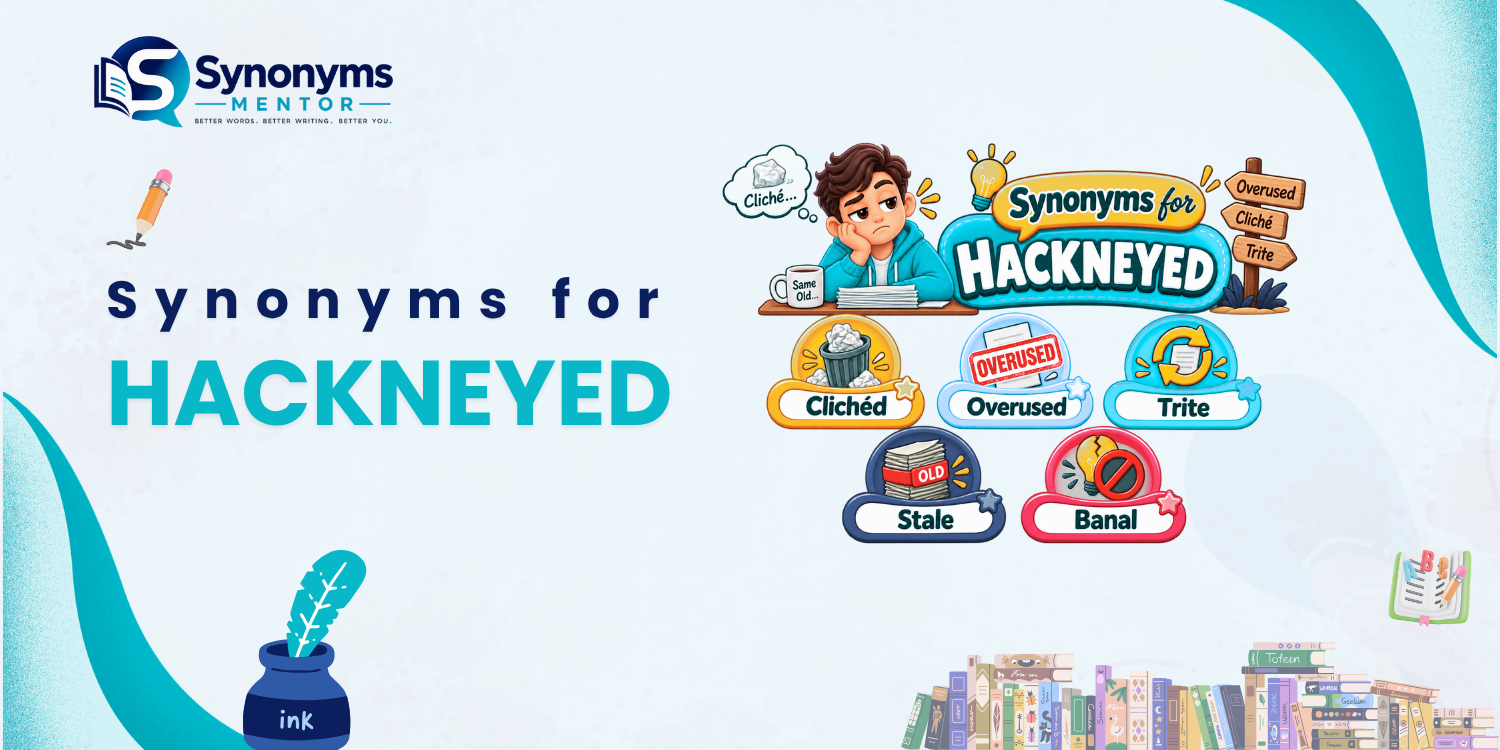
The closest alternatives include trite, clichéd, stale, threadbare, timeworn, shopworn, commonplace, banal, and stereotyped. However, these words are not completely interchangeable.
Trite often emphasizes an idea that has become dull through familiarity, while clichéd commonly describes language or ideas that have become predictable through repeated use. Stereotyped, meanwhile, emphasizes a fixed or predictable pattern.
Choosing the right alternative therefore depends on what you are describing and exactly why it feels unoriginal or tired.
Quick Answer: What Are the Best Synonyms for Hackneyed?
The closest synonyms for hackneyed include trite, clichéd, stale, threadbare, timeworn, shopworn, commonplace, banal, and stereotyped. Among these options, clichéd and trite are usually the most natural choices for an overused phrase or expression.
When an idea or plot feels worn out from repeated use, threadbare, stale, or timeworn can be more precise. For something based on a fixed or predictable pattern, stereotyped is often the better choice.
Core Synonyms for Hackneyed
| Word | Relationship | Main Meaning | Best Context |
|---|---|---|---|
| Trite | Very close synonym | Dull because of overuse or familiarity | Ideas, remarks, expressions |
| Clichéd | Very close synonym | Predictable or unoriginal because it has been repeatedly used | Phrases, writing, ideas, plots |
| Stale | Near synonym | No longer fresh, interesting, or effective | Ideas, jokes, arguments, writing |
| Threadbare | Near synonym | Worn out through repeated use | Arguments, plots, explanations |
| Timeworn | Near synonym | Very old or repeatedly used | Ideas, traditions, expressions |
| Shopworn | Near synonym | Used so often that it has lost freshness | Arguments, phrases, ideas |
| Commonplace | Broader synonym | Ordinary, familiar, or lacking distinction | Ideas, observations, language |
| Banal | Near synonym | So ordinary or predictable that it becomes dull | Comments, ideas, writing |
| Stereotyped | Contextual alternative | Following a fixed, predictable pattern | Characters, portrayals, ideas |
| Stock | Contextual alternative | Conventional and repeatedly used | Characters, phrases, situations |
| Platitudinous | Contextual alternative | Full of conventional or predictable statements | Speeches, writing, opinions |
| Worn-out | Contextual alternative | Exhausted through excessive use | Phrases, arguments, ideas |
| Overused | Related/near synonym | Used too frequently | Words, phrases, expressions |
| Unoriginal | Broader alternative | Lacking originality | Ideas, writing, creative work |
| Corny | Contextual alternative | Obviously sentimental, predictable, or unsophisticated | Jokes, romance, dialogue |
The first eight entries have particularly strong semantic overlap with hackneyed. Cambridge lists clichéd, commonplace, shopworn, stock, threadbare, timeworn, tired, and trite among its synonyms, while Merriam-Webster highlights stereotyped, threadbare, and trite as especially close alternatives.
What Does Hackneyed Mean?
Hackneyed is an adjective meaning lacking freshness or originality because something has been used, repeated, or encountered too often.
Cambridge defines a hackneyed phrase or idea as one that has been said or used so frequently that it becomes boring and loses meaning. Merriam-Webster similarly defines the adjective as lacking freshness or originality.
Example:
The novel relies on a hackneyed plot about two rivals who eventually fall in love.
The criticism is not simply that the plot is old. The point is that the plot feels overfamiliar and unoriginal because readers have encountered the same basic pattern many times.
Pronunciation
US: /ˈhæk.nɪd/
UK: /ˈhæk.nɪd/
Part of speech
Adjective
Common collocations include:
- hackneyed phrase
- hackneyed expression
- hackneyed idea
- hackneyed plot
- hackneyed argument
- hackneyed theme
- hackneyed metaphor
- hackneyed cliché
The Closest Synonyms for Hackneyed
1. Trite
Trite is one of the closest substitutes for hackneyed. It describes an idea, remark, expression, or observation that has become dull because people have heard it too many times.
Example:
The article was full of trite advice about achieving success.
Hackneyed vs. trite
These words overlap heavily. Hackneyed emphasizes overuse, while trite often emphasizes the resulting dullness or lack of freshness.
Merriam-Webster specifically notes that trite can describe something that was once effective but has been spoiled by familiarity.
Best choice: Use trite when you want to criticize a familiar idea or statement for being dull.
2. Clichéd
Clichéd means overly familiar or predictable because a phrase, idea, situation, or style has been used repeatedly.
Example:
The movie’s ending was predictable and clichéd.
Use clichéd particularly often for:
- phrases
- dialogue
- plots
- themes
- descriptions
- ideas
Hackneyed vs. clichéd
A cliché is a conventional expression or idea that has become overly familiar. Hackneyed describes something that has lost freshness through repeated use.
In many contexts, clichéd is the most natural replacement for hackneyed.
3. Stale
Stale means no longer fresh, interesting, effective, or original.
Example:
The columnist’s arguments have become stale.
Hackneyed vs. stale
Stale is broader. It can describe things that are not literally overused but have simply lost their freshness.
For example:
The team’s strategy has become stale.
This does not necessarily mean everyone has copied the strategy. It means the strategy no longer feels fresh or effective.
Best choice: Use stale when emphasizing a loss of freshness rather than repetition alone.
4. Threadbare
Threadbare originally refers to fabric worn thin through extensive use. Figuratively, it describes an argument, plot, explanation, or idea that has been used so extensively that little freshness remains.
Example:
The detective story depends on a threadbare plot.
Hackneyed vs. threadbare
These words are close, but threadbare has a particularly vivid metaphorical sense: something has been worn down by repeated use.
Merriam-Webster describes threadbare as applying to something whose possibilities for interest have been exhausted.
Best choice: Use threadbare for tired plots, arguments, explanations, or ideas.
5. Timeworn
Timeworn describes something that has existed or been used for a long time and therefore feels familiar, old, or lacking freshness.
Example:
The speaker relied on timeworn arguments about success.
Hackneyed vs. timeworn
Timeworn emphasizes age and repeated exposure. Hackneyed puts greater emphasis on the resulting lack of originality.
Best choice: Use timeworn when the long history of an idea or expression is important.
6. Shopworn
Shopworn is especially useful metaphorically for ideas, arguments, or expressions that have been used so often that they have lost their appeal.
Example:
The politician returned to the same shopworn arguments.
Hackneyed vs. shopworn
Both suggest excessive use. Shopworn creates a stronger image of something that has been repeatedly displayed or handled until it has lost its appeal.
It is somewhat more literary or stylistically marked than the everyday stale or clichéd.
7. Commonplace
Commonplace means ordinary, familiar, or lacking anything distinctive.
Example:
The essay contains several commonplace observations.
Hackneyed vs. commonplace
These are not perfect substitutes.
Something can be commonplace without being hackneyed. A common fact may simply be ordinary, whereas something hackneyed has generally become stale or unoriginal through excessive familiarity.
Best choice: Use commonplace when the emphasis is on ordinary or unsurprising rather than specifically overused.
8. Banal
Banal describes something so ordinary, predictable, or lacking in originality that it becomes boring.
Example:
The speech was filled with banal observations.
Hackneyed vs. banal
Banal focuses strongly on dullness caused by ordinariness. Hackneyed focuses more specifically on loss of freshness through repeated use.
Best choice: Use banal when you want to emphasize dull, predictable content rather than repetition itself.
9. Stereotyped
Stereotyped describes something that follows a fixed, conventional, or predictable pattern.
Example:
The novel contains stereotyped portrayals of its supporting characters.
Hackneyed vs. stereotyped
This distinction matters.
A hackneyed idea is worn out through overuse. A stereotyped portrayal follows a fixed pattern or conventional type.
Merriam-Webster specifically explains that stereotyped implies repeatedly falling into the same pattern or form.
Best choice: Use stereotyped for characters, portrayals, representations, behaviors, and predictable patterns.
Context-Specific Alternatives
Not every useful alternative works equally well everywhere.
For a hackneyed phrase
Best choices:
- clichéd
- trite
- stale
- overused
- worn-out
Example:
“Everything happens for a reason” can sound clichéd in some contexts.
For a hackneyed idea
Best choices:
- trite
- stale
- banal
- commonplace
- timeworn
Example:
The article repeats several timeworn ideas about leadership.
For a hackneyed plot
Best choices:
- clichéd
- predictable
- threadbare
- stereotyped
- stale
Example:
The film follows a clichéd romantic plot.
For hackneyed writing
Best choices:
- clichéd
- trite
- stale
- banal
- unoriginal
Example:
The introduction relies on clichéd language instead of making a specific argument.
For a hackneyed argument
Best choices:
- tired
- stale
- threadbare
- shopworn
- timeworn
Example:
The editorial returns to the same tired argument.
Which Word Should You Use?
| If you mean… | Best choice |
| A phrase has been repeated too often | clichéd |
| An idea has become dull through familiarity | trite |
| Something has lost its freshness | stale |
| An argument or plot has been exhausted through use | threadbare |
| Something is old and repeatedly used | timeworn |
| An argument feels repeatedly recycled | shopworn |
| Something is simply ordinary or familiar | commonplace |
| Something is dull and predictable | banal |
| Something follows a fixed pattern | stereotyped |
| A conventional character or situation is being described | stock |
| A speech contains predictable conventional statements | platitudinous |
| Something has been used excessively | overused |
| Something lacks originality generally | unoriginal |
| Something is predictable and overly sentimental | corny |
Hackneyed vs. Clichéd
These are among the closest alternatives.
Hackneyed emphasizes something becoming dull or unoriginal through repeated use.
Clichéd emphasizes a phrase, idea, expression, or situation that has become overly familiar and predictable.
Compare:
The writer used a hackneyed metaphor.
The writer used a clichéd metaphor.
Both sentences work naturally. Clichéd may sound slightly more direct when discussing conventional expressions or imagery.
Hackneyed vs. Trite
Both words describe language or ideas that have lost their freshness.
Hackneyed → worn out through repeated use
Trite → dull or ineffective because of excessive familiarity
Example:
His advice sounded trite.
This focuses on how uninteresting the advice feels.
His speech was filled with hackneyed phrases.
This highlights the repeated, familiar nature of the language.
Hackneyed vs. Stale
Hackneyed is more closely associated with overuse.
Stale is broader and can describe anything that has lost freshness.
Compare:
The writer uses hackneyed expressions.
The writer’s approach feels stale.
The first specifically suggests overused language; the second suggests that the overall approach no longer feels fresh.
Hackneyed vs. Stereotyped
These words should not automatically be treated as interchangeable.
Hackneyed → overused and therefore lacking freshness
Stereotyped → based on a fixed or conventional pattern
For example:
The dialogue was hackneyed.
The dialogue felt overused or clichéd.
The characters were stereotyped.
The characters were portrayed according to predictable conventional types.
Words That Are Related but Not Exact Synonyms
Some words often appear on broad synonym lists but require caution.
Overused
Overused is closely related but more literal and neutral. Something can be overused without necessarily becoming dull or meaningless.
The phrase is overused.
This does not necessarily contain the same strong criticism as:
The phrase is hackneyed.
Unoriginal
Unoriginal means lacking originality, but it does not necessarily imply repeated use.
A person can create an unoriginal idea without copying or repeatedly using a familiar expression.
Derivative
Derivative means heavily influenced by or imitative of existing work. It is related to hackneyed but describes imitation more than simple overuse.
Predictable
Something predictable can be accurately anticipated without being hackneyed.
A mystery novel can be predictable without relying on a tired or overused plot.
Boring
Boring is much broader. Something can be boring for many reasons and need not be hackneyed.
This distinction is important because a strong vocabulary resource should not treat every negative word as a true synonym.
Common Mistakes With Hackneyed
1. Using “old” as an exact synonym
Old only describes age. It does not necessarily suggest overuse or loss of originality.
an old tradition
does not mean the same thing as:
a hackneyed idea
2. Assuming “overused” always equals “hackneyed”
Overused describes frequency. Hackneyed adds the idea that excessive familiarity has made something dull or unoriginal.
3. Using “stereotyped” for every cliché
A cliché can be a phrase or idea, while stereotyped is especially useful for fixed patterns and conventional portrayals.
4. Using “banal” when repetition is the main point
Banal emphasizes dullness or ordinariness. If repetition is central, hackneyed, trite, or clichéd may be more precise.
5. Confusing “cliché” with “clichéd”
Cliché is normally a noun:
That expression is a cliché.
Clichéd is the adjective:
That expression sounds clichéd.
Common Collocations With Hackneyed
Some of the most useful combinations are:
- hackneyed phrase
- hackneyed expression
- hackneyed idea
- hackneyed plot
- hackneyed argument
- hackneyed metaphor
- hackneyed theme
- hackneyed language
- hackneyed writing
- hackneyed formula
- hackneyed approach
- hackneyed cliché
The word is particularly useful when discussing writing, literature, journalism, speeches, creative work, arguments, and familiar expressions. Current dictionary examples likewise show hackneyed used for plots, phrases, tropes, and other forms of repeated creative language.
Antonyms of Hackneyed
The natural opposite of hackneyed is language that feels fresh, original, unusual, or inventive.
Useful antonyms include:
- original
- fresh
- novel
- innovative
- imaginative
- creative
- distinctive
- unusual
- inventive
- unconventional
Cambridge specifically lists original, new, fresh, novel, imaginative, creative, unusual, uncommon, and striking among antonyms of hackneyed.
Example:
The author’s fresh approach avoided the hackneyed conventions of the genre.
Frequently Asked Questions
What is the closest synonym for hackneyed?
Trite and clichéd are among the closest synonyms. Trite emphasizes dullness caused by familiarity, while clichéd is particularly natural for overused phrases, expressions, ideas, and situations.
Is “clichéd” the same as “hackneyed”?
They are very close, but not identical in every context. Both can describe something that has lost freshness through excessive familiarity. Clichéd is especially common for phrases, expressions, plots, and ideas, while hackneyed can describe a broader range of overused creative elements.
What is a formal synonym for hackneyed?
Trite, threadbare, timeworn, commonplace, and platitudinous can work in formal writing, depending on context. Platitudinous is particularly useful when describing speech or writing full of predictable conventional statements.
What is a synonym for a hackneyed phrase?
The best choices are clichéd, trite, stale, overused, and worn-out. Clichéd is usually the most direct choice when a phrase has become predictable through repeated use.
What is a synonym for a hackneyed idea?
Good choices include trite, stale, banal, commonplace, timeworn, and unoriginal. Choose trite when the idea feels dull through familiarity and stale when you want to emphasize its loss of freshness.
Is “overused” stronger than “hackneyed”?
Not necessarily. Overused describes frequency, while hackneyed usually carries an evaluative judgment that excessive use has made something dull or unoriginal. Something can be overused without being completely hackneyed.
What is the opposite of hackneyed?
The strongest general opposites are original, fresh, novel, creative, imaginative, distinctive, and unconventional. The best choice depends on whether you are emphasizing novelty, creativity, or departure from convention.
Can hackneyed describe a person?
It is possible in unusual contexts, but hackneyed is much more naturally used for language, ideas, plots, arguments, themes, images, and other things that can become stale through repeated use. For a person, alternatives such as predictable or stereotyped may be more appropriate depending on the intended meaning.
Conclusion
The best synonym for hackneyed depends on what has become tired or unoriginal.
Use clichéd for familiar phrases and expressions, trite for dull ideas or remarks, stale for things that have lost freshness, threadbare for exhausted arguments or plots, and stereotyped for fixed and predictable patterns. Timeworn, shopworn, commonplace, and banal are useful alternatives when their specific shades of meaning fit the context.

Our editorial team is dedicated to making English vocabulary easier to understand and use correctly. We research and review synonyms, antonyms, definitions, word usage, and example sentences to ensure our content is clear, accurate, practical, and useful for students, writers, professionals, and English learners.