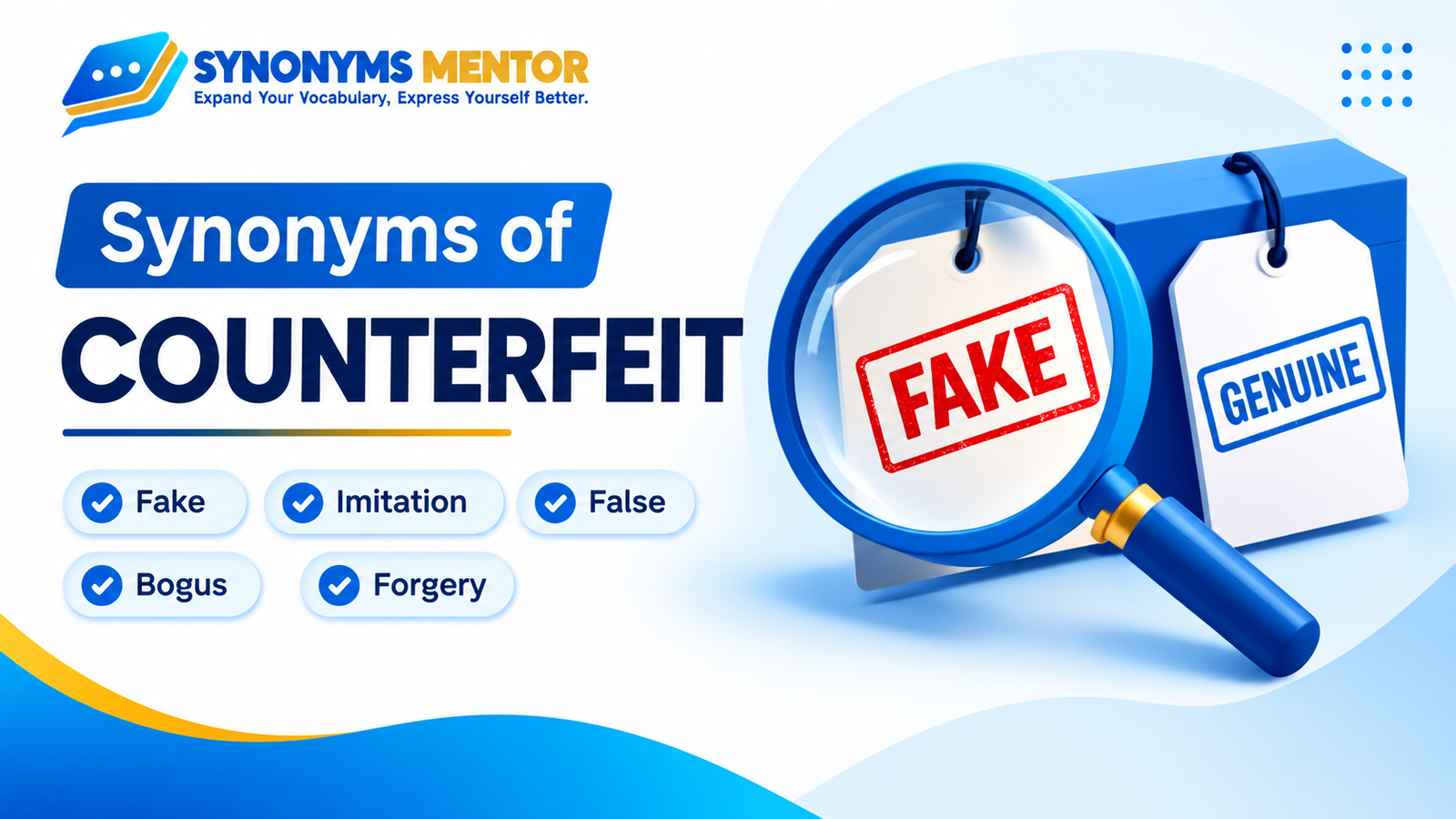
Synonyms of Counterfeit: 20+ Alternatives and Examples
Finding the right synonym for counterfeit depends on what you are describing. Fake, forged, bogus, imitation, and fraudulent are among the closest alternatives, but they are not interchangeable in every sentence. Counterfeit usually refers to something made to look genuine, especially when the imitation is intended to deceive.
This guide explains the closest synonyms of counterfeit, shows how their meanings differ, and provides natural examples for everyday, academic, business, and professional writing.
Quick Answer
The closest synonyms of counterfeit include fake, forged, bogus, fraudulent, imitation, phony, sham, spurious, false, and inauthentic. The best choice depends on context. Use forged for illegally copied documents or signatures, fake for general everyday use, and fraudulent when the emphasis is on deception or dishonest activity.
What Does “Counterfeit” Mean?
Counterfeit can function as an adjective, verb, or noun.
As an adjective, it describes something made to look like a genuine item, usually with an intention to deceive. For example:
The police discovered counterfeit banknotes.
As a verb, counterfeit means to make a fraudulent copy of something valuable or to imitate something deceptively.
Criminals attempted to counterfeit the currency.
As a noun, counterfeit refers to the fake item itself.
The watch was a counterfeit.
Cambridge defines the adjective as something made to look like the original, usually for dishonest or illegal purposes. Merriam-Webster similarly emphasizes imitation and an intent to deceive.
Pronunciation
- US: /ˈkaʊn.t̬ɚ.fɪt/
- UK: /ˈkaʊn.tə.fɪt/
The pronunciation is the same for the adjective and noun in standard English.
The Closest Synonyms of Counterfeit
Not every word associated with counterfeit has exactly the same meaning. The table below separates close synonyms from words that are more context-specific.
| Word | Relationship | Strength | Formality | Best Context |
|---|---|---|---|---|
| Fake | Direct/near synonym | Neutral | Casual–neutral | General use |
| Forged | Contextual synonym | Strong | Neutral–formal | Documents, signatures, money |
| Bogus | Near synonym | Strong | Casual–neutral | Claims, credentials, products |
| Fraudulent | Near synonym | Strong | Formal | Transactions, claims, documents |
| Imitation | Near synonym | Neutral | Neutral | Products, art, designs |
| Phony | Near synonym | Strong | Informal | People, claims, objects |
| Sham | Near synonym | Strong | Neutral–formal | Actions, organizations, situations |
| Spurious | Near synonym | Strong | Formal | Claims, evidence, reasoning |
| False | Broad alternative | Variable | Neutral | Statements, information |
| Inauthentic | Contextual alternative | Moderate | Formal | Art, identity, experiences |
| Artificial | Contextual alternative | Moderate | Neutral | Objects, materials, appearances |
| Simulated | Contextual alternative | Moderate | Formal | Conditions, behavior, environments |
| Mock | Contextual alternative | Variable | Neutral | Tests, versions, demonstrations |
| Ersatz | Near synonym | Strong | Literary/formal | Substitute goods or materials |
| Spurious | Near synonym | Strong | Formal | Arguments, claims, evidence |
| Unauthentic | Contextual alternative | Moderate | Formal | Objects, experiences, representations |
The major dictionaries support words such as fake, forged, bogus, sham, imitation, fraudulent, spurious, false, and simulated as synonyms or closely related alternatives.
1. Fake
Fake is the most common everyday alternative to counterfeit.
It refers broadly to something that is not genuine or is made to appear genuine.
Example:
The customer realized that the designer bag was fake.
Counterfeit vs. fake
These words often overlap, but counterfeit more strongly suggests a deliberate imitation intended to deceive. Fake is broader and does not always imply fraud.
The museum displayed a fake painting.
The store was selling counterfeit designer watches.
Merriam-Webster notes that fake can replace counterfeit in many situations, although fake does not necessarily imply dishonesty.
2. Forged
Forged is particularly useful for documents, signatures, certificates, banknotes, and other things that have been illegally reproduced or altered.
Example:
The bank discovered several forged checks.
Use forged instead of counterfeit when the emphasis is on unauthorized reproduction or alteration.
Natural collocations:
- forged signature
- forged document
- forged passport
- forged certificate
- forged banknote
Cambridge lists forge as a direct synonym of the verb counterfeit, particularly when something is deliberately reproduced for dishonest purposes.
3. Bogus
Bogus means false, fake, or not genuine.
It commonly describes:
- claims
- credentials
- products
- offers
- websites
- organizations
Example:
The website was offering bogus investment opportunities.
It is natural in everyday and journalistic English but generally less formal than fraudulent.
4. Fraudulent
Fraudulent emphasizes deception for dishonest or unlawful gain.
Example:
The company was accused of using fraudulent documents.
This word is especially appropriate in:
- legal writing
- financial contexts
- business communication
- official reports
Unlike fake, fraudulent strongly highlights dishonest conduct.
5. Imitation
Imitation refers to something designed to resemble another thing.
It is not always as strongly negative as counterfeit.
Example:
She bought an imitation leather jacket.
An imitation may be openly sold as an imitation, whereas a counterfeit is commonly presented as genuine.
That distinction makes imitation a near synonym rather than a perfect replacement.
6. Phony
Phony means fake, false, or not genuine.
It is mainly informal.
Example:
The salesman made several phony claims about the product.
It can describe:
- people
- promises
- claims
- credentials
- products
For formal writing, false, fraudulent, or inauthentic may be more appropriate.
7. Sham
A sham is something presented as genuine or legitimate when it is not.
Example:
The investigation revealed that the charity was a sham.
The word can describe an organization, activity, relationship, or situation as well as an object.
This makes sham useful when the idea involves broader deception rather than simply a copied physical product.
8. Spurious
Spurious is a formal word meaning false, invalid, or apparently genuine but actually not what it claims to be.
Example:
The report was based on spurious evidence.
It is particularly useful in academic, professional, and analytical writing.
Common combinations include:
- spurious claim
- spurious argument
- spurious evidence
- spurious reasoning
- spurious connection
It is usually not the best choice for everyday objects such as fake shoes or fake watches.
9. False
False is a broad alternative to counterfeit, but it is not always a direct synonym.
Example:
The document contained false information.
Use false when something is incorrect, untrue, or deceptive. For a physically copied object, counterfeit, fake, or forged may be more precise.
10. Inauthentic
Inauthentic means not genuine, original, or sincere.
Example:
The reviewer described the brand’s marketing as inauthentic.
This word works especially well for:
- art
- experiences
- behavior
- identity
- communication
- branding
It is usually more neutral and less explicitly connected to criminal counterfeiting than counterfeit.
11. Artificial
Artificial can sometimes replace counterfeit, but it is not a universal synonym.
It generally means made by humans rather than occurring naturally, or produced to resemble something natural.
Example:
The room was decorated with artificial flowers.
Artificial flowers are not necessarily deceptive, so calling them counterfeit flowers would be unnatural.
This is an important example of why related words should not automatically be treated as exact synonyms.
12. Simulated
Simulated means deliberately made to resemble a real condition, event, or experience.
Example:
The students practiced in a simulated emergency environment.
A simulation is normally created openly for practice or testing. It does not necessarily involve deception.
For that reason, simulated is usually a contextual alternative rather than a direct synonym of counterfeit.
13. Mock
Mock can describe something created as a model, imitation, or representation.
Example:
The students completed a mock interview before the real interview.
A mock interview is not fraudulent because everyone knows it is a practice exercise.
Therefore, mock should not automatically replace counterfeit.
14. Ersatz
Ersatz describes an inferior or substitute product or material used instead of something genuine or more desirable.
Example:
During the shortage, consumers relied on ersatz materials.
It is a relatively uncommon word in everyday American English, but it can be useful in formal or literary writing.
Which Synonym Should You Use?
The best synonym depends on the situation.
Use “fake” for general situations
Choose fake when you want the simplest and most natural everyday word.
The watch is fake.
Use “forged” for documents and signatures
Choose forged when something has been illegally copied, altered, or reproduced.
The signature was forged.
Use “fraudulent” for dishonest activity
Choose fraudulent when deception or unlawful conduct is central.
The company submitted fraudulent documents.
Use “imitation” for something designed to resemble another item
Choose imitation when the emphasis is on resemblance rather than deception.
She purchased an imitation leather handbag.
Use “bogus” for false claims or credentials
The applicant provided bogus credentials, making the information unreliable.
Use “spurious” for formal arguments or claims
In formal contexts, spurious describes an argument or claim that appears valid but lacks a sound basis.
Use “phony” in informal English
For casual English, phony is a natural choice. For example, that website looks phony.
Counterfeit vs. Fake
Counterfeit and fake are often interchangeable, especially when describing products or money.
The main difference is emphasis.
| Word | Main Idea | Example |
| Counterfeit | Deliberately made to resemble something genuine | counterfeit currency |
| Fake | Not genuine or real | a fake watch |
Counterfeit is more specific when an imitation is intended to pass as genuine. Fake is broader and more conversational.
Counterfeit vs. Forged
These words overlap, but forged is especially common for documents, signatures, certificates, and financial instruments.
The passport was forged.
The company discovered counterfeit passports.
The first sentence focuses on the act or unauthorized reproduction. Counterfeit can describe the resulting false item more generally.
Counterfeit vs. Imitation
The difference is mainly about deception.
An imitation resembles something else but may be openly presented as an imitation.
A counterfeit is generally intended to appear genuine.
The store sells imitation jewelry.
The authorities seized counterfeit jewelry bearing a famous brand’s name.
Counterfeit vs. Fraudulent
Counterfeit often describes the false item itself.
Fraudulent more often describes the dishonest nature of an action, transaction, claim, or document.
The police seized counterfeit banknotes.
The company was investigated for fraudulent transactions.
Counterfeit vs. Bogus
Bogus means false or fake and can apply to many kinds of things.
a bogus certificate
a bogus website
a bogus claim
Counterfeit is more strongly associated with a manufactured imitation of something genuine.
Common Mistakes with Counterfeit Synonyms
Mistake 1: Treating every related word as an exact synonym
Words such as artificial, mock, and simulated can describe something that resembles another thing, but they do not necessarily involve deception.
Mistake 2: Using “forged” for every fake product
A fake designer bag is usually described as counterfeit or fake, not necessarily forged.
Mistake 3: Using “fraudulent” only for physical objects
Fraudulent commonly describes conduct, claims, transactions, records, and documents.
Mistake 4: Using “phony” in highly formal writing
Phony is natural in conversation but can sound informal in academic or legal contexts.
Mistake 5: Assuming imitation always means illegal
An imitation can be openly sold as a copy. Counterfeit usually carries a stronger implication of deceptive imitation.
Natural Collocations with Counterfeit
Some combinations are especially common:
- counterfeit money
- counterfeit currency
- counterfeit coins
- counterfeit banknotes
- counterfeit goods
- counterfeit products
- counterfeit documents
- counterfeit passports
- counterfeit jewelry
- counterfeit medicine
- counterfeit brand
- counterfeit merchandise
These combinations help show where counterfeit sounds more natural than broader alternatives such as fake.
Antonyms of Counterfeit
The clearest opposites are words describing authenticity or genuineness.
Common antonyms
- genuine
- authentic
- real
- original
- legitimate
- genuine article
For example:
The first watch was counterfeit, but the second one was genuine.
Cambridge lists genuine, authentic, and real as opposites of counterfeit.
FAQ About Counterfeit Synonyms
What is the closest synonym for counterfeit?
Fake is usually the closest everyday synonym. Depending on context, forged, bogus, fraudulent, or imitation may be more precise.
What is another word for counterfeit products?
Common alternatives include fake products, bogus products, imitation products, and knockoffs. Fake is the broadest everyday option, while counterfeit more strongly suggests an attempt to pass the product off as genuine.
What is a formal synonym for counterfeit?
Fraudulent, spurious, inauthentic, and forged can work in formal contexts, depending on the noun being described.
Is “fake” the same as “counterfeit”?
Not always. Fake is broader and can describe anything that is not genuine. Counterfeit more specifically suggests an imitation intended to appear genuine.
What is the difference between counterfeit and imitation?
An imitation resembles something else but does not necessarily involve deception. A counterfeit is generally created or presented to deceive people into believing it is genuine.
What is the strongest synonym for counterfeit?
There is no universal “strongest” synonym. Fraudulent emphasizes deception, forged emphasizes unauthorized reproduction, and bogus emphasizes falseness.
What is the opposite of counterfeit?
The most useful opposites are genuine, authentic, real, and original.
Can counterfeit be used as a verb?
Yes. As a verb, counterfeit means to make a fraudulent copy or to imitate something deceptively.
Criminals attempted to counterfeit banknotes.
Conclusion
The best synonym for counterfeit depends on the context. Fake is the most versatile everyday alternative, while forged works particularly well for documents and signatures. Fraudulent emphasizes dishonest conduct, imitation focuses on resemblance, bogus describes something false or not genuine, and spurious suits formal claims or arguments.

Sophia Martinez is an ESL educator who specializes in teaching vocabulary and word meanings. She writes beginner-friendly content that helps learners understand synonyms and improve their English fluency step by step.