Synonyms of Identify: 20+ Accurate Alternatives With Examples
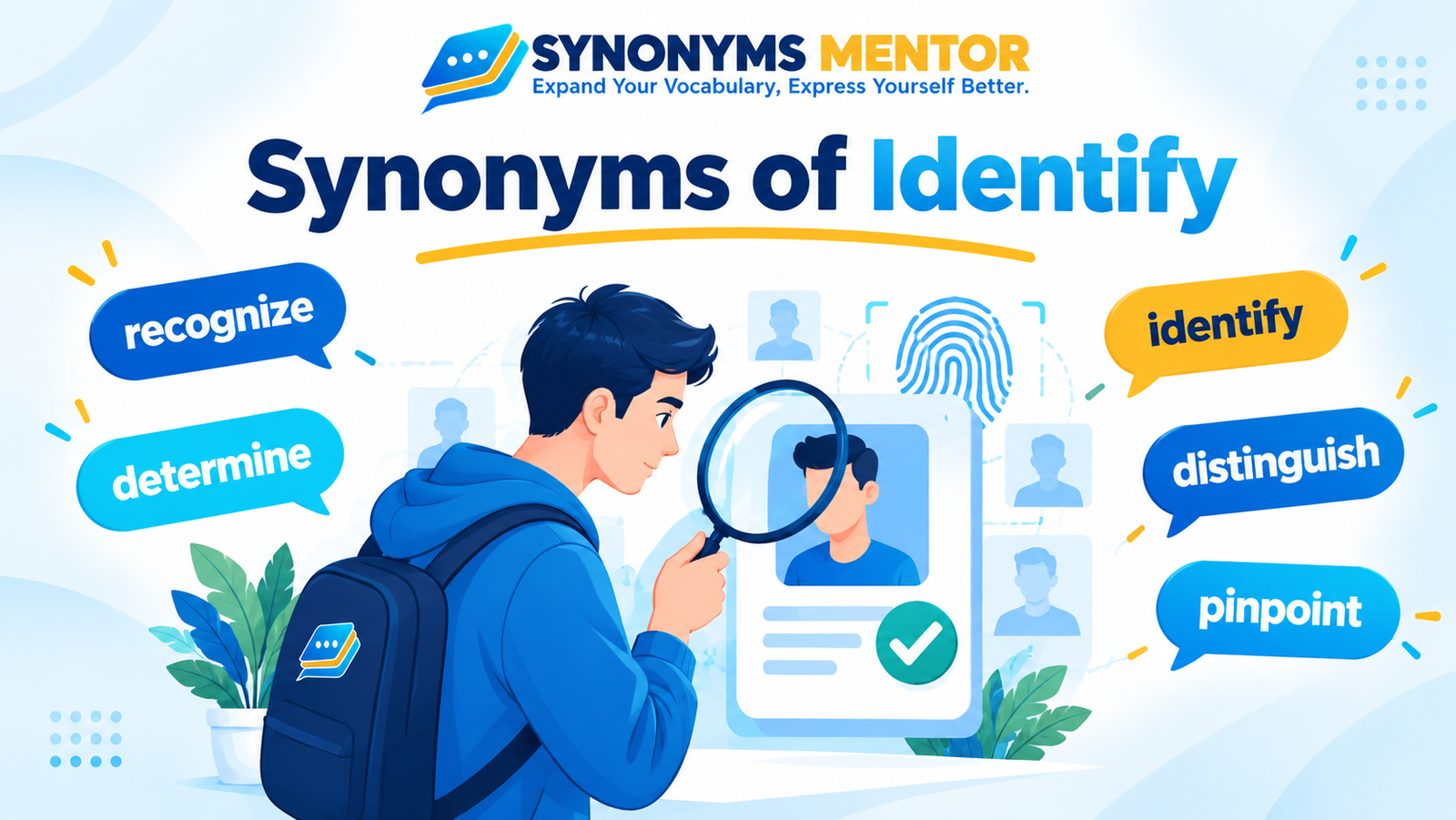
Finding the right synonym for identify depends on what you mean by the word. You might recognize a person, determine the cause of a problem, pinpoint an exact location, establish someone’s identity, or name a person or object.
This guide explains the closest synonyms of identify, shows how their meanings differ, and gives natural examples so you can choose the right word for each context.
Quick Answer
The closest synonyms of identify include recognize, distinguish, determine, establish, pinpoint, name, locate, spot, detect, classify, and single out.
The best choice depends on context: use recognize for knowing someone or something from previous experience, determine for finding an answer, pinpoint for locating something precisely, and establish when confirming identity or facts.
What Does “Identify” Mean?
Identify is a verb meaning to recognize or establish who, what, or where someone or something is. It can also mean discovering a particular problem, need, cause, or characteristic.
For example:
- The witness identified the suspect.
- Scientists identified the cause of the problem.
- She immediately identified the painting.
- The team identified several areas for improvement.
Cambridge defines identify in contexts involving recognizing someone or something and determining or showing what it is.
Part of Speech
Identify is primarily a verb.
Pronunciation
- US: /aɪˈden.t̬ə.faɪ/
- UK: /aɪˈden.tɪ.faɪ/
Word Origin
Identify ultimately comes from Late Latin identificare, related to identity.
Core Synonyms of Identify
Not every word associated with identify is interchangeable with it. The table below separates the strongest alternatives according to meaning and practical usage.
| Word | Relationship | Strength | Formality | Best Context |
|---|---|---|---|---|
| Recognize | Direct/near synonym | Equal | Neutral | Knowing someone or something |
| Determine | Near synonym | Equal | Neutral–formal | Finding an answer or cause |
| Establish | Near synonym | Strong | Formal | Confirming identity or facts |
| Distinguish | Near synonym | Equal | Neutral–formal | Telling things apart |
| Pinpoint | Contextual alternative | Strong | Neutral | Finding something precisely |
| Name | Contextual alternative | Equal | Neutral | Saying who or what something is |
| Locate | Contextual alternative | Equal | Neutral | Finding a place or object |
| Spot | Contextual alternative | Slightly narrower | Casual–neutral | Seeing or noticing something |
| Detect | Contextual alternative | Equal | Neutral–formal | Discovering something hidden |
| Classify | Contextual alternative | More specific | Formal/academic | Assigning a category |
| Single out | Contextual alternative | More specific | Neutral | Selecting one person or thing |
| Pick out | Contextual alternative | Neutral | Casual | Selecting or recognizing |
| Diagnose | Contextual alternative | Specialized | Professional | Identifying a medical/problem cause |
| Label | Contextual alternative | More specific | Neutral | Giving something a category or description |
| Flag | Contextual alternative | More specific | Professional | Marking something for attention |
| Discover | Near/contextual synonym | Related | Neutral | Finding something previously unknown |
| Find | Broad contextual alternative | Broad | Neutral | Discovering or determining something |
| Verify | Related alternative | More specific | Formal | Confirming that something is true |
| Confirm | Related alternative | More specific | Neutral–formal | Establishing that something is correct |
| Associate | Different sense | Context-dependent | Neutral | Linking one thing with another |
The Closest Synonyms of Identify
1. Recognize
Recognize is often the closest everyday alternative when identify means knowing who or what someone or something is from previous experience.
Example:
I recognized him immediately from his photograph.
Best used for: people, faces, voices, objects, places, and familiar things.
Difference: Recognize emphasizes familiarity or perception. Identify can involve recognizing and stating or proving what something is.
2. Determine
Determine means to find out or establish an answer, fact, cause, or result.
Example:
The investigation determined the cause of the accident.
Use it when identify means find out exactly what something is or what caused it.
Best collocations:
- determine the cause
- determine the problem
- determine the source
- determine the reason
- determine the best option
3. Establish
Establish is especially useful when identify means confirming or proving someone’s identity or a particular fact.
Example:
Police established the victim’s identity through dental records.
It is generally more formal than identify.
4. Distinguish
Distinguish means to recognize the difference between people or things.
Example:
The test helps doctors distinguish between the two conditions.
Use distinguish when the key idea is telling one thing apart from another.
Compare:
Scientists identified the species.
versus:
Scientists distinguished the species from a similar one.
5. Pinpoint
Pinpoint means to identify something with particular precision.
Example:
Investigators pinpointed the source of the leak.
It is stronger and more precise than the general identify.
Common phrases include:
- pinpoint the cause
- pinpoint the source
- pinpoint the location
- pinpoint the problem
- pinpoint the error
6. Name
Name is a straightforward alternative when identify means saying who or what someone or something is.
Example:
Can you name the person in this photograph?
It is simpler and more conversational than identify in many situations.
7. Locate
Locate means find the position of someone or something.
Example:
The engineers located the damaged cable.
Do not treat locate as a universal synonym. It works specifically when identification involves finding where something is.
8. Spot
Spot means notice or see someone or something, often quickly.
Example:
She spotted an error in the report.
It is more conversational than identify.
9. Detect
Detect means discover or notice something that may be difficult to see, hear, measure, or recognize.
Example:
The system detected a security problem.
It is particularly natural for:
- errors
- problems
- diseases
- threats
- signals
- changes
- abnormalities
10. Classify
Classify means place someone or something into a particular group or category.
Example:
Researchers classified the samples according to their chemical properties.
It overlaps with identify in scientific and academic contexts but is more specific.
Context-Specific Alternatives
Synonyms for Identify a Person
When you mean discovering or confirming who someone is, the best choices include:
- recognize
- establish
- name
- single out
- pick out
- identify
Example:
The witness recognized the suspect.
The police established the suspect’s identity.
These sentences are related but not identical. Recognized emphasizes recognition, whereas established emphasizes confirmation.
Synonyms for Identify a Problem
For problems, causes, or weaknesses, consider:
- determine
- detect
- pinpoint
- discover
- locate
- diagnose
- uncover
Example:
The engineers pinpointed the source of the malfunction.
Synonyms for Identify a Cause
The strongest choices include:
- determine
- establish
- pinpoint
- discover
- diagnose
Example:
Doctors identified the cause of the symptoms.
Doctors determined the cause of the symptoms.
Doctors pinpointed the cause of the symptoms.
The third sentence emphasizes precision.
Synonyms for Identify an Error
Natural alternatives include:
- detect
- spot
- find
- notice
- pinpoint
- uncover
Example:
The editor spotted several errors in the manuscript.
Here, spot sounds more natural than a formal alternative such as establish.
Which Word Should I Use?
Use “recognize” when:
You know or perceive someone or something from previous experience.
I recognized her voice immediately.
Use “determine” when:
You are finding an answer, cause, reason, or fact.
The researchers determined the cause of the failure.
Use “establish” when:
You are confirming identity or proving a fact.
The records established his identity.
Use “distinguish” when:
You need to tell two similar things apart.
The test distinguishes genuine products from imitations.
Use “pinpoint” when:
You want to emphasize exactness.
Investigators pinpointed the source of the contamination.
Use “locate” when:
You mean finding where something is.
The rescue team located the missing hiker.
Use “spot” when:
You mean noticing something quickly, especially in everyday language.
She spotted a mistake in the contract.
Use “detect” when:
You discover something that is hidden, subtle, or difficult to notice.
The sensor detected a change in temperature.
Identify vs. Recognize
These words overlap, but they are not always interchangeable.
Identify can mean establishing or stating what someone or something is.
The scientist identified the unknown substance.
Recognize usually suggests that you know or perceive something because you have encountered it before.
I recognized the actor from another movie.
A useful rule:
Recognize = know or perceive as familiar.
Identify = establish or state what someone or something is.
Identify vs. Determine
Determine focuses on reaching an answer or conclusion.
We need to determine why the machine stopped.
Identify focuses on recognizing or establishing the particular thing involved.
We need to identify the problem.
The words can overlap, but determine often emphasizes finding the answer, while identify emphasizes specifying what the thing is.
Identify vs. Distinguish
Identify means establish what something or someone is.
Distinguish means recognize the difference between two or more things.
Compare:
The expert identified the bird.
The expert distinguished the bird from a similar species.
The second sentence emphasizes comparison.
Identify vs. Pinpoint
Pinpoint is narrower and more precise.
We identified the source of the problem.
We pinpointed the exact source of the problem.
Use pinpoint when you want to stress precision or exact location.
Natural Collocations With Identify
Some of the most useful phrases with identify include:
- identify a problem
- identify an issue
- identify a cause
- identify a need
- identify a risk
- identify an opportunity
- identify a person
- identify a suspect
- identify the source
- identify the reason
- identify a pattern
- identify an error
- identify a weakness
- identify a solution
- identify priorities
The best synonym changes with the collocation.
| Phrase | Natural Alternative |
| identify a problem | detect, pinpoint, determine |
| identify a person | recognize, name, establish |
| identify the cause | determine, establish, pinpoint |
| identify an error | spot, detect, notice |
| identify a location | locate, pinpoint |
| identify a species | classify, determine |
| identify a risk | detect, recognize, flag |
| identify a need | determine, recognize |
| identify an opportunity | recognize, spot |
| identify a pattern | detect, recognize |
Common Mistakes
Mistake 1: Treating every related word as a perfect synonym
Words such as locate, diagnose, and classify are not interchangeable with identify in every sentence.
Better approach: Choose the word according to the exact meaning.
Mistake 2: Using “recognize” when discovery is intended
❌ The research recognized the cause of the problem.
✓ The research identified the cause of the problem.
Recognize usually suggests perceiving something as known or familiar, whereas identify can mean determining what something is.
Mistake 3: Using “locate” for identity
❌ The police located the suspect’s identity.
✓ The police established the suspect’s identity.
Locate concerns position, not identity.
Mistake 4: Assuming “pinpoint” is always interchangeable
The researchers pinpointed the exact source.
This works because the sentence emphasizes precision. In a general context, identify may be more natural.
Real-World Examples
Workplace
The manager identified several weaknesses in the current process.
A more precise alternative:
The manager pinpointed the main weakness in the current process.
Academic Writing
Researchers identified a significant pattern in the data.
If the emphasis is on discovering the result:
Researchers determined the underlying cause.
Everyday Conversation
I recognized him as soon as he walked in.
Here, recognized is more natural than the formal identified.
Professional Communication
The audit identified several potential risks.
A stronger professional alternative can be:
The audit detected several potential risks.
Antonyms of Identify
The opposite depends on the sense of identify. Useful opposites include:
- conceal
- hide
- disguise
- obscure
- overlook
- miss
For example:
The evidence helped investigators identify the suspect.
versus:
The disguise helped conceal the suspect’s identity.
FAQ
What is the closest synonym for “identify”?
Recognize is often the closest everyday synonym when identify means recognizing who or what someone or something is. However, determine or establish may be closer when the meaning involves discovering or confirming a fact.
What is another word for identify a person?
Depending on context, use recognize, name, establish, pick out, or single out. Use recognize when you know the person from previous experience and establish when confirming the person’s identity.
What is a formal synonym for identify?
Establish and determine are useful formal alternatives, depending on meaning. Ascertain can also work in formal contexts when the meaning is to find something out, although it is not interchangeable with identify in every sentence.
What is a synonym for identify a problem?
Good choices include detect, determine, pinpoint, discover, and diagnose. The best option depends on the type of problem and the context.
What is the difference between identify and recognize?
Recognize usually means knowing or perceiving someone or something as familiar. Identify can mean recognizing and stating what someone or something is, or determining its identity.
What is the difference between identify and determine?
Identify focuses on specifying or establishing what something is. Determine focuses more on finding an answer, cause, fact, or result.
What is the strongest synonym for identify?
There is no single strongest synonym. Pinpoint can be stronger when precision is important, while establish can be stronger when confirmation or proof is involved.
What is a synonym for identify an error?
Natural choices include spot, detect, notice, find, and pinpoint. Spot is especially natural in everyday writing, while detect works well in technical and professional contexts.
Conclusion
The best synonym for identify depends on the specific meaning you want to express. Use recognize for familiarity, determine for finding an answer, establish for confirming identity or facts, distinguish for telling things apart, pinpoint for precision, locate for position, and detect for discovering something hidden or difficult to notice.

Our editorial team is dedicated to making English vocabulary easier to understand and use correctly. We research and review synonyms, antonyms, definitions, word usage, and example sentences to ensure our content is clear, accurate, practical, and useful for students, writers, professionals, and English learners.