Synonyms for Pay: 30 Better Alternatives With Examples
The word pay is one of the most versatile words in English. You can pay a bill, pay an employee, pay for dinner, pay back a loan, or talk about how much a job pays. Because the word has several meanings, the best synonym depends heavily on the sentence.
For example, compensate is useful when discussing payment for work or loss, while reimburse usually means returning money someone has already spent. Settle works naturally for bills and debts, whereas remunerate is a more formal choice for paying someone for services.
This guide organizes the most useful alternatives by meaning so you can choose a word that sounds natural rather than simply replacing pay with a random thesaurus entry.
Quick Answer
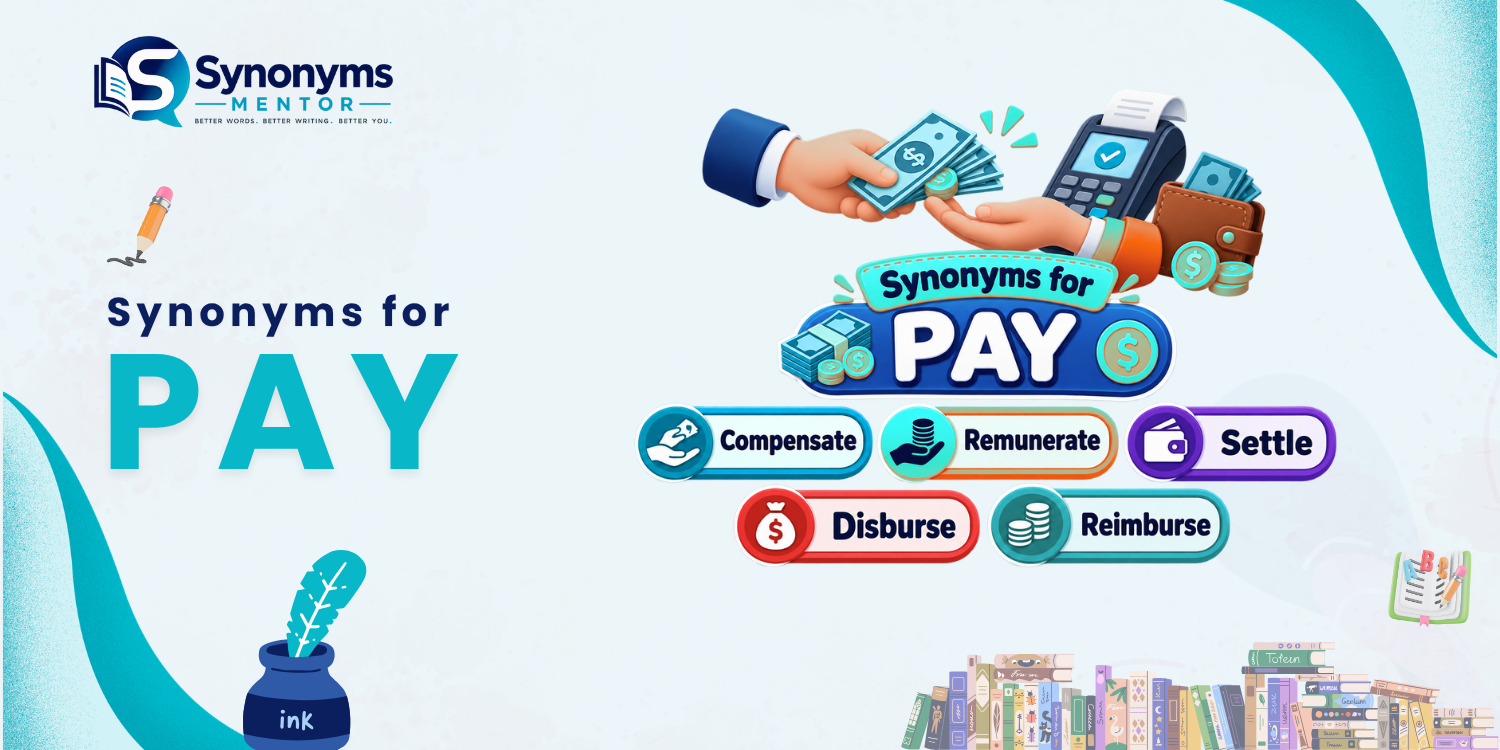
The closest synonyms for pay include compensate, reimburse, remunerate, repay, settle, remit, discharge, meet, and foot. However, the best alternative depends on context.
Use compensate for payment for work or loss, reimburse for returning expenses, settle for bills or debts, repay for returning borrowed money, and remunerate in formal contexts involving payment for services.
Core Synonyms for Pay
| Word | Relationship | Meaning | Formality | Best Context |
|---|---|---|---|---|
| compensate | Direct/near synonym | Pay someone for work, loss, or a service | Neutral–formal | Employees, services, losses |
| reimburse | Contextual | Repay money someone has already spent | Formal–neutral | Expenses, business |
| remunerate | Near synonym | Pay someone for work or services | Formal | Professional writing |
| repay | Near synonym | Give back money or an equivalent amount | Neutral | Loans, debts, favors |
| recompense | Near synonym | Compensate or repay for something | Formal/literary | Losses, services |
| settle | Contextual | Pay an outstanding bill or debt | Neutral | Bills, accounts |
| discharge | Contextual | Fulfill or clear a financial obligation | Formal | Debts, obligations |
| meet | Contextual | Satisfy a financial obligation | Neutral/formal | Expenses, costs |
| foot | Contextual | Pay a bill or expense | Informal | Bills, meals, trips |
| remit | Contextual | Send or pay money owed | Formal | Payments, taxes, invoices |
| liquidate | Contextual | Pay or clear a debt | Formal | Financial/legal contexts |
| defray | Contextual | Pay or cover a cost | Formal | Expenses |
| shell out | Contextual | Pay money, often reluctantly | Informal | Everyday speech |
| fork out | Contextual | Pay money, often unwillingly | Informal | Everyday speech |
| cough up | Contextual | Produce money that is owed or requested | Informal | Demands, debts |
| spend | Contextual | Use money to buy something | Neutral | Purchases |
| invest | Contextual | Put money into something for a potential return | Neutral/formal | Business, finance |
| fund | Contextual | Provide money for a project or activity | Neutral/formal | Projects, organizations |
| finance | Contextual | Provide or arrange money for something | Neutral/formal | Purchases, projects |
| subsidize | Contextual | Help pay costs, often partially | Formal | Organizations, services |
These distinctions reflect the different senses of pay recognized by major English thesaurus resources.
What Does “Pay” Mean?
Pay is primarily a verb meaning to give money in exchange for goods or services or to fulfill a financial obligation. It can also refer to money received for work, as in good pay. In other contexts, pay can mean to be profitable or advantageous, as in the investment paid off.
The word is therefore broader than many of its alternatives.
For example:
- Pay the bill → settle the bill
- Pay an employee → compensate or remunerate the employee
- Pay back a loan → repay a loan
- Pay for a product → purchase or spend money on it
- Pay someone’s expenses → cover or defray the expenses
- Pay for a project → fund or finance the project
The right replacement depends on the exact meaning.
Synonyms for “Pay” When Giving Money for Work
1. Compensate
Compensate is one of the closest alternatives when pay means giving someone money for work or services. It can also refer to making up for a loss, injury, or disadvantage.
Example:
The company compensates its employees fairly for overtime.
Use compensate when the relationship between work, service, or loss and the payment matters. Merriam-Webster specifically distinguishes compensate from the broader pay by associating it strongly with payment for services or making up for something.
2. Remunerate
Remunerate means to pay someone for work or services. It is considerably more formal than ordinary pay.
Example:
The consultant was remunerated for providing specialist advice.
This word works especially well in professional, academic, legal, and business writing.
3. Recompense
Recompense means to compensate or repay someone, often for a service, loss, or inconvenience.
Example:
The company recompensed customers for the inconvenience.
It has a formal tone and is less common in everyday conversation.
4. Reward
Reward can overlap with pay when money is given because of achievement, effort, or a desirable result.
Example:
The company rewarded the employee for her outstanding performance.
However, reward is not a general synonym for pay. It emphasizes recognition rather than ordinary compensation.
Synonyms for “Pay” a Bill or Debt
When pay refers to fulfilling an obligation, several alternatives become more natural.
5. Settle
Settle is a common alternative for paying a bill, account, or debt.
Example:
I need to settle the electricity bill today.
It is especially natural with bill, account, debt, invoice, and claim.
6. Discharge
Discharge means to fulfill or clear an obligation. It is more formal than settle.
Example:
The borrower eventually discharged the outstanding debt.
This word is particularly useful in formal financial or legal writing.
7. Meet
Meet can mean to satisfy a financial obligation or requirement.
Example:
The company has enough cash to meet its financial obligations.
Common combinations include meet the cost, meet expenses, and meet a payment obligation.
8. Liquidate
Liquidate can mean to pay or clear a debt or financial obligation.
Example:
The company is working to liquidate its outstanding debts.
It is a specialized financial term, so it should not replace pay in ordinary sentences.
9. Remit
Remit means to send or pay money that is owed.
Example:
Please remit the payment by the end of the month.
It is more formal and frequently appears in financial, administrative, or business contexts.
Synonyms for “Pay for Something”
Sometimes pay simply means giving money to obtain something.
10. Spend
Spend focuses on the money being used rather than the act of transferring it to a seller.
Pay:
I paid $50 for the jacket.
Spend:
I spent $50 on the jacket.
Both are natural, but the grammatical structure changes.
11. Purchase
Purchase means obtaining something by paying for it. It is not always a direct grammatical replacement for pay, but it can express the same overall transaction.
Example:
She purchased a new laptop.
Use purchase when you want to emphasize acquiring the item rather than the payment itself.
12. Invest
Invest is appropriate when money is put into something with the expectation of future value or return.
Example:
The company invested $2 million in new technology.
Do not use invest as a general synonym for pay. It adds the idea of putting resources toward a future benefit.
13. Finance
Finance means providing or arranging money for something.
Example:
The bank financed the purchase of the new building.
It is especially useful for large purchases, businesses, projects, and loans.
14. Fund
Fund means provide money for a project, activity, organization, or purpose.
Example:
The organization funded the research project.
Again, fund is more specific than pay because it usually emphasizes supplying financial resources for a purpose.
Informal Synonyms for Pay
Sometimes you want an everyday or conversational expression rather than a formal synonym.
15. Foot
Foot means to pay a bill or expense.
Example:
The company footed the bill for the team dinner.
It is informal but widely understood in American English.
16. Shell out
Shell out means to pay money, often suggesting that the amount feels expensive or that the speaker is reluctant to spend it.
Example:
I don’t want to shell out $300 for a new phone.
17. Fork out
Fork out has a similar meaning to shell out and often suggests reluctance.
Example:
We had to fork out extra money for repairs.
18. Cough up
Cough up is an informal expression meaning to produce money that is owed or demanded.
Example:
He finally coughed up the money he owed.
These informal alternatives are useful in conversation but are usually inappropriate for formal reports or professional documents. Cambridge lists expressions such as shell out, fork out, and cough up among informal alternatives related to pay.
Which Word Should I Use Instead of “Pay”?
The easiest way to choose is to identify what kind of payment you mean.
Choose compensate when:
You are paying someone for work, services, or a loss.
The company compensated the workers for overtime.
Choose reimburse when:
You are returning money someone has already spent.
The company reimbursed her for travel expenses.
Choose repay when:
You are returning borrowed money or something equivalent.
I need to repay the loan.
Choose settle when:
You are paying a bill, account, or debt.
We settled the restaurant bill.
Choose remunerate when:
You need a formal term for paying someone for professional services.
The researchers were remunerated for their work.
Choose spend when:
You want to emphasize the money being used.
She spent $100 on books.
Choose fund when:
You are providing money for a project or activity.
The grant funded the program.
Choose foot when:
You want an informal expression for paying an expense.
His parents footed the bill.
Pay vs. Compensate vs. Reimburse vs. Repay
These four words are particularly easy to confuse.
| Word | Main Idea | Example |
|---|---|---|
| pay | Give money generally | I paid the contractor. |
| compensate | Pay for work, service, loss, or inconvenience | The airline compensated passengers for the delay. |
| reimburse | Return money someone already spent | The company reimbursed me for the hotel. |
| repay | Return money or an equivalent amount | She repaid the loan. |
The distinctions are important. Reimburse normally involves returning an expense already incurred by someone else, while repay emphasizes giving back money or an equivalent amount. Compensate can involve payment for services or making up for a loss.
Pay vs. Salary vs. Wage
When pay is a noun, it can refer to money earned from work. But several more specific terms are available.
- Pay — the broadest term for money received for work.
- Salary — usually a fixed regular amount paid for professional or salaried employment.
- Wage — commonly associated with payment calculated by an hour, day, or other work period.
- Earnings — the money someone earns from work or another source.
- Compensation — a broader professional term that can include salary and other benefits.
- Stipend — a regular payment, often provided for study, training, research, or specific professional purposes.
Dictionary.com similarly distinguishes pay as the general term while describing wage, salary, and stipend as more specific forms of compensation.
Common Mistakes With Synonyms for “Pay”
Using “reimburse” for ordinary payment
Incorrect or unnatural:
I reimbursed the cashier for my groceries.
Better:
I paid the cashier for my groceries.
Reimburse normally means returning money that someone has already spent.
Using “repay” for every payment
Unnatural:
I repaid the cashier for my coffee.
Natural:
I paid the cashier for my coffee.
Use repay when returning money, a debt, or something equivalent.
Using “remunerate” in casual conversation
I remunerated the waiter.
This is grammatically possible in an appropriate context, but it sounds unnecessarily formal. Paid or tipped would normally be more natural depending on the meaning.
Treating “salary” as a direct synonym for the verb
Pay can be a verb:
The company pays its employees well.
Salary is normally a noun:
She earns a good salary.
The two are related but are not interchangeable grammatical forms.
Confusing “pay for” with “purchase”
I purchased the restaurant.
This does not mean the same thing as:
I paid for the meal.
Purchase emphasizes obtaining something; pay for emphasizes the financial transaction.
Antonyms of Pay
The appropriate opposite depends on the meaning.
For paying money, possible opposites include:
- receive
- collect
- keep
- withhold
When pay refers to fulfilling an obligation, owe provides a useful contrast:
I owe the money.
I paid the money.
In the context of receiving payment, receive is the natural opposite:
The customer paid the invoice.
The business received the payment.
The exact antonym therefore depends on which sense of pay is being used. Cambridge lists collect, receive, and owe among opposites associated with different uses of pay.
Frequently Asked Questions
What is the best synonym for pay?
There is no single best synonym because pay has several meanings. Compensate is a strong choice for payment for work or services, reimburse for returning expenses, repay for returning borrowed money, and settle for bills or debts.
What is a formal word for pay?
Remunerate is a formal synonym when you mean paying someone for work or services. Compensate, reimburse, remunerate, and remit can all work in formal writing, but each has a different meaning.
What is another word for paying someone for work?
Depending on context, you can use compensate or remunerate. Compensate is more common and flexible, while remunerate has a more formal tone.
What is another word for paying a bill?
Common alternatives include settle, clear, discharge, and meet. For example, “I need to settle the bill” sounds natural in everyday English.
What is another word for paying someone back?
The most direct alternative is repay.
She repaid the money she borrowed.
Reimburse is different because it usually refers to returning money someone spent on your behalf.
What is an informal synonym for pay?
Common informal expressions include foot, shell out, fork out, and cough up. Shell out and fork out often suggest that the payment is expensive or unwelcome.
Is “compensate” the same as “pay”?
They overlap, but they are not identical. Pay is broader. Compensate often emphasizes payment for services or making up for a loss, injury, inconvenience, or disadvantage.
Is “salary” a synonym for “pay”?
Salary can be a type of pay, but it is more specific. Pay is the broader term, while salary normally refers to a fixed regular amount earned from employment.
Conclusion
The best synonym for pay depends on what you are trying to express. Use compensate for work or losses, reimburse for expenses already paid, repay for borrowed money, settle for bills and debts, and remunerate when a formal professional term is appropriate. For spending, spend may be better, while fund and finance work when the emphasis is on providing money for a project or purchase.

James Anderson is an English teacher and language researcher who creates easy synonym guides and vocabulary lessons. His goal is to help students and writers improve their language skills through simple and clear explanations.