Synonyms for Indifference: Better Alternatives With Examples
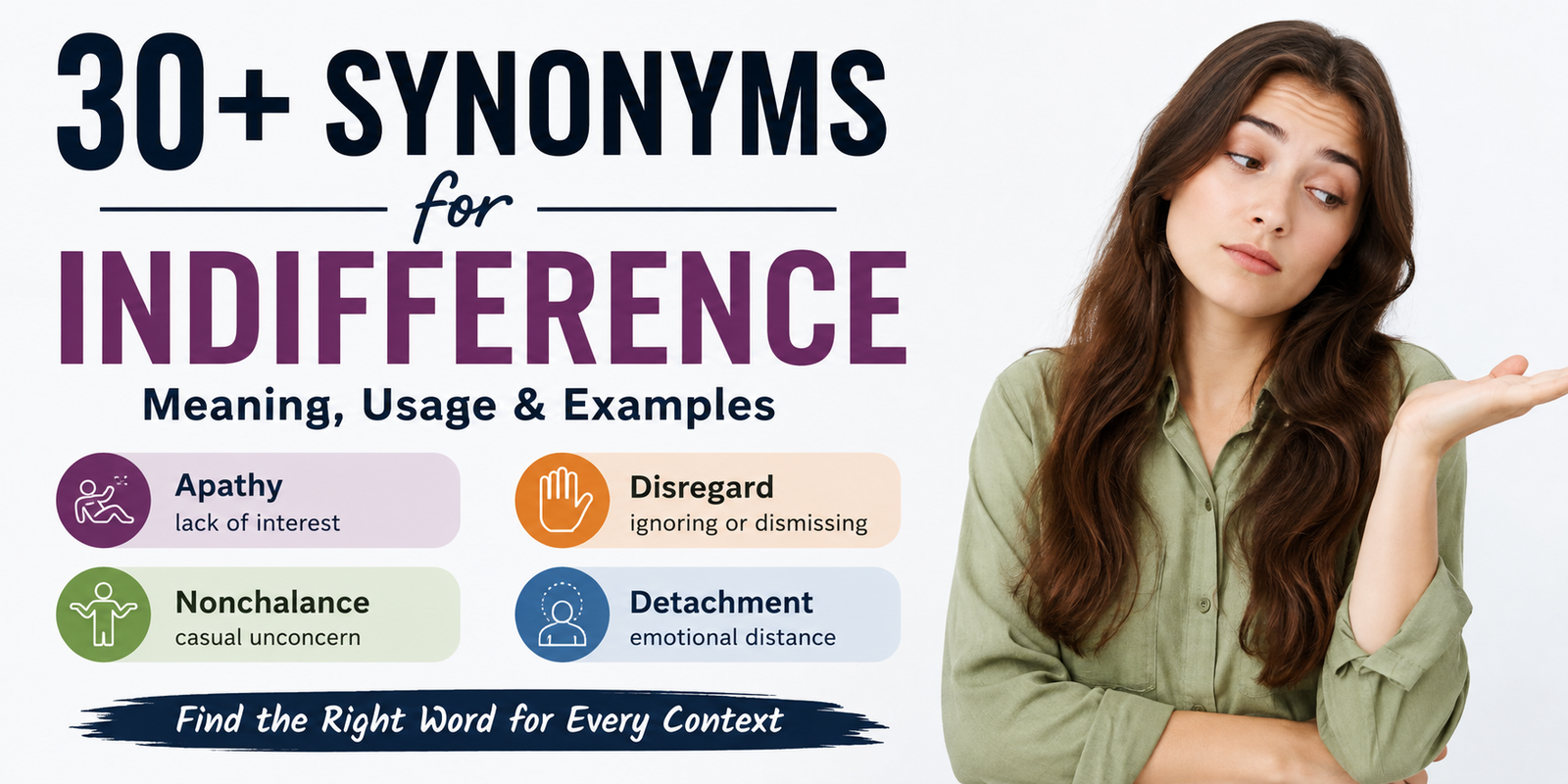
Finding a synonym for indifference is easy; finding the right synonym is harder. Words such as apathy, unconcern, disregard, nonchalance, detachment, aloofness, and dispassion overlap with indifference, but each emphasizes something slightly different. Some describe a lack of interest, while others suggest emotional distance, casual calmness, or a failure to give something proper attention.
This guide separates close synonyms from near-synonyms and related words so you can choose the most natural alternative for your sentence.
Quick Answer: What Are the Best Synonyms for Indifference?
The closest everyday synonyms for indifference include unconcern, apathy, disinterest, nonchalance, disregard, detachment, and dispassion. However, they are not interchangeable in every context.
- Unconcern — lack of worry or concern
- Apathy — lack of interest, enthusiasm, or emotional engagement
- Disinterest — lack of interest
- Nonchalance — a relaxed, casual lack of concern
- Disregard — failure or refusal to give something proper attention or consideration
- Detachment — emotional distance or separation
- Dispassion — absence of strong emotion, especially when calm objectivity is intended
The best choice depends on whether you mean not caring, not being interested, remaining emotionally detached, or failing to pay attention.
Core Synonyms for Indifference
| Word | Relationship | Main idea | Typical tone | Best context |
|---|---|---|---|---|
| Unconcern | Direct/very close | Lack of concern | Neutral | Problems, consequences, other people |
| Apathy | Near synonym | Lack of interest or enthusiasm | Usually negative | Causes, activities, social issues |
| Disinterest | Close synonym | Lack of interest | Neutral | Topics, activities, offers |
| Nonchalance | Contextual synonym | Casual lack of concern | Neutral to positive | Manner, attitude, behavior |
| Disregard | Contextual synonym | Failure to consider or heed | Often negative | Rules, warnings, consequences |
| Detachment | Near synonym | Emotional distance | Neutral | People, emotions, analysis |
| Dispassion | Near synonym | Lack of strong emotion | Often neutral/positive | Analysis, judgment, discussion |
| Aloofness | Near synonym | Social or emotional distance | Often negative | Personality, relationships |
| Impassivity | Near synonym | Lack of visible emotional reaction | Formal | Behavior, reactions |
| Coldness | Related/near synonym | Lack of warmth or sympathy | Negative | Relationships, treatment |
| Insensitivity | Related word | Failure to recognize or respond to feelings | Negative | Other people’s feelings |
| Callousness | Related word | Lack of sympathy toward suffering | Strongly negative | Harm, suffering, serious consequences |
These distinctions reflect the fact that reputable thesauruses group words by overlapping meanings rather than treating every word as a perfect replacement. Merriam-Webster, for example, lists disregard, unconcern, nonchalance, apathy, disinterestedness, detachment, and aloofness among words related to indifference.
What Does “Indifference” Mean?
Indifference is a noun meaning a lack of interest, feeling, concern, or reaction toward someone or something. Oxford gives the common construction indifference to somebody/something, while Cambridge similarly defines it as a lack of interest in someone or something.
For example:
The committee showed indifference to the complaints.
This means the committee did not show much interest or concern about the complaints.
Indifference can also have other dictionary senses. Oxford records a formal sense involving lack of importance and another sense referring to something being average or not very good. Those meanings are less common in ordinary vocabulary questions.
Pronunciation
US: /ɪnˈdɪf(ə)rəns/
UK: /ɪnˈdɪfərəns/
The Most Useful Alternatives to “Indifference”
1. Unconcern
Unconcern is one of the closest alternatives when indifference means a lack of worry or concern.
Example:
His unconcern about the approaching deadline surprised his manager.
Use unconcern when the important idea is “I am not worried about this.”
Compare:
She showed indifference to the criticism.
She showed unconcern about the criticism.
The second sentence more strongly suggests that the criticism did not worry her.
2. Apathy
Apathy refers to a lack of interest, enthusiasm, motivation, or emotional engagement.
Example:
Public apathy made it difficult to attract volunteers.
Apathy is often broader and more negative than simple indifference.
If someone says:
“I don’t particularly care which restaurant we choose.”
That can be indifference.
If someone consistently has little interest or enthusiasm for activities generally, apathy may be more appropriate.
Cambridge includes apathy among the words related to indifference, and Merriam-Webster likewise lists it as a synonym.
3. Disinterest
Disinterest means a lack of interest.
Example:
His disinterest in the subject was obvious.
This is a useful choice when the sentence is specifically about interest rather than concern or emotional distance.
Do not confuse disinterest with disinterestedness.
In modern everyday English, disinterest commonly means lack of interest. Disinterested can also mean impartial or unbiased, so context matters.
4. Nonchalance
Nonchalance describes a calm, casual attitude that suggests a person is not worried or concerned.
Example:
She accepted the unexpected criticism with remarkable nonchalance.
The key difference is manner.
Indifference:
He showed indifference to the criticism.
Nonchalance:
He responded to the criticism with nonchalance.
Nonchalance often suggests that the person appears relaxed rather than simply uninterested. Cambridge includes it among words related to indifference.
5. Disregard
Disregard means failing or choosing not to give something proper attention or consideration.
Example:
The company was criticized for its disregard of safety regulations.
This word is usually stronger and more active than indifference.
Someone can be indifferent because they simply do not care. Disregard can imply that they ignore, neglect, or fail to heed something.
That makes it especially useful for:
- rules
- warnings
- responsibilities
- consequences
- advice
- other people’s rights
6. Detachment
Detachment emphasizes emotional distance rather than simply a lack of interest.
Example:
The journalist discussed the controversy with professional detachment.
This can be neutral or even positive.
For example, a person can approach a difficult subject with emotional detachment to remain objective.
Therefore, detachment is not always a criticism in the way indifference can be.
7. Dispassion
Dispassion means an absence of strong emotion, particularly when evaluating or discussing something.
Example:
The issue should be examined with dispassion.
This is often a better word than indifference when the intended meaning is calm objectivity.
Compare:
The judge considered the evidence with dispassion.
This does not necessarily mean the judge did not care. It means the judge was not allowing strong emotion to influence the evaluation.
8. Aloofness
Aloofness describes emotional or social distance from other people.
Example:
His aloofness made it difficult for his colleagues to approach him.
Use it mainly for people, personalities, relationships, and social behavior.
It is not a universal replacement for indifference.
9. Impassivity
Impassivity refers to a lack of visible emotional reaction.
Example:
She listened to the announcement with complete impassivity.
The important distinction is that an impassive person may still care internally; they simply do not show much emotion.
Which Synonym Should You Use?
Choose “unconcern” when:
You mean lack of worry or concern.
His unconcern about the consequences was surprising.
Choose “apathy” when:
You mean lack of interest, enthusiasm, or motivation.
Voter apathy can affect participation.
Choose “disinterest” when:
You specifically mean lack of interest.
Her disinterest in the proposal was obvious.
Choose “nonchalance” when:
You mean casual calmness or a relaxed lack of concern.
He treated the mistake with nonchalance.
Choose “disregard” when:
You mean failure to pay attention to or respect something.
The decision showed disregard for the rules.
Choose “detachment” when:
You mean emotional distance.
She discussed the matter with detachment.
Choose “dispassion” when:
You mean calmness without strong emotion, especially in analysis.
The evidence should be assessed with dispassion.
Choose “aloofness” when:
You mean social or emotional distance from other people.
His aloofness made him seem unapproachable.
Indifference vs. Apathy
These words overlap considerably, but they are not always identical.
Indifference usually describes a person’s lack of concern, interest, or reaction toward a particular person or thing.
Apathy often suggests a broader lack of interest, enthusiasm, or motivation.
Compare:
I have no preference between the two options; I am indifferent.
versus:
The community’s apathy toward the issue made the campaign difficult.
The first describes neutrality toward a particular choice. The second suggests a broader lack of engagement.
Indifference vs. Unconcern
Unconcern is especially appropriate when the issue involves worry or consequences.
His indifference to the problem was frustrating.
His unconcern about the consequences was frustrating.
The second sentence more clearly emphasizes that he was not worried about what might happen.
Indifference vs. Nonchalance
Both can describe a person who appears not to care, but nonchalance emphasizes the person’s relaxed manner.
She showed indifference to the criticism.
This emphasizes lack of concern.
She accepted the criticism with nonchalance.
This emphasizes how calmly and casually she responded.
Indifference vs. Disregard
This is an important distinction.
Indifference = not caring or showing little concern.
Disregard = failing or refusing to consider something.
His indifference to the warning was concerning.
His disregard for the warning was concerning.
The second suggests that the warning was ignored or not properly heeded.
Merriam-Webster’s current thesaurus places disregard prominently among the synonyms of indifference, but contextual differences still matter when choosing between them.
Indifference vs. Detachment
Detachment emphasizes separation from emotion or involvement.
The researcher maintained professional detachment.
That does not necessarily mean the researcher did not care.
By contrast:
The manager showed indifference to the employees’ concerns.
This more directly suggests a lack of concern.
Words That Are Related but Not Exact Synonyms
Some words are close enough to appear in thesaurus results but should not automatically replace indifference.
Insensitivity
Insensitivity means a failure to recognize or respond appropriately to another person’s feelings.
His insensitive remark upset his colleague.
A person can be indifferent without being insensitive.
Callousness
Callousness suggests a particularly hard or unsympathetic attitude toward suffering.
Her callousness toward the victims shocked the audience.
It is much more strongly negative than neutral indifference.
Coldness
Coldness usually describes a lack of warmth, affection, friendliness, or sympathy.
His emotional coldness created distance in the relationship.
Carelessness
Carelessness means failing to give sufficient attention or take sufficient care.
The accident resulted from carelessness.
This is about lack of care in action, not necessarily lack of emotional interest.
Ambivalence
Ambivalence is not a direct synonym for indifference.
It acts as a bridge to show that a new idea, statement, or action matches the general direction or tone of a previous one.
She felt ambivalent about moving abroad.
That means she had both positive and negative feelings, not that she had no feelings.
This distinction is especially important because ambivalence is frequently confused with simple neutrality or indifference.
Common Mistakes When Choosing an Indifference Synonym
Mistake 1: Using “apathy” for every case of indifference
Apathy can suggest a deeper or broader lack of enthusiasm.
For simple neutrality between two choices, indifference is usually clearer.
Mistake 2: Using “disregard” when you only mean “not interested”
Disregard can imply that something was ignored or not given proper consideration.
Mistake 3: Calling “ambivalence” a synonym
Ambivalence means mixed or conflicting feelings, not an absence of interest.
Mistake 4: Using “coldness” when there is no emotional relationship
Coldness is particularly associated with a lack of warmth or sympathy.
Mistake 5: Assuming “detachment” is always negative
Detachment can be desirable in contexts where emotional distance helps someone remain objective.
Common Collocations With Indifference
Some natural phrases include:
- complete indifference
- total indifference
- supreme indifference
- an attitude of indifference
- an air of indifference
- show indifference
- display indifference
- feel indifference
- indifference to something
- indifference toward someone
- treat something with indifference
Oxford specifically records patterns such as indifference to, indifference towards/toward, an air of indifference, and an attitude of indifference.
Useful Context-Specific Alternatives
| Context | Natural alternative |
|---|---|
| Lack of concern | unconcern |
| Lack of enthusiasm | apathy |
| Lack of interest | disinterest |
| Casual lack of concern | nonchalance |
| Ignoring a rule or warning | disregard |
| Emotional distance | detachment |
| Calm objective judgment | dispassion |
| Social distance | aloofness |
| Lack of visible emotion | impassivity |
| Lack of sympathy | insensitivity or coldness |
| Harsh lack of sympathy | callousness |
Antonyms of Indifference
The opposite of indifference depends on the sense you mean.
For lack of interest or concern, useful opposites include:
- interest
- concern
- care
- attention
- involvement
- enthusiasm
- sympathy
- regard
- warmth
For emotional distance, closeness, affection, warmth, and connection may be better opposites.
Cambridge lists words such as concern, warmth, attention, interest, eagerness, and caring among antonyms of indifference.
FAQ
What is the closest synonym for indifference?
Unconcern is one of the closest general synonyms, while apathy, disinterest, and nonchalance are close alternatives in particular contexts. The best choice depends on whether you mean lack of concern, lack of interest, or a casual lack of worry.
What is a stronger word for indifference?
The answer depends on what kind of indifference you mean. Apathy can suggest a deeper lack of interest or enthusiasm, while callousness or disregard can express a more strongly negative attitude. Neither is a universal replacement for indifference.
Is apathy the same as indifference?
Not exactly. They overlap, but apathy often suggests a lack of interest, enthusiasm, or motivation, whereas indifference can simply mean that someone does not particularly care about or react to something.
Is disregard a synonym for indifference?
It can be, particularly when indifference means failing to give something attention or consideration. However, disregard is often more active and can imply ignoring or failing to heed something.
What is a formal synonym for indifference?
Depending on the context, dispassion, detachment, impassivity, or unconcern can work in formal writing. The correct choice depends on the intended meaning rather than formality alone.
What is a synonym for indifference toward a person?
Possible choices include aloofness, detachment, coldness, unconcern, or disinterest, depending on what you mean. Aloofness emphasizes social distance, while coldness emphasizes lack of warmth or sympathy.
What is the difference between indifference and ambivalence?
Indifference means lacking particular concern, interest, or preference. Ambivalence means having conflicting or mixed feelings. If you cannot decide because you genuinely have both positive and negative feelings, ambivalence is usually more accurate.
What is a professional word for indifference?
There is no single professional replacement that works everywhere. Dispassion works well when discussing objective analysis, detachment for emotional distance, and unconcern for lack of concern. Choose according to the intended meaning.
Conclusion
The best synonym for indifference depends on the exact shade of meaning you want.
If you mean lack of concern, choose unconcern. The right synonym for indifference depends on the specific shade of meaning. Apathy or disinterest works well for a lack of interest or enthusiasm, while nonchalance suggests a casually unconcerned attitude. When someone ignores or fails to heed something, disregard is more precise. For emotional distance, consider detachment or aloofness; when the emphasis is on calm, objective judgment, dispassion is usually the better choice.

David Wilson is a content strategist and SEO expert who focuses on creating structured vocabulary content. He combines keyword research with simple explanations to make learning English both effective and search-friendly.