Synonyms for Knife: Accurate Alternatives for Every Context
Finding a synonym for knife is not as simple as replacing it with any word associated with a sharp blade. Some alternatives, such as blade and cutter, can work in many contexts, while others describe a particular type of knife or a related cutting instrument.
Words such as dagger, cleaver, machete, scalpel, and stiletto should therefore be treated as specific types or contextual alternatives, not universal synonyms.
This guide separates the closest synonyms from related words and explains the differences so you can choose the most natural term for your sentence.
Quick Answer
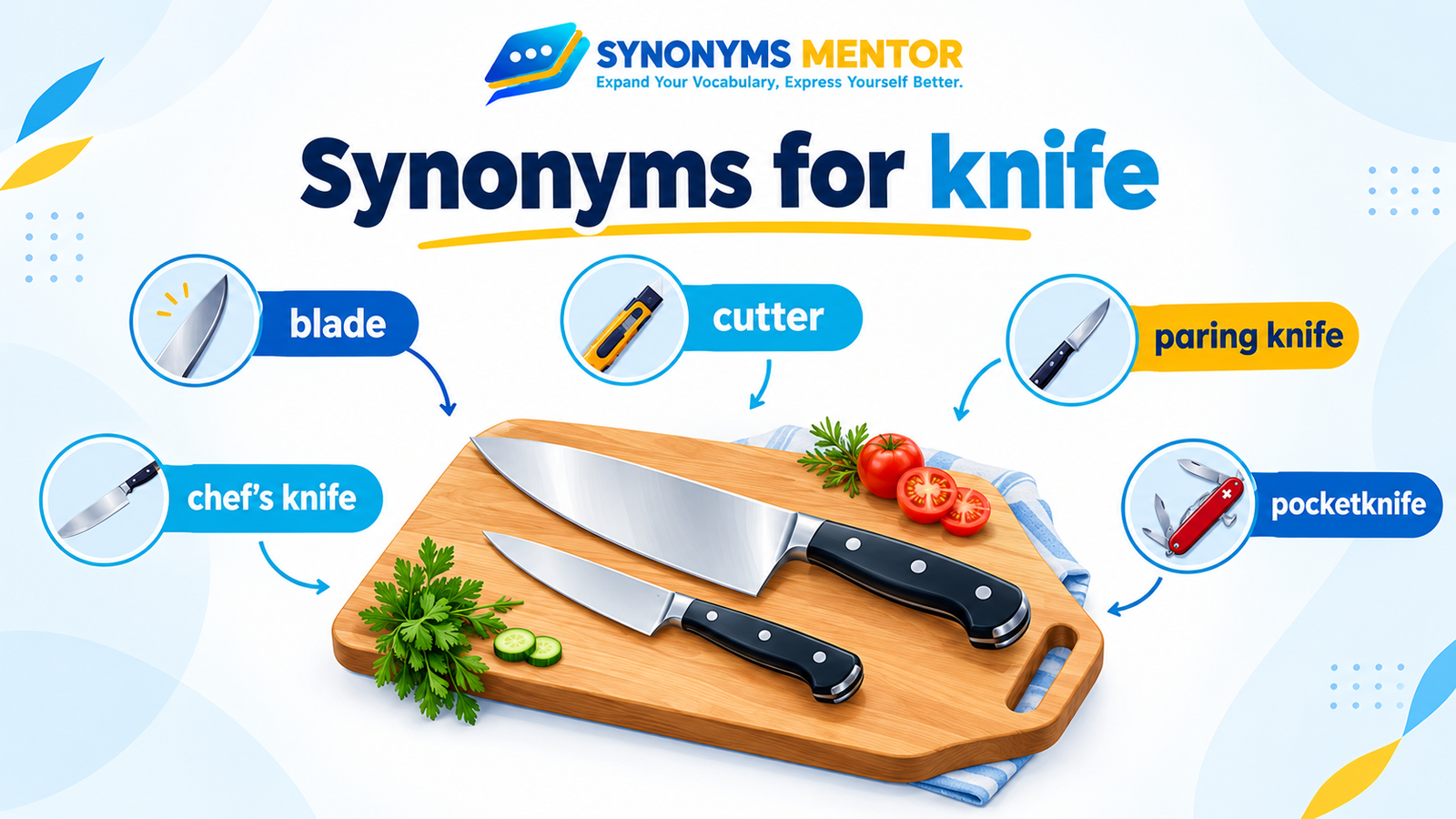
The closest synonyms for knife are blade, cutter, and cutting tool. Blade emphasizes the sharp cutting part, while cutter emphasizes an instrument used for cutting. Cutting tool is a broader, more functional expression.
Words such as dagger, cleaver, machete, and scalpel are better treated as specific types of knives rather than exact synonyms.
What Does “Knife” Mean?
Knife is primarily a countable noun referring to a tool or weapon consisting generally of a sharp blade and a handle. In everyday English, a knife can be used for cutting or spreading food and other substances; it can also refer to a weapon. Cambridge gives these ordinary senses and examples such as fish knife, butter knife, and steak knife.
The word also has a verb form. To knife someone means to attack them with a knife, while the verb can also mean to cut, mark, or spread something with a knife.
Part of speech: noun and verb
Plural: knives
Pronunciation: /naɪf/ in both UK and US English.
Examples
- She used a knife to slice the bread.
- Put the knife beside the plate.
- The chef reached for a clean knife.
- The word knife can also be used as a verb in contexts involving attacking or cutting.
The Closest Synonyms for Knife
| Word | Relationship | Strength | Formality | Best Context |
|---|---|---|---|---|
| Blade | Near/direct synonym | Equal or slightly broader | Neutral | Emphasizing the cutting part |
| Cutter | Direct/near synonym | Similar | Neutral | A tool designed for cutting |
| Cutting tool | Contextual alternative | Broader | Neutral/formal | Technical or functional descriptions |
| Carver | Contextual alternative | Specific | Neutral | A carving knife or carving implement |
| Cutlery | Related word | Broader | Neutral | Knives, forks, and spoons collectively |
| Dagger | Specific type | More specific | Neutral/literary | A short pointed weapon |
| Cleaver | Specific type | More specific | Neutral | A heavy knife for chopping |
| Machete | Specific type | More specific | Neutral | A large, broad-bladed cutting tool |
| Scalpel | Specific type | More specific | Technical | Surgical cutting instrument |
| Stiletto | Specific type | More specific | Literary/historical | A slender pointed weapon |
The first three are the most useful alternatives when you genuinely need a substitute for knife. The remaining terms depend heavily on context.
1. Blade
Blade is one of the closest alternatives to knife, but it is not always interchangeable.
Meaning: The sharp, flat cutting part of a knife or another tool.
How it differs: A knife normally refers to the complete implement, whereas a blade specifically emphasizes the cutting edge or metal component.
Example:
The knife has a sharp blade.
You could not normally replace blade with knife in that sentence without changing the meaning.
Best used when: You are discussing the cutting part, sharpness, design, or construction of an object.
2. Cutter
Cutter can refer to something designed or used for cutting.
How it differs: It is broader than knife. A cutter may be a knife-like instrument, a machine, or another cutting device.
Example:
The worker used a cutter to trim the material.
Merriam-Webster and Cambridge both identify cutter among the main words associated with knife.
Best used when: The function of cutting matters more than the specific shape of the instrument.
3. Cutting Tool
Cutting tool is a useful descriptive alternative, particularly in technical, manufacturing, educational, or professional writing.
How it differs: It is much broader than knife. A knife is one kind of cutting tool, but not every cutting tool is a knife.
Example:
The knife is a simple cutting tool used for food preparation.
Best used when: You want to describe the object according to its function rather than its specific identity.
4. Carver
Carver can refer to a knife designed for carving, especially in culinary contexts.
Example:
He picked up the carver to slice the roast.
It should not normally replace knife in every sentence because carver carries a specific contextual meaning. Collins includes carver among its British English alternatives for knife.
5. Cutlery
Cutlery is a broader term related to knife, referring collectively to eating utensils such as knives, forks, and spoons rather than a direct synonym for knife.
Example:
The restaurant provided clean cutlery.
Do not write:
She picked up a cutlery.
Instead:
She picked up a knife.
Classification: Related word, not a direct synonym.
Specific Types of Knives
Many thesaurus pages list words such as dagger, cleaver, machete, scalpel, stiletto, pocketknife, switchblade, and jackknife. These are useful vocabulary alternatives only when the context requires a particular type of knife.
Dagger
A dagger is a specific type of short, pointed weapon. It is therefore more specific than knife.
The historical figure carried a dagger.
Use dagger when the particular weapon is important.
Cleaver
A cleaver is a broad, heavy knife associated especially with chopping meat or other food.
The butcher used a cleaver to chop the meat.
It is not a general replacement for knife.
Machete
A machete is a large, broad-bladed cutting tool. It belongs in a category of specific implements rather than as an exact synonym for knife.
Scalpel
A scalpel is a specialized surgical cutting instrument.
The surgeon prepared a sterile scalpel.
Calling every knife a scalpel would obviously be inaccurate.
Stiletto
A stiletto can refer to a slender, pointed weapon. It has a much narrower meaning and often carries historical or literary associations.
Knife Synonyms by Context
Everyday English
For ordinary conversation, knife is usually the most natural word.
Please pass me the knife.
Replacing it with cutting tool would sound unnecessarily technical.
Technical or Functional Writing
Cutting tool can be appropriate when discussing tools according to their function.
The device functions as a precision cutting tool.
Describing the Sharp Part
Use blade when the cutting edge or metal component is the focus.
The blade needs to be cleaned carefully.
Food Preparation
Carver, cleaver, and other specialized terms may be appropriate when the particular type of knife matters.
The chef selected a carving knife for the roast.
Medical Context
Use scalpel rather than the general word knife when referring specifically to a surgical instrument.
Historical or Literary Context
Words such as dagger, stiletto, and dirk may be appropriate when describing particular weapons or historical settings. They should not be treated as interchangeable with knife in ordinary modern English.
Which Word Should I Use?
Use “knife” when:
You mean the ordinary tool or weapon.
She put the knife on the table.
Use “blade” when:
You specifically mean the sharp cutting part.
The blade was extremely sharp.
Use “cutter” when:
You want to emphasize an instrument’s cutting function.
The machine uses a rotary cutter.
Use “cutting tool” when:
You want a broad, functional or technical description.
A knife is a basic cutting tool.
Use “cleaver” when:
You mean a particular heavy chopping knife.
Use “scalpel” when:
You mean a specialized surgical instrument.
Use “dagger” when:
You mean a particular short, pointed weapon.
This distinction is important because a thesaurus may group words together based on semantic similarity, but that does not mean native speakers can substitute them freely.
Knife vs. Blade
| Word | What It Usually Refers To | Can It Replace “Knife”? |
| Knife | Complete cutting implement | Yes |
| Blade | Sharp cutting component | Sometimes, depending on context |
| Cutter | Cutting instrument/device | Sometimes |
| Cutting tool | Broad functional category | Sometimes |
Compare:
He bought a new knife.
This refers naturally to the complete object.
He bought a new blade.
This normally suggests that the blade itself is the relevant object or replacement component.
Therefore, blade is a close semantic alternative but not a perfect substitution.
Knife vs. Cutter
A knife is a specific type of cutting implement, whereas cutter is a broader functional term.
She used a knife to slice the apple.
She used a cutter to trim the material.
The second sentence does not necessarily mean that the instrument was a conventional knife.
Bottom line: Use knife when identity matters; use cutter when cutting function matters.
Knife vs. Dagger
These words overlap when knife is used to describe a weapon, but they are not equivalent.
A knife can be a kitchen tool, utility tool, or weapon.
A dagger specifically denotes a type of pointed weapon.
He carried a knife.
The character carried a dagger.
The second sentence provides much more specific information.
Common Mistakes
Mistake 1: Treating every related word as a synonym
Words such as dagger, machete, and scalpel are not universal substitutes for knife. They identify particular types or specialized forms.
Mistake 2: Using “cutlery” for one knife
Cutlery is generally a collective category.
Incorrect:
I need a cutlery.
Better:
I need a knife.
Mistake 3: Confusing the knife with its blade
A blade is generally the cutting part of a knife, not necessarily the entire implement.
Mistake 4: Using “cutter” when a specific knife is meant
Cutter can refer to many cutting devices. If the object is clearly a knife, knife is often more precise.
Mistake 5: Assuming thesaurus entries are interchangeable
Thesauruses often provide words that are semantically related rather than perfectly substitutable. Cambridge’s shorter list and broader thesaurus lists illustrate why context matters.
Knife as a Verb: Synonyms for “Knife”
The query synonyms for knife can also refer to the verb knife. In that sense, the appropriate alternatives are different.
| Verb | Main Nuance |
| Stab | Push a pointed object into someone or something |
| Slash | Cut with a sweeping or forceful movement |
| Pierce | Make a hole by passing through something |
| Jab | Make a quick, sharp thrust |
| Wound | Injure someone |
| Lacerate | Tear or cut flesh deeply or irregularly |
| Cut | General term for separating or damaging with a sharp edge |
These are contextual alternatives, not interchangeable in every sentence.
Pronunciation of Knife
Knife is pronounced:
- US: /naɪf/
- UK: /naɪf/
The pronunciation is identical in standard US and UK English. The initial k is silent.
The plural is knives, pronounced /naɪvz/.
one knife → two knives
Etymology of Knife
The noun knife has a very old Germanic history. Merriam-Webster traces it through Middle English knif to Old English cnīf, with a possible connection to Old Norse knīfr. The word’s ultimate origin is uncertain.
The verb knife developed much later. Merriam-Webster dates the verb to the 19th century, while the noun is considerably older.
Natural Collocations with Knife
Common phrases include:
- sharp knife
- kitchen knife
- butter knife
- steak knife
- bread knife
- carving knife
- pocket knife
- knife blade
- knife handle
- knife and fork
- cut with a knife
- use a knife
- sharpen a knife
The most natural synonym depends on the phrase.
For example:
knife blade is natural because blade identifies a component.
But:
cutter and fork
would not normally replace the familiar phrase knife and fork.
Cambridge specifically lists common combinations such as fish knife, butter knife, steak knife, and knife and fork.
Antonyms of Knife
There is no single standard antonym for knife because it is a concrete noun naming an object.
Depending on the intended contrast, you might discuss:
- blunt object
- non-cutting tool
- dull instrument
However, these are contextual opposites rather than dictionary antonyms.
For the verb knife, an opposite might depend on the sentence, such as heal, protect, or avoid harming, but none is a universal antonym.
FAQ
What is another word for knife?
The closest alternatives are blade, cutter, and cutting tool. However, each has a slightly different meaning, so the best choice depends on context.
What is the closest synonym for knife?
Blade and cutter are among the closest alternatives. Blade emphasizes the sharp cutting part, while cutter emphasizes the object’s cutting function.
Is “blade” a synonym for knife?
Blade is a close semantic alternative but is not always interchangeable with knife. A blade is normally the sharp cutting component, while a knife usually refers to the complete implement.
Is “dagger” another word for knife?
Only in a limited sense. A dagger is a specific type of pointed weapon, so it is better classified as a specific type of knife or knife-like weapon rather than a universal synonym.
Is “cutter” a synonym for knife?
Yes, cutter can function as a close or contextual alternative, particularly when the cutting function is the focus. It is broader than knife, however.
Is “cutlery” a synonym for knife?
No. Cutlery is a collective term for eating utensils, commonly including knives, forks, and spoons.
What are synonyms for knife as a verb?
Depending on meaning, alternatives include stab, slash, wound, cut, pierce, jab, and lacerate. These words express different types or results of cutting or attacking and should not be treated as exact equivalents.
What is the plural of knife?
The plural is knives, not knifes.
one knife → two knives
Conclusion
The best synonyms for knife are not simply a long list of blade-related words. Blade, cutter, and cutting tool are the most useful broad alternatives, while carver works in particular culinary contexts. Dagger, cleaver, machete, scalpel, and stiletto are more specific terms and should be used only when their particular meanings are intended.

David Wilson is a content strategist and SEO expert who focuses on creating structured vocabulary content. He combines keyword research with simple explanations to make learning English both effective and search-friendly.