Synonyms for Dictator: 15 Powerful Alternatives With Examples
Looking for synonyms for dictator can be more complicated than simply replacing the word with tyrant. Although several words describe people who exercise excessive or unchecked power, they do not all emphasize the same thing.
Tyrant highlights cruel or unjust rule, autocrat emphasizes concentrated personal authority, while despot strongly suggests oppressive or arbitrary power.
This distinction matters in political writing, essays, journalism, historical discussion, and general English. The best alternative depends on whether you want to emphasize absolute authority, cruelty, oppression, political ideology, or controlling behavior.
Below, the alternatives are organized by how closely they match dictator, with practical examples to help you choose the right word.
Quick Answer: What Are the Best Synonyms for Dictator?
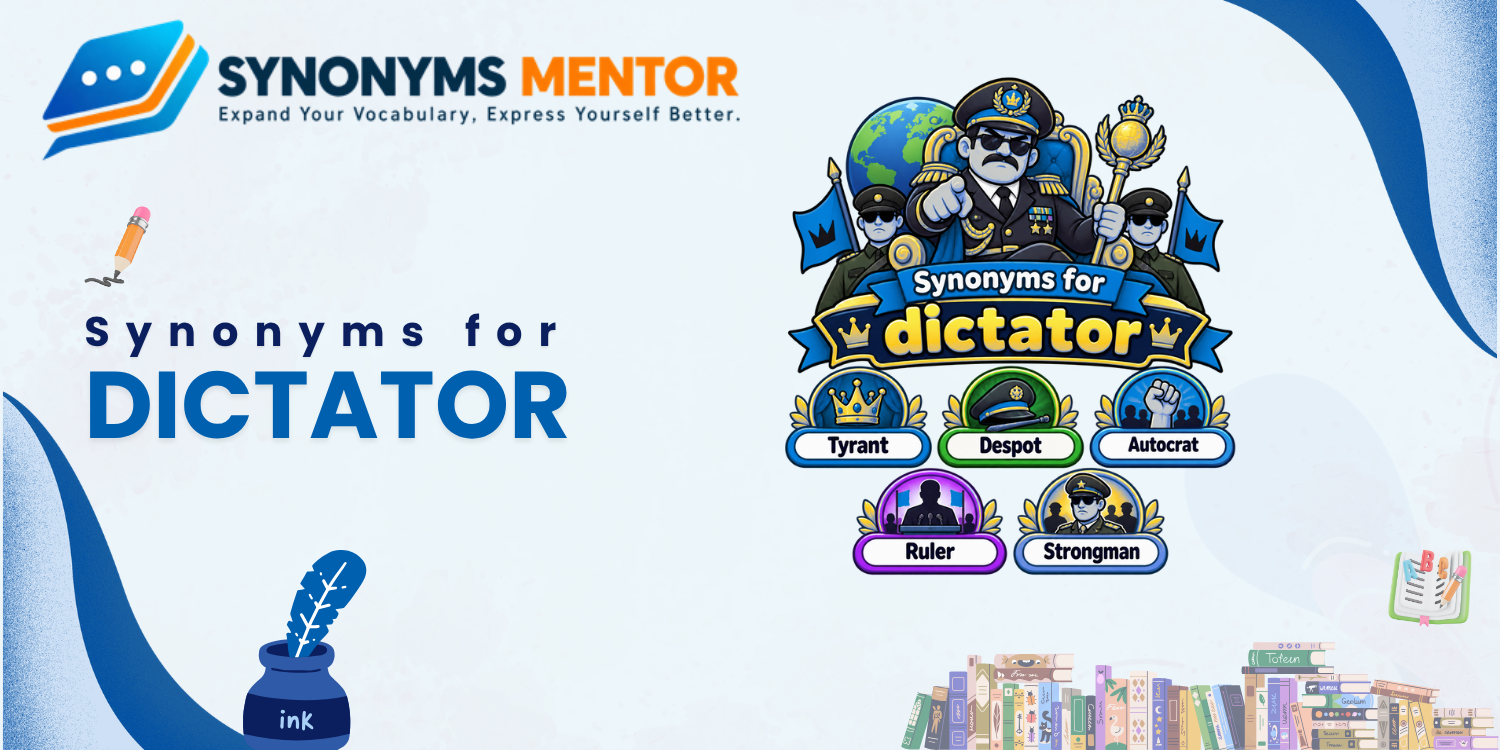
The closest synonyms for dictator include tyrant, despot, autocrat, and absolute ruler. These words overlap because they describe people who exercise unusually extensive or unchecked authority.
However, they are not identical: tyrant stresses cruel or unjust rule, despot suggests oppressive and arbitrary power, and autocrat focuses more specifically on concentrated personal authority.
The Best Synonyms for Dictator at a Glance
| Word | Relationship | Meaning | Strength | Formality | Best Context |
|---|---|---|---|---|---|
| Tyrant | Direct/near synonym | A ruler who uses power cruelly or unjustly | Strong | Neutral | Cruel or oppressive rule |
| Despot | Direct synonym | A person who exercises oppressive, often arbitrary power | Strong | Formal | Political and historical writing |
| Autocrat | Direct synonym | A ruler with concentrated or unlimited personal authority | Strong | Formal | Politics and government |
| Absolute ruler | Direct synonym | Someone with essentially unrestricted ruling power | Strong | Formal/neutral | Political or historical writing |
| Authoritarian | Near synonym | Someone or a system favoring strict control and limited political freedom | Strong | Formal | Politics and government |
| Oppressor | Contextual alternative | A person or group that subjects others to unjust control | Strong | Neutral/formal | Emphasis on victims |
| Totalitarian | Contextual alternative | Relating to a system seeking extensive control over public and private life | Very strong | Formal | Political systems |
| Strongman | Near synonym | A leader who exercises power through force or personal authority | Strong | Neutral | Political journalism |
| Warlord | Contextual alternative | A military leader who controls territory through armed power | Strong | Neutral/formal | Conflict and history |
| Monocrat | Rare near synonym | A person who holds sole governing authority | Strong | Formal/rare | Political or historical writing |
| Absolutist | Near synonym | A person who favors or exercises absolute authority | Strong | Formal | Political theory |
| Overlord | Contextual alternative | A dominant ruler or person exercising authority over others | Strong | Literary/historical | Historical or figurative writing |
| Iron-fisted ruler | Descriptive alternative | A ruler known for harsh, forceful control | Strong | Neutral | Descriptive writing |
| Tyrannizer | Rare synonym | Someone who rules or treats others tyrannically | Very strong | Formal/rare | Literary or specialized contexts |
| Control freak | Contextual alternative | Someone excessively concerned with controlling others | Moderate | Informal | Everyday or figurative use |
The core four—tyrant, despot, autocrat, and absolute ruler—are the safest choices when you need a close replacement for dictator. Cambridge’s thesaurus specifically lists absolute ruler, despot, autocrat, and tyrant as synonyms.
What Does “Dictator” Mean?
Dictator is a noun referring primarily to a political leader who possesses complete or nearly unlimited power, particularly when that power is not obtained through ordinary democratic election. Oxford also recognizes a broader use for someone who behaves as though they have complete power over other people.
In political contexts, the word is normally disapproving. It can describe a leader who exercises extensive personal control over a country and suppresses political opposition.
Example:
The dictator maintained tight control over the country’s political institutions.
The word can also be used figuratively:
My supervisor isn’t a dictator, but she insists on approving every small decision.
This second use is useful because dictator does not always refer literally to a national political leader.
1. Tyrant
Tyrant is one of the closest and most natural alternatives to dictator. It emphasizes cruel, oppressive, or unjust use of power rather than simply the fact that someone has concentrated authority.
Example:
The tyrant ruled through fear and intimidation.
Best when:
You want to emphasize cruelty or injustice.
Difference from dictator:
A dictator is defined primarily by concentrated political power, while a tyrant emphasizes the abusive way that power is exercised. Cambridge similarly defines a tyrant in terms of unlimited power used unfairly and cruelly.
2. Despot
Despot is a strong, formal synonym for a ruler who exercises oppressive and often arbitrary power.
Example:
The despot tolerated no criticism from his advisers.
It is especially effective in historical, political, and literary writing.
Best when:
You want a formal word that strongly conveys oppression and arbitrary authority.
Tone:
Strongly negative.
Collins lists despot among the principal synonyms of dictator and describes it in terms of someone in power who acts tyrannically.
3. Autocrat
Autocrat focuses on a person who exercises personal and concentrated authority.
Example:
The autocrat made major government decisions without consulting parliament.
Best when:
The important idea is one person’s control over government.
Difference from dictator:
Autocrat can describe someone who exercises absolute authority without necessarily putting cruelty at the center of the description. It can therefore be a useful choice when you want a more analytical or political tone.
4. Absolute Ruler
Absolute ruler is a straightforward descriptive alternative to dictator.
Example:
The country was governed by an absolute ruler for decades.
Best when:
You want a clear, relatively neutral description of unrestricted political authority.
This phrase is particularly useful in historical writing because it describes the concentration of power without automatically adding the same strongly negative emotional force as tyrant.
5. Authoritarian
Authoritarian is closely related to dictator, but it requires some care because it can describe a person, government, political system, or style of rule.
Example:
The authoritarian leader restricted political opposition.
Best when:
Writing about political systems, leadership styles, or restrictions on political freedom.
Important distinction:
Authoritarian is not always a direct noun-for-noun replacement for dictator. For example, you can naturally say “an authoritarian government,” whereas dictator is normally a person.
6. Oppressor
Oppressor emphasizes the people who suffer under someone’s power.
Example:
The rebels portrayed the ruler as an oppressor of the population.
Best when:
Your focus is on subjugation, injustice, or the treatment of other people.
Difference from dictator:
A dictator is defined by concentrated political authority; an oppressor is defined by unjust treatment or domination. Therefore, oppressor is best treated as a contextual alternative rather than a perfect synonym.
7. Totalitarian
Totalitarian is more specific than dictator. It generally describes a political system or ideology characterized by exceptionally extensive state control.
Example:
The country developed a totalitarian political system.
Best when:
Discussing political systems, governments, or ideologies rather than simply naming a particular ruler.
Important distinction:
Calling a person totalitarian can be possible in some contexts, but totalitarian is often more naturally used to describe a system, government, or ideology. It should therefore not be treated as a universal replacement for dictator.
8. Strongman
Strongman is a common political term for a leader who maintains power through personal authority, force, or a highly centralized leadership style.
Example:
The military strongman dominated the country’s political life.
Best when:
Writing about politics or journalism in a relatively contemporary style.
Tone:
Usually negative or critical, although it can sometimes be used more descriptively.
9. Warlord
Warlord is a contextual alternative rather than a general synonym.
A warlord is typically a military leader who controls territory or political power through armed force.
Example:
The warlord controlled several regions outside the government’s effective reach.
Best when:
The person’s authority is closely connected to military power, armed groups, or territorial control.
Calling every dictator a warlord would be inaccurate.
10. Monocrat
Monocrat is a rare and formal term for someone who holds sole governing authority.
Example:
The monocrat concentrated political power in his own office.
Best when:
You are writing in a formal or historical context and specifically want to emphasize one-person rule.
Because it is uncommon in everyday English, autocrat or dictator will usually sound more natural.
11. Absolutist
Absolutist can describe someone who supports or exercises absolute authority.
Example:
The absolutist ruler rejected any limitation on his powers.
Best when:
Discussing political ideas, systems of government, or attitudes toward authority.
Important distinction:
An absolutist may refer to someone who supports a political philosophy rather than necessarily being a dictator. Context determines whether the terms are interchangeable.
12. Overlord
Overlord is usually a historical or literary term for a dominant ruler or authority figure.
Example:
The regional overlord demanded loyalty from the surrounding territories.
Best when:
Writing about historical power structures, feudal settings, or literary contexts.
It is not normally the best modern substitute for dictator.
13. Iron-Fisted Ruler
Iron-fisted ruler is a descriptive phrase rather than a dictionary-style synonym.
Example:
The iron-fisted ruler crushed organized opposition.
It emphasizes harsh and uncompromising control.
Best when:
You want vivid descriptive language in journalism, essays, or narrative writing.
14. Tyrannizer
Tyrannizer refers to someone who treats others tyrannically.
Example:
The tyrannizer demanded complete obedience from his followers.
It is grammatically valid but considerably less common than tyrant.
Best when:
A rare or literary word is specifically appropriate.
For ordinary writing, tyrant is usually much more natural.
15. Control Freak
Control freak is an informal contextual alternative.
Example:
His colleagues called him a control freak because he wanted to approve every decision.
Best when:
You are describing someone who tries to control other people or situations, especially in everyday life.
Important distinction:
A control freak does not necessarily have political power and does not necessarily behave cruelly. It is therefore not a true synonym for a political dictator.
Which Word Should I Use?
The easiest way to choose is to identify the aspect of power you want to emphasize.
Choose “dictator” when:
You mean a political leader with extensive or effectively unlimited power.
The dictator dissolved the opposition party.
Choose “tyrant” when:
You want to emphasize cruel or unjust rule.
The tyrant ruled through fear.
Choose “despot” when:
You want a formal word emphasizing oppressive, arbitrary authority.
The despot refused to tolerate dissent.
Choose “autocrat” when:
You want to emphasize personal concentration of political power.
The autocrat controlled every major government decision.
Choose “absolute ruler” when:
You want a relatively straightforward description of unrestricted authority.
The absolute ruler controlled the state without meaningful institutional limits.
Choose “oppressor” when:
The emphasis is on the people being subjected to unjust power.
The population viewed the regime as an oppressor.
Choose “strongman” when:
You are describing a powerful political leader whose authority rests heavily on personal control or force.
The military strongman became the country’s dominant political figure.
Dictator vs. Tyrant vs. Despot vs. Autocrat
These four words overlap heavily, but their emphasis differs.
| Word | Main emphasis | Typical tone |
|---|---|---|
| Dictator | Complete or near-complete political power | Strongly negative |
| Tyrant | Cruel or unjust use of power | Very negative |
| Despot | Oppressive and arbitrary authority | Very negative |
| Autocrat | Concentrated personal authority | Negative to analytical |
A useful rule is:
Dictator = concentrated political power
Tyrant = cruel or unjust power
Despot = oppressive, arbitrary power
Autocrat = personal, concentrated authority
These distinctions are not absolute in every sentence. The terms overlap considerably, which is why major thesauruses list them together.
Dictator vs. Authoritarian
Dictator and authoritarian are closely related but grammatically and semantically different.
A dictator is normally a person:
The dictator controlled the government.
Authoritarian can describe a person, government, system, or style:
The government became increasingly authoritarian.
Use dictator when the individual ruler is the focus. Use authoritarian when the emphasis is on strict political control or limited freedom.
Dictator vs. Warlord
A dictator gains and maintains political authority through a system of concentrated rule, while a warlord is specifically associated with military power and territorial control.
The dictator controlled the national government.
The warlord controlled territory through armed forces.
A ruler can be described as both in the right context, but the terms are not interchangeable.
Common Mistakes When Choosing a Synonym for Dictator
1. Treating “authoritarian” as an exact noun replacement
You generally cannot replace the dictator with the authoritarian without changing the grammatical construction or meaning.
2. Calling every dictator a “warlord”
A warlord specifically suggests military or territorial power. It is too narrow for many dictators.
3. Using “control freak” for political writing
Control freak is informal and usually refers to everyday controlling behavior. It is much weaker and broader than dictator.
4. Assuming “tyrant” and “dictator” are identical
They overlap, but tyrant places greater emphasis on cruel or unjust behavior. Cambridge explicitly associates tyranny with unfair and cruel use of power.
5. Using “totalitarian” as a universal synonym
Totalitarian is especially useful for political systems and ideologies. It is more specific than dictator.
Related Words for Dictator
Some words are closely associated with dictator without being direct synonyms:
- dictatorial — describes behavior, powers, or systems associated with dictatorship
- dictatorship — the system or government ruled by a dictator
- authoritarianism — a political approach centered on concentrated authority
- tyranny — cruel or oppressive rule
- oppression — unjust or harsh exercise of power over others
- autocracy — government by a person with extensive or absolute authority
For example, dictatorial is an adjective, not a noun synonym for dictator. Oxford defines it as something connected with a dictator or behavior involving unreasonable control over others.
Antonyms of Dictator
The strongest opposites depend on what aspect of dictator you mean.
For political rule, useful contrasting concepts include:
- democratic leader
- elected representative
- constitutional ruler
- democrat
- liberal leader
These are not all strict dictionary antonyms, but they represent systems or styles of leadership that contrast with concentrated, unchecked personal rule.
Pronunciation of Dictator
US: /ˈdɪk.teɪ.t̬ɚ/
UK: /dɪkˈteɪ.tə(r)/
The pronunciation is documented by Cambridge and Oxford.
Etymology of Dictator
The modern word dictator ultimately comes from Latin dictator, related to dictare, meaning “to dictate.” The historical development is interesting because the word originally referred to a specific political office in ancient Rome before its modern meaning became associated with concentrated and often oppressive rule.
FAQ About Synonyms for Dictator
What is the closest synonym for dictator?
The closest common synonyms are tyrant, despot, autocrat, and absolute ruler. The best choice depends on the intended emphasis. Tyrant stresses cruelty, despot emphasizes oppressive authority, and autocrat focuses on concentrated personal power. Cambridge’s thesaurus specifically lists these four as synonyms for dictator.
What is a stronger word than dictator?
Tyrant or despot can sound stronger when you want to emphasize cruelty and oppression. Neither is automatically “stronger” in every context, however. The difference is primarily one of meaning and connotation, not a fixed scale of intensity.
Is “tyrant” a synonym for dictator?
Yes. Tyrant is a genuine near-synonym and is frequently used for a ruler who exercises power cruelly or unjustly. It can also be used figuratively for someone who behaves in a tyrannical way.
Is “autocrat” the same as “dictator”?
They overlap substantially. An autocrat is someone who exercises concentrated personal authority, while dictator usually refers specifically to someone with extensive or unlimited political power. In many political contexts, either word may work, but autocrat puts greater emphasis on the concentration of authority.
What is a formal synonym for dictator?
Autocrat, despot, and absolute ruler are useful formal alternatives. Despot has a particularly strong negative connotation, whereas autocrat can sound more analytical in political writing.
What is a synonym for a cruel dictator?
Tyrant is usually the most natural choice because it directly emphasizes cruel or unjust use of power. Despot is another strong option, particularly in formal or historical writing.
Can “authoritarian” replace “dictator”?
Not always. Authoritarian describes a person, government, system, or approach characterized by strict control and limited political freedom. Dictator specifically identifies a person who exercises extensive political authority. The words overlap but should not be treated as interchangeable in every sentence.
Conclusion
The best synonyms for dictator are tyrant, despot, autocrat, and absolute ruler, but each emphasizes a slightly different aspect of concentrated power. Choose tyrant for cruel or unjust rule, despot for oppressive and arbitrary authority, autocrat for concentrated personal power, and absolute ruler for a straightforward description of unrestricted authority.

Sophia Martinez is an ESL educator who specializes in teaching vocabulary and word meanings. She writes beginner-friendly content that helps learners understand synonyms and improve their English fluency step by step.