Synonyms of Nazi: Meaning, Alternatives, and Historical Context
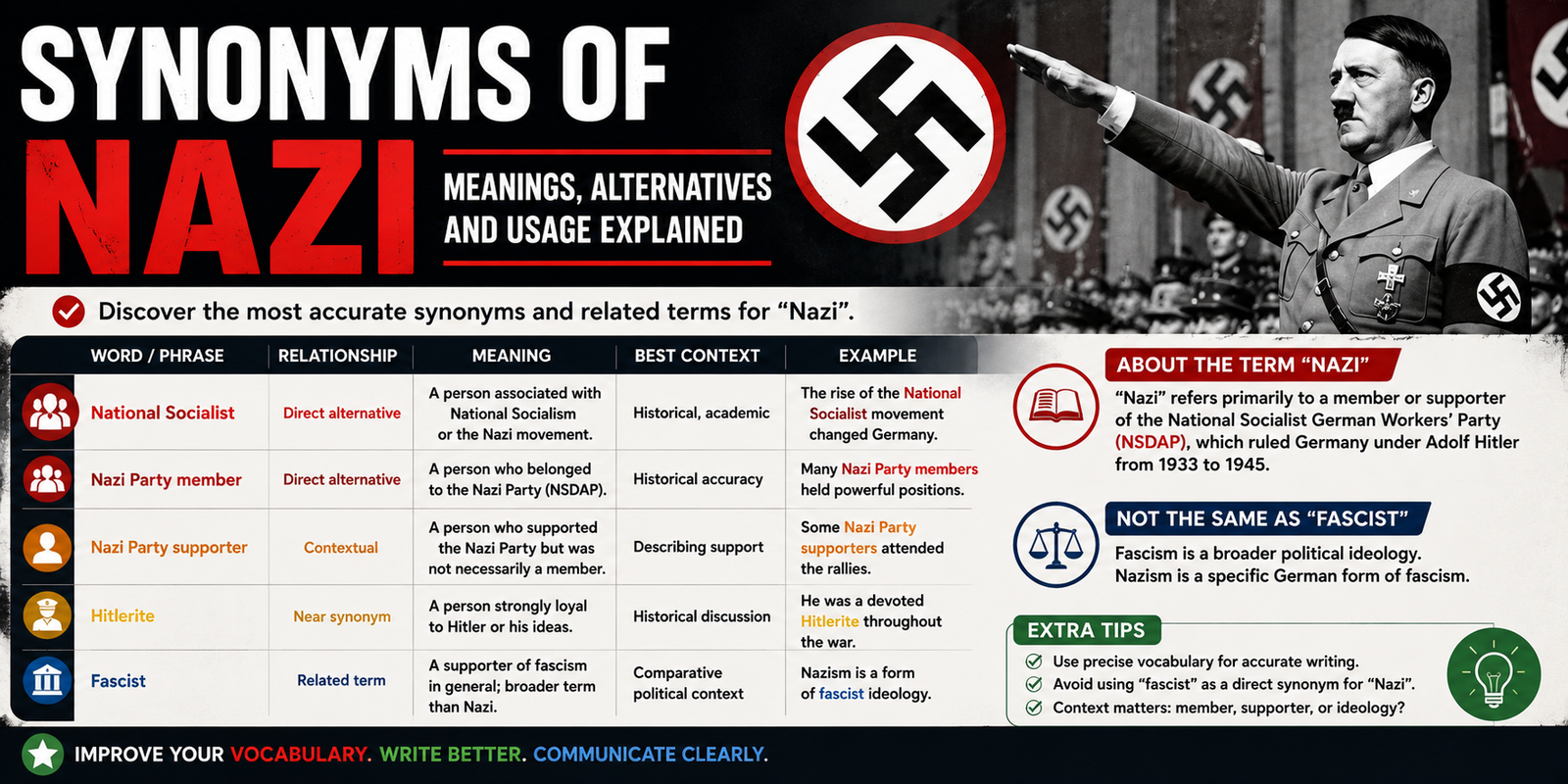
Finding synonyms for “Nazi” requires more care than simply copying words from a thesaurus. The term has a specific historical and political meaning: it refers primarily to a member or supporter of the Nazi Party, formally known as the National Socialist German Workers’ Party (NSDAP), which ruled Germany under Adolf Hitler from 1933 to 1945.
Therefore, words such as “National Socialist,” “Nazi Party member,” and, in certain historical contexts, “Hitlerite” can function as alternatives. However, broader terms such as “fascist” are related rather than exact synonyms. Choosing the right word depends on whether you are describing a person, political party, ideology, government, or historical period.
Quick Answer
The closest alternatives to “Nazi” include National Socialist, Nazi Party member, and member of the Nazi Party. Hitlerite can work in certain historical contexts, while fascist is a broader political term and should not automatically be treated as an exact synonym. The best choice depends on what you are describing.
Core Synonym Resource
| Word or phrase | Relationship | Meaning | Best context |
|---|---|---|---|
| National Socialist | Direct historical alternative | A person associated with National Socialism or the Nazi movement | Historical writing |
| Nazi Party member | Direct contextual alternative | A person who belonged to the Nazi Party | Historical accuracy |
| Nazi Party supporter | Contextual alternative | Someone who supported the Nazi Party | Describing political support |
| Hitlerite | Near synonym | A person strongly associated with Hitler or his political ideas | Historical discussion |
| National Socialist Party member | Formal descriptive alternative | A member of the NSDAP | Formal historical writing |
| Fascist | Related term, not exact | A supporter of fascism generally | Comparative political discussion |
| National Socialist | Ideological term | Someone associated with Nazi ideology | Discussion of ideology |
The distinction matters because the Nazi Party was specifically the National Socialist German Workers’ Party, while fascism is a broader political ideology that also existed outside Nazi Germany.
What Does “Nazi” Mean?
Nazi is the common English short form associated with the National Socialist German Workers’ Party (NSDAP) and its members. The Nazi Party emerged in post-World War I Germany and became a major political force under Hitler. In 1933, Hitler became Chancellor, and the Nazi leadership subsequently transformed Germany into a one-party dictatorship.
The term can function as both a noun and an adjective:
- Noun: “A Nazi Party member.”
- Adjective: “Nazi Germany.”
- Adjective: “Nazi ideology.”
Because the word is historically specific, replacing it with a broad political label can sometimes make a sentence less precise.
1. National Socialist
National Socialist is one of the closest formal historical alternatives to Nazi.
The Nazi Party’s official name was the National Socialist German Workers’ Party. Despite the word “Socialist” in its name, Nazi ideology was fundamentally opposed to Marxist socialism and communism and was characterized by racism, antisemitism, ultranationalism, and authoritarianism.
Example:
The National Socialist movement gained political influence in Germany during the early 1930s.
Best for: historical and academic writing.
2. Nazi Party Member
Nazi Party member is often more precise than simply using “Nazi” when the sentence specifically concerns membership in the organization.
Example:
The historian examined the political activities of former Nazi Party members.
This phrase is especially useful when you want to make clear that you are referring to membership in the party, rather than merely discussing an ideology.
3. Nazi Party Supporter
Nazi Party supporter is a contextual alternative rather than a perfect synonym.
A party member and a supporter are not necessarily the same thing. Someone could support a political organization without formally belonging to it.
Example:
Some Nazi Party supporters participated in the movement’s political campaigns.
This distinction improves historical precision.
4. Hitlerite
Hitlerite is a historical term associated with people who supported or followed Hitler and his political ideas.
However, it should not automatically replace Nazi. The two terms overlap but emphasize different things.
Nazi → association with Nazi ideology or the Nazi Party.
Hitlerite → association with Hitler personally or with his leadership and political doctrine.
Example:
The writer used the term “Hitlerite” to emphasize the individual’s loyalty to Hitler.
Use it selectively rather than as a generic substitute.
5. Fascist
Fascist is one of the most commonly confused alternatives.
It is not an exact synonym for Nazi.
Fascism is a broader political ideology. Nazi Germany developed a form of fascist politics, but the word fascist can describe movements and regimes outside Nazi Germany as well. The U.S. Holocaust Memorial Museum explains that fascist movements appeared in several European countries, while Nazi Germany represented the German form of fascism.
So:
Nazi = historically specific
Fascist = broader political category
This distinction is important in academic and historical writing.
Which Word Should I Use?
Choose “Nazi” when:
You are referring specifically to the Nazi movement, its members, ideology, government, or associated institutions.
Choose “National Socialist” when:
You want a formal historical or ideological term connected with the NSDAP.
Choose “Nazi Party member” when:
You specifically mean someone who belonged to the Nazi Party.
Choose “Nazi Party supporter” when:
You mean someone who supported the party but do not want to imply formal membership.
Choose “Hitlerite” when:
The emphasis is specifically on loyalty to Hitler or his political ideas.
Choose “fascist” when:
You are discussing the broader political ideology rather than specifically identifying a Nazi.
Nazi vs. Fascist
| Feature | Nazi | Fascist |
|---|---|---|
| Scope | Specific historical movement | Broader political category |
| Main association | Nazi Germany and NSDAP | Fascist movements generally |
| Historical figure most associated | Adolf Hitler | Various leaders, including Hitler and Mussolini |
| Exact synonym? | — | No |
| Best use | Specific historical reference | Comparative or broader political discussion |
The Nazi Party was a radical far-right movement with racist, antisemitic, nationalist, and anti-democratic ideology. Fascism, meanwhile, describes a broader family of authoritarian political movements.
Contextual Alternatives for Common Phrases
Sometimes the best alternative depends on the phrase rather than the individual word.
“Nazi Germany”
Possible alternatives:
- Nazi-controlled Germany
- Germany under Nazi rule
- the Nazi regime
- the German dictatorship under Hitler
These are not interchangeable in every sentence, but they can provide greater precision.
“Nazi Party”
Possible alternatives:
- National Socialist German Workers’ Party
- NSDAP
- National Socialist Party
- Nazi movement
The first two are especially useful in formal historical writing.
“Nazi ideology”
Possible alternatives:
- National Socialist ideology
- Nazi political ideology
- National Socialism
Again, the appropriate choice depends on sentence structure.
Common Mistakes
1. Treating “fascist” as an exact synonym
This is the biggest vocabulary mistake. Fascist is broader than Nazi, so replacing one with the other can remove important historical specificity.
2. Calling every supporter a party member
A supporter and a formal party member are different categories. Use Nazi Party member only when membership is established.
3. Treating “National Socialist” as modern democratic socialism
In the historical context of the Nazi Party, National Socialism refers to the specific ideology of the Nazi movement. The name should not be interpreted simply from the modern meaning of the individual words “national” and “socialist.”
4. Using “Hitlerite” everywhere
Although related to Nazism, Hitlerite emphasizes allegiance to Hitler and is therefore more context-specific.
5. Using vague alternatives
Terms such as “extremist” or “dictator supporter” may describe characteristics of a person or movement, but they are not synonyms for Nazi.
Antonyms and Contrasting Terms
There is no single perfect antonym for Nazi because the word identifies a historical political affiliation.
Depending on context, useful contrasting terms may include:
- anti-Nazi
- Nazi opponent
- resistance member
- political opponent
- democratic opponent
These terms describe opposition to Nazi rule rather than forming a simple dictionary opposite.
Pronunciation
Nazi
- US: /ˈnɑːtsi/
- UK: /ˈnɑːtsi/
The pronunciation is generally similar in American and British English.
FAQ
What is another word for Nazi?
The closest historical alternatives are National Socialist and Nazi Party member. However, the best choice depends on context. Hitlerite can describe someone associated particularly with Hitler, while fascist is broader and should not automatically be treated as a direct synonym.
Is “National Socialist” the same as “Nazi”?
In historical discussions of the Nazi movement, National Socialist refers to the ideology or organization associated with the Nazi Party. The Nazi Party’s official name was the National Socialist German Workers’ Party (NSDAP).
Is “fascist” a synonym for Nazi?
Not exactly. Fascist is a broader term for someone associated with fascism. Nazism was a particular German form of fascist politics, but not every fascist was a Nazi.
What is the formal name of the Nazi Party?
Its formal name was the National Socialist German Workers’ Party, abbreviated NSDAP. It became Germany’s only legal political party after the Nazi leadership established its dictatorship.
What does “Hitlerite” mean?
Hitlerite is a historical term for someone associated with or supportive of Hitler and his political ideas. It overlaps with “Nazi” but is more specifically focused on Hitler and his leadership.
Can “Nazi Party member” replace “Nazi”?
Often, yes. In sentences referring specifically to membership, Nazi Party member can be more explicit and precise than the shorter word Nazi.
What is the difference between Nazi and Nazi Party?
Nazi can describe a person, ideology, or adjective relating to the movement. Nazi Party specifically refers to the political organization—the National Socialist German Workers’ Party.
Conclusion
The best synonym for “Nazi” depends on what you are trying to describe. National Socialist is the closest formal historical alternative, while Nazi Party member is more precise when discussing membership. Hitlerite is a narrower historical term, and fascist is a broader related concept rather than an exact synonym.

David Wilson is a content strategist and SEO expert who focuses on creating structured vocabulary content. He combines keyword research with simple explanations to make learning English both effective and search-friendly.