Synonyms of Impetus: Better Alternatives With Means & Examples
Finding synonyms of impetus is not simply a matter of replacing one word with another. Impetus can refer to something that encourages an action, gives energy to a process, or drives something forward. The best alternative therefore depends on the context.
For example, motivation is often appropriate when the focus is on a reason or desire to act, while stimulus emphasizes something that produces a response. Spur suggests something that encourages action, whereas momentum is more closely associated with continuing progress.
Understanding these differences helps you choose a word that preserves the original meaning rather than merely sounding similar.
Quick Answer: What Are the Best Synonyms of Impetus?
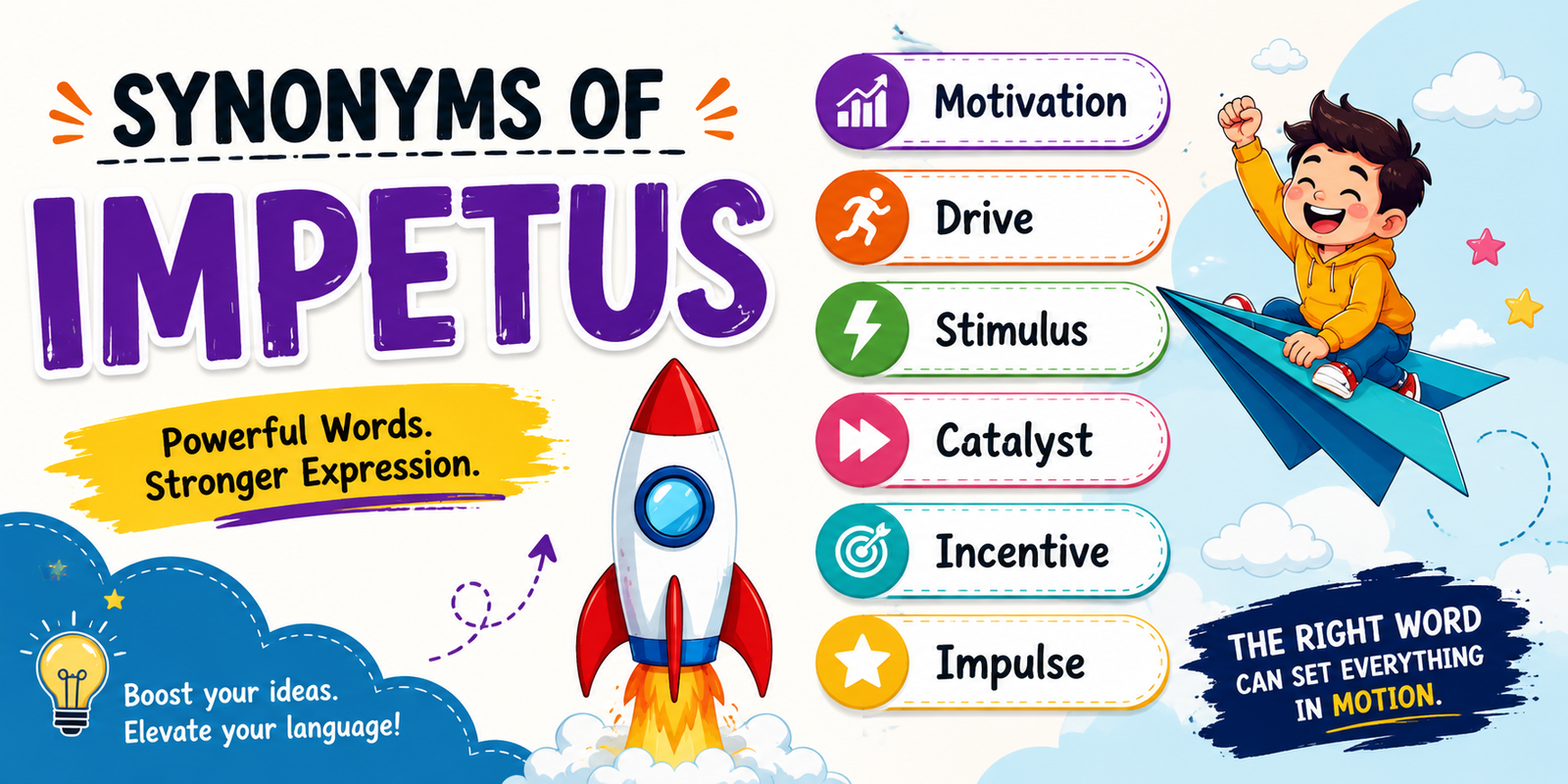
The closest synonyms of impetus include motivation, incentive, stimulus, spur, drive, push, encouragement, and force. The best choice depends on context.
Use motivation for a reason or desire to act, incentive for something that encourages action through a benefit or reward, stimulus for something that prompts a response, and spur or push for something that encourages progress. Momentum is related but usually emphasizes continuing movement rather than the original force that starts it.
Core Synonyms of Impetus
| Word | Relationship | Meaning | Strength | Formality | Best Context |
|---|---|---|---|---|---|
| Motivation | Near synonym | A reason or desire that encourages action | Similar | Neutral | Goals, behavior, work |
| Incentive | Near synonym | Something that encourages action, often through a benefit | Similar | Neutral/Formal | Business, policy, rewards |
| Stimulus | Direct/near synonym | Something that causes or encourages activity or response | Similar | Formal | Economics, research, change |
| Spur | Direct synonym in many contexts | Something that encourages faster or stronger action | Strong | Neutral | Progress, action, achievement |
| Drive | Near synonym | Strong energy or determination that pushes activity forward | Strong | Neutral | People, organizations, ambition |
| Push | Contextual alternative | An effort or force encouraging movement or progress | Similar | Informal/Neutral | Projects, campaigns, change |
| Encouragement | Contextual alternative | Support or approval that makes action more likely | Weaker | Neutral | People, learning, behavior |
| Force | Near synonym | Power that produces movement or change | Variable | Neutral/Formal | Physical or figurative contexts |
| Catalyst | Contextual alternative | Something that causes or accelerates change | Strong | Neutral/Formal | Change, development |
| Impulse | Near synonym | A force or influence that prompts action | Variable | Neutral | Decisions, behavior, ideas |
Not every word above can replace impetus in every sentence. The distinctions are important.
What Does “Impetus” Mean?
Impetus is a noun meaning a force, influence, or stimulus that encourages something to happen or develop more quickly. Cambridge defines it as something that encourages an activity or makes it more energetic or effective. Collins similarly describes it as a moving force, impulse, or stimulus.
Example
The new funding gave impetus to the research project.
Here, impetus means something that encouraged or accelerated the project.
The word is especially common in formal, academic, business, political, and professional writing.
Common expressions include:
- fresh impetus
- new impetus
- renewed impetus
- added impetus
- provide impetus
- give impetus to something
Collins specifically lists combinations such as fresh impetus, initial impetus, major impetus, new impetus, and renewed impetus.
The Most Useful Synonyms of Impetus
1. Motivation
Motivation is one of the closest alternatives when impetus refers to the reason or desire that encourages someone to act.
Best for: people, goals, work, learning, behavior, and personal decisions.
Example:
Her desire to improve was the main motivation behind the project.
Impetus vs motivation
Impetus often describes something that sets a process moving or gives it additional energy. Motivation more directly concerns the reason or desire for action.
The grant provided the impetus for the project.
His ambition provided the motivation to complete it.
2. Incentive
Incentive refers to something that encourages someone to take action, especially when there is a benefit, reward, or advantage involved.
Best for: business, employment, economics, government policy, and consumer behavior.
Example:
The company offered bonuses as an incentive for employees to improve performance.
Important distinction: An incentive usually gives someone a reason to act because of an expected benefit. Impetus is broader and does not require a reward.
3. Stimulus
Stimulus is a strong alternative when something causes activity, development, or a response.
Best for: economics, science, education, research, and social change.
Example:
The policy provided a stimulus for economic growth.
Why it differs: Stimulus emphasizes something that produces or encourages a response, whereas impetus emphasizes the driving force behind progress or action.
4. Spur
Spur is an especially natural substitute when something encourages a person, group, or process to act more quickly or energetically.
Best for: action, progress, improvement, achievement, and change.
Example:
The criticism was a spur to improve the quality of the service.
Tone: Neutral and slightly vivid.
Compared with impetus, spur often has a stronger sense of prompting someone into action.
5. Drive
Drive refers to strong energy, determination, or force directed toward achieving something.
Best for: ambition, business, personal achievement, organizations, and progress.
Example:
Her determination provided the drive behind the campaign.
Difference: Drive can describe an internal quality or continuing energy, while impetus often refers to an external or identifiable factor that gives something momentum.
6. Push
Push is a more informal alternative to impetus when talking about efforts to encourage progress or change.
Best for: projects, campaigns, business, technology, and informal communication.
Example:
The announcement gave the project a much-needed push.
In formal writing, impetus, stimulus, or catalyst may sound more appropriate depending on the intended meaning.
7. Encouragement
Encouragement means support, approval, or positive influence that makes someone more willing to continue or act.
Best for: people, education, personal development, teamwork, and learning.
Example:
Her teacher’s encouragement gave her the confidence to continue.
Difference: Encouragement usually involves support or reassurance, while impetus can refer to a broader force that drives a process forward.
8. Force
Force can substitute for impetus when the emphasis is on power or influence that produces movement or change.
Best for: physical movement, social forces, political change, and figurative influence.
Example:
Public opinion became a powerful force for reform.
However, force is much broader than impetus, so it should not be treated as interchangeable in every context.
9. Catalyst
Catalyst is a useful contextual alternative when something causes or accelerates a significant change.
Best for: transformation, reform, innovation, development, and major events.
Example:
The discovery became a catalyst for further research.
Impetus vs catalyst
Both words can describe something that encourages change, but catalyst emphasizes an event, person, or factor that causes or accelerates a transformation. Impetus has a broader meaning and can simply mean a driving force.
10. Impulse
Impulse overlaps with impetus because both can refer to a force that prompts action. However, impulse also commonly means a sudden desire or inclination to do something.
Example:
An impulse to explore new ideas led to the project.
Use impulse carefully when you mean a sustained driving force, because readers may interpret it as a sudden urge.
Which Synonym of Impetus Should You Use?
The best replacement depends on what you mean.
Choose motivation when:
You mean a reason or desire that makes someone want to act.
Financial independence was her motivation.
Choose incentive when:
A benefit or reward encourages action.
The discount was an incentive to buy the product.
Choose stimulus when:
Something triggers or encourages a response or activity.
The investment provided a stimulus for growth.
Choose spur when:
Something prompts faster or stronger action.
The setback became a spur to improve.
Choose drive when:
You mean sustained energy, ambition, or determination.
Innovation is a major drive behind the company.
Choose catalyst when:
Something triggers or accelerates major change.
The discovery was a catalyst for reform.
Choose push when:
You want an informal word for an effort that advances something.
The campaign needs another push.
Impetus vs Motivation
These words overlap but are not identical.
| Impetus | Motivation |
|---|---|
| A driving force that encourages progress or action | A reason or desire for acting |
| Often describes an event, factor, or influence | Often describes a person’s internal reason |
| Common in formal writing | Common across everyday and professional English |
| “The grant gave impetus to research.” | “Curiosity was her motivation.” |
Simple rule: If you are emphasizing what moved something forward, impetus is often appropriate. If you are emphasizing why someone wanted to act, motivation is usually better.
Impetus vs Incentive
An incentive is specifically something that encourages action, often by offering an advantage or reward.
The tax reduction was an incentive for investment.
An impetus does not need to involve a reward.
The economic crisis provided an impetus for reform.
Therefore, incentive is narrower than impetus in many contexts.
Impetus vs Momentum
These words are frequently confused.
Impetus is the force or influence that encourages something to start or progress.
Momentum usually refers to the strength or progress that continues once something is already moving.
The new funding gave the project impetus.
Once the project succeeded, it gained momentum.
This distinction is particularly useful in business, politics, research, and discussions of social change.
Impetus vs Impulse
Although the words look and sound related, they are not interchangeable in every context.
Impetus usually refers to a driving force behind activity or progress.
Impulse can mean a sudden desire to act, as well as a force or stimulus in other contexts.
The funding provided the impetus for expansion.
He bought the item on impulse.
Using impulse when you mean a sustained source of progress can change the meaning of the sentence.
Common Collocations With “Impetus”
Some natural combinations are:
- fresh impetus
- new impetus
- renewed impetus
- added impetus
- major impetus
- provide impetus
- give impetus to
- provide the impetus for
- impetus for change
- impetus for growth
- impetus to reform
- impetus to action
Examples
The announcement gave fresh impetus to the campaign.
The investment provided the impetus for growth.
The discovery gave new impetus to scientific research.
These patterns are useful because impetus is particularly common in formal phrases involving change, growth, development, reform, research, and progress.
Common Mistakes With Synonyms of Impetus
Mistake 1: Treating every related word as an exact synonym
Words such as momentum, initiative, and motivation overlap with impetus but have distinct meanings.
Mistake 2: Using “incentive” without a benefit or reason to act
An incentive generally gives someone a reason to take action, often through an expected advantage.
Mistake 3: Using “momentum” for the initial driving force
Momentum is usually about continuing movement or progress, whereas impetus can describe the force that gets a process moving.
Mistake 4: Using “impulse” when you mean sustained motivation
Impulse can suggest a sudden urge, so it may not communicate the broader idea of a continuing driving force.
Mistake 5: Using “catalyst” for every type of impetus
A catalyst strongly suggests that something triggers or accelerates change. It is not a universal replacement for impetus.
Antonyms of Impetus
There is no single perfect antonym for every sense of impetus, but depending on context, useful opposites may include:
- inhibition
- discouragement
- deterrent
- obstacle
- hindrance
- restraint
- resistance
For example:
The funding provided an impetus for development.
The opposite idea might be:
A lack of funding became a hindrance to development.
Pronunciation of “Impetus”
US: /ˈɪmpət̬əs/
UK: /ˈɪmpɪtəs/
Impetus is pronounced roughly like IM-puh-tuhs in American English.
It is a noun.
FAQ About Synonyms of Impetus
What is the closest synonym for impetus?
There is no single synonym that works in every context. Stimulus, spur, motivation, incentive, drive, and push can all overlap with impetus. Stimulus and spur are especially useful when the meaning involves something that encourages activity or progress.
What is another word for impetus in a sentence?
Depending on the sentence, alternatives include motivation, stimulus, incentive, spur, drive, push, and catalyst. For example, “The funding gave impetus to the project” could become “The funding gave a boost to the project,” although boost is generally less formal.
Is motivation a synonym for impetus?
Sometimes. Motivation focuses more strongly on the reason or desire that encourages someone to act. Impetus can refer to a broader force that starts, encourages, or accelerates a process.
Is momentum the same as impetus?
No. Impetus is commonly the force or influence that encourages action or progress, while momentum usually describes continuing strength or progress after something has begun moving.
Is incentive a synonym for impetus?
In some contexts, yes, but they are not identical. An incentive is something that encourages action, often through an expected benefit. Impetus is broader and does not require a reward or advantage.
What is a formal synonym for impetus?
Depending on context, stimulus, driving force, catalyst, or incentive can work in formal writing. The correct choice depends on the precise relationship between the factor and the action it produces.
What is the difference between impetus and impulse?
Impetus generally refers to a driving force behind action or progress. Impulse can refer to a sudden urge to act, although it also has broader meanings involving force and motion.
Conclusion
The best synonyms of impetus depend on the specific meaning you want to express. Motivation works well for reasons or desires to act, incentive for benefits that encourage action, stimulus for something that produces a response, and spur for something that prompts stronger or faster action.
Drive emphasizes energy or determination, while catalyst highlights a trigger for change. Momentum is related but usually describes continuing progress rather than the force that initiates it.

Sophia Martinez is an ESL educator who specializes in teaching vocabulary and word meanings. She writes beginner-friendly content that helps learners understand synonyms and improve their English fluency step by step.