Synonyms for Bullshit: 20 Better Alternatives With Examples
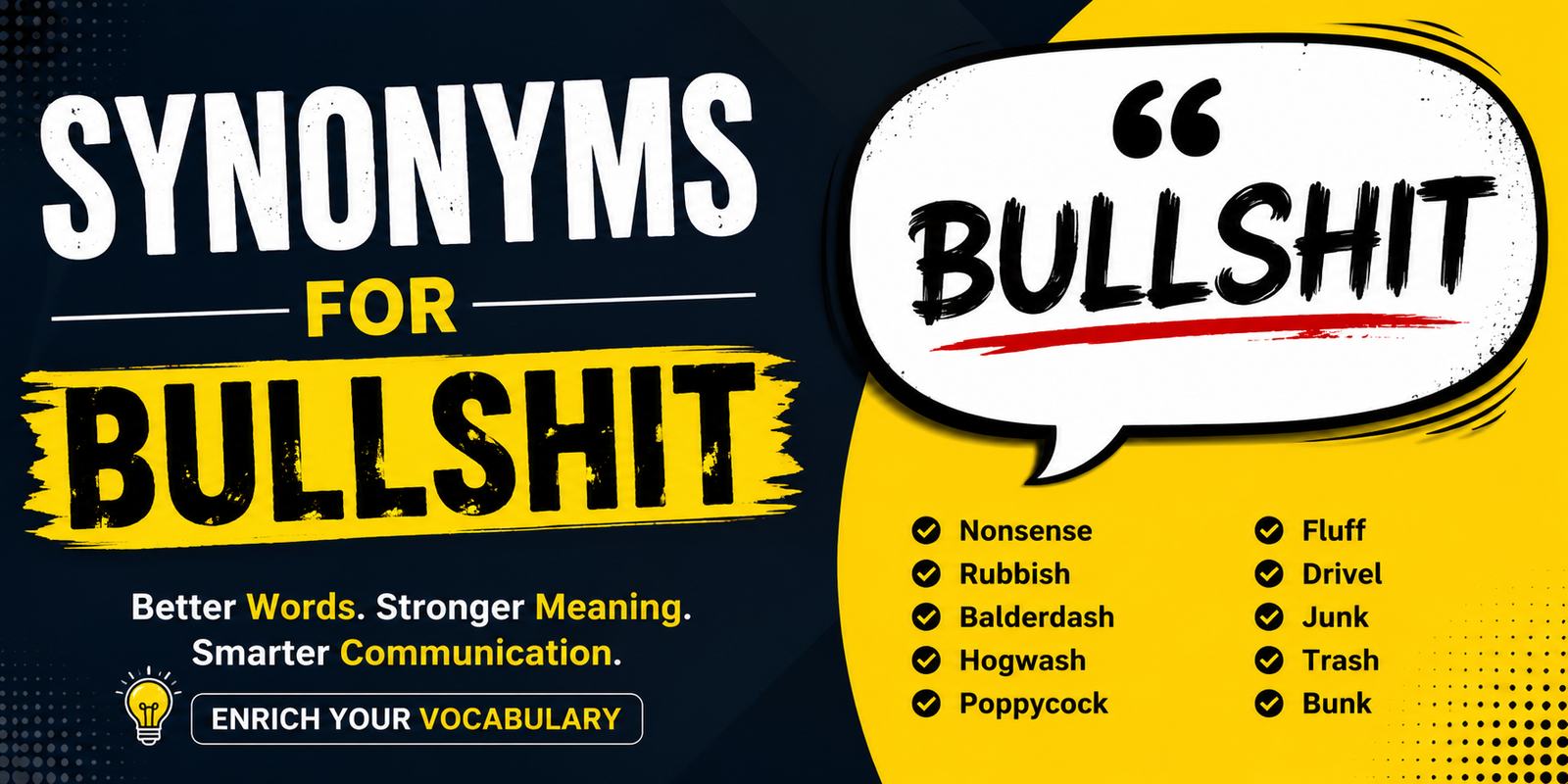
If you need a synonym for bullshit, the best choice depends on what you actually mean. Nonsense is the safest general alternative, while baloney and bunk can describe foolish or deceptive claims.
Hot air fits empty promises or boastful talk, drivel works for boring or worthless speech, and humbug emphasizes dishonest or deceptive talk. More colorful choices such as hogwash, balderdash, poppycock, and codswallop can sound humorous or old-fashioned.
The important point is that these words are not perfect substitutes in every situation.
Quick Answer: What Are the Best Synonyms for Bullshit?
The closest alternatives to bullshit include nonsense, baloney, bunk, rubbish, crap, hogwash, and horseshit. For more specific meanings, use hot air for empty or insincere promises, drivel for worthless or boring talk, humbug for deceptive talk, and disregard neither as a synonym nor as a replacement—because it means something different.
For professional or polite writing, nonsense, false claims, unsupported claims, misleading statements, or inaccurate information are usually better choices.
Core Synonyms for Bullshit
| Word | Relationship | Main Meaning | Tone | Best Context |
|---|---|---|---|---|
| Nonsense | Direct synonym | Something foolish, meaningless, or untrue | Neutral | General use |
| Baloney | Direct/near synonym | Foolish or deceptive talk | Informal | American English |
| Bunk | Direct/near synonym | Nonsense or false claims | Informal | Claims, arguments |
| Bunkum | Direct/near synonym | Insincere or meaningless talk | Informal | Speech, arguments |
| Rubbish | Contextual synonym | Nonsense or worthless ideas | Informal | Especially British English |
| Crap | Near synonym | Nonsense or worthless stuff | Informal/vulgar | Casual speech |
| Horseshit | Very close synonym | Bullshit or nonsense | Vulgar | Strong informal speech |
| Hot air | Contextual synonym | Empty or insincere talk | Informal | Promises, boasting |
| Drivel | Contextual synonym | Boring, foolish, worthless talk | Disapproving | Speech or writing |
| Guff | Contextual synonym | Empty or trivial talk | Informal | Conversation |
| Hogwash | Near synonym | Complete nonsense | Informal/playful | Rejecting a claim |
| Humbug | Contextual synonym | Dishonest or deceptive talk | Formal-ish/old-fashioned | Deception, politics |
| Malarkey | Near synonym | Insincere or foolish talk | Informal | Claims, arguments |
| Balderdash | Near synonym | Nonsense | Playful/old-fashioned | Humorous disagreement |
| Poppycock | Near synonym | Nonsense | Playful/old-fashioned | Humorous disagreement |
| Claptrap | Contextual synonym | Silly talk that should not be believed | Informal | Claims, speeches |
| Codswallop | Near synonym | Nonsense | British informal | Humorous criticism |
| Eyewash | Contextual synonym | Nonsense or something untrue | Old-fashioned | Deceptive claims |
| Double-talk | Related/contextual | Deliberately confusing language | Neutral/negative | Evasive communication |
| Weasel words | Related/contextual | Evasive or ambiguous wording | Negative | Public/professional communication |
What Does “Bullshit” Mean?
Bullshit is an informal, impolite noun and verb. As a noun, it commonly means nonsense, foolish talk, exaggerated claims, or statements that are untrue. As a verb, to bullshit can mean to talk nonsense, boast, exaggerate, or try to mislead someone.
The word is therefore unusually versatile. It can describe the content of a statement, the way someone talks, or the act of deliberately producing misleading or exaggerated talk.
For example:
That explanation is bullshit.
Here, the speaker is rejecting the explanation as nonsense, false, or unconvincing.
He’s bullshitting me.
Here, the speaker believes the person is saying things that are false, exaggerated, or misleading.
Because bullshit is considered rude or vulgar, the appropriate alternative depends heavily on the audience and situation.
1. Nonsense
Nonsense is the safest general-purpose synonym.
It can describe something that makes no sense, is foolish, or is not true.
That claim is complete nonsense.
Unlike bullshit, nonsense is suitable for many situations where profanity would be inappropriate.
Best choice when: you want a clear, widely understood alternative without the vulgar tone.
2. Baloney
Baloney means foolish or deceptive talk and can also be used to reject a claim.
That’s a load of baloney.
It is informal but considerably less vulgar than bullshit. Merriam-Webster defines the relevant sense as pretentious nonsense and notes that it can be used as a generalized expression of disagreement.
Best choice when: you want an informal but relatively mild alternative.
3. Bunk
Bunk is a concise informal word for nonsense or false claims.
The whole argument is bunk.
It works particularly well when someone is dismissing an argument, theory, or claim.
Best choice when: you want something short and direct.
4. Bunkum
Bunkum is closely related to bunk and refers to insincere or meaningless talk.
The politician’s promises were dismissed as bunkum.
It sounds more old-fashioned than bunk.
Best choice when: you want a traditional term for empty or insincere talk.
5. Rubbish
Rubbish can mean nonsense, especially in British English.
That’s absolute rubbish.
It is common and natural in British usage but can sound less characteristic of American English.
Best choice when: writing for a British audience or using British-style vocabulary.
6. Crap
Crap can function as a milder substitute for bullshit, particularly in casual speech.
Don’t give me that crap.
However, crap is still informal and somewhat vulgar, so it is not an appropriate choice for formal professional writing.
Best choice when: you want a casual, blunt alternative without using bullshit itself.
7. Horseshit
Horseshit is extremely close to bullshit in meaning and tone.
That’s a load of horseshit.
It is vulgar and strongly informal, so it should generally remain in casual dialogue or deliberately blunt writing.
Best choice when: you want nearly the same force and register as bullshit.
8. Hot Air
Hot air is especially useful for empty promises, boasting, or insincere statements that have little practical value.
His promises were nothing but hot air.
The phrase does not necessarily mean that every statement is literally false. The emphasis is on words without substance or practical results.
Best choice when: someone talks confidently but offers little meaningful substance.
9. Drivel
Drivel refers to foolish, boring, unnecessary, or worthless information.
I stopped reading the article because it was full of drivel.
It can describe both speech and writing.
Best choice when: the problem is that the material is tedious, worthless rather than necessarily deceptive.
Cambridge specifically defines drivel as nonsense or boring and unnecessary information.
10. Guff
Guff is informal and refers to empty, trivial, or meaningless talk.
I don’t want to listen to any more of his guff.
It is useful for describing someone who talks at length without saying anything worthwhile.
Best choice when: you want an informal word for empty talk.
11. Hogwash
Hogwash means nonsense and is often used to dismiss something strongly.
That’s a load of hogwash.
It is less vulgar than bullshit but has a playful or old-fashioned flavor.
Merriam-Webster directly defines the relevant sense of hogwash as nonsense or balderdash.
Best choice when: you want a humorous alternative to nonsense.
12. Humbug
Humbug is more specific than nonsense. It refers to dishonest talk, writing, or behavior intended to deceive people.
The politician’s speech was dismissed as political humbug.
That makes it especially useful when deception or insincerity matters.
Best choice when: the speaker is not merely talking nonsense but is presenting insincere or deceptive claims.
13. Malarkey
Malarkey means insincere or foolish talk.
Don’t believe all that malarkey.
It is informal and has a slightly playful flavor. Merriam-Webster explicitly gives insincere or foolish talk as its meaning.
Best choice when: you want a colorful alternative to nonsense or bullshit without profanity.
14. Balderdash
Balderdash means nonsense and is usually playful or old-fashioned.
That’s absolute balderdash.
It is understandable to modern English speakers but is much less blunt than bullshit.
Best choice when: you want a humorous, theatrical, or deliberately old-fashioned tone.
15. Poppycock
Poppycock is another playful and old-fashioned word for nonsense.
What a load of poppycock.
It works particularly well when you want to sound humorous rather than aggressive.
Best choice when: the goal is colorful vocabulary rather than modern slang.
16. Claptrap
Claptrap refers to silly talk that means little and should not be believed.
The advertisement was full of empty promises and claptrap.
This word is particularly useful for speeches, arguments, advertising, and persuasive claims.
Best choice when: someone is using impressive-sounding language without meaningful substance.
17. Codswallop
Codswallop is a British informal word meaning nonsense.
That’s a load of codswallop.
It has a distinctly British and humorous flavor, so it would not normally be the first choice in neutral American English.
Best choice when: you want a British or deliberately colorful alternative.
18. Eyewash
Eyewash can mean nonsense or something that is not true, although Cambridge labels this sense old-fashioned informal.
The company’s explanation was nothing but eyewash.
It is therefore a useful word to recognize, but it is not one of the most natural modern replacements for bullshit.
Best choice when: you are discussing deceptive or superficial claims and want an older term.
19. Double-Talk
Double-talk should not be treated as a perfect synonym for bullshit.
It describes language that is deliberately confusing, evasive, or difficult to interpret.
The statement was full of political double-talk.
Someone using double-talk may avoid making a clear statement rather than simply saying nonsense.
Best choice when: the problem is deliberately confusing or evasive language.
20. Weasel Words
Weasel words are another related expression rather than a direct synonym.
They are vague, evasive, or carefully chosen words that avoid making a clear commitment.
The advertisement relies on weasel words instead of making a specific promise.
Best choice when: someone is deliberately using vague language to avoid accountability.
Which Word Should You Use Instead of “Bullshit”?
The fastest way to choose is to identify what kind of bullshit you mean.
| If you mean… | Better choice |
|---|---|
| General nonsense | nonsense |
| Foolish or deceptive claims | baloney |
| False or worthless arguments | bunk |
| British-style nonsense | rubbish |
| Casual vulgar nonsense | crap |
| Equally strong vulgar slang | horseshit |
| Empty promises or boasting | hot air |
| Boring or worthless talk | drivel |
| Empty trivial talk | guff |
| Strong but playful dismissal | hogwash |
| Dishonest or deceptive talk | humbug |
| Insincere or foolish talk | malarkey |
| Humorous nonsense | balderdash |
| Deliberately old-fashioned nonsense | poppycock |
| Meaningless persuasive talk | claptrap |
| British informal nonsense | codswallop |
| Evasive or confusing language | double-talk |
| Vague, evasive wording | weasel words |
Bullshit vs. Nonsense
Nonsense is the closest broadly acceptable substitute for bullshit.
The major difference is register. Bullshit is vulgar and blunt, whereas nonsense is neutral enough for formal or educational contexts.
Compare:
That’s bullshit.
That’s nonsense.
The second sentence communicates the basic idea without the profanity.
Choose nonsense when: you want the meaning without the offensive tone.
Bullshit vs. Baloney
Both can describe foolish or deceptive talk.
Bullshit is much stronger and more vulgar. Baloney is informal but comparatively mild.
That’s bullshit.
That’s baloney.
The second sounds less aggressive and can even sound humorous.
Bullshit vs. Hot Air
These words overlap, but hot air specifically emphasizes empty talk, boasting, or promises without substance.
His business proposal is bullshit.
This broadly rejects the proposal.
His business proposal is hot air.
This suggests that the proposal contains impressive-sounding claims without practical substance.
Bullshit vs. Humbug
Humbug is more strongly associated with dishonesty, deception, or insincerity.
The sales pitch was bullshit.
This broadly rejects the pitch.
The sales pitch was humbug.
This emphasizes its deceptive or insincere character.
Bullshit vs. Drivel
Drivel focuses on the quality of the speech or writing: it is boring, foolish, unnecessary, or worthless.
I don’t have time for this bullshit.
I don’t have time to read this drivel.
The second sentence specifically criticizes the material itself.
Formal and Professional Alternatives to “Bullshit”
If you are writing an email, report, academic assignment, business document, or professional complaint, bullshit is usually too informal and vulgar.
Choose a replacement according to the problem:
The meaning of “bullshit” is false information:
- false information
- false claims
- inaccurate information
- untrue statements
Instead of “bullshit” meaning unsupported claims:
- unsupported claims
- unsubstantiated assertions
- unverified claims
- unsupported statements
When “Bullshit” Means Deceptive or Misleading Talk
- misleading statements
- deceptive claims
- misrepresentation
Instead of “bullshit” meaning empty corporate language:
- empty rhetoric
- vague language
- meaningless jargon
- evasive language
For example:
Informal:
The report is full of bullshit.
Professional:
The report contains several unsupported claims and misleading statements.
The professional version is more precise because it identifies what is actually wrong.
Words That Are Related but Are Not Exact Synonyms
Some words frequently appear alongside bullshit but should not automatically replace it.
Lies
A lie is deliberately false information. Not all bullshit is a deliberate lie.
Misinformation
Misinformation is false or inaccurate information, regardless of whether the speaker intended to deceive. That makes it broader and more neutral.
Fabrication
A fabrication is something invented or made up, especially a false story or claim.
Propaganda
Propaganda involves information or ideas presented to influence people’s opinions or behavior. It can contain truthful information, falsehoods, or selective presentation.
Jargon
Specialized language is associated with a particular profession or group. It is not automatically meaningless or deceptive.
Gobbledygook
Gobbledygook refers to language that is difficult to understand because it is overly complicated, unclear, or filled with technical wording.
These terms may describe specific forms of what someone casually calls bullshit, but they are not interchangeable in every sentence.
Common Mistakes
Calling every synonym an exact replacement
Words such as hot air, drivel, and humbug highlight different aspects of the original idea. Substituting them mechanically can change the meaning.
Using old-fashioned words in modern professional writing
Poppycock, balderdash, and codswallop are legitimate vocabulary, but their playful or old-fashioned tone may sound strange in a serious report.
Using “lies” when exaggeration is the real problem
Someone can exaggerate, boast, or speak without substance without making a deliberately false statement.
Using “jargon” to mean nonsense
Technical vocabulary is not automatically meaningless. The issue may be poor communication rather than false information.
Using “bullshit” in formal writing
The word is dictionary-recognized, but it remains informal and impolite. A more precise neutral term will usually be better in academic or professional contexts.
FAQ
What is the closest synonym for bullshit?
Nonsense is the closest general-purpose synonym. Depending on context, baloney, bunk, bunkum, rubbish, and hogwash can also work. If the emphasis is on empty promises, hot air is more precise.
What is a polite word for bullshit?
Nonsense is usually the best polite alternative. In professional writing, more precise choices include unsupported claims, misleading statements, false information, or unsubstantiated assertions, depending on what you mean.
What is a formal synonym for bullshit?
There is no single formal equivalent because bullshit covers several meanings. Nonsense, false claims, misleading statements, unsupported assertions, and empty rhetoric are useful formal alternatives in different contexts.
Is baloney the same as bullshit?
They overlap, especially when describing foolish or deceptive talk. However, baloney is milder and less vulgar. It can be a good choice when you want to reject a claim without using profanity.
Is hot air a synonym for bullshit?
Sometimes. Hot air specifically describes talk that lacks substance, sincerity, or practical results. It is especially appropriate for boastful claims and empty promises.
What is a British synonym for bullshit?
Rubbish is a common British alternative. Codswallop is another British informal term for nonsense, although it has a more humorous and distinctive flavor.
What is a professional way to say “that’s bullshit”?
The most accurate professional replacement depends on the problem. You might say “That claim is unsupported,” “That statement is inaccurate,” “That information is misleading,” or “The argument lacks sufficient evidence.”
What is the difference between bullshit and nonsense?
Nonsense is the broader and more neutral word. Bullshit is more vulgar and can additionally suggest exaggeration, insincerity, deception, or deliberate misleading. As a result, nonsense is usually safer when you want to criticize an idea without using profanity.
Conclusion
The best synonym for bullshit depends on the exact problem with the statement. Nonsense is the safest general alternative, while baloney and bunk work well for foolish or questionable claims.
Hot air is better for empty promises, drivel for worthless or boring talk, and humbug for deceptive or insincere language. In professional writing, replacing the profanity with a precise description such as unsupported claims, misleading statements, or false information usually communicates the criticism more effectively.

Our editorial team is dedicated to making English vocabulary easier to understand and use correctly. We research and review synonyms, antonyms, definitions, word usage, and example sentences to ensure our content is clear, accurate, practical, and useful for students, writers, professionals, and English learners.