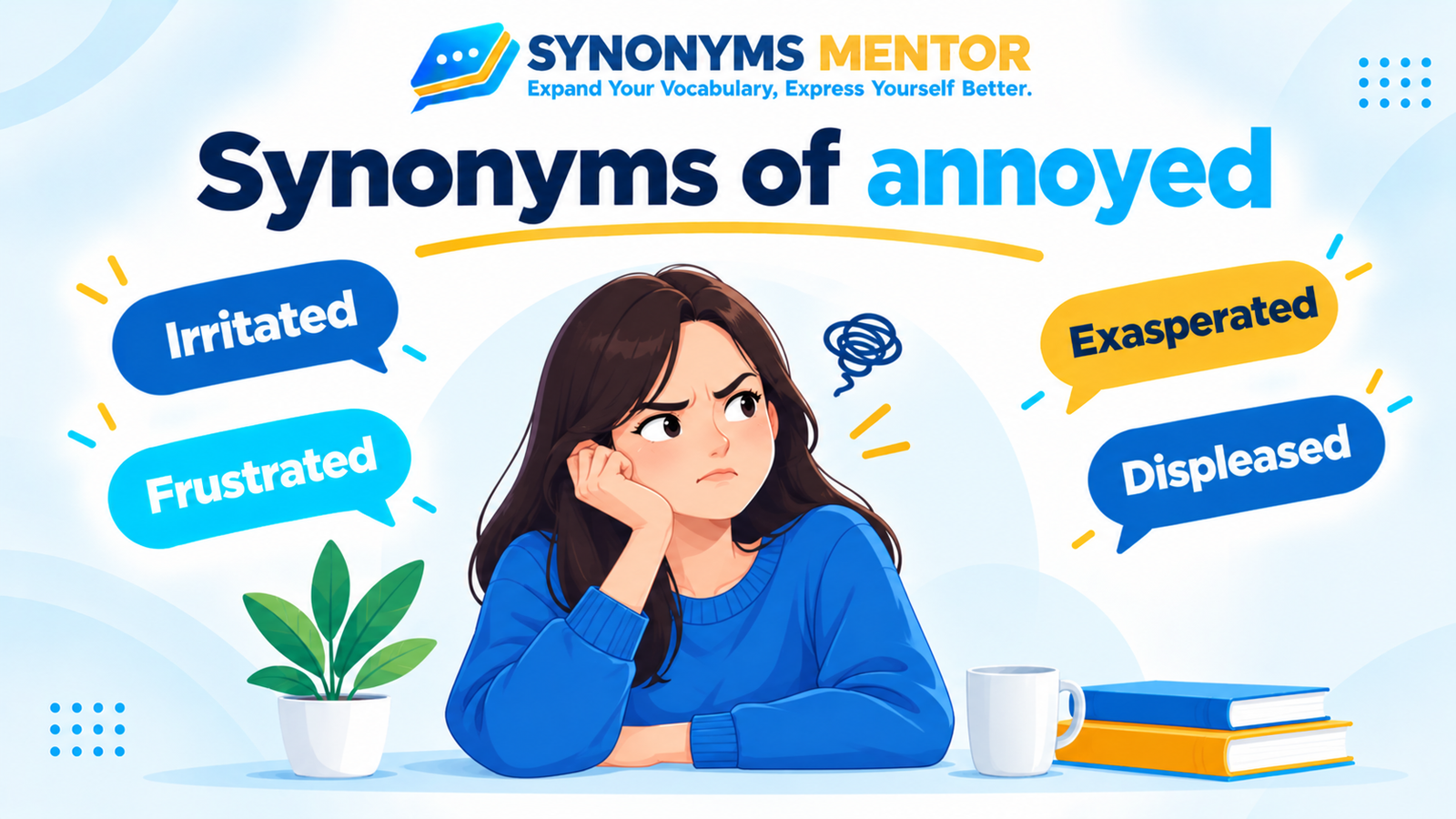
Synonyms of Annoyed: Better Alternatives, Meanings & Examples
Finding a good synonym for annoyed is not simply a matter of replacing one word with another. Words such as irritated, bothered, peeved, exasperated, and irked overlap with annoyed, but they do not always communicate exactly the same feeling.
Annoyed generally describes a state of slight anger or irritation. The best alternative depends on why someone is annoyed, how strongly they feel it, and the tone you want to create.
In this guide, you will find the closest synonyms, useful near-synonyms, informal alternatives, important differences, natural examples, and practical guidance for choosing the right word.
Quick Answer
The closest synonyms of annoyed are irritated, bothered, peeved, miffed, irked, and exasperated. However, they are not interchangeable in every situation. Irritated is especially close to annoyed, bothered is broader, peeved and miffed are informal, while exasperated usually suggests stronger irritation caused by repeated problems.
Core Synonyms of Annoyed
| Word | Relationship | Meaning | Strength | Formality | Best Context |
|---|---|---|---|---|---|
| Irritated | Direct synonym | Slightly angry or bothered | Similar | Neutral | General use |
| Bothered | Near synonym | Troubled, disturbed, or annoyed | Similar or weaker | Neutral | General situations |
| Peeved | Direct/near synonym | Slightly annoyed or displeased | Similar | Informal | Casual conversation |
| Miffed | Near synonym | Slightly offended or annoyed | Similar | Informal | Personal situations |
| Irked | Direct/near synonym | Annoyed by something irritating | Similar | Neutral | Writing and speech |
| Exasperated | Near synonym | Extremely irritated after repeated problems | Stronger | Neutral/Formal | Repeated frustrations |
| Aggravated | Near synonym | Annoyed or made more frustrated | Often stronger | Neutral | Problems and obstacles |
| Vexed | Contextual alternative | Annoyed, sometimes with worry or puzzlement | Similar/stronger | Formal/Literary | Formal writing |
| Displeased | Near synonym | Dissatisfied or unhappy | Often weaker | Formal | Professional contexts |
| Frustrated | Contextual alternative | Upset because something prevents progress | Different emphasis | Neutral | Work, tasks, obstacles |
Major dictionaries support irritated, bothered, exasperated, aggravated, displeased, frustrated, peeved, and vexed as words related to annoyed, while also distinguishing their shades of meaning.
What Does “Annoyed” Mean?
Annoyed is an adjective meaning that someone feels or shows irritation or slight anger. Oxford specifically describes it as “slightly angry”, while Merriam-Webster defines it in terms of feeling or showing angry irritation.
For example:
I was annoyed by the constant noise.
The feeling is negative, but it does not necessarily mean intense anger. Someone can be annoyed without being furious or enraged.
The word can commonly appear with with, at, about, and by:
- annoyed with someone
- annoyed at something
- annoyed about a situation
- annoyed by someone’s behavior
Oxford gives these patterns as common constructions for annoyed.
The Closest Synonyms of Annoyed
1. Irritated
Meaning: Feeling slightly angry or bothered.
How it differs: Irritated is probably the safest direct replacement for annoyed. It works in most ordinary situations.
Best contexts: People, noise, delays, interruptions, behavior, and everyday problems.
Example:
I was irritated by the constant interruptions.
Choose it when: You want a natural, neutral alternative with almost the same basic meaning.
2. Bothered
Meaning: Troubled, disturbed, or annoyed by something.
How it differs: Bothered is broader than annoyed. It can describe emotional discomfort or concern as well as irritation.
Example:
She seemed bothered by his comment.
Choose it when: You do not want to emphasize anger specifically.
For example, someone can be bothered by a problem without being angry about it.
3. Peeved
Meaning: Slightly annoyed or displeased.
Register: Informal.
Example:
He was a little peeved when his plans changed.
Choose it when: You want a casual expression for mild annoyance.
Cambridge and Collins both identify peeved as an informal synonym or close alternative to annoyed.
4. Miffed
Meaning: Slightly annoyed, often because of something someone did.
Register: Informal.
Example:
She was miffed that nobody invited her.
Choose it when: The annoyance has a personal or social element, particularly when someone feels slighted.
Miffed is not simply a stronger form of annoyed; it can carry a sense of being offended or displeased.
5. Irked
Meaning: Annoyed or irritated.
Register: Neutral; somewhat more literary than everyday annoyed.
Example:
He was irked by the unnecessary delay.
Choose it when: You want a concise alternative that emphasizes irritation.
It is especially useful in polished writing where repeating annoyed would feel monotonous.
6. Exasperated
Meaning: Extremely irritated or frustrated, particularly because a problem keeps happening.
Example:
After explaining the same problem five times, she became exasperated.
Choose it when: The annoyance has built up because of repeated difficulty, delays, mistakes, or interruptions.
This is generally stronger than annoyed. Merriam-Webster lists exasperated among the synonyms of annoyed, but the semantic difference is important: exasperated commonly suggests that patience is running out.
7. Aggravated
Meaning: Annoyed or frustrated by a difficult situation.
Example:
He was aggravated by the repeated technical problems.
Choose it when: The situation itself is causing increasing irritation or frustration.
In American English, aggravated is common in everyday speech, although it can also have other meanings in different contexts.
8. Vexed
Meaning: Annoyed, troubled, or sometimes puzzled.
Register: Formal or literary.
Example:
The researcher was vexed by the unexpected result.
Choose it when: You are writing in a formal or literary style and want a less conversational alternative.
A useful distinction is that vexed can involve perplexity or worry as well as annoyance. Merriam-Webster specifically distinguishes vex from annoy by noting that vex can suggest stronger disturbance and sometimes perplexity or anxiety.
9. Displeased
Meaning: Not satisfied or pleased with something.
Example:
The manager was displeased with the quality of the report.
Choose it when: You need a professional or formal expression and want to emphasize dissatisfaction rather than irritation.
It is therefore not always a perfect substitute for annoyed.
10. Frustrated
Meaning: Upset or dissatisfied because something is preventing progress or producing the desired result.
Example:
She was frustrated by the slow internet connection.
Choose it when: The central problem is an obstacle, failure, delay, or inability to accomplish something.
Frustrated and annoyed overlap, but they focus on different causes. You can be annoyed by someone’s loud music; you are more likely to be frustrated when repeated attempts to solve a problem fail.
Which Word Should I Use?
The quickest way to choose is to focus on the source of the feeling.
Choose “irritated” when:
You want the closest neutral synonym for annoyed.
I was irritated by the noise.
Choose “bothered” when:
You want a broader word that does not necessarily imply anger.
She was bothered by the criticism.
Choose “peeved” when:
You want a mildly annoyed, informal tone.
He was peeved about the cancellation.
Choose “miffed” when:
The annoyance is connected to feeling slighted or offended.
She was miffed that nobody told her.
Choose “exasperated” when:
The problem has continued long enough to test someone’s patience.
He was exasperated after another failed attempt.
Choose “frustrated” when:
An obstacle or failure is the main reason for the negative feeling.
They were frustrated by the lack of progress.
Choose “displeased” when:
You need a more formal or professional expression of dissatisfaction.
The client was displeased with the final result.
Annoyed vs. Irritated
These two words are extremely close.
Annoyed is a general word for feeling slightly angry or irritated. Irritated places slightly more emphasis on the feeling of irritation itself.
Compare:
I was annoyed by the noise.
I was irritated by the noise.
Both sound completely natural. In most everyday contexts, either can work. Oxford explicitly identifies irritated as a synonym of annoyed.
Best choice: Use irritated when you want a particularly close substitute without changing the tone significantly.
Annoyed vs. Bothered
Bothered has a wider meaning.
I was annoyed by the delay.
This clearly communicates irritation.
I was bothered by the delay.
This could communicate irritation, but it could also suggest concern or discomfort.
Best choice: Use annoyed when irritation is central. Use bothered when the person’s reaction is broader or less specifically angry.
Annoyed vs. Frustrated
These words are often confused.
| Word | Main idea | Example |
|---|---|---|
| Annoyed | Something irritates you | I was annoyed by the noise. |
| Frustrated | Something prevents progress | I was frustrated by the software error. |
You can experience both emotions simultaneously:
I was frustrated by the repeated errors and annoyed that nobody fixed them.
The sentence works because the frustration comes from the obstacle, while the annoyance comes from the situation and people’s failure to address it.
Annoyed vs. Exasperated
The main difference is intensity and repetition.
Annoyed can describe a relatively mild reaction:
I was annoyed when the bus arrived late.
Exasperated usually suggests that the person has experienced repeated problems and is losing patience:
After three hours of delays, I was exasperated.
Therefore, replacing annoyed with exasperated can make the emotion sound substantially stronger.
Annoyed vs. Angry
Angry is broader and can be considerably stronger.
Someone who is annoyed may be mildly angry, but someone who is angry does not necessarily feel merely annoyed.
Compare:
She was annoyed that he forgot her book.
She was angry that he deliberately lied to her.
The second sentence communicates a stronger emotional response.
Oxford describes annoyed specifically as slightly angry, which makes it useful when you want to avoid overstating someone’s reaction.
Useful Synonyms by Context
For everyday situations
Use:
- irritated
- bothered
- annoyed
- irked
Example:
I was irritated by the constant notifications.
For mild, informal annoyance
Use:
- peeved
- miffed
- put out
Example:
She was a little peeved about the change of plans.
For repeated problems
Use:
- exasperated
- aggravated
- frustrated
Example:
He was exasperated after dealing with the same error all morning.
For professional writing
Use:
- displeased
- irritated
- concerned, depending on the intended meaning
Example:
The client was displeased with the delayed response.
Be careful with concerned: it is related to negative reactions but is not a direct synonym for annoyed.
For formal or literary writing
Use:
- vexed
- irked
- displeased
Example:
The committee was vexed by the unexpected complication.
Common Collocations With “Annoyed”
Some common grammatical patterns are especially useful for learners:
- annoyed with someone
- annoyed at something
- annoyed about something
- annoyed by something
- annoyed that something happened
- annoyed to discover something
Examples:
I was annoyed with him.
She was annoyed at the interruption.
They were annoyed about the cancellation.
He was annoyed by the noise.
We were annoyed that nobody had warned us.
She was annoyed to discover that the meeting had been canceled.
Oxford’s usage information specifically records these common patterns.
Common Mistakes When Choosing a Synonym
1. Treating every related emotion as an exact synonym
Words such as frustrated, angry, upset, and disturbed overlap with annoyed, but they can introduce different meanings.
2. Using “exasperated” for every minor irritation
Exasperated usually communicates a stronger, more prolonged loss of patience.
3. Using informal words in formal writing
Words such as peeved and miffed are natural, but they may sound too conversational in a formal report.
4. Confusing frustration with annoyance
If an obstacle prevents someone from achieving a goal, frustrated may be more precise than annoyed.
5. Assuming “angry” always means the same thing
Angry can be substantially stronger than annoyed. Use it when the emotional intensity genuinely warrants it.
Related Words That Are Not Always Exact Synonyms
A good vocabulary resource should distinguish synonyms from related concepts.
- Angry — broader and potentially much stronger.
- Frustrated — focuses on blocked goals or unsuccessful efforts.
- Upset — broader emotional distress or disturbance.
- Offended — emphasizes feeling insulted or disrespected.
- Impatient — emphasizes unwillingness to wait.
- Resentful — suggests lasting bitterness about perceived unfairness.
- Agitated — can describe emotional or physical restlessness as well as irritation.
- Grumpy — describes a generally bad-tempered mood rather than one specific annoyance.
These words can sometimes replace annoyed in particular sentences, but they should not automatically be presented as exact equivalents. Cambridge and Merriam-Webster’s thesaurus entries illustrate how broad the semantic neighborhood around annoyed can be.
Pronunciation
Annoyed
- US IPA: /əˈnɔɪd/
- UK IPA: /əˈnɔɪd/
Oxford and Cambridge both give the pronunciation as /əˈnɔɪd/.
A Note on the Word’s History
The verb annoy has a long history in English. Oxford traces it through Middle English and Old French, ultimately connecting it with a Latin expression meaning that something was hateful or objectionable. The modern meaning developed from that older sense toward causing irritation or discomfort.
FAQ
What is the closest synonym for annoyed?
Irritated is usually the closest straightforward synonym. Both words commonly describe feeling slightly angry or bothered. However, bothered, peeved, miffed, and irked can also work depending on the context and desired tone.
What is a stronger word for annoyed?
Exasperated is often stronger than annoyed, especially when repeated problems have caused someone to lose patience. Infuriated, enraged, and furious are much stronger and should not normally be treated as simple replacements for mild annoyance.
What is a formal synonym for annoyed?
Irritated, displeased, and sometimes vexed can work in formal writing. The best choice depends on the meaning: displeased emphasizes dissatisfaction, while vexed can also suggest being troubled or puzzled.
What is an informal synonym for annoyed?
Peeved and miffed are useful informal alternatives. Put out is another conversational expression, especially in phrases such as “She was put out by the cancellation.”
Is “irritated” the same as “annoyed”?
They are very close, and irritated is one of the most direct synonyms of annoyed. The distinction is usually subtle rather than categorical. Irritated can place slightly more emphasis on the feeling of irritation, but the two words are interchangeable in many everyday sentences.
Is “frustrated” a synonym for annoyed?
Sometimes, but not always. Frustrated specifically emphasizes difficulty, failure, or an obstacle preventing someone from achieving something. Annoyed focuses more generally on irritation. A person can be both frustrated and annoyed by the same situation.
Is “peeved” the same as “annoyed”?
Peeved is a close informal synonym of annoyed. It generally describes mild irritation or displeasure and is especially natural in casual conversation.
What is the difference between annoyed and angry?
Annoyed usually describes a relatively mild degree of anger or irritation, while angry is broader and can indicate much greater emotional intensity. If you want to convey a mild irritation without suggesting serious anger, “annoyed” is usually more precise.
Conclusion
The best synonym for annoyed depends on the exact feeling you want to express. Irritated is the closest general replacement, while bothered is broader, peeved and miffed are informal, irked is a concise alternative, and exasperated communicates stronger irritation caused by repeated problems.
Frustrated, angry, displeased, and vexed can work in specific contexts but introduce additional shades of meaning.

David Wilson is a content strategist and SEO expert who focuses on creating structured vocabulary content. He combines keyword research with simple explanations to make learning English both effective and search-friendly.