Synonyms of Cat: 15 Words and Terms for Different Contexts
The word cat is simple and extremely common, but English has many alternatives for describing a cat. Some are genuine synonyms, such as feline and kitty, while others are more specific, informal, regional, or descriptive.
Choosing the right alternative depends on what you mean. Feline works well in formal or scientific contexts, kitty sounds affectionate and informal, and moggy is a chiefly British informal term. Words such as tabby and tomcat, meanwhile, do not mean exactly the same thing as cat because they identify particular kinds of cats.
This guide separates these terms so you can choose the most accurate word rather than simply replacing cat with any related animal term.
Quick Answer: What Are the Best Synonyms of Cat?
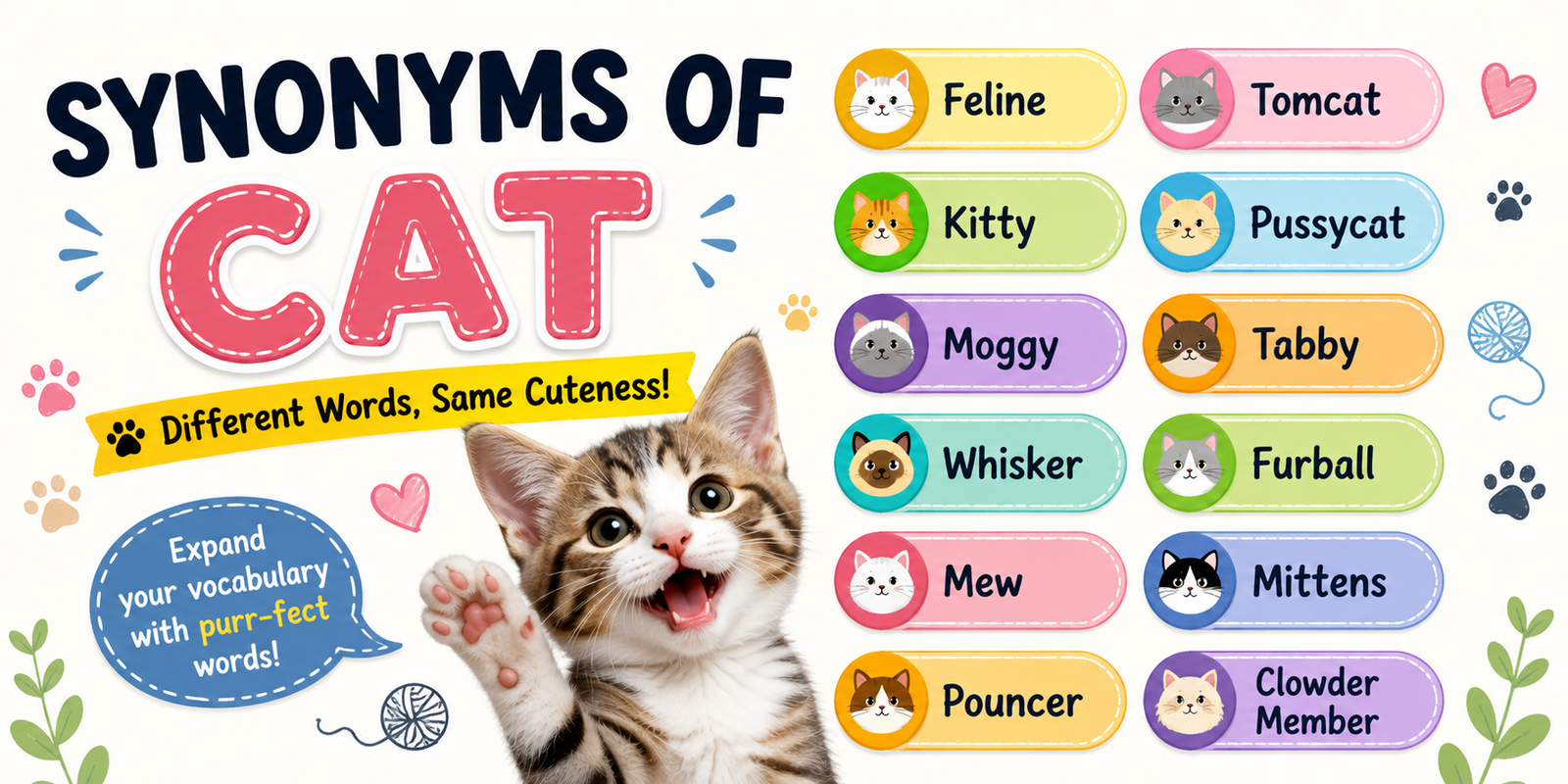
The closest synonyms of cat include feline, kitty, pussycat, puss, mouser, and moggy. Feline is the best formal or general alternative, while kitty and pussycat are informal and often affectionate. Moggy is an informal British term. Kitten, tabby, tomcat, and house cat are related terms rather than exact synonyms because they identify a cat by age, appearance, sex, or living environment.
Core Synonym Resource
| Word | Relationship | Meaning | Register | Best Context |
|---|---|---|---|---|
| Feline | Direct synonym | A cat; also relating to cats | Neutral/formal | General and formal writing |
| Kitty | Direct/near synonym | A cat, often affectionately | Informal | Conversation, pets |
| Pussycat | Direct synonym | A cat, usually affectionate | Informal | Conversational or affectionate language |
| Puss | Direct synonym | A cat | Informal | Familiar speech |
| Moggy | Contextual synonym | An ordinary domestic cat | Informal, chiefly British | British English |
| Mouser | Contextual alternative | A cat that catches mice | Descriptive | Pest-control or rural contexts |
| House cat | Contextual alternative | A domestic cat kept as a pet | Neutral | Domestic animals |
| Kitten | Related, more specific | A young cat | Neutral | Young cats |
| Tabby | Related, more specific | A cat with a characteristic striped or patterned coat | Neutral | Describing appearance |
| Tomcat | Related, more specific | A male cat | Neutral | Male cats |
| Alley cat | Contextual term | A cat associated with streets or alleys | Informal | Urban/street context |
| Gib | Specific term | A male cat, especially a neutered male | Specialized/less common | Animal terminology |
| Queen | Specific term | An adult female cat, especially in breeding contexts | Specialized | Cat breeding |
| Puss | Informal synonym | A familiar term for a cat | Informal | Casual speech |
| Kit | Related/short form | A young animal or kitten in some usage | Uncommon | Literary or specialized contexts |
Several of these terms appear in established dictionary thesauruses, but dictionaries themselves distinguish between general alternatives and more specific terms. Merriam-Webster, for example, lists kitten, kitty, and feline among its synonyms while also listing tabby, tomcat, and alley cat as related alternatives.
What Does “Cat” Mean?
Cat is primarily a noun referring to a small domesticated carnivorous mammal, commonly kept as a pet and historically valued for catching rodents. The word can also refer more broadly to members of the Felidae family, including wild cats such as lions, tigers, and leopards.
In everyday English, however, cat normally means the familiar domestic animal.
Example:
My cat likes sleeping beside the window.
Because cat has both everyday and broader zoological uses, the best alternative depends heavily on context.
The Most Useful Synonyms of Cat
1. Feline
Feline is probably the most useful formal alternative to cat. As a noun, it can mean a cat; as an adjective, it means relating to cats or the cat family.
Best contexts: formal writing, zoology, veterinary contexts, descriptive writing.
Example:
The veterinarian specializes in feline health.
Cat vs feline
Use cat for ordinary conversation. Use feline when you want a more formal or technical tone.
2. Kitty
Kitty is a familiar and often affectionate word for a cat. It is especially common when speaking to or about a pet.
Example:
The little kitty curled up on the sofa.
It is not necessarily a different kind of animal; it is simply a more informal way to refer to a cat. Merriam-Webster identifies kitty as a synonym of cat.
3. Pussycat
Pussycat is an informal, often affectionate term for a cat.
Example:
The child gently stroked the pussycat.
It tends to sound more playful or affectionate than the neutral cat.
4. Puss
Puss is another informal term for a cat.
Example:
Come here, puss.
It is familiar rather than formal and may sound old-fashioned depending on the speaker and context.
5. Moggy
Moggy is an informal term particularly associated with British English. It generally refers to an ordinary domestic cat rather than a specific breed. Collins lists moggy as a slang synonym, while Merriam-Webster includes it among similar words for cat.
Example:
They adopted a friendly moggy from the shelter.
For American English, cat or kitty will generally sound more natural.
6. Mouser
A mouser is a cat valued or known for catching mice.
This is not a perfect synonym for every cat, because the word emphasizes the animal’s function or behavior.
Example:
The farm needed a good mouser to keep the barn free of mice.
So:
cat = the animal generally
mouser = a cat specifically characterized by catching mice
Specific Terms That Are Related to “Cat”
These words are useful, but calling all of them direct synonyms would be inaccurate.
Kitten
A kitten is a young cat.
Example:
The kitten followed its mother across the garden.
Every kitten is a cat, but not every cat is a kitten. Therefore, kitten is a hyponym, not a complete synonym.
Tabby
A tabby is a cat with a distinctive patterned coat, commonly involving stripes or swirls.
Example:
A gray tabby was sitting on the porch.
Calling every cat a tabby would be incorrect because many cats do not have tabby markings.
Tomcat
A tomcat is a male cat.
Example:
A large tomcat appeared in the backyard.
It is therefore more specific than cat.
House Cat
House cat refers to a domestic cat kept as a companion or living primarily in a home.
Example:
Unlike the wildcat, the house cat is commonly kept as a pet.
This term is useful when you need to distinguish a domestic cat from wild members of the cat family.
Alley Cat
An alley cat is a cat associated with streets or alleys, traditionally suggesting a stray or free-roaming urban cat.
Example:
An alley cat wandered through the neighborhood.
It has a more specific image and context than the neutral word cat.
Which Word Should I Use Instead of “Cat”?
Choose feline when:
You need a formal, scientific, or professional alternative.
The study examined feline behavior.
Choose kitty when:
You want an affectionate or casual tone.
The kitty is sleeping on the blanket.
Choose pussycat when:
You want a familiar or affectionate expression.
What a lovely pussycat!
Choose moggy when:
You are writing in or about informal British English.
She adopted a rescue moggy.
Choose mouser when:
The cat’s ability to catch mice matters.
The farmer kept a mouser in the barn.
Choose kitten when:
You specifically mean a young cat.
The kitten needs a safe place to sleep.
Choose tabby when:
The cat’s coat pattern is relevant.
A brown tabby was sitting by the door.
Choose tomcat when:
You specifically mean a male cat.
A stray tomcat entered the yard.
Cat vs Feline: What’s the Difference?
Cat is the ordinary everyday word. Feline is more formal and can function as both a noun and an adjective.
| Cat | Feline | |
|---|---|---|
| Everyday speech | Very common | Less common |
| Formal writing | Common | Very useful |
| Scientific context | Common | Especially useful |
| Refers to a cat | Yes | Yes, as a noun |
| Describes cat-related things | Limited | Yes, as an adjective |
Example:
The cat is sleeping.
The veterinarian specializes in feline medicine.
Both sentences are natural, but their registers differ.
Cat vs Kitten: What’s the Difference?
The distinction is straightforward:
Cat refers to the animal generally.
Kitten refers specifically to a young cat.
Therefore, kitten should not be used as a universal replacement for cat.
Correct: We adopted a cat.
More specific: We adopted a kitten.
Cat vs Kitty: What’s the Difference?
The main difference is register and tone.
Cat is neutral.
Kitty is informal and often affectionate.
The cat is sitting outside.
The kitty is sitting outside.
Both can describe the same animal, but kitty sounds warmer and more conversational.
Common Mistakes When Choosing a Synonym for “Cat”
1. Treating “kitten” as a complete synonym
A kitten is specifically a young cat, so it cannot replace cat in every sentence.
2. Treating “tabby” as another word for every cat
A tabby describes a particular coat pattern. It is a type of cat, not a universal synonym.
3. Using “feline” in every casual sentence
Although feline is accurate, it can sound unnecessarily formal in everyday conversation.
Natural: My cat is hungry.
More formal: The feline is hungry.
The second sentence is grammatically possible but would usually sound unnatural when simply talking about your pet.
4. Assuming “moggy” works everywhere
Moggy is informal and strongly associated with British English. It may sound unusual in American English.
5. Confusing a category with a synonym
Words such as kitten, tabby, tomcat, and house cat describe particular categories or characteristics of cats. They should not automatically be presented as interchangeable synonyms.
Related Cat Vocabulary
Some useful terms are better treated as related vocabulary rather than synonyms.
- Queen — an adult female cat, especially in breeding terminology.
- Gib — a male cat, particularly a neutered male.
- Clowder — a traditional collective noun for a group of cats.
- Feline — relating to cats or the cat family.
- Felidae — the biological family containing cats and other feline species.
Collins similarly distinguishes terms such as tom for a male cat, queen for a female cat, and kitten for a young cat from general synonyms of cat.
FAQ
What is the best synonym for cat?
Feline is usually the best formal synonym, while kitty is a natural informal alternative. The best choice depends on context: feline suits professional or scientific writing, whereas kitty is more appropriate for casual or affectionate speech.
What is a fancy word for cat?
Feline is the most common formal or sophisticated alternative to cat. It is especially useful in professional, scientific, veterinary, and literary contexts.
What is a cute word for cat?
Kitty and pussycat are common affectionate alternatives. The choice depends on the tone and audience.
Is “feline” another word for “cat”?
Yes. Feline can be used as a noun meaning a cat, although it is more formal than cat. It can also be an adjective meaning related to cats or the cat family.
Is “kitten” a synonym for cat?
Not exactly. A kitten is a young cat, so it is a more specific term. It is related to cat but cannot replace it in every context.
Is “kitty” a synonym for cat?
Yes. Kitty is an informal and often affectionate synonym for cat.
What is a British word for cat?
Moggy is an informal British term for an ordinary domestic cat. Other informal terms include puss and pussycat.
Conclusion
The best synonym for cat depends on what you want to communicate. Feline is the strongest formal alternative, while kitty, pussycat, and puss are informal or affectionate choices. Moggy is particularly associated with British informal English, while mouser emphasizes a cat’s ability to catch mice.

Olivia Brown is a vocabulary expert and content writer who focuses on synonyms, antonyms, and word usage. She helps learners understand English words in a simple and practical way, making communication clearer and more effective